
Are the Braves Finally Running Out of Pitchers?
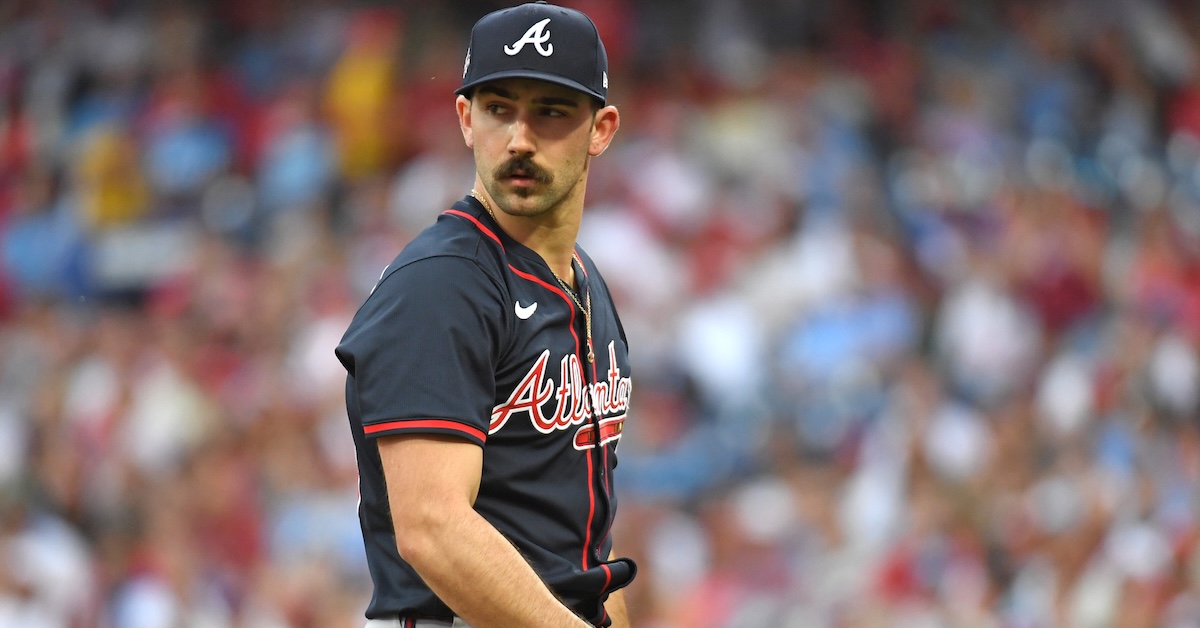
One of the foundational assumptions of the past 10 years in baseball is that the Braves will always figure something out. Their run of six straight division titles from 2018 to 2023 placed them in a conversation with the Dodgers and Astros as the one of the most consistently successful teams in baseball.
The Braves run a big payroll, but not on a level that allows them to outspend their mistakes. And those mistakes have been few. They always make smart trades, always get their star players to sign under-market extensions, always develop their own talent well. You could argue that the Braves have had more success developing undersized right-handed college starters named Spencer than the Orioles have had with their own pitching prospects of any size, name, and origin over the past 30 years.
But as Atlanta tries to bounce back from its first losing season since 2017, that sense of inevitability is fading. Spencer Schwellenbach is out until midseason with bone spurs in his elbow, and as of Monday, Spencer Strider has a strained oblique muscle and will start the season on the IL.
Strider, along with Ronald Acuña Jr., was one of Atlanta’s greatest scouting-and-development triumphs from an era with an enormous number to choose from. The small, sinewy Clemsonite developed into arguably the game’s best power pitcher, confounding all expectations.
You’re not supposed to be able to hold 98 mph for six innings a start, 30 starts a year, at 6-foot, 195 pounds. You’re not supposed to be able to turn over a lineup multiple times with just a four-seamer and a slider. But he did; in 2022 and 2023, Strider struck out 483 batters in 318 1/3 innings, and averaged more than 5 WAR per season.
But he blew out his UCL two starts into 2024, and was a shadow of himself in 2025; velocity down by three miles an hour, strikeout rate down by a third from his peak. The year-long recovery from a torn UCL is supposed to be inconvenient but routine at this point in history, but Strider has not been the same pitcher since his internal brace procedure.
Before his injury, Strider was ramping up his fastball velocity through the spring, but he only got as high as an average of 95 mph in any start. An optimist might say that 95 in spring training with a core muscle injury isn’t a bad foundation; a pessimist might look at Strider’s setback as yet another crack in Atlanta’s once-impenetrable armor.
The Braves’ run of NL East dominance was in homegrown talent, specifically in growing players who’d been overlooked elsewhere. Austin Riley was a first-round pick. So was Kyle Wright, Ian Anderson, and Michael Soroka, whose contributions, while important, were fleeting. Shea Langeliers, Atlanta’s last top-10 pick, brought back Matt Olson in a trade with the A’s.
But A.J. Minter, Strider, Schwellenbach, Michael Harris II, Bryce Elder, and AJ Smith-Shawver were all drafted between the second round and the seventh. The Braves spent $460,000 — total — on amateur free agent bonuses for Acuña, Ozzie Albies, and William Contreras.
Because they scouted and developed so well, they could afford to trade near-majors prospects and young big leaguers to shore up what few weak spots remained on the roster. They could take risks on pitchers with extensive injury histories because there was always an Elder or a Smith-Shawver or a Jared Shuster to plug a temporary hole in the rotation.
At the same time, the lineup — seemingly made up entirely of players in their prime — was unnervingly stable. In 2023, the Braves had three top-10 MVP finishers (Acuña, Olson, and Riley) play at least 159 games and record at least 700 plate appearances. That year, the Braves ran a catching tandem of Sean Murphy and Travis d’Arnaud; every other starting position player got into at least 138 games. Apart from d’Arnaud, only one Atlanta reserve, Kevin Pillar, recorded more than 80 plate appearances.
But as that lineup has aged over the past two years, everyone except Olson has gotten hurt. It’s true that Olson suffered a massive drop-off in 2024, but there’s a long way to fall from a 54-homer, 6.6-WAR season. He’s still one of the National League’s better first basemen.
We saw the impact of this cascade of injuries and regressions last year, when this perennial NL juggernaut went 76-86. And while a bounce-back has always seemed likely, it can no longer be taken for granted. A month ago, after Schwellenbach and Hurston Waldrep went down with bone spurs, Dan Szymborski blogged about what was left of Atlanta’s rotation. Even after those injuries, ZiPS had the Braves on pace for a top-10 rotation in baseball, if the remaining pitchers stayed healthy. Dan then ran a simulation in which the top five starting pitchers had their playing time cut in half, with pitchers from lower on the depth chart backfilling until they reached 90% of the original playing time. Every team with a half-decent rotation would lose big in that scenario, but the Braves dropped by 7.7 WAR, the largest margin of any team.
Dan went on to note that this doomsday scenario was not some farfetched nightmare for Atlanta, as four of the team’s five remaining starters, including Strider, had significant injury concerns heading into 2026.
To a greater or lesser extent, every team goes into a new season knowing it’s going to need between eight and 10 starting pitchers, not six. When I say the Braves are running out of depth, I don’t mean that they’ve failed to plan, or that their 10th-best starting pitcher is significantly worse than the 10th guy on any other team’s depth chart; on the contrary, the healthiest version of the Braves’ pitching depth chart remains quite good.
If every NL team had every starting pitcher at 100%, I’d pick the Dodgers’ and Phillies’ rotations over Atlanta’s, but the Braves are close enough to compete. And both of those teams are fighting injuries as well; if Strider’s return from an internal brace procedure has been bumpy, imagine how much more fraught the 35-year-old Zack Wheeler’s comeback from thoracic outlet syndrome could get.
But the Phillies, with Taijuan Walker and Andrew Painter in the rotation, are only up to no. 6 on the depth chart. The Braves passed that point ages ago.
Here are, according to RosterResource, the first 18 names on Atlanta’s starting pitching depth chart, along with their non-Depth Charts-adjusted ZiPS projections for 2026.
| Name | G | GS | IP | K% | BB% | K-BB% | AVG | ERA | FIP | WAR | RA9-WAR |
|---|---|---|---|---|---|---|---|---|---|---|---|
| Chris Sale | 22 | 21 | 124 2/3 | 29.2% | 6.6% | 22.6% | .223 | 3.10 | 3.10 | 2.9 | 3.4 |
| Spencer Schwellenbach | 20 | 20 | 124 2/3 | 24.4% | 4.6% | 19.8% | .235 | 3.39 | 3.42 | 2.4 | 2.8 |
| Reynaldo López | 35 | 16 | 100 2/3 | 24.0% | 8.4% | 15.6% | .232 | 3.57 | 3.67 | 1.4 | 1.9 |
| Spencer Strider | 25 | 24 | 137 2/3 | 28.5% | 8.0% | 20.5% | .224 | 3.87 | 3.51 | 2.6 | 2.3 |
| AJ Smith-Shawver | 20 | 20 | 80 2/3 | 25.1% | 9.1% | 16.0% | .233 | 3.90 | 3.83 | 1.1 | 1.3 |
| Dylan Dodd | 34 | 11 | 85 1/3 | 19.9% | 5.8% | 14.1% | .257 | 4.11 | 4.08 | 0.7 | 0.9 |
| José Suarez | 22 | 13 | 82 1/3 | 21.9% | 7.9% | 14.0% | .249 | 4.16 | 3.95 | 1.0 | 1.0 |
| Grant Holmes | 24 | 9 | 69 1/3 | 21.3% | 9.0% | 12.3% | .249 | 4.16 | 4.32 | 0.4 | 0.7 |
| Jhancarlos Lara | 32 | 16 | 76 1/3 | 25.3% | 12.8% | 12.5% | .223 | 4.25 | 4.30 | 0.6 | 0.8 |
| Hurston Waldrep | 26 | 25 | 130 2/3 | 20.5% | 9.8% | 10.7% | .244 | 4.27 | 4.24 | 1.2 | 1.5 |
| Bryce Elder | 27 | 27 | 152 | 19.7% | 7.7% | 12.0% | .250 | 4.38 | 4.10 | 1.7 | 1.6 |
| JR Ritchie | 24 | 24 | 118 2/3 | 20.2% | 8.4% | 11.8% | .247 | 4.41 | 4.36 | 1.1 | 1.2 |
| Didier Fuentes | 21 | 21 | 87 | 21.6% | 7.7% | 14.0% | .244 | 4.45 | 4.25 | 1.1 | 0.9 |
| Martín Pérez | 22 | 19 | 107 | 17.2% | 8.8% | 8.4% | .263 | 4.46 | 4.45 | 1.3 | 0.9 |
| Joey Wentz | 33 | 12 | 89 1/3 | 22.3% | 9.4% | 12.9% | .250 | 4.54 | 4.08 | 0.9 | 0.5 |
| Landon Harper | 24 | 12 | 89 1/3 | 17.1% | 6.1% | 11.1% | .264 | 4.64 | 4.52 | 0.5 | 0.5 |
| Elieser Hernández | 18 | 12 | 63 2/3 | 19.6% | 7.6% | 12.0% | .262 | 4.95 | 4.77 | 0.2 | 0.2 |
| Carlos Carrasco | 21 | 19 | 95 2/3 | 16.6% | 7.6% | 9.0% | .285 | 5.36 | 5.00 | 0.3 | -0.1 |
Yellow: Projected to start in the minor leagues
Blue: Projected to start in the bullpen
It’s March 24, and the Braves are already on their 10th-choice starting pitcher. No team is going to come out of that looking good. And the lineup is no more secure, between injuries, players like Albies regressing, and Jurickson Profar’s inability to provide a clean urine sample.
Ever since 2018, we’ve been able to start each season with the assumption that the Braves were going to be good. They’re too discerning in talent acquisition, too accomplished in development, too committed to maintaining a core of stars, for the whole enterprise to collapse.
That might still prove to be the case. But the Braves look rickety in a way they haven’t in almost a decade, and with the Mets maybe finally getting their act together under the much-feared Steve Cohen-David Stearns partnership, the margin for error is getting thinner. Strider’s injury doesn’t throw the Braves into a position of danger; they were already there.
Michael is a writer at FanGraphs. Previously, he was a staff writer at The Ringer and D1Baseball, and his work has appeared at Grantland, Baseball Prospectus, The Atlantic, ESPN.com, and various ill-remembered Phillies blogs. Follow him on Twitter, if you must, @MichaelBaumann.
I’ve never assumed the Braves bouncing back was likely, and every time I read people say that it was likely, I didn’t agree. For me, there were always too many assumptions underpinning that narrative. They’re older and more fragile than everyone wants to admit, that didn’t change since last season.
I think it was a lot easier to be confident in that before six of their guys ended up looking like they’ll miss anywhere from a decent chunk to the whole season, all before Spring was over. It’s hard to paint that as some error in planning. The Phillies and Mets are at least as old and carry plenty of guys with injury histories, too.
It’s easy to see this is a continuation of previous seasons problems, especially in hindsight, but come on, Profar is getting suspended again, Kim falling on ice, and Wentz tearing his ACL were not predictable. Pitcher injuries happen, but there’s no good reason to have expected this volume, again, before the season even starts.
They went into the offseason knowing that Schwellenbach was coming off an injury, Strider had yet to regain his pre-TJS form, Lopez had only thrown 5 innings last year, Holmes is pitching with an injury, AJSS is recovering from TJS, and Sale has only made more than 20 starts once since 2019. When you look at the depth chart above, every one of the top 5 options had question marks at the end of last season. Knowing all this, the organization chose not to spend on additional starting pitching in the offseason. You can call it a calculated risk instead of an error in planning if you like, either way they’re likely in for a rough start to the season unless their offense comes out hot.
Or you could say they went in the offseason expecting each and every one of those guys (except AJSS) and also Waldrep and Wentz, to be healthy to start the season, to the extent you can ever expect any pitcher to be healthy. Having a perfect outcome wasn’t needed. It’s easy to look at a pitching staff which in fact gets a lot of injuries and after the fact claim they had a lot of question marks. That’s because all pitchers have question marks when it comes to health, point blank period. Post hoc ergo proctor hoc and all that.
The issue is exactly that– they expected all of those guys to be healthy and productive, even though history suggested they might not be. No one is suggesting that they were expecting a perfect outcome; but some guys are riskier than others. The guys on the top of this list all carry a bit more injury or performance risk than other pitchers, and the Braves didn’t do a whole lot in the offseason to mitigate that risk.
No, they didn’t expect them all to be healthy, and repeating that doesn’t make it true. They just didn’t expect to once again have much worse luck with injuries than most anyone else. Wentz (who, granted, may or may not be any good) and Strider didn’t even hurt their arms. If just those two were healthy right now things wouldn’t look that bad.
Other than Lopez, who while playing seems perilous, and Sale, who as of today is healthy, there was no reason to believe, at least not a publicly available one, that these guys were a particularly high injury risk. The two guys you could really point to as injury risks are both currently active. That’s baseball for you! The only evidence for these other guys being more likely to get hurt is that they did in fact get hurt. But guess what? Pitchers get hurt. Seeing that they got hurt and then saying “they were a higher injury risk” is a logical fallacy. A lot of pitchers get hurt and there is no way to predict it and by normal distribution there will be some teams that have more and some that have fewer.
Are you kidding?
And those are the currently-healthy guys!
Looking at the list of starters, without knowing anyone’s current status, who would you have confidently put money on to make 25+ starts with an ERA below 4? There was so much uncertainty on that list before Spring Training even started, and the uncertainty is about performance as much as health.
They made a conscious choice to go with what they had and not invest in more SP. Maybe it will work out. I wish you and Martin Perez and Jose Suarez all the best, and please take good care of Dom Smith- he’s a special boy.
You could make a slanted, misinformation list like this about every team in MLB. Pitchers are fragile. The Mets and Phillies combine for a total of one pitcher (Sanchez) who could get hurt and you wouldn’t be able to make an after-the-fact rationalization just like these. I get it. You’re jealous. The Braves have probably made you cry more times than you can count. It’s no reason to write such nonsense.
I don’t know what to tell you, anonymous interwebs person. I’ve seen seasons where ownership was unwilling to pay for depth, and the endings often suck. (The middles often suck!) If you truly believe that they made the right call in not investing in more SP, then you deserve the team that you get. Enjoy it.
And you enjoy your tears
How can the Braves make someone cry more times than they can count?! Do you always act like this when people disagree with you? Nice.
Presumably some combination of many episodes of crying and a lower ability to count.
And to answer your other question, no. I have been commenting on this site for at least 15 years and it is very rare for me to say anything like that but the guy is clearly a troll and I guess sometimes I want to give it back.
I’ve become really cautious about expecting a club to bounce back with the same returning regulars after I thought the White Sox would bounce back instead of completely collapsing
Even some of the younger guys have been declining- Albies and Harris put up wRC+ under 100 each of the past two seasons, while Riley has steadily declined from 144 in 2022 to 103 last year. Sure, there have been injuries and they may bounce back some, but they may also never get back to where they were.
And this is where the Braves front office may deserve criticism. After ‘24 the Braves replaced their hitting coach (there for the historically good offense in ‘23) and adopted a much more conservative approach. The effect of this ranged from “suboptimal” to “catastrophic” depending on the player. So the change seems to have been an overreaction and an unforced error.