
As Before, So Again: Cody Bellinger Is a Yankee
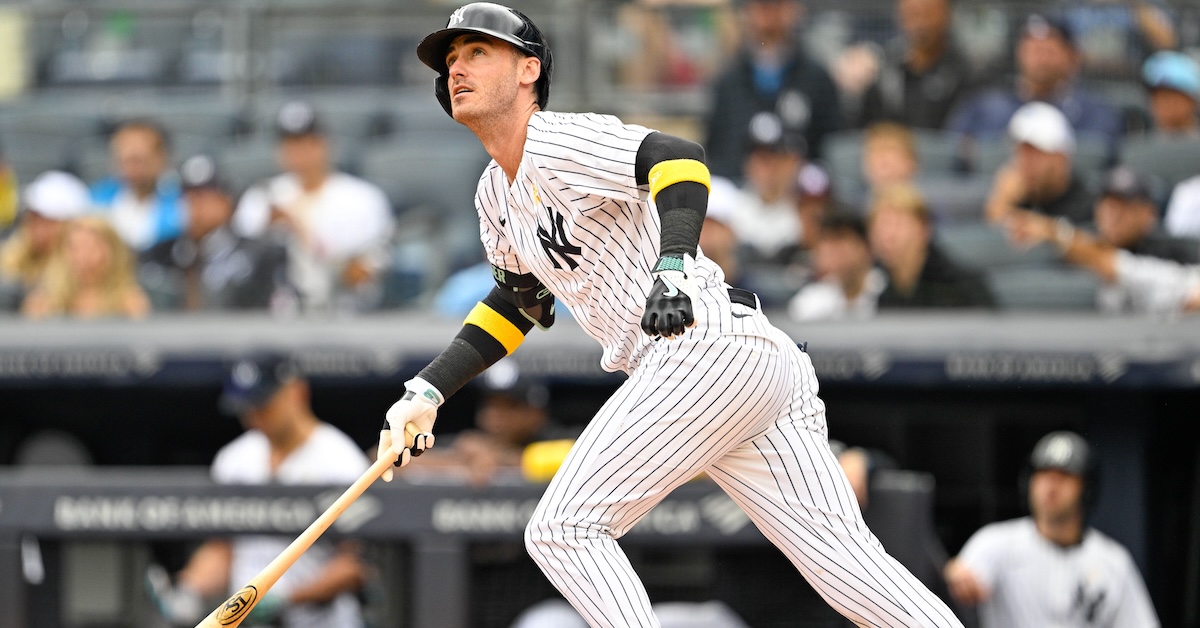
Our long national nightmare is over. After weeks of back and forth between Cody Bellinger and the New York Yankees, it’s official: He’s staying in the Bronx. The two sides have agreed to a five-year, $162.5 million deal with opt outs after the second and third seasons, a $20 million signing bonus, and a full no-trade clause, as first reported by Jeff Passan.
This fit was so obvious that it almost had to happen. The Yankees need offense, and they’d prefer it to come in the form of a left-handed outfielder who can cover center field in a pinch. They’re already familiar with Bellinger, who just put up a 5-WAR season in pinstripes. No other teams needed this exact type of player as much, at this current moment, as they did. Likewise, Bellinger was probably going to have to sign with the Yankees to get the deal he wanted. Now that that foregone conclusion has been reached, let’s unpack how this all fits together.
This contract is the culmination of a long, decorated career that was conspicuously lacking in free agency appeal. Bellinger burst onto the scene in 2017 with 39 homers for the Dodgers, taking Rookie of the Year honors in the process. He then went fully supersonic in the homer-happy 2019 season, with the rocket ball propelling him to 47 homers, a 161 wRC+, and NL MVP honors. Disaster struck in the 2020 World Series, however. Bellinger dislocated his shoulder celebrating a home run, and his performance fell off a cliff immediately after.
For the next two seasons, Bellinger managed only 29 combined homers and a 69 wRC+. Far from his MVP heights, he was essentially replacement level (0.4 WAR over 900 PA), leading the Dodgers to non-tender him rather than pay him the roughly $20 million he was likely to earn in his final season of arbitration. He signed a one-year deal with the Cubs, bounced back with a 135 wRC+ and 4.4 WAR in 130 games, then hit free agency looking for his taste of the good life.
The market didn’t see it that way, and in the end, Bellinger snagged a pillow contract of sorts, a three-year deal with Chicago that had opt outs after each season. A middling 2024 led him to decline his first opt out, and the cost-conscious Cubs then sent him to the Yankees for a pittance (swingman Cody Poteet). That brings us to Bellinger’s superlative 2025, and his long-awaited big free agency payday.
I haven’t spent too long describing the specifics of Bellinger’s game because you probably already know it, what with him being one of the more famous players of the last decade and all, but a refresher is still in order. Defensively, he can handle all three outfield positions, and he’s meaningfully above average in a corner. He’s also an incredible first baseman, though his defensive talents are wasted there and he only plays there sporadically these days.
We don’t have to wonder what Bellinger will look like in Yankee Stadium because we already know it’s a match made in heaven. His lift-and-pull approach isn’t only a product of the snug right field dimensions, but the match of swing and park is about as good as it gets. Of Bellinger’s 29 homers in 2025, 27 were pulled, and the other two were hit to right-center. He hasn’t always been so geared to pull, but from the start of his career, he’s looked to elevate and celebrate, and now he’s going to keep doing so in one of the best places for lefties with that profile.
Thanks to that profile, Bellinger’s slow swing speed is a feature and not a bug. He’s blessed with a good batting eye and outrageous contact skills. His 90.6% zone contact rate in 2025 was 26th in the majors, the domain of slap hitters and their ilk. But his contact is lifted – he had the 10th-highest fly ball rate in baseball, with a quarter of his batted balls pulled in the air. That’s not quite Isaac Paredes territory, but it’s in the top 15% of all major leaguers. By making a ton of contact and aiming that contact at dangerous angles, Bellinger produces power numbers out of whack with what you’d expect from a 20th-percentile bat speed guy who strikes out at a minuscule 13.7% clip. He might not hit the ball all that hard, but swinging less viciously helps him make more contact, and the natural uppercut shape of his swing handles the rest.
This approach probably precludes him from being a high-BABIP type, but honestly, who cares? Between walking a lot, rarely striking out, and clobbering 30 bombs a season, you can produce a lot of offensive value without seeing-eye singles. The Bellinger approach is an excellent way to make the most of his post-injury skill set; his average exit velocities early in his career were consistently at the top of the league, but he’s been squarely below average now for three straight years. By leaning into that, he’s found a wonderful second act.
Add it all up, and you get a wonderful running mate for Aaron Judge. Bellinger was a stalwart at the top of the Yankees lineup in 2025, and he’s going to play that role again for at least the next two years. He’s a great hedge against one of the most common strategies for neutralizing Judge. The Yankees like to surround Judge with a gob of lefties, putting opponents in a bind of giving Judge a good platoon matchup or letting everyone around him eat. The easy solution to this is to bring in a lefty reliever and then intentionally walk Judge, getting good matchups against everyone else. But Bellinger has near-neutral splits for his career, and his power-and-walks game plays incredibly well with runners on base. It’s not the easy matchup pitchers would hope for after handing their opponent a free runner.
Defensively, Bellinger’s ability to play multiple spots is just what the Yankees need. I had him second on my Fielding Bible ballot in left field, the position where he played the most innings. He was also great in right, as the Yankees gave Judge 56 games of DHing, particularly when Giancarlo Stanton was on the IL. Finally, he was neutral in center backing up Trent Grisham (who will also return after accepting the team’s qualifying offer). He played 300 innings or more at each position. That kind of versatility let the Yankees toggle between their best offensive lineup and various other permutations with impunity, sliding Bellinger around to wherever there was a hole without worrying about defense.
This contract is more than I predicted for Bellinger coming into the winter, and that’s before you add in the value of the opt outs. I think that agent Scott Boras played this one incredibly well. As I’ve mentioned, the Yankees needed a very particular archetype of player. There aren’t a lot of other guys like Bellinger out there, certainly not ones available in free agency. Kyle Tucker might fit the bill, but it didn’t feel like Brian Cashman was interested in wading into that particular fray, and you don’t really want Tucker to spot in center anyhow. Defensive versatility along with offensive firepower is mostly the domain of young, untouchable franchise cornerstones these days. Kudos to Boras for understanding that Bellinger’s value exceeded a linear estimation of his contributions as a result, and sticking to his convictions until the deal was done.
About those opt outs: I don’t think they’re that likely to be exercised. ZiPS has Bellinger down for a gentle decline over the five seasons he’s under contract:
| Year | BA | OBP | SLG | AB | R | H | 2B | 3B | HR | RBI | BB | SO | SB | OPS+ | WAR |
|---|---|---|---|---|---|---|---|---|---|---|---|---|---|---|---|
| 2026 | .264 | .324 | .439 | 542 | 84 | 143 | 25 | 2 | 22 | 90 | 50 | 86 | 12 | 112 | 3.3 |
| 2027 | .260 | .320 | .428 | 523 | 79 | 136 | 24 | 2 | 20 | 84 | 48 | 83 | 10 | 108 | 2.9 |
| 2028 | .258 | .319 | .420 | 500 | 74 | 129 | 23 | 2 | 18 | 77 | 46 | 80 | 9 | 105 | 2.6 |
| 2029 | .254 | .315 | .410 | 468 | 67 | 119 | 21 | 2 | 16 | 69 | 43 | 77 | 7 | 102 | 2.1 |
| 2030 | .247 | .310 | .394 | 429 | 60 | 106 | 19 | 1 | 14 | 60 | 40 | 72 | 6 | 96 | 1.6 |
Plugging those values into a homemade calculator to estimate the likelihood of an opt out, I get only a 26% chance that either option will be exercised. The reason is straightforward: The three years remaining on Bellinger’s deal after the first opt out are his age-32, -33, and -34 seasons. Not many 32-year-olds sign three-year, $82.5 million deals in the first place. Getting more than that is only likely if Bellinger is markedly better than expected over the next two years. It’s not that it can’t happen, but this isn’t a pillow contract with some longevity built in as a fallback; it’s a five-year deal with a tiny escape valve for Bellinger if he’s really good.
I’d still be incredibly satisfied with this deal if I were Bellinger. Combine this and the two years of his last contract that he played out before returning to free agency, and it’s like he signed a seven-year, $217 million deal, the kind of blockbuster contract that he was angling for all along. By betting on himself via the pillow contract with opt outs, he didn’t even sacrifice much in average annual value to get here, because he got a nice $27.5 million AAV on that short-term contract, barely lower than the average value of this deal. If you’re looking for an example of what happens when players take short-term deals and then do well, this is a perfect one.
Is it an “overpay”? Maybe to a model. ZiPS would offer Bellinger $139 million over five years with these projections, incredibly close to my $140 million estimate. But the Yankees aren’t a model; they’re a major league baseball team that needed a slugging lefty outfielder. Playing cute in the negotiations, trying to save a few bucks, carried meaningful downside risk. Outfitting Judge with a less-than-spectacular supporting cast, while he stacks 10-WAR seasons like firewood, is front office malpractice. The Judge deal has been such a huge win for the Yankees that they should be tripping over themselves to make small overpays to get their preferred supporting cast, and this is a wonderful example of that.
Ben is a writer at FanGraphs. He can be found on Bluesky @benclemens.
Considering the frontloaded structure, I think both sides should be happy about this. Bellinger only has to beat 3/77.5 at age 32 or 2/65 at age 33, which really just requires him to roughly approximate his 2025 a few times. Considering he gets to hit behind Aaron Judge in a ballpark essentially built for him, it shouldn’t be too hard, while the Yankees could end up with only a two-year commitment before getting to re-evaluate.
There wasn’t a better fit in free agency for the Yankees than Bellinger; it’s really a match made in heaven. The opportunity cost of missing out on him was steeper than it would be for most team/player combinations, and they get the additional bonus of being able to trade Dominguez or Jones for pitching.
Well done all around!
Don’t see the point of trading either of those 2 for pitching. Rodon is expected to miss 3-5 starts. Yanks have 5 other starters plus 2 swing guys (break glass in case of emergency), then Rodon returns, then May / June Cole returns. All of the starters are controlled through ‘28, with Schmidt maybe available late season but also controlled for ‘27. Plus at least 2 guys starting in AAA if deeper injuries require them . By then the season is ??
The 2 OFs can start in AAA (delaying Marian’s arb) with an added 4th OF FA maybe but gear up to slide in this year or next as needed upon Grisham’s ‘27 FA. Maybe another depth starter that could be plunked in AAA as well but those 2 have more trade value than that and there are FA starters still available for emergency and maybe not much cash
Rotation is in very bad shape until Cole and Rodón return, and it’s hard to know what you’ll get out of them (especially Cole). Warren wasn’t good last season, Gil was terrible, Schlittler doesn’t have much of a track record, and Weathers can’t stay healthy.
The Yankees are projected to be about middle of the pack in pitching fWAR, and a World Series contender should aspire to do better.
You’re not wrong but the main issue is that they need to be healthy in the fall rather than the spring. Someone like Bassitt would be ideal to tide them over at the beginning of the year or maybe they could see if Alex Cobb or old friend Jordan Montgomery are finally healthy. That’s kind of what Ryan Weathers is too. They don’t really need Framber Valdez, although if they wanted to bring him in I am sure he would make them better.
Minor point – Bellinger dislocated his shoulder game 7 of the 2020 NLCS, after hitting the go-ahead home run, not in the World Series.
out of curiosity is that ZIPS projection accounting for Bellinger playing 82 games at Yankee Stadium? I’m curious how the projection handle him in a context neutral park vs him at YS? Do they take into account the specifics of the park beyond the standard park factor?
I think at that point, you really start to risk trying to get too cute with the model. I don’t know what level of park factors ZiPS uses, but I think using a pretty standard “observed park effects” for hitters of that hand is going to be a much more accurate approach in general.
I’ve been really hard on Bellinger, but he might just be one of those types of hitters, like Isaac paredes, who is just really difficult to project because the batted ball tendency veers into the extreme. I would really love an explanation from the projections guys. How do you work with outliers like this ?
I think if I were the Yankees specifically, I’d take Bellinger over Tucker on identical deals, so this feels like a pretty big win for them.
On identical deals? No you wouldn’t
I actually would, though. Bellinger has had an up-and-down career but I think his defense will age a lot better than Tucker’s, and Bellinger’s bat is good enough that their total value will be a wash. (Again, assuming Yankees specifically here)
Tucker would also get a boost from playing half his games at Yankee Stadium. I’d have a hard time seeing the difference in corner outfield defense making up for the difference in offensive production
I think this was within about $15M of the contract that everyone predicted, for the exact length of time everyone predicted, and for the exact team that every single person predicted. It took every other team finding outfielders somewhere else for it to happen, but it was super obvious for a long time that the Yankees should be the most motivated to keep him. And they were! And eventually Bellinger realized it was the best he was going to do.
Bellinger’s fun to watch in a “huh, that’s an interesting approach” sort of way. He sets up about as close to the catcher as legally allowed (certainly in depth; he’s not quite Rizzo, but he’s in there pretty close) and he is just crazy good at getting the bat on the ball. And every now and again, he does let it rip and he can still put a decent hurt on a pitch.
First impression was that $32.5m per year AAV is too high, but then we see Kyle Tucker getting $60m per year and Bo Bichette getting $42m per year, though for shorter terms, and the Bellinger contract sounds downright reasonable by comparison. The contract is $5m per year above the crowd source estimates on this site, compared to $22m and $15m over the estimates per year, respectively, for Tucker and Bichette.
I guess what I don’t get is over the past three seasons, Josh Naylor and Cody Bellinger have been identical hitters:
And indeed, unsurprisingly, their ZiPS are very similar. Naylor is projected for 10.4 fWAR over the next 5 years, Bellinger for 12.5. That 2 WAR difference is effectively the excess value from Bellinger playing LF while Naylor plays 1B
Yet, Naylor just got $92.5M. Bellinger got $162.5M. So we’re saying playing LF, and the additional ~0.5 WAR per year that comes with it, is worth a $70M premium over 5 years? I really don’t get how that’s the case, especially when Naylor is two years younger. It feels like the Yankees badly overpaid here (or that the Mariners got a terrific deal)
There’s also the defense itself. Bellinger is excellent in LF while also being able to play several other positions competently or above-average, while Naylor is 1B-only and pretty rough there.
Naylor’s been an average to above average defensive 1B during his career.
Ya I personally picture Naylor as pretty damn good
Sure but the difference in zWAR accounts for both the difference in quality of defense and the positional adjustment. That difference is only 2 WAR. I don’t see how that leads to Bellinger meriting a $70M premium over Naylor, especially when Naylor is two years younger
Mariner FO getting out in front of the market and locking Naylor up early looks smarter and smarter as the offseason moves along. Naylor is younger, a better baserunner, and seemingly less likely to get hurt.
You’re right. Essentially the Yankees don’t believe the zWAR projections are right for Bellinger or right for what he’ll produce in Yankee Stadium.
Otherwise paying 32M/year for a 2.5 WAR player is a gross overpay. It’s also more or less been the market for Cease, Alonso, Schwarber, and Bregman before him.
I think both are somewhat true — Naylor’s contract was a good deal for the Mariners and Bellinger’s a bit of an overpay.
As others point out, the positional flexibility in of itself is a value — Bellinger is a plus defender in the COF, scratch in CF, and plays a really good 1B. Naylor is a good 1B, but that’s it.
There’s a sneaky bit of business here in that the Yankees didn’t really have a backup 1Bman on the 40. Sure, Cabrera can fill in there, and Rosario nominally plays it, but if Rice is hurt/struggles, you can slide Belli to first and use the little bit of OF depth you have. There’s also some musical chairs you can play with Rice behind the plate if need be.
I think it’s a bit of both (overpay and underpay), but also that Belli has several seasons under his belt better than anything Naylor has done. Yes, that MVP season is way in the rear-view mirror, but I think that type of thing leads many a front office to think that the projection systems are underrating upside.
I don’t think teams pay based entirely off the median projections for a player. If Naylor gets worse at defense, he might still stay at first base, but can go to DH and that’s it. If he stops hitting even league average, he’s not rosterable.
If Bellinger gets worse at defense, he stays in left field or goes to first, but there’s a large margin of error there. If he stops hitting and still plays defense well enough, he won’t be a great player, but he’s still playable in the outfield, especially if he manages centerfield well enough.
The downside risk of both players are fairly different and I think that’s a big driver of the larger contract, though I do think the Yankees paid extra to support Judge as Ben said in the article too.
It’s no great mystery. The Yankees projections and these projections must disagree or they have different risk tolerance.
It’s not as though ZiPS is universal and Belli just had a 5 WAR season, while Naylor had a career year eclipsing 3.
Belli has been worth over 3 more fWAR than Naylor over the last 3 seasons.
The Yankees are betting the next 2-3 seasons will be 4+ WAR, while there is little to suggest Naylor could even reach that level.
Tucker was always my preference for the Yankees, but even without the monster AAV, Bellinger was always going to be the Yankees’ preference because of lack of draft pick compensation.
Bellinger’s career progression is so weird. Are there many precedents for it?
Yes, he got hurt, which precipitated his struggles. But then, after he was fully healthy (or at healthy as he’ll ever get), he spent several years being terrible and then decent-but-fortunate before becoming good again. And during those years, he also made huge adjustments to his swing and approach. I can’t decide if he’s good at making adjustments (he was terrible, and then adjusted to become good again!), or bad at making adjustments (look at how long it took him to become good again!).
Baseball is hard.
I view it as the position player version of a Tanana-Sabathia transformation from power pitcher to finesse guy. Clearly the shoulder injury screwed him up and it took a while to get back on track.
Correct me if I’m wrong, but didn’t Jason Heyward have similar shoulder injuries and never quite recover? I think he should be lauded as good at making adjustments, mostly because I can’t think of anyone better off the top of my head.
Now I’m curious what calculation ZiPS uses for contract value?
fangraphs uses what $8 mil per WAR? 12.5*8=100. That would make this contract a massive overpay. I doubt that’s accurate to 2026 free agent salary levels.
I’ve seen Ben allude to the Dodgers paying a premium for wins above average or something like that. ZiPS has Bellinger basically being 1 win above average in each of his first two seasons, then half a win, then league average, then just below. It seems to me like the Yankees are paying a higher premium for what looks like a fairly small amount of wins above average. Or their projection models have him being better than ZiPS projects. Based on recent track record, I’m not particularly confident in the Yankees’ projection models for aging vets that are not named Aaron Judge.
I hear what Ben is saying about real world not being a projection model, and I tend to not put a ton of weight in them. Still, if Bellinger is only a 112 wRC+ in the first year of this deal, then I don’t see how this could be viewed as a good deal for both sides. I don’t see how that’s the kind of bat you have to overpay for to get next to Judge. Even if he does something between what ZiPS projects and what he did in 2025, that’s around a 118 wRC+, that’s better, but that’s still probably the ceiling of the 5 year deal. That’s a good hitter, but not a massive impact. That’s basically what Gleyber Torres was in 2022 and 2023.
If he is only a 112-118 wRC+ hitter, then they’re mostly paying a premium for his defense. Good defense isn’t nothing, but that doesn’t actually help the issue at hand which is giving Aaron Judge other really good hitters around him
The Belli home-road splits over the next 5 years will be fascinating. Or at least fan reactions to them will. I expect he will post several decent 3+ WAR seasons and people will goofily dismiss his performance as too reliant on Yankee Stadium boosting his numbers. I’ve always liked Belli, though. Had to adjust his game from the 47-dinger goliath down to a slow-swinging contact sellout of sorts, but one who still has 25-homer pop and one helluva versatile glove. Smart signing by the Yankees, even if a touch overpaid
Now if only my Red Sox could add a third baseman (ahem, Paredes!)
I mean, Wade Boggs probably still winds up a HOFer (or at least a HOVG) if he’s not in Fenway, but the fit of park and player were truly perfect. Bellinger obviously isn’t at that level, but certain players are going to be more valuable in certain ballparks.
I’m not thrilled that’s it an overpay, or the Yankees seem fully content to run back ’25, but you do have a limited window with Judge; it’s worth committing a little more now if you have to.
Bellinger had a very nice season at home in 2025. It’s tempting to conclude that’s because the park suits him so well. But he had a comparably good season at home in Chicago in 2023, then fell off the following year. I think it was a necessary deal for the Yankees to make, but beware of the inconsistency. He may not put up 2025 numbers despite the park effects.
It would have been interesting to see his projection with Seattle or something as a comparison
He seems especially suited to Yankee Stadium
Clearly, the Yankees are looking at a window that they see closing around ’29-’30. Which makes the line-in-the-sand about the two extra years make more sense.
Let me tell you, though, between the way the contracts and arb control lines up for the current roster and the hollowness of the Yankee system, it is going to get ugly around the turn of the decade unless they go full Dodgers.
Hey FanGraphs,
As a long-time member, I don’t care to have my carefully-written comment marked as SPAM. What is going on?