At This Point in Giancarlo Stanton’s Career, Health Is the Main Barrier to Success

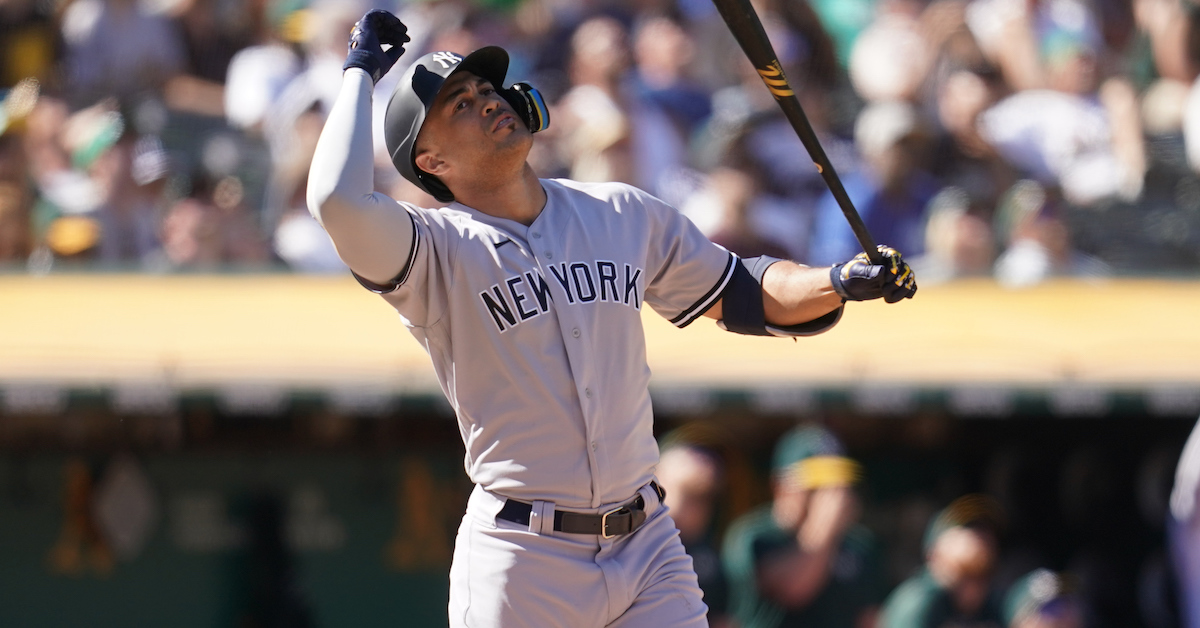
In baseball, there are two sounds that can’t quite be matched: the pop of the catcher’s glove after a sizzling fastball, and the sound of the ball being crushed by the meaty part of the barrel. No one is more familiar with the latter than Giancarlo Stanton. In the Statcast era, no hitter has consistently hit the ball as hard as he has; his otherworldly bat speed leads to some of the most impressive batted balls you’ll ever see.
Stanton’s outlier ability to hit the ball like it came out of a rocket will always raise his floor as a hitter compared to the average player. If you hit the ball like he does, even pounding it on the ground isn’t a huge concern. That doesn’t mean Stanton is impervious, however. You can’t post an exit velocity if you swing through the ball, and if he were to start making less contact, it would be a problem. In 2022, Stanton’s hit tool looked closer to that of Joey Gallo than Aaron Judge, which led to his worst full season in pinstripes by wRC+, and perhaps since his rookie year all the way back in 2010. His .211 batting average and .293 on-base percentage were both more than 50 points off his career marks. And while that decline could be partially attributed to Stanton entering his mid-30s, that’s not the only factor at play here.
Stanton’s season was marred by injury. He constantly dealt with lower leg injuries; ankle tendinitis, a calf strain, and a bruised foot all messed with the way he interacted with the ground, and it showed at the plate. As a rotational athlete, your ability to exude force into the ground is directly tied to the stability of your lower half. When a hitter’s stride foot lands, it sends energy into the ground that shoots back up for the lower half to absorb. If you stomp on the ground, there is a wave of energy that recoils through your legs and hips that you must control if you want to transfer that energy into your swing. Any hitter’s ability to do this would be disrupted by a single lower leg injury. That only worsens when you deal with injuries on both sides of your body like Stanton did, which can lead to multiple energy leakages that completely throw off your swing. For Stanton, those can be seen in the atypical movement of his feet before and during his rotation.
I’m going to show you exactly what that looked like, but first, let’s detail some of the ways Stanton struggled relative to previous seasons from a statistical perspective:
| Year | wRC+ | AVG | Zone Contact % | wOBA v. Fastballs | PA |
|---|---|---|---|---|---|
| 2018 | 128 | .266 | 76.6 | .415 | 705 |
| 2019 | 139 | .288 | 77.3 | .365 | 72 |
| 2020 | 143 | .250 | 74.7 | .428 | 94 |
| 2021 | 137 | .273 | 76.5 | .410 | 579 |
| 2022 | 115 | .211 | 71.0 | .320 | 452 |
Stanton’s drop in performance can be seen in his increased whiff rate in the zone and general performance against fastballs. A general rule of thumb is that great hitters crush fastballs. If a pitcher makes a mistake with a heater in the middle of the plate, they will pay the price. That becomes more difficult as velocity rises, but that’s where the great hitters set themselves apart from good hitters. Stanton has never been one to be overwhelmed by high velocity; in fact, he’s always been well above league average. But his injuries compromised his connection to the ground, and as a result, he struggled. The table below details his performance against high-velocity fastballs as a Yankee:
| Year | Total Seen | wOBA |
|---|---|---|
| 2018 | 397 | 0.375 |
| 2019 | 63 | .374 |
| 2020 | 54 | 0.640 |
| 2021 | 393 | .359 |
| 2022 | 403 | .294 |
Stanton has dealt with soft tissue injuries for his entire tenure in New York, but he has still hit when he’s been on the field, including against high-velocity fastballs. But his .294 wOBA against this group of pitches was .017 points below league average and a big drop from his .359 mark in 2021, which was .049 points higher than the league average. This regression can be zoomed out on a more macro level, too. Stanton’s performance in the heart of the zone against fastballs also changed from 2021 to ’22:
| Year | Overall wOBA/xwOBA | Overall K% | wOBA/xwOBA Behind in Count | K% Behind in Count |
|---|---|---|---|---|
| 2018 | .440/.460 | 13.5 | .461/.469 | 28.9 |
| 2019 | .261/.310 | 14.0 | > 10 pitches | > 10 pitches |
| 2020 | .526/.547 | 14.7 | > 10 pitches | > 10 pitches |
| 2021 | .459/.501 | 15.2 | .493/.523 | 35.7 |
| 2022 | .444/.382 | 34.1 | .307/.259 | 56.3 |
There are a few takeaways from this. First, the drop in xwOBA in 2022 tells us Stanton’s expected stats were significantly worse than previous years on fastballs in the heart. He managed to keep his wOBA relatively high, but it seems like there was at least a little bit of luck involved. Next, when we focus in on in-zone fastballs when Stanton was behind in the count, you can see a precipitous drop from previous seasons. Like any great hitter, he would make pitchers pay for mistakes in the heart of the plate even when he was behind in the count, but that wasn’t the case last year. And while he is naturally a guess hitter, he seemed to rely too heavily on those guesses, and it resulted in many poor at-bats. A hitter of this caliber missing fastballs in the heart of the zone this much when behind in the count is a tell-tale sign that something is wrong. Those are the types of things you do when your body feels different and you can’t get to pitches you’ve always crushed.
To understand what I’m talking about, let’s run through a sequence where Stanton just looked off. This at-bat is from mid-July, after he suffered a right calf strain in late May and right around the time when he began missing time due to his left ankle. He started 2–0 on two fastballs out of the zone, then got three straight in the heart of the plate:
Pitch 3 (2–0 count)
Pitch 4 (2–1 count)
Pitch 5 (2–2 count)
This is a perfect in-game example of him letting fastball mistakes go by. One of the reasons Stanton has been such an incredible hitter for so long is that he creates his bat speed with minimal movement; his swing is shockingly quiet for somebody so large. On his two swings in advantage counts, his feet are dancing, especially in the first. He has a natural scissor kick from a closed stride, but it looks like he is losing grip on the ground before his swing gets going. Every hitter guesses or cheats at some point in an at-bat, but if they’re wrong, they can usually fight off a center-cut pitch with two strikes. Despite another fastball in the heart of the plate, Stanton couldn’t get a swing off. When your lower half isn’t properly connected to the ground, it can be difficult to rotate! As he took the pitch down the plate, you can see him enter extreme ankle eversion (ankle collapses inwards). Stand up and try to take a swing like that. Not so comfortable, right?
To illustrate that point further, here are a few swings from earlier in the season when Stanton’s feet are near neutral through the entire swing.
May 12
May 16
May 21
Each of these swings resulted in batted balls with exit velocities over 114 mph, a typical range for Stanton. But more importantly, his movements were quiet from his knees down. Relative to the swings against Cincinnati, there is no exaggeration of movement in any one part of his lower legs. In his home run swing against Dylan Cease, he uses his typical toe tap on his front foot and subtle scissor kick in the back foot to stay closed. There is no back foot slide like in July. These are fully healthy swings where Stanton maintains his connection to the ground from the beginning of rotation through contact.
Unfortunately for him, the compensations he showed in July only got worse through the end of the year.
August 29
September 24
October 1
From August on, Stanton was healthy enough to be on the field as other Yankees hitters faced injuries of their own, but he was clearly not close to 100%. These three swings can either be tied to his injured left ankle being unable to stay connected to the ground, or to his back foot not being strong enough to compensate for the energy leakage in his lead foot/ankle. In the first swing, his back leg slides way out because it’s attempting to do all the work for his body. The second swing is weeks later; he made an adjustment but still leaked into the same early ankle eversion in his back leg that we saw in July. It’s not impossible to hit like this, but when you’re struggling with stabilization, it’s not ideal.
His swing in early August is the most extreme example of how early ankle eversion can impact your lower half. It caused him to lose his back leg entirely, along with his posture. Those movements cut off his swing path, leading to his barrel being unable to cover the outer half. If you go back to Stanton’s swings from earlier in the year, you can see the best ones all come with athletic, straight posture. He’s a big dude, and to have success, he needs a stable base to control his body. This is obvious for any athlete, but as players age and lose a little bit of baseball skill, health and body control become more and more important. I’m not necessarily saying Stanton is losing skill; his first two months show that he seems to be okay. But he might be entering a stage of his career where he has less room for error and injuries like this compromise his skills and expose the biggest hole in his profile: swing and miss. I’m sure Stanton will be conscious of this heading into 2023.
Injuries have plagued Stanton for a while now, but as he heads into his mid-30s, health is more important than it’s ever been. His swing needs to stay quiet to make the most of his outlier strength. None of these injuries were major long-term concerns, but they were enough to compromise his swing and performance. Assuming he enters 2023 fully recovered from these issues, there is no question in my mind he still has the skills to deliver a 130–140 wRC+ season each year. But he will need to be conscious of how any injury impacts his swing as he enters the latter half of his career.
Esteban is a contributing writer at FanGraphs. One of his main hobbies is taking dry hacks every time he sees a bat.
Like Patrick Mahomes in this year’s playoffs, you can see the impact of a stud like Stanton playing while hamstrung.
Just neighing.
Making fun of how someone looks? classy