Author Archive

FanGraphs Live! Tuesday: OOTP Brewers

The alternate OOTP universe is now past the halfway point. Today, we’ll take stock of our Brewers, consider a few bullpen moves, and take a look around the league for outstanding performances. Read the rest of this entry »


So You Want to Bunt in Extra Innings

Last week, an interesting question got me wondering about Billy Hamilton and the new extra-innings rules. As it turns out, he’s a valuable runner to have on second base! So valuable in fact, that he projects to gain his team roughly 0.3 wins in a 60-game season just by being fast.

For the Giants, that’s great. For the other 29 teams in baseball (or 28 if the Dodgers end up rostering Terrance Gore), that’s no help. What should their strategy be in extra innings? I had all these run expectancy tables, so I decided to dive in.

First things first: let’s set the parameters of this discussion. I’m going to be considering two decisions. First, does bunting to lead off the inning make sense, and does that decision change based on whether you’re the home or visiting squad? Second, assuming bunting doesn’t make sense, what about stealing third? Presumably you’d steal with one out, what with not making the first out at third base and all, so we’ll focus on those two decision points: bunting to lead off, and stealing if the first at-bat doesn’t produce any advancement.

The value of being a home team is immediately evident when looked at through this lens. Consider a situation where the visiting team scores two runs in the top of the inning. Right away, a bunt goes out the window. That’s a big edge; in 2019, and excluding extra innings so that walk-offs don’t interrupt a team’s run scoring, teams that reached the position of a runner on second base with no outs scored two or more runs 29.1% of the time.

In other words, nearly a third of the time, bunting the runner over serves no purpose at all; your team will need two or more runs just to tie, so the position of that runner is nearly immaterial. Getting to act after knowing how many runs your opponent scored is huge. Read the rest of this entry »


Ben Clemens FanGraphs Chat – 6/29/20

Read the rest of this entry »


OOTP Brewers: When Worlds Collide

In the world of Out Of The Park, the day is June 29, and the teams have played roughly 83 baseball games. Real life, of course, is markedly different; the day is the same, but pretty much everything else isn’t. There have been no games, to name one obvious discrepancy. In a month’s time, however, the lines will be blurrier. Real teams will be playing real games, which makes the prospect of following along with a fake baseball team somewhat less exciting.

To that end, I’d like to take today to lay out my future plans for this series, as well as take a quick look at some outstanding performances across the league this year. Let’s handle the outstanding performances first, because they’re more fun: who needs to plan for the future when you can watch hulking sluggers swat dingers left and right?

Why bring up home runs first? Giancarlo Stanton’s superlative season demands it. The Yankees have played 84 games this year, and Stanton’s health has been uncharacteristically excellent; he’s appeared in 83 of them, almost exclusively in left field. More important than his position, however, is his bat:

Giancarlo Stanton is hot in 2020
Player PA AVG OBP SLG wRC+ K% BB% HR WAR
Giancarlo Stanton 369 .305 .391 .732 184 26.6% 11.9% 40 4.5

That’s right: 40 home runs through 84 games. That’s a 77-dinger pace for a full season! The .300 average is mostly a byproduct of the home runs, but not exclusively; when you’re Stanton, getting down to 26.6% strikeouts is actually a big deal. He’s on pace for a season for the ages; not by WAR, necessarily, where his indifferent outfield defense holds him back. Even accounting for that defensive hit, however, his offensive prowess has him on pace for a 9-WAR season. Read the rest of this entry »


Billy Hamilton, On Second, With No Outs

When baseball returns next month, it will be a little weird. Not just because of the empty stands, though of course that will be weird too. Not because of the NL DH — despite the bellyaching about the sanctity of the game, baseball with a DH feels more or less the same as baseball without one. No, I’m talking about the new extra innings rule, which will place a runner on second base to start each half inning beyond the ninth.

A runner on second by itself isn’t weird, but having it happen every inning without a leadoff double will definitely take some getting used to. It’s not all dark clouds, however, because weird baseball rules create weird baseball situations. Effectively Wild listener Brett Mobly wrote in about a particularly interesting angle, and via the magic of Ben-to-Ben communication (read: Meg emailed me about it), here we are.

Mobly wondered about a hypothetical that Jeremy Frank posed on Twitter. What if Billy Hamilton comes to the plate with two outs and no one aboard in the bottom of the ninth? Given that the runner who starts on second base is, by rule, the player on the batting team due up last in the batting order, a Hamilton out comes with a huge carrot: the best baserunner in baseball starting the next inning in scoring position. How should that change his behavior at the plate?

We can start by eliminating the extreme scenario of Hamilton purposefully making an out. Even if he were intent on starting the next inning on second base, he could do better by taking a regular at-bat and then simply running until he’s thrown out. Single? Steal second, then try to steal third, then try to steal home. The end result will either be an out — the same result as purposefully making an out — or a game-winning run. Heck, he might luck into a home run, unlikely as that sounds. Read the rest of this entry »


Every Pitcher, Missing the Zone

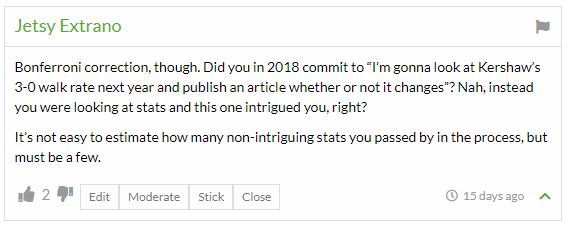
Last week, I noticed something strange about Clayton Kershaw: he’d seemingly lost the will or ability to throw strikes in a 3-0 count. I did some middlingly fancy statistics, declared that a result like Kershaw’s was unlikely to happen by chance, and called it a day.

Unfortunately, I’d missed something subtle but important:

The Bonferroni correction is, in essence, a way to adjust confidence intervals to avoid taking too much signal from your data. Imagine, if you will, 10 gamblers each flipping 10 coins. One of them flips nine heads in his sample of 10. Amazing, right? There’s only a 1% chance of that happening!

Well, kind of. There were 10 of those gamblers, after all. The Bonferroni correction asks us to formulate a hypothesis beforehand, like “Gambler Number Nine is unusually likely to flip heads.” If we wanted to hypothesize that each gambler was likely to flip heads, that’s 10 hypotheses right there. Without getting too far into the realm of explaining statistical methods, suffice it to say that the Bonferroni correction requires more extreme values to reject the null hypothesis the more hypotheses you start with. In other words, the more things you observe, the weirder they need to be before they’re notable. Read the rest of this entry »


The Most Feared Hitters in Baseball — And Jacob Stallings

If you’re looking for a way to assess pitchers’ respect for hitters, staying away from the zone is a decent proxy. Pitchers know Mike Trout has power, so they try to keep the ball away from him. When an opposing pitcher steps up to bat, it’s the opposite: it’s time to flood the box with impunity, because they’re unlikely to do any damage even if they do make contact.

You could, if you were so inclined, get even more specific. Forget the strike zone: let’s focus on the heart of the plate, middle/middle. It’s not a sign of disrespect to throw Cody Bellinger a slider on the black, low and away. Lobbing a meatball down Main Street? That’s really what we’re after. While we’re at it, let’s adjust for context, in a crude way, by looking only at 0-0 counts. Throwing down the middle on the first pitch of the at-bat doesn’t make sense against a power hitter — you can only get one strike if they take, while bad (for the pitcher) outcomes abound when they swing.

Indeed, if you’re looking for a list of batters who pitchers disrespect, the highest middle/middle rates on 0-0 counts (minimum 50 PA) really paint a picture:

Highest Meatball Rates on 0-0 (min 50 PA)
Player Middle/Middle Rate Tracked PA
Clayton Kershaw 17.5% 63
Merrill Kelly 16.7% 60
Isaac Galloway 16.7% 54
Walker Buehler 16.7% 66
Jonathan Davis 15.8% 95
Braden Bishop 15.3% 59
Jack Flaherty 15.2% 66
Jedd Gyorko 14.0% 100
Dustin Garneau 13.9% 101
Jack Mayfield 13.8% 65

Read the rest of this entry »


FanGraphs Live! Tuesday: OOTP Brewers, Noon ET

It’s a Keston Hiura extension party, and you’re all invited. Read the rest of this entry »


MLB to Impose 60-Game Season After Talks Stall

On Monday night, Major League Baseball released a statement that, despite the legalese and lengthy section recapitulating earlier letters, set the terms under which baseball will return:

88 days after the league and the Major League Baseball Players Association reached an agreement to pay players a pro-rata share of their salaries (with the commissioner retaining the right to set the length of the season unilaterally), the two sides weren’t able to come to a satisfactory agreement for the resumption of play; they’ll instead abide by the terms of the March deal. Sources told Ken Rosenthal of The Athletic that the league plans to announce a 60-game season, equal in length to the owners’ final proposal to the players.

Many of the details of the actual season remain unsettled. The union and the league must still agree on health and safety protocols, though representatives from both sides maintain that a deal there is imminent. The league’s statement mentions this specifically, but even without that particular ask of the players, the March 26 agreement is subject to the two parties agreeing on such regulations.

There has not yet been an official declaration that there will be a season. In addition to being contingent on a final health protocol agreement, there’s the matter of a second spring training. MLB has asked the players to report by July 1. The MLBPA seems very likely to comply with this request, however, which means that a followup announcement with an exact season schedule should follow soon. Read the rest of this entry »


Ben Clemens FanGraphs Chat – 6/22/20

Read the rest of this entry »