Author Archive

Jalen Beeks, Dallas Braden, and John Means on Crafting Their Changeups

Pitchers learn and develop different pitches, and they do so at varying stages of their lives. It might be a curveball in high school, a cutter in college, or a changeup in A-ball. Sometimes the addition or refinement is a natural progression — graduating from Pitching 101 to advanced course work — and often it’s a matter of necessity. In order to get hitters out as the quality of competition improves, a pitcher needs to optimize his repertoire.

In this installment of the series, we’ll hear from three pitchers — Jalen Beeks, Dallas Braden, and John Means— on how they learned and developed their changeups.

———

Jalen Beeks, Tampa Bay Rays

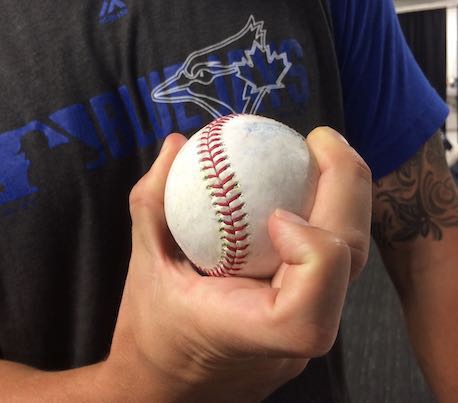
“I had a changeup in high school, but it wasn’t very good. When I got to college, I changed the grip; I moved my pinky finger down. It’s pretty much a circle change. I grip it hard and think about it almost like a fastball. I don’t pronate. No one taught it to me. I just threw it one day and it worked. You have to tinker. You have to figure out what works for you.

Jalen Beeks’ changeup grip

“It’s gotten better over the last year. I think that’s mainly from my mechanics having changed a little bit. I use my legs more, and have shortened my arm action. I’m not so tall on the mound now. I’m activating my legs more, by getting into more of a squat position. And like I said, I think fastball. I throw it as hard as I can. My average fastball is around 92 [mph] and my changeup is around 88. Read the rest of this entry »


Sunday Notes: Rowdy Swings Maple, Mancini Swings Birch

Rowdy Tellez’s weapon of choice is 34 inches long, weighs 32 ounces, and is made out of maple. Trey Mancini’s is 33-and-a-half inches long, weighs 31 ounces, and is made out of birch. Both do damage. The Blue Jays first baseman is known for his light-tower power, while the Orioles outfielder is coming off of consecutive 24-home-runs seasons.

How they went about choosing, and then settling on, their bat models differs.

“When I first got into pro ball, I signed a bat contract with Victus,” explained Tellez, who was drafted by Toronto out of an Elk Grove, California in 2013. “I told them what I wanted, and they sent me bats. I didn’t really like it at first, so I tweaked it a little more. I got to what they called an AC24, which is kind of a combination of models. It’s kind of like a 271 knob and handle, maybe a little bit thicker heading towards the barrel, and then almost like an I13 barrel, but circumference-wise a little bit thinner, and a tick longer. I’ve kind of stuck with that. It’s a comfort thing.”

Mancini was drafted by Baltimore out of Notre Dame in 2013. Three years later, a C243 model Louisville Slugger became his bat of choice. Read the rest of this entry »


Red Sox Prospect Tanner Houck Has That Sinking Feeling Again

Tanner Houck is off to a book-ended beginning to his second full professional season. Boston’s first-round pick in the 2017 draft allowed seven runs in his first start, and in his fifth, he allowed five. In between, he authored three beauties. Pitching for the Portland Sea Dogs, the 22-year-old righty held Double-A opponents to 10 hits, and a lone marker, over 16 innings.

Houck relies heavily on a worm-killing two-seamer. It’s the pitch that wowed scouts when he was at the University of Missouri, and while it’s once again his go-to, that wasn’t the case over the first half of last season. The Red Sox had Houck put his signature pitch in his back pocket and primarily throw four-seamers against Carolina League competition. The reasoning was sound, but the results weren’t particularly pretty. A fish out of water without his sinker, Houck got hit around.

Come midseason, the Boston brain trust decided that Houck should go back to his old bread and butter. The news came as a relief. His best pitch back at the forefront of his arsenal, Houck proceeded to reestablish himself as one of the organization’s top prospects.

Houck, who takes the hill today in an 11 a.m. matinee, sat down for an in-depth discussion of his two-seamer, and what he gained from last year’s four-seam experiment, at the outset of the current campaign.

———

David Laurila: How would you describe the transition away from, and back to, your two-seamer?

Tanner Houck: “Honestly, [transitioning back] was just like riding a bike. It was getting back to my staple — back to who I am — and to how my career is going to be going forward. It was enjoyable. At the same time, not having thrown a four-seam in college, learning that side of the coin was really big for me. I’m still throwing one now, and it makes the two-seam that much better. Being able to ride a four-seam through the zone — not sink it — in certain counts has definitely helped. I’m able to give the hitter two different looks with relatively the same pitch.”

Laurila: What kind of movement do you get on your four-seamer? Read the rest of this entry »


Matt Chapman Talks Hitting

Matt Chapman is starting to come into his own as a hitter. Known primarily for his defense — he won a Gold Glove last year in his first full big-league season — the 26-year-old third baseman is slashing .295/.384/.597. He leads the Oakland A’s in all three of those categories, while his nine home runs rank second, behind Khris “Mr. .247” Davis. Moreover, he’s displaying far better discipline than he did a year ago. Along with upping his walk rate, Chapman has nearly halved his K rate. Slowly but surely, he’s becoming an offensive force.

Chapman talked about his offensive approach, which includes looking for pitches middle, middle-away, when the A’s visited Fenway Park last week.

David Laurila: I start a lot of interviews with this question: Do you consider hitting to be more of an art, or more of a science?

Matt Chapman: “Baseball, in general, is kind of like a fine line. So it’s a little bit of both. It’s an art in the sense that everybody is unique — everybody has the things that work for them — and you have to let your natural ability take over. But then there are the mechanics and the numbers. That’s the science part of it. Both are important. You can’t live and die with either.

“For me, the science part is that I see little tiny things in my swing, on video, that need to be mechanically sound. When I’m not feeling as good as maybe I should, I’ll go to the film. I don’t dissect every little thing, but there are a few things I look at. Am I on time? Am I getting in the right hitting position? Sometimes when I struggle, it’s because I’m getting a little too pull-happy. So, is my barrel up, or am I opening up and my barrel is dropping?”

Laurila: Are you looking at more video, and data, than in the past? Read the rest of this entry »


Wade LeBlanc, Michael Lorenzen, and Lou Trivino on Cultivating Their Cutters

Pitchers learn and develop different pitches, and they do so at varying stages of their lives. It might be a curveball in high school, a cutter in college, or a changeup in A-ball. Sometimes the addition or refinement is a natural progression — graduating from Pitching 101 to advanced course work — and often it’s a matter of necessity. In order to get hitters out as the quality of competition improves, a pitcher needs to optimize his repertoire.

In this installment of the series, we’ll hear from three pitchers — Wade LeBlanc, Michael Lorenzen, and Lou Trivino — on how they learned and developed their cutters.

———

Wade LeBlanc, Seattle Mariners

“I learned a cutter in 2009. I taught myself. That was after I got my brains beat in, and got sent back to Triple-A. I figured it was my last shot. If I was going to make anything out of this career, I was going to have to find something that worked.

“My fear about throwing cutters, or sliders, was always arm issues. I’ve never actually had an arm issue, but that was the fear. I didn’t want to throw something that could cause some problems with my arm, so I’d held off. But at that point, I was on my last legs. It was either figure something out, or go home. Read the rest of this entry »


Sunday Notes: Grayson Greiner Compares His Dingers

Grayson Greiner hit the first home run of his brief big-league career two weeks ago Friday. He then banged out number-two the following Tuesday. What did the blasts have in common? I asked the Detroit Tigers catcher that very question a day after the second dinger.

“They were similar pitches,” Greiner told me. “They were kind of down in the zone, and middle-in-ish. Both fastballs. One was off Ryan Burr, a right-hander for the White Sox, and yesterday’s was off Chris Sale. The one off the righty was on a 2-2 count, and the one off Sale was 1-1 count. I think the counts being even is a reason they were both home runs. I wasn’t sure what was coming, and that made me stay back a little bit longer, instead of getting out front. I was in a good, strong hitting position.”

Greiner and Burr know each other, having played summer ball together when they were collegians. Baseball friendships being what they are, Greiner received a text after the April 19 game saying, ‘Congrats on the first homer. I wish it wasn’t off of me.’ He didn’t hear from Sale after taking him deep. “He probably doesn’t know who I am,” was Greiner’s guess as to why that didn’t happen.

The fact that Sale is Sale, and Fenway is Fenway, made Greiner’s second-ever home run even more meaningful than his first. Read the rest of this entry »


Jesse Winker Talks Hitting

Jesse Winker had a strange April at the plate. The Cincinnati Reds outfielder came into May with eight home runs — that’s already a career high — and a frustratingly-low .200 BABIP. As a result, his slash line is a far cry from what it was over his first two big-league seasons. A .299/.397/.460 hitter coming into the current campaign, Winker is slashing a more-akin-to-slugger .228/.311/.511.

What kind of numbers can we expect going forward? At age 25, with 574 big-league plate appearances under his belt, Winker profiles as a player well capable of merging the best of both worlds — on-base excellence and pop. That’s exactly what he’s looking to do. The sweet-swinging native of Orlando doesn’t want to be boxed in as a hitter. He wants to do everything.

Winker discussed his multi-dimensional approach when the Reds visited PNC Park in early April.

———

David Laurila: How have you evolved as a hitter? I’m thinking of both your approach, and your bat path.

Jesse Winker: “I use the ball to tell me where my bat path is at. The ball gives me the best feedback I need for that. What’s changed the most for me is the knowledge I’ve gained about opposing pitchers. That, and what I’m trying to feel at the plate. I’m more aware of how I’m feeling in the box, and what I’m trying to do.”

Laurila: What do you mean by ‘what I’m trying to feel at the plate’? Read the rest of this entry »


Tyler Glasnow on Embracing (and Controlling) the Cut

Tyler Glasnow has a plus fastball — a somewhat-unique plus fastball — and he relies on it heavily. The Tampa Bay Rays righty is throwing it 66% of the time, the fourth-highest rate among qualified pitchers. A four-seamer delivered from Glasnow’s towering 6-foot-8 frame, the offering has an average velocity of 96.6 mph. It’s the pitch you’re going to read about here.

When I approached him on Saturday, I’d actually been thinking about his changeup. While it’s a pitch Glasnow throws infrequently, the always-insightful Daniel Russell wrote about it recently at Drays Bay, and I was intrigued. When I’d spoken to Glasnow last August, we talked primary breaking balls; his seldom-used change-of-pace wasn’t even mentioned.

Glasnow threw me a changeup on Saturday. When I suggested it as a topic, he said we should talk about his fastball instead, for the aforementioned reason: he rarely throws his changeup.

The following day, Glasnow threw nine of them in a dominating performance against the Red Sox at Fenway Park. That’s as many changeups as he’d thrown in his first five starts combined; hence his subterfuge. It was part of the plan going in.

Is it also his plan going forward? I asked that question following the game. Read the rest of this entry »


Kevin Gausman, Bob Scanlan, and Matt Shoemaker Reflect on Their Splitters

Pitchers learn and develop different pitches, and they do so at varying stages of their lives. It might be a curveball in high school, a cutter in college, or a changeup in A-ball. Sometimes the addition or refinement is a natural progression — graduating from Pitching 101 to advanced course work — and often it’s a matter of necessity. In order to get hitters out as the quality of competition improves, a pitcher needs to optimize his repertoire.

In this installment of the series, we’ll hear from three pitchers — Kevin Gausman, Bob Scanlan, and Matt Shoemaker — on how they learned and developed their splitters.

———

Kevin Gausman, Atlanta Braves

“I want to say I started throwing it my sophomore year of high school. I had a coach at the time who had pitched — his name is Chris Baum — and he had been trying to teach me a circle changeup. I couldn’t really figure it out, so he showed me this fosh, this split-change, that I throw now.

Kevin Gausman splitter grip.

“It was a pretty frustrating pitch at first, because it’s tough to gain consistency with. He kind of told me from Day One, ‘Hey, if you keep throwing it, you’ll eventually have a feel for it.’ I trusted him, and he was right. It’s a big weapon for me.

“The only thing I’ve really changed is where my thumb is on the ball. I’ll kind of mess around with it when I want to throw a strike, or when I don’t want to throw a strike. Moving the thumb affects the speed, and how much break, and tilt, you get on the pitch. If my thumb is under it, it’s going to be a little bit straighter. When my thumb is on the side of it, it might be a little bigger, with more fading action. Read the rest of this entry »


Sunday Notes: Daniel Norris is Missing One of His Friends

Daniel Norris has a lot of friends. They include a fastball, a slider, a changeup, and a curveball. The Detroit Tigers southpaw doesn’t actually converse with them — not in the way that Mark “The Bird” Fidrych once talked to the baseball — but they are nonetheless part of his coterie. They are his compadres. His amigos.

Norris is known for his unconventional ways. A few years back he gained a certain amount of notoriety for living in a VW van. His beard — since shorn — is often bushy, his soliloquies on life thoughtful. Moreover, his responses to reporters’ questions have rarely been of the paint-by-numbers variety. A few hours before he fanned the first big-league batter he faced — David Ortiz, in September 2014 — I happened to ask Norris if he’s imagined what his debut would feel like. His response was, “I have, and it will be like that times 10.”

A few days ago, I asked the now-26-year-old about his arsenal. The answer I received didn’t disappoint. Read the rest of this entry »