
Beat up Blue Jays Acquire Lenyn Sosa From White Sox
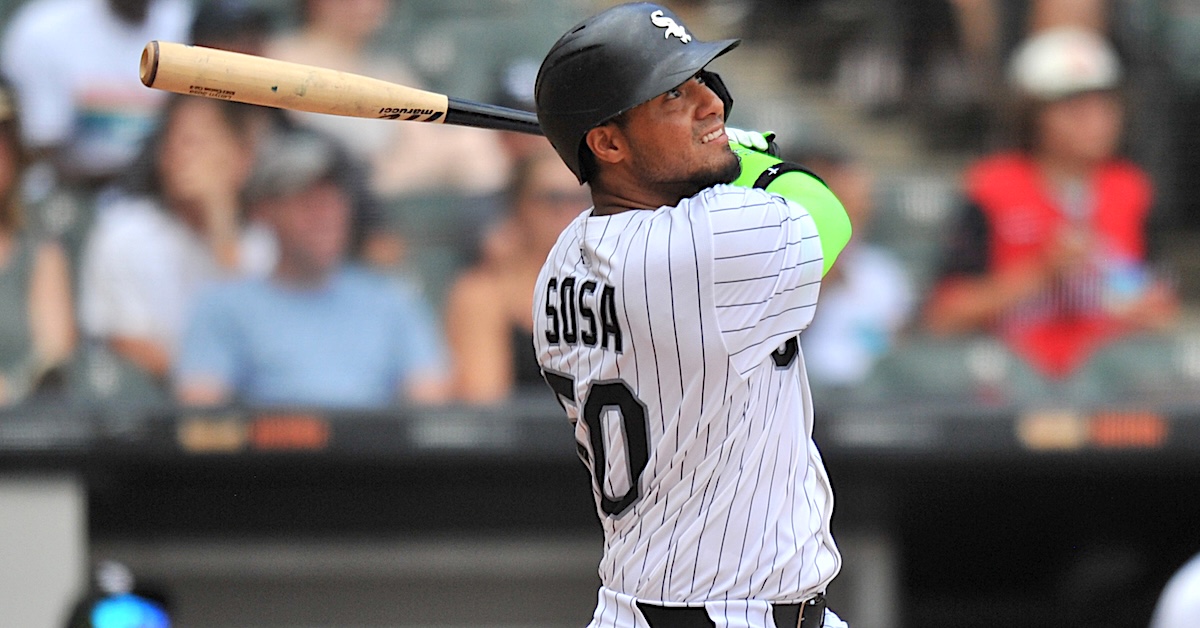
Over the last week and a half, the Blue Jays have placed Alejandro Kirk, Addison Barger, and George Springer on the IL with maladies of varying severity. With Anthony Santander already out for the season after undergoing shoulder surgery in February, that’s four players from the starting lineup who have been sidelined just a few weeks into the season. No matter how well constructed the roster is, that amount of talent missing would strain the depth of any team in baseball. To alleviate some of that stress, the Blue Jays acquired infielder Lenyn Sosa from the White Sox on Monday. Chicago received minor league outfielder Jordan Rich and a player to be named later or cash considerations.
In 2025, Sosa led the White Sox in home runs and hit for a 100 wRC+. It was a career-best season for the utility infielder, driven by a slight uptick in bat speed and a corresponding improvement in contact quality. He set career highs in average exit velocity, EV90, maximum exit velocity, pulled AIR%, hard-hit rate, and barrel rate.
Despite the louder and more potent contact off the bat, the limiting factor in Sosa’s profile at the plate is a hyper-aggressive approach. His 3.3% walk rate was the second lowest among all qualified batters last year. He swings aggressively early and often and has good enough bat-to-ball skills that he can put the ball in play before getting too deep in the count. Just 4.8% of the pitches he saw last year came in three-ball counts, the 10th-lowest rate among all 419 batters who saw at least 500 pitches. Because his production is so dependent on batted balls, he can be pretty streaky. To wit, he’s collected just eight hits in 34 plate appearances this year and has yet to draw a walk. (He went 1-for-1 in his Blue Jays debut on Tuesday.)
Defensively, Sosa doesn’t really have a home. He’s played all four infield positions in the big leagues, though he hasn’t seen time at shortstop since his debut in 2022. He spent the majority of his time at second base last year and filled in at the corners from time to time. No matter which metric you use, he grades out as a poor defender at every infield position. DRS had him at -10 at second last year, though Statcast’s FRV was a little more generous, at -2.
With Barger on the IL and Kazuma Okamoto off to an extremely slow start this year, Sosa provides some much needed infield depth for the Blue Jays. Okamoto has struck out in 35% of his plate appearances so far and looks like he’s still adjusting to MLB pitching after coming over from Japan this offseason. Springer’s injury also means the Jays selected the contract of Eloy Jiménez on Sunday. He collected two hits in his debut for Toronto, but he hasn’t been a big league regular since 2023. With his lengthy injury history, Jiménez is probably only a designated hitter at this point in his career, and it’s very possible he’ll be designated for assignment before the end of this month, when Barger is expected to return from his left ankle sprain. (Barger managed to injure both ankles on the same play in a game against the White Sox on Easter Sunday, but the left was more severe.) Sosa’s versatility, lead glove notwithstanding, gives manager John Schneider more options off the bench.
Normally, a few early-season injuries wouldn’t pose such a problem to warrant a move like this, but the Blue Jays are in danger of falling too far behind in a very competitive AL East race. Per Baseball Prospectus’ Injured List Ledger, Toronto has lost the most WARP to injury of any team in baseball so far this year. In addition to the aforementioned position players, the Jays began the season with three starting pitchers — José Berríos, Shane Bieber, and Trey Yesavage — on the IL, and then lost a fourth starter, Cody Ponce, to a season-ending ACL injury in their fourth game of the year. They moved Bieber to the 60-day IL after acquiring Sosa, but Yesavage is well into a rehab assignment and Berríos should begin his own minor league rehab shortly.
Offensively, the Blue Jays have struggled to replicate the production that carried them to the World Series last year. Through the first three weeks of the season, they’ve been a hair below league average, with a 99 wRC+, but they’re just 26th in baseball in runs scored. They’re still making a ton of contact — their team strikeout rate is 18.1%, best in the majors — but all those balls in play aren’t being hit with as much authority. Their team hard-hit rate is just 37.4%, 27th in the majors.
It’s worth noting that Toronto took a while to get its offense going last year, as well. The team posted an 85 wRC+ in April 2025 and greatly improved as the season progressed. As MLB.com’s Mike Petriello noted in his examination of the Jays’ historic postseason offense from last October, their batters really started to produce once they started swinging hard a lot more often. Here’s a look at some of those key swing metrics at the team level over the last calendar year:
| Month | wOBA | ISO | HardHit% | Avg. Bat Speed | Fast Swing% |
|---|---|---|---|---|---|
| April 2025 | .290 | .110 | 39.0% | 70.6 | 19.8% |
| May 2025 | .339 | .172 | 45.2% | 71.7 | 26.5% |
| June 2025 | .320 | .140 | 39.9% | 71.3 | 25.6% |
| July 2025 | .362 | .185 | 41.1% | 71.2 | 25.1% |
| August 2025 | .354 | .199 | 40.8% | 71.8 | 28.7% |
| September 2025 | .317 | .171 | 40.4% | 72.2 | 31.9% |
| Postseason 2025 | .352 | .186 | 38.2% | 72.0 | 30.9% |
| April 2026 | .314 | .133 | 37.4% | 71.3 | 25.5% |
It’s far too early to know if the team will follow the same pattern as last year, though it’s encouraging to see that the rate of fast swings this month matches what it was doing during the middle of last season. Sosa’s aggressive approach and good bat-to-ball skills seem like a good fit for what the Blue Jays have been teaching these past few years. Perhaps they can help him maximize the contact he’s producing and help him take another small step forward.
For the White Sox, this move seems like it was geared toward getting more flexibility on the big league roster. Sosa was out of minor league options and had been squeezed out of an everyday role by the addition of Munetaka Murakami. There was some speculation that Sam Antonacci was going to be promoted this week, and while that has not yet come to pass, he is the kind of flexible (and optionable) utility player the Sox would rather have on their bench.
As for Jordan Rich, there’s not much of a scouting report to work from. He was a 17th-round draft pick last year out of high school and he hasn’t even made his professional debut yet. Here are Eric Longenhagen’s notes on the young outfield prospect:
Rich was 17 on draft day and was a plus contact hitter in a limited showcase sample. A two-sport athlete (football) who hadn’t fully committed to baseball until signing, he has blazing speed and a shot to be a plus center field defender. He lacks any modicum of power and only maxed out around 94 mph hitting on the showcase circuit. The Blue Jays had not yet begun playing extended spring games when this trade was made, so there’s very little new information to glean about Rich. One potentially interesting nugget is that he may have gotten taller. He was listed at 5-foot-8 before the draft but is now listed at 5-foot-10. Maybe there’s a more relevant, passable degree of power that can be attained if, in fact, he is still growing.
Getting a long-term developmental project in exchange for a defensively challenged utility infielder isn’t the worst risk the White Sox could take. Sosa more than likely maxed out his ceiling last year and didn’t really fit their roster as it’s currently constructed. We don’t know the details, but the player to be named later could also change the calculus of this deal, though probably not in any significant way.
Jake Mailhot is a contributor to FanGraphs. A long-suffering Mariners fan, he also writes about them for Lookout Landing. Follow him on BlueSky @jakemailhot.
The White Sox got a lottery ticket for a 24th or 25th man on a 90+ loss team. They identified a team that was desperate and turned a 0 – 1 win player into a prospect. I’d say that’s good work by Chris Getz.
I don’t know, I see a 1-2 WAR player locked up through 2030 for super cheap. Felt like they could have got a little more.
For much of last year he was actually one of the White Sox’s best hitters.
Finished as league average (100wRC+) and I don’t see any reason for decline. He underperformed his xwOBA and had good statcast numbers. Good bat speed, contact, and barrel rates. Equally solid facing both righties and lefties. After showing significant consistent improvement year-to-year and only 26.
Getz just has too many low-ceiling infield prospects and not enough outfield prospects.
Another way to put it: Sosa was a better (and younger) than Luis Robert and Andrew Vaughn.
Calling Lenyn Sosa a “1-2 WAR player” when he’s been worth 0.3 fWAR and -1.1 bWAR in 1156 career PA across MLB five seasons is laughably optimistic, especially when he’s already produced -0.2 WAR in only 34 PA this year.
Similarly, describing him as a “poor defender,” as the author does here, is incredibly generous. He’s so utterly terrible in the field, and makes such baffling, incomprehensible defensive decisions that he raises the act of being bad defensively to a form of performance art. If you don’t believe me, just search his defensive “highlights” on Twitter.
Sosa is a truly singular player, and not in a positive way. Anybody who’s confused by this trade simply hasn’t watched enough recent White Sox baseball.
Sosa has 0.3 career WAR in 1159 PAs.