
Brewing with Gas: Evaluating Jett Williams and Brandon Sproat
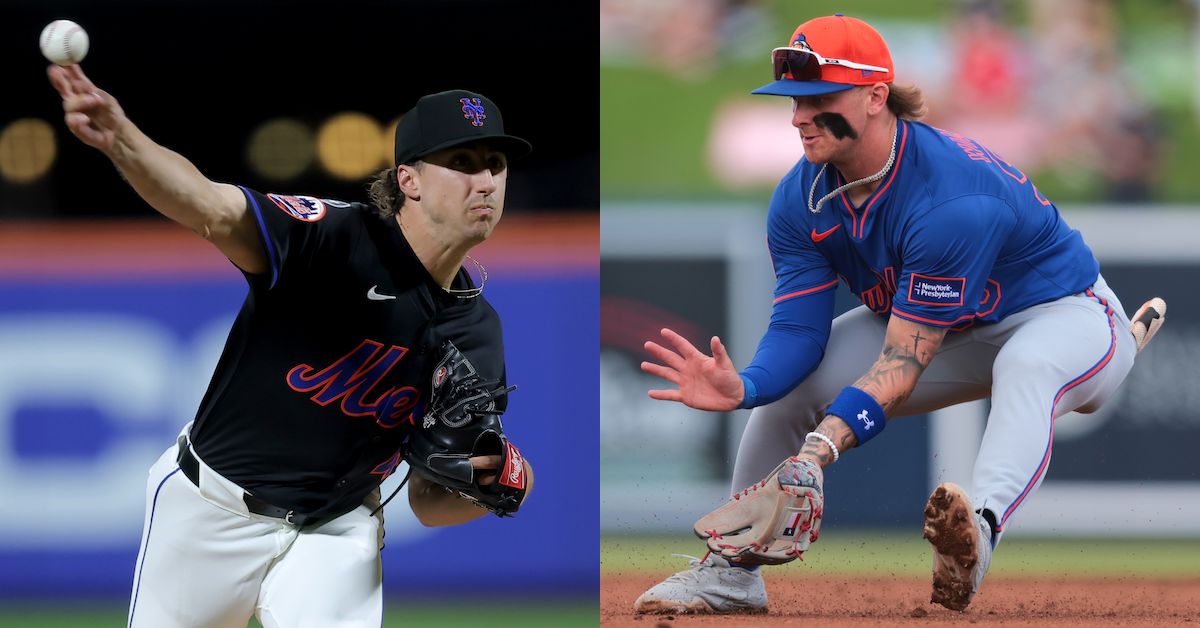
Last night, the Brewers and Mets swung a big trade. Milwaukee sent staff ace Freddy Peralta, along with righty Tobias Myers, to Queens in exchange for two Top 100 prospects in Brandon Sproat and Jett Williams. Both are near-ready contributors who grade out as 50 FVs and slot into Milwaukee’s farm system as the club’s third- and fourth-best prospects, respectively. Sproat projects as a mid-rotation starter, while Williams is a middle-of-the-diamond player with an as-yet undetermined defensive home. Davy Andrews wrote up New York’s side of the swap. Here, we’ll take a look at the youngsters heading to the Midwest.
Let’s start with Sproat. After selecting the righty in the third round in 2022 and then failing to sign him, the Mets went back to the well a round earlier the following season. This time they got their man, and the former Florida Gator took to pro ball quickly. He posted a 3.40 ERA with 131 strikeouts in 116.1 innings in 2024, with solid walk and contact-management metrics alongside. He capped the year with seven starts at Triple-A, and while those were mostly forgettable, he entered 2025 as the club’s top farmhand and one of the brightest pitching prospects in baseball.
He then battled through an uneven 2025 campaign. He started slowly, with a new, less deceptive motion, and missed significantly fewer bats in the first half of the season than he had the year prior. Still, the traits that long made Sproat an enticing prospect mostly endured, as he was still sitting in the mid-to-upper 90s and mixing in a plus breaking ball. He righted the ship in July and saved some of his best baseball for the latter part of August, a run of form that culminated in his first big league call-up.
Sproat’s four starts for the Mets were a mixed bag. He tossed six shutout innings without a walk against the Rangers and didn’t allow a dinger across 21 total innings of work. But Sproat also had outings where he looked green, and his inability to hit his spots led to long counts and a couple of short starts. On the balance, there was more good than bad — he posted a 2.80 FIP across those 21 frames — but regardless of your priors on Sproat, he found ways to confirm them.
Sproat works with six pitches, including both fastballs. He can crest 100 but tends to live in the 95-97 mph range. His four-seamer doesn’t have bat-missing shape and plays a little below the number. His sinker is more effective. While he doesn’t command it very well — his catchers tend to set up down the middle and hope he finds one side of the plate or the other — plus velocity and above-average tail tend to produce a lot of grounders regardless of where they wind up.
His secondaries flash but, as with his fastball command, inconsistency abounds. He’ll show a plus sweeper with long, hard break, and he actually seems to have better feel for locating this than the heat. His low-90s change flashes plus once in a while too; at other times, he’ll either overthrow and flatten it, or pull the string too early and bury it harmlessly in the dirt. The story is similar for his slider and especially his curve, pitches that can be part of a balanced arsenal, but that often don’t behave as he wants.
It’s hard to develop feel for so many weapons, and Sproat’s long, deep arm circle doesn’t help. He’s strong and athletic but, particularly with how much his ball moves, small variations in his timing can lead to significant misses, and he wasn’t reliably hitting a region, much less a spot, in his big league outings. Sproat is generally around the plate, but he’s a good example of a guy whose control is well ahead of his command.
While Sproat ultimately projects as a no. 3 starter, there is a little push and pull in how this could go. Oftentimes guys who don’t command the ball well turn into inefficient, five-and-dive types. But even when he isn’t sharp, Sproat can still hit the box more often than most guys with below-average command, and you can imagine him gutting through outings by leaning on his sinker to induce weak contact. The aforementioned stretch where he didn’t miss bats is a little concerning, however, and while it’s not time to whisper about the bullpen yet, you can see a scenario in which he alternates gems and clunkers in a frustrating, backend starter sort of way.
But the stuff is also good enough to support a no. 2 profile if he finds his way to average command. While not likely, it isn’t out of the question, either. Might there be a way to shorten his arm path? Could a slightly narrowed arsenal key a step forward with the rest of the mix? He’s changed his delivery before; perhaps another adjustment will be the tonic. Given Milwaukee’s lengthy track record of developing starting pitchers, he’s in a great place to find out.
Turning to Williams, this past summer, Sam Miller persuasively argued that Milwaukee, as a team, succeeds in part by leveraging the value of running and playing hard in an increasingly no-hustle league. He estimated that, by having fast players who barrel down the line and turn routine groundouts and forces on the bases into contested plays, the Brewers bought themselves an extra out per game last year, a small-sounding margin that adds up quite a bit over the course of a season. In Williams, Milwaukee has found another player who perfectly suits this system.
Like several players already in the lineup, Williams is fast, a plus runner. And like all of those players, he’s a high-motor guy who digs out of the box and plays hard in all facets. He steals bases (34 last year), legs out singles, and can take an extra base on a gapper. As a bonus, he has a little more pop than most of his new teammates: Both his max and 90th-percentile exit velocities were average, and he may yet have another half-gear in him. His swing and approach are geared for damage, and we’re projecting average in-game power to go along with everything else.
There are a few markers that suggest Williams’ hit tool will mature south of average. He has a steep swing plane and there isn’t much manipulation in the path. He also swings hard — not recklessly so, but with enough effort to think that he’s compromising his barrel feel a tick to squeeze out as much power as his frame will allow. He has a fast bat and short levers, which helps but doesn’t fully compensate for everything else.
We saw some of the consequences during his bumpy stretch at Triple-A Syracuse, where he often missed well-executed fastballs pretty badly. And, like a lot of fast guys accustomed to legging out infield hits in the low minors, we also saw how better infield defenders can turn some of those soft-contact singles into outs. He hit a solid .281/.390/.477 (156 wRC+) at Double-A Binghamton, but his line dipped markedly at Syracuse, where he hit .209/.285/.433 (81 wRC+); big league defenders will further eat into those margins. Statistically, his strikeout and contact rates — 23% and 75% last year, respectively — are tolerable but lend support to a below-average hit-tool projection.
We’re still working out where Williams belongs defensively. He’s played plenty in center field and at both middle infield spots, and the emerging consensus is that he’s playable, if not special, at both center and short. That versatility is a positive for the Brewers. They like to mix and match in the outfield and, perhaps more pertinently, now have an in-house alternative at short if Joey Ortiz’s bat doesn’t bounce back in 2026. Williams isn’t fully developed at either spot — his hands and throwing accuracy are just fair at short, and his feel for center is a work in progress — but he’s also young and has split his attention between spots. There’s runway for improvement with experience, enough to justify a 50 defensive grade even with so much up in the air.
Taken together, this all feels like a good fit. Nobody’s a sure thing, and there’s enough hit tool risk to make Williams less of one than plenty of other enticing prospects. Still, he’s done enough in the minors to project a viable big league bat, and even if he’s more of a 30- or 35-hitter, he has enough secondary skills to play a very useful utility role — particularly on a team adept at putting its players in spots where they excel.
Brendan covers prospects and the minor leagues for FanGraphs. Previously he worked as a Pro Scout for the Pittsburgh Pirates.
It’ll be interesting to see how the Brewers approach Jett’s defensive development. Cooper Pratt is/was ticketed to be the AAA shortstop, and Made (AA) is everybody’s preferred long-term solution regardless. Logistics would seem to dictate putting Jett in center from the jump in the hopes he can improve rapidly with focused reps.
I wouldn’t even bother sending him out at shortstop. He’s either a second baseman or a center fielder and he needs reps at one of those two positions every day he is in the lineup.
It does feel like center field is the more obvious place if they want to get him to the majors faster. Their outfield situation is a little up in the air because Garrett Mitchell is a near-permanent fixture on the injured list and Blake Perkins can’t hit. They could theoretically trade Turang to make space for him at second base but he’s under contract for a while so it seems like trading him after 2026 is a bit early? And with Pratt, Made, and maybe Fischer and Pena they will almost certainly have more competition in the infield than the outfield.
Agree. The IF depth is a full boat. Run him in the OF where he’s more likely to help at the MLB level soon and give the other kids space to grown in AA and AAA.
Plus, he slots as the #4 prospect, and #1 and #2 are also middle infielders only another year or two away (Made is a potential superstar).
Pena is a super interesting prospect but there’s no guarantee he sticks in the infield or makes it to MLB in a starting role. I wouldn’t be surprised at all to see Williams become the starter in center field in 2027 and getting pushed by Pena there in 2029.
Offering Pena to the Twins should get them a large chunk of the way toward acquiring Joe Ryan. Brewers won’t do it because they probably don’t neeeeeeed Ryan to make the playoffs, but come October they are once again going to be scrambling to overcome their lack of frontline SP. Of course, even more than pitching they need a middle-of-the-order thumper, but there’s zilch on the trade market right now. (Abrams is a bad fit — can’t hack it at SS, too unknown in CF.)
With this many well-regarded prospects, the Crew should be serious players for midseason acquisitions. I’ll be keeping an eye on Royce Lewis (if healthy, ugh).
99% sure- they are not trading Turang. If he wants to stay he will be a Brewer. They trade pitchers because of the volatility that makes them a bad investment.
Turang will be an interesting extension candidate. I think there’s a 60% chance they extend him for the first couple years of his potential free agency.
An interesting thing reading about how the Brewers play in this article is that they struck me as the MLB version of the NHL’s Carolina Hurricanes. The Canes cruise through the regular season every year playing a very high-effort, 100% give it their all night in night out system with precisely zero guys other teams would consider capital S Superstars and yet they manage to grind out a comfortable Playoff appearance every season (and, less like the Brewers, even typically win the first Series) with their team of underappreciated, undersized young tryhards. And then they always hit a hard Wall when they run into a team that is also trying 100% now that it’s the Postseason and also happens to have those Superstars
The Canes tried an against the grain trade for one of those Superstars last year and he didnt take very well to the tryharding so he got repackaged for possibly the most tryhard player of all time – a 5’7 22 year old utility guy who isnt even that fast but looks it because he’s tiny and zips around the ice at full effort annoying the heck out of everyone all the time but he does have oddly low shooting percentages (call it NHLs version of babip) I imagine because he just quite simply is physically challenged at the point of attack
Then they signed him to a long extension and made him their 2nd center, which would be a bit like Milwaukee anointing Jett Williams their starting shortstop. It doesnt make a lot of sense and you can tell when that Wall is gonna pop up he’s probably not the guy who will scale it even if he’ll make it further than you’d think but it’s also kind of the best way to make use of his talents while they have no one better there in the mean time – the guy he replaced is in the dog house after multiple failed attempts to make it work. Is that similar to the Brewers’ situation with Joey Ortiz after his bat cratered last year? Well, maybe it would be if he repeats that performance
I believe there’s real concern about Jett’s hit tool and he’d be challenged at short defensively but I also bet Milwaukee is more likely than New York to live with a year or two of an ugly but passable batting line with a low batting average but just enough OBP and power as long as he can be just a smidge above scratch at Short, even if there’s some booted balls and errant throws along the way. They dont have a psychotic opposing fanbase who is going to clip every mistake and post it on Xitter like what happened with Volpe last year. The question is, can he do that?
I dont really think any of his possible positions make sense otherwise. He’s not gonna beat out Turang and I think pretty much every aspect of his profile is a grade down from Garrett Mitchell if you stick him in the outfield. Then he’s just a UTIL but what use is a UTIL when you already have a team of UTILs? Thus the problem Carolina has if Logan Stankoven doesnt work out as a Center. Jett probably has to be a SS to make it work as a Brewer
It works only when you exaggerate what fits and not mention what is not fitting.
1) The idea that its just the Brewers who are trying in the regular season and other teams starts to play 100% only in playoffs is ridiculous.
2) Its not true Brewers have only 5´7´´ utility players and they never have superstars. They literally had league MVP and CY Young winner during those playoff years and other star players like Woodruff, Peralta, Hader, Williams, Cain, Adames or Contreras
3) This speedy small players might be their identity now, but they are not rigid in this and evolving. First few years of this playoff dynasty they had power over contact/fielding guys everywhere with players like Thames, Aguillar, Shaw, Moustakas, Hiura, Grandal, Braun, A. Garcia, Renfroe… They even used Shaw and Moustakas at 2B and Avisail Garcia in CF.
4) Its like the “they always have good pitching but bad hitting narative” but for exmaple in 2018 they won 96 games with Jhoulys Chacin as their ace or in 2019 when Zach Davies was their no. 2 starter.
The Brewers have had some bad luck in the playoffs. Between Hader and Devin Williams, they blew games that would have won series (2019 to Nats, 2024 Mets) or lost the series instead of tying (2021 Braves). They’re 2-7 in playoff series, but when you bring the Reliever of the Year to close out a series, you’re hoping that’d either be 5-4 or 4-5. I know the 2025 Brewers season was successful, but the offense wasn’t the same after the 19 games over 18 days starting in mid-August. A lot of players seemed to have nagging injuries after that.