Brian McCann’s Great Career and Fascinating Hall of Fame Case
Atlanta’s Game 5 loss to St. Louis last week marked not only the end of a season, but also the end of an era, as Braves catcher Brian McCann announced his retirement after the contest. It came without much warning: McCann hadn’t tipped his hand publicly and he certainly could have found work in 2020 had he wanted to play. For a man who mostly kept quiet away from the diamond, his understated goodbye was a fitting conclusion to a great and perhaps under-appreciated career. While at times overshadowed by others at the position, McCann was one of the game’s premier catchers for more than a decade. His steady production at the plate and prowess with the glove made him a star — and an intriguing test case for Cooperstown.
McCann was Atlanta’s second-round pick out of Duluth High School in Georgia in 2002, a prequel of sorts to the club’s strategy of locking down home-state talent in the draft later that decade. High school backstops are a notoriously risky player pool, but McCann bucked the odds and blossomed into one of Atlanta’s top prospects almost immediately. He was one of the best players in the Sally League as a 19-year-old, and he slugged nearly .500 in the pitcher-friendly Florida State League a year later. He then proved equal to the Double-A test in 2005. Fifty games into the season, he’d walked nearly as often as he’d struck out and with good power to boot. Stuck in third place and receiving little production from their catchers, Atlanta summoned him to the big leagues that June. (The minor league skipper who delivered the good news? None other than Brian Snitker.)
McCann made his debut at 21 years old and homered in his second game. True to form, he circled the bases quickly and unemotively, not even cracking a smile until he’d reached the dugout. By mid-August, he’d claimed the starter’s job. He finished his first campaign with a respectable .279/.345/.400 line (93 wRC+) and clubbed two more home runs in the NLDS that fall. His quick success prompted the Braves to anoint him their catcher of the future and dispatch Johnny Estrada, an All-Star the previous year, to Arizona for bullpen help.
McCann immediately rewarded Atlanta’s show of faith. In 130 games, he hit .333/.338/.572 (142 wRC+) and led all National League catchers with 4.3 WAR. That kicked off a 12-year run in which he was one of the league’s best-hitting backstops. Over that span, he made seven All-Star teams and won six Silver Slugger Awards. We didn’t realize it at the time, but McCann was legitimately one of the best and most consistent players in baseball at his peak:
| Year | BA | OBP | Slugging | wRC+ | DRS | WAR |
|---|---|---|---|---|---|---|
| 2008 | .301 | .373 | .523 | 135 | 47.1 | 8.6 |
| 2009 | .281 | .349 | .486 | 119 | 36.9 | 6.3 |
| 2010 | .269 | .375 | .453 | 123 | 38.0 | 6.7 |
| 2011 | .270 | .351 | .466 | 122 | 40.3 | 6.9 |
Why didn’t we realize it? If you look closely at McCann’s defensive statistics, you’ll notice that his production behind the plate jumps dramatically starting in 2008, the first year in which we have detailed framing metrics. A good blocker with a serviceable arm, McCann was always considered a decent defender, particularly given his beefy frame and lack of speed. Rudimentary catching statistics confirmed as much, but it was the emergence of reliable framing data that solidified just how valuable he was behind the plate — information that we didn’t have until earlier this decade.
Retroactively, we learned that he led all of baseball in framing runs saved in 2008 and 2009, and he remained among the league leaders well into his career. By our metrics, he’s the third-best defensive catcher over the last 12 years and the second-best framer — just a fraction behind Russell Martin, and better on a per inning basis.
| Name | Framing Runs Saved |
|---|---|
| Russell Martin | 165.7 |
| Brian McCann | 165.6 |
| Yadier Molina | 146.3 |
| Jose Molina | 143.5 |
| Yasmani Grandal | 134.1 |
On both sides of the ball, McCann’s production dipped after he left Atlanta. He signed with the Yankees in 2014, and between New York’s small right field and the increased prevalence of the shift, his batting average plummeted.
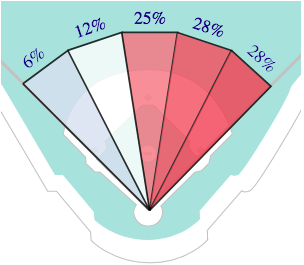
(Image courtesy of Baseball Savant)
A .300 hitter early in his career, McCann never reached .250 after leaving the Braves, and his BABIP never crested .270 after the 2011 season. He still walked plenty and hit for enough power to remain a good hitter through 2017, if not a noticeably diminished one.
The inevitable wear and tear catchers accumulate over time also contributed to his decline. Unlike many of his contemporaries, who either fully or partially moved out from behind the plate to save their legs or keep their bats fresh, McCann spent virtually his entire career in the bucket. Across 15 years and nearly 1,800 games, McCann only started 69 anywhere besides catcher. That he remained an above-average hitter through the age of 33 is notable, particularly as offense at the position atrophied throughout the league.
In 2017, McCann finally earned the ring he’d chased for 13 years. He’d been traded to the Astros prior to the season, and despite missing more than 50 games with injuries, he chipped in 2.6 WAR and a 103 wRC+ for the American League’s best team. He didn’t hit particularly well in October, though he did play an important role in Game 5 of the World Series. His solo homer in the eighth provided a crucial insurance tally, as Los Angeles would rally for three runs in the ninth to tie the game. With two outs in the 10th, Kenley Jansen hit McCann; that too proved important, as pinch runner Derek Fisher lumbered home with the game’s winning run two batters later.
After another injury-plagued year in Houston, McCann returned to Atlanta in 2019. He offered reliable defense and an adequate bat in what amounted to a job-share with Tyler Flowers. McCann emerged as the first-stringer down the stretch, and he started all five of Atlanta’s Division Series games. He played nine innings of Atlanta’s Game 5 clunker, singling in his penultimate at-bat before Snitker lifted him for a pinch-hitter in the ninth to close out his career.
Inevitably, some fans will remember McCann as a curmudgeon, thanks to a few incidents late in the 2013 season. That September 11th, José Fernández ripped his first career homer and, as he was known to do, celebrated the accomplishment. Atlanta’s third basemen, Chris Johnson, jawed at Fernández a little, but it was McCann’s yelling that sparked a benches-clearing confrontation.
His behavior was even more pronounced two weeks later. Carlos Gómez belted a first-inning homer and gave his bat a dramatic flip before he strolled out of the box. After plenty of chatter between Gómez and the Braves on his home run trot, McCann blocked his path to the plate and started a screaming match as Gómez approached; this too emptied the benches.
Reaction from the baseball world was mixed and broke down along the lines you’d expect. Many of the Braves were undoubtedly annoyed at Gómez, who had started yelling at pitcher Paul Maholm as soon as he left the box, and McCann earned kudos for sticking up for his pitcher. On the internet, McCann became a laughingstock, appearing in a number of memes and articles that lampooned his brand of hostile sensitivity. In neither incident was McCann the first to chirp at his opponent, but in each case his demonstrative yelling made him a focal point of any subsequent discussion. Fairly or not, in some quarters McCann’s angry scowl became the face of the conservatives in baseball’s Culture Wars, the embodiment of a group of staid, tradition-minded, mostly white players seeking to police a more expressive group of their mostly brown contemporaries.
But yesterday’s storm has a way of becoming today’s water under the bridge, and the image of McCann as baseball’s fun cop faded. It helped that he reportedly cleared the air with both Fernández and Gómez: He notably exchanged a hug and shared a few nice words about the latter, and he was reportedly near tears upon learning of the former’s passing. Over time, his veteran leadership and steady clubhouse presence took on more resonance than those heated confrontations. In a postgame interview last week, Dansby Swanson called him one of the best teammates he’s ever had, a sentiment echoed by a number of other Braves past and present, including Chipper Jones.
Might McCann’s career be worthy of induction to the Hall of Fame? That’s a question best answered in detail at another time. Jay Jaffe looked more closely at McCann (and Martin) back in April, and JAWS will have much more to say on the subject five years from now.
At the moment though, McCann’s record presents a novel test for the BBWAA. By conventional metrics, McCann looks ticketed for the Hall of Very Good. His raw numbers, while impressive, are well shy of the Gary Carters and Carlton Fisks of the world. He didn’t quite reach 300 homers, his wRC+ slipped to 110 by the end of his career, and you can reasonably argue that his peak wasn’t long enough to justify the first two parts of this sentence. Per Baseball Reference, which doesn’t credit catchers for their framing contributions, he accrued 31.8 bWAR — well short of the typical standard for the position.
The framing has to count for something, though. As an elite defender at a time when many teams were content to let seemingly anyone flop around behind the dish, McCann’s steady hand and nimble glovework stole hundreds of strikes and dozens of runs from his opponents. If anything, our metrics likely sell his contributions short, as they only date back to 2008. It stands to reason that McCann was probably an adept framer in the first 2 1/2 years of his career as well.
On the other hand, you could argue that McCann’s enormous framing numbers are as much the product of mediocre peers as his own considerable skill. The delta in framing production from the best to the worst catcher is much smaller these days than in an era when teams didn’t know how to properly weigh that particular contribution. It’s fair to wonder whether McCann should get full credit for winning a race that few others entered.
Regardless of how the writers interpret that slice of his career, his defensive performance should be enough to merit serious Hall of Fame consideration. How the BBWAA chooses to evaluate framing will be an intriguing subplot in an exercise that has become somewhat rote in recent years, particularly since McCann’s case will have repercussions for guys like Molina and Martin.
Whether he makes it or not, McCann’s accomplishments are worthy of celebration. He had a a long stint with the hometown nine and he leaves with a ring, 54.5 WAR, several awards and accolades, a healthy chunk of change, and hopefully a long life ahead. It would be hard to want much else.
Brendan covers prospects and the minor leagues for FanGraphs. Previously he worked as a Pro Scout for the Pittsburgh Pirates.
Fine player, not necessarily of HOF caliber, and there’s no shame in that. Nice article.
Maybe not HOF caliber but this:
On the other hand, you could argue that McCann’s enormous framing numbers are as much the product of mediocre peers as his own considerable skill. The delta in framing production from the best to the worst catcher is much smaller these days than in an era when teams didn’t know how to properly weigh that particular contribution. It’s fair to wonder whether McCann should get full credit for winning a race that few others entered.
…is nonsense. All players are judged relative to their peers. The HOF is full of guys who’s offensive exploits were prodigious for their era, but just “meh” in today’s environment. If McCann was an ace framer in an era when few were, that counts for something.
Yeah, I agree. Maybe there was no way of measuring framing reliably, but I seriously doubt that Atlanta didn’t notice borderline calls seemed to go their way when young McCann was behind the plate. Almost certainly he, McCann, had a sense he could influence the game in a subtle/sneaky way and took advantage of it. Certainly he was in the vanguard of the movement toward prioritizing framing in the roles of a catcher.
For whatever it may be worth, per the Fangraphs career defensive rankings, these are the top 10 glovemen in MLB history at any position — excluding 19th century stalwarts like Germany Smith and Charlie Bennett — on a runs saved per 150 game basis (minimum 1,000 games played):
1) Yadier Molina 27.74 defensive runs above avg. per 150 games
2) Jonathan Lucroy, oddly, also exactly 27.74 runs
3) Russell Martin 27.2
4) Mark Belanger 25.7
5) Brian McCann 24.6
6) Buster Posey 24.2
7) Joe Tinker 24.0
8) Andrelton Simmons 23.0
9) Art Fletcher 22.9
10) Ozzie Smith 21.9
Molina will likely pass Smith in 2020 for #1 in career total runs saved. Smith has 375.3 and Molina 366.7. (In case you were wondering, and you know you were, Andruw Jones was worth 19 runs per 150 games. And the greatest defender if we lower the games played standard a little, would be Jose Molina at an astronomical 34.6 runs per 150.)
To me the guys that aren’t catchers on that list are the most shocking. Clearly someone who touches the ball on every single play is going to be the most important non-pitcher on defense. The fact that Simmons, and Smith even make the list alongside guys who touch the ball every play is downright crazy.
These lists make me a little uncomfortable, as the metrics seem to work at least reasonably well in comparing players across eras, except for the massive difference in catchers since 2008. The best and most likely way to get yourself into a Fangraphs list of the best defenders in baseball history is to be a catcher since 2008. Maybe that data is accurate, but at best it gives short shrift to every other catcher in baseball history.
Perhaps I didn’t make my point well. It’s not that Atlanta didn’t notice they had a gem on their hands; it’s that the league didn’t know how valuable framing really was.
Or to make a kind of ridiculous analogy: Imagine that every team played their second basemen right on top of second base; in this hypothetical world, that’s just where second basemen were supposed stand. Then, one year, one second basemen decided to play much closer to first base. Nobody really paid him any mind, but over the course of a few years, it eventually became apparent that his positioning was helping his team save gobs and gobs of runs — 20+ more runs per year than any other second basemen and 30+ runs above average. In time, the rest of the league catches on, and our one-time revolutionary is now a good but hardly extraordinary fielder: a true talent +5 defender at second or so. In the interim though, he racked up 15-20 wins by simply standing in a better position. Those 15-20 wins put him on the cusp of HOF consideration.
Now, when evaluating this second basemen’s career, you have a choice: You can give the 2B full credit for all that value he captured while every other second basemen was standing on second base itself… Or you can decide that, no, he was a perfectly fine defender and he had a really good feel for his position, but his talent was not extraordinary and that the way he racked up his value doesn’t warrant HOF consideration. I’m not positive where I stand on that — I lean toward rewarding the second basemen (or McCann) — but I think the opposite stance is defensible, and that was my only point with that passage.
I get what you are trying to say, but your analogy implies that positioning (like shifting today) may not have been his doing. If, in your analogy, the positioning was entirely his idea, then I think you have to give him credit for successfully anticipating where balls are more likely to go.
There are going to be some really interesting HOF discussions about catchers coming up in the next decade or so–from Mauer to McCann to Molina to Posey. Who knows if any will get in! I’m biased toward Posey (second in fWAR in the 2010s at 53, behind only Trout) but even there, if he doesn’t find a resurgence at the plate, there are going to be doubts, I’m afraid.
I think Posey is a lock because of his MVP and the team’s success. Molina, McCann, Mauer and Martin are much tougher calls. I would put them in that order, but I’m sure others disagree.
my hunch is that the only contemporary catchers who will make the HOF are Posey and Molina b/c of the championships. But McCann’s numbers certainly bear notice, especially when compared to Molina’s.
A lot of the numbers look a lot like Carter’s. He’s top 10 for C ever in FWAR. I don’t see how he doesn’t.
If McCann isn’t in then there’s no way Molina should be.
Per the Bill James Hall Of Fame Monitor yardstick, McCann is very strong with an 84 score — a total of 100 makes one a “likely Hall Of Famer.”
Molina’s score is 162.
Yes but I invented this new statistic overnight that gives McCann +25 WAR, instant hall of fame candidate.
You invented the framing metrics?
The James’ stat measures likelihood of election not worthiness for election. OP was talking about whether McCann “deserved” election as much as Molina, not what a bunch of dunderheaded sportswriters are likely to do, which is all the Hall of Fame Monitor purports to measure.
Agreed but Molina will waltz into the HOF while McCann will be left behind. It was sickening to listen to the announcers fawn continually over Molina in the NLDS while almost totally ignoring McCann. It was like that most of their careers too.
Sickening? You may not agree with the majority that Molina is a better player, but do you really get that upset that others don’t share your view?
I am a Braves fan and would love to see McCann make it, but he almost surely won’t. I think at times there is a little too much weight put into WAR and other advanced stats when predicting HOF enshrinement. For the vast majority of players in the Hall, there is both a good traditional case and a good SABR case for the player. Not surprisingly these go pretty hand in hand.
Look even at perhaps the two biggest successful campaigns for SABR-darlings in Bert Blylevin and Tim Raines. In a lot of ways each was very close to the type of player who would make the Hall without a push from new ways of thinking.
But then look at all the players better than McCann who are not getting in. Guys who depended on walks for value, and defensive guys. And here we are talking traditional or at least more established new stats. Kenny Lofton, Larry Walker, Scott Rolen, and Andruw Jones.
Well, McCann is not only is a defense guy, but it’s a type of value that voters are not going to take to for quite a while, and by the time they do, McCann will be off the ballot. As an added detriment, he was also a walks guy.
McCann won’t get past the first vote, and honestly even if you’ve totally bought into pitch framing and believe it is on par with other aspects of the game when looking at Hall worthiness, you can’t possibly view his snub as a travesty. In the best of light, he’s still not a sure-thing inductee.
I can’t help but be very skeptical of the framing numbers which is going to be a big part of the argument for McCann in the hall.
I understand that framing could be very valuable in theory.
But the idea that McCann added 13(!) WAR in five seasons on framing alone simply does not pass the smell test.
This guy is catching shy of a thousand pitches a week over a 6 month season and you don’t think that it could make that much difference! I simply disagree!
This. Guy touches the ball every single play! Of course it is worth that much. Problem to me lies in all the catchers who never had framing numbers. Wonder who else would be on that list?
Yes, I feel the same way about this as I did about Jason heyward s defense being worth $200 million. It’s good but not that good.
They’re a big part of Yadi Molina’s case for the Hall, too, though. Yadi added about 12 WAR in 6 seasons on framing alone, and you rarely hear framing skeptics questioning his case for the Hall of Fame.
The difference is that people were talking about Molina and HoF long before framing became a big thing. McCann not so much.
Great article.. very well done
It will be interesting to track McCann’s HOF candidacy vs. Joe Mauer’s.
McCann has a slight career edge in WAR (54.5 vs. 52.5 per Fangraphs) and did so with ~1,000 less PAs. As the article explains, a lot of McCann’s WAR is due to his defensive metrics. Mauer’s WAR is mainly due to his hitting – although he was an above average defensive catcher prior to moving to 1B after age 30.
There’s a lot of boxes that Mauer checks (e.g., 2,000 career hits, MVP (2009), career .300 hitter) that McCann doesn’t. As a result, it seems like most people are convinced Mauer will get in, but there’s a good argument McCann is more deserving.
If Mauer gets elected to the HoF it will be because of his hitting and his peak. Mauer was a 3x batting champion and an a MVP. Mauer’s 2009 MVP seasons is literally one of the greatest seasons ever by a catcher. His .365 batting average in 2009 is the single seasons record for catchers surpassing the .362 record held by Billy Dickey (1936) and Mike Piazza. McCan was never as dominant as Mauer.
Good points, and I agree. Counterpoint: Mauer’s WAR in 2009 was 8.4, which was a career best. McCann’s career best WAR was 8.6 (in 2008).
Depending on how beholden you are to the WAR metric, McCann at his best was every bit as good as Mauer at his best.
Still, Mauer’s offensive production far exceeded McCann’s in these years, and it’s hard to imagine that McCann defensive difference more than made up for that gap when Mauer was a well regarded defensive catcher in his own right.
fWAR has McCann at 8.6 but bWAR only has McCann at 5.5. That’s a rather large discrepancy than many will pounce on. Many people will never accept that a catcher who hit .301/.375/.523 was a more valuable than a catcher who hit .365/.444/.587. As you said way they will not accept that the difference in defense was so huge as to overcome this massive gap in hitting. Narrative is and should be a major part of a player’s Hall of Fame candidacy. Mauer has it and McCann basically doesn’t it. I’m sympathetic to McCann’s case but I think he falls short of HoF stature. Just my opinion.
Basically no chance Mauer doesn’t get in. A lot of HOF voting isn’t dependent on production. Whether or not a guy who does hair commercials should get votes for doing the hair commercials can be argued, but the fact remains that he clearly will get votes due to celebrity.
While I disagree with the voting, I can guarantee you it will go like this:
Molina – In
Mauer – In
Posey – In
McCann – Out
An interesting case might be Grandal. While he certainly doesn’t seem like the type of guy who would get in, if he continues what he has been doing for another 3-4 years, and then has a relatively graceful decline for a catcher he will be an interesting case study for the more analytically inclined voters of 2030+
I’m not so sure that Mauer will easily get elected. The BBWAA voters are a fickle bunch and Mauer dropped off rather young. I think he gets in. I hope he gets in because I believe that how Mauer is treated will be very similar how Buster Posey gets treated.
Guarantee, huh? What do I get if you’re wrong?
The framing discussion was interesting when it was first proposed and as a Molina fan, it certainly helps drive up WAR for those who did it well. But with the advent of automated strike zones, many years from now when people are voting, we will be asking them to put someone in the Hall for a “skill” that really doesn’t exist anymore. It would be like putting A pitcher in solely for their ability to scuff up a baseball.
Would Gaylord perry get in the hall today if people were voting? Probably – because the spitter can’t explain his results, but if framing is the thing that makes a catcher a ball of famer, I think it will be a hard sell. Maybe Lou Brock is a better example – he got in on the strength of his stolen base superiority. Not sure he would get that much credit today for that skill since we now know you have to be really elite to add value with stolen bases. Of course he also had 3000 hits
Even if there was a player who could still 80-100 bases a year with a 90%+ success rate would he even be allowed to run that much in today’s game?
Lou Brock is an interesting case. His stolen base exploits and 3,000 got him elected on the first ballot. But I don’t think Brock was viewed as a transcendent star player DURING his career. He only made six All Star teams and only one of those selections happened before age 32. So in Brock’s 20’s, usually a player’s prime, Brock wasn’t viewed as elite player it seems.
As a Braves fan, I’m a huge fan. I don’t think he’s a Hall of Famer. However, if Molina gets in, then McCann should get in. The only difference in argument is that Molina is the face of a franchise with multiple rings and McCann isn’t. Which isn’t a valid case.
I am not yet convinced of the accuracy and reliability of pitch framing data. However, if we are going to take away all those from McCann, we have to do the same for Molina. And in that case, McCann’s offense is so much better that there is no reasonable case to put Molina in but not him. So I think they both deserve to get in, though I think McCann having been on 4 teams (if you count the Braves twice) and only winning a championship as a non-star might keep him out. I don’t think that’s fair, but I think that is what will happen.
A greater concern is how do we account for framing of guys like Carter, Fisk, Piazza, Terry, etc.? If the answer is that we can’t, then I don’t see how we can compare catchers across eras at all. Without the absurd framing numbers, neither McCann nor Molina stacks up at all with those guys and I would then say neither should be in. But if that’s the case, would any current catchers get in? Mauer and maybe Posey?
Should Jason Kendall get more credit for framing? If so, he leaps ahead of some of those guys. What about Javy Lopez?
I just think we are going to have to compare catchers only within their own era for now (presumably we will be able to compare in different eras from here on forward with real framing data). So we should be deciding who are the top 2-4 catchers of this era and say they get in, regardless of how they do or don’t stack up to catchers from older decades. To me, that’s Posey, Mauer, Molina, and McCann, though I confess that I have no idea what to do about Martin.
We already have a similar problem with baserunning/fielding data.
Lou Brock was mentioned above as an example of a player with a skill set that is no longer as valued as much but you need to keep in mind that Brock is probably missing a lot of baserunning runs that he deserves.
I’ll always remember McCann as the “Fun Police”. It’s a shame he never got to catch for Bumgarner as I’m sure they would have tried to suck all the joy out of the game and would have had all sorts of problems with guys like Beltre, Fernandez, Baez, Gomez, etc. Good riddance!
Hahaha. I wonder if McCann ever caught MadBum in an All Star game? I checked and they were only All Star teammates once in 2013. But neither actually played in the game. What a shame.
Oh, yeah McCann is the fun police – not the guy commenting “good riddance” on a nice career retrospective…
The problem with the Gomez situation was his yelling at the Braves as he rounded the bases. You can bat flip all you want, that is your own celebration, you don’t yell at the opposition.
I have to drop in a shoutout for Ted Simmons here. He’s a better hitter than McCann and didn’t get the benefit of the framing readjustment that Gawlowski references in the article. Even then he’s 11th all-time in fangraphs’ WAR for catchers yet somehow isn’t in the hall of fame. I guess maybe he should have made friends with Tony LaRussa.