
Cardinals, Red Sox Link up Again in Willson Contreras Trade
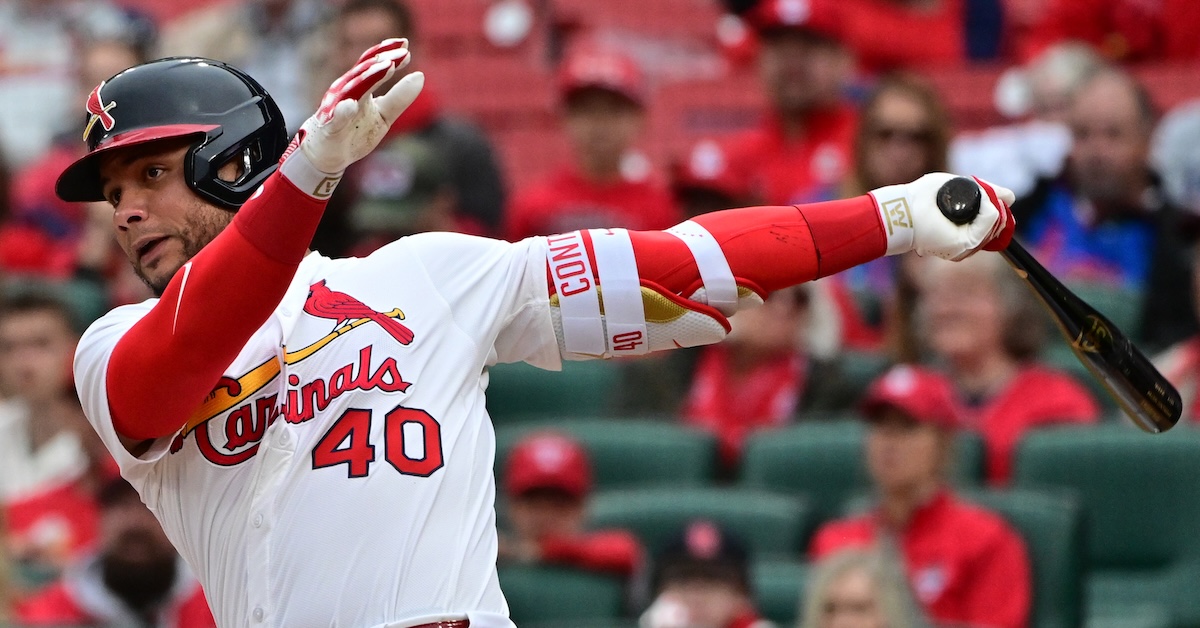
‘Twas the week before Christmas, and all through Fenway, every fan was insistent: “Get a first baseman, today.” Or, well, probably not – why would there be fans at Fenway when there are no games, anyway? Why Christmas week in particular? Why did they construct their sentence awkwardly to suit a rhyme scheme? But forget about how hard it is to open an article – or at least how hard I’ve made it seem with this one. There’s a trade afoot! The Red Sox have acquired first baseman Willson Contreras from the Cardinals in exchange for right-handed starter Hunter Dobbins and righty pitching prospects Yhoiker Fajardo and Blake Aita, as Jeff Passan first reported.
In a free agent market awash in slugging first base/DH types, Contreras flew under the radar this offseason. Kyle Schwarber and Pete Alonso were the top names at the position, and both secured the deals befitting that status. The Red Sox were clearly interested in adding some offense, particularly in the infield, and were linked to both sluggers before they signed elsewhere. But there are more ways to improve your team than on the open market, and a pivot to Contreras soon followed.
If you’re an fan of an AL team who mostly checks in on the NL via the playoff race, you might be a little confused at this point. Aren’t all the Brothers Contreras catchers? Didn’t Willson catch the last pitch of that curse-breaking Cubs World Series win back in 2016? But while the Cardinals faded into the background of the national conversation and entered into a rebuilding phase, Contreras shifted to first base (after some trials and tribulations behind the plate), putting the tools of ignorance away and acquitting himself fairly well at his new defensive home. This year was the first season of his career where he didn’t appear behind the plate; instead, he played 120 games at first base and 15 more at DH.
Contreras has always had the bat to play first base. His career 122 wRC+ would fit right in among the top full-time first basemen of the past five years. In 2025, he posted a 124 mark while also racking up the most plate appearances of his career at age 33. Switching from catcher does wonders for your durability, as it turns out.
In that expanded playing time, Contreras basically did what he’s always done: He tried to hit the snot out of the ball every time he came to the plate. He’s one of the hardest swingers in the majors, and he puts that ferocity to good use by lifting and pulling the ball. That approach comes with its fair share of strikeouts, but Contreras has sneaky good bat control for a guy rotating this ferociously. He struck out 25.2% of the time in 2025, much less than you’d expect if you just watch him swing. He has a solid sense of the strike zone, too, and while he makes a below-average amount of contact, it’s not that far below average. Most major leaguers capable of scalding the ball this frequently come up empty more than he does.
If there’s one concern about Contreras’ offensive fit in Boston, it’s how many line drives he hits. His hardest contact clusters in the line drive/low fly ball area, optimized for distance, whereas Fenway rewards loft, particularly for right-handed hitters. Baseball Savant calculates expected home runs by park, transforming initial batted ball trajectories to each park’s particular conditions and dimensions to approximate what a hitter’s production might look like if he played 100% of his games there. For his career, Contreras’ batted ball mix would produce very few home runs in Fenway, as it turns out, with the Monster turning many into smashed singles or doubles. In fact, only cavernous Kauffman Stadium would be a tougher home run park for him, per this calculation.
That sounds worse than it is, though, because turning some homers into doubles isn’t the end of the world. It’s also worth considering that players are the products of their environments; put a 600-foot wall 17 feet from third base (all calculations approximate), and many righty batters will naturally start hitting with more loft. ZiPS thinks that the bigger threat to his offensive potential is that old implacable enemy, time:
| Year | BA | OBP | SLG | AB | R | H | 2B | 3B | HR | RBI | BB | SO | SB | OPS+ | WAR |
|---|---|---|---|---|---|---|---|---|---|---|---|---|---|---|---|
| 2026 | .254 | .350 | .443 | 413 | 57 | 105 | 25 | 1 | 17 | 64 | 44 | 117 | 4 | 120 | 2.2 |
| 2027 | .249 | .345 | .425 | 374 | 50 | 93 | 22 | 1 | 14 | 55 | 39 | 108 | 3 | 114 | 1.7 |
| 2028 | .240 | .335 | .401 | 334 | 42 | 80 | 19 | 1 | 11 | 46 | 34 | 99 | 3 | 105 | 1.1 |
I asked Dan Szymborski for a three-year projection to match Contreras’ contract. After a slight reworking of his deal in the trade to the Red Sox, he’s due $18 million in ‘26, $17 million in ‘27, and then either a $7.5 million buyout or a club option for $20 million in ‘28. The Cardinals are kicking in $8 million of that, bringing Boston’s commitment down to either two years and $34.5 million or three years and $47 million. The option year is very much up in the air; the median ZiPS projection would probably lead the Sox to decline the option, but it wouldn’t take much of an outperformance to change the math. The computer would offer Contreras $36 million over two years or $44 million over three, basically a match for his real-life contract.
Personally, I value Contreras more highly than that. It’s harder than you’d think to find good offense at first base. Jorge Polanco just got two years and $40 million to mostly play first, and while he’s more versatile than Contreras, I think he’s a worse hitter. Reliable power hitters have been beating a WAR-based estimate of open-market value for years at this point. Contreras might be heading into his age-34 season, and he might not be one of the very best hitters in baseball, but a lot of teams would love to plug in 20 or so homers and a 120ish wRC+ at first.
The Red Sox seem to agree with me, because they surrendered multiple pitching prospects to acquire him. Hunter Dobbins, the headliner, is the kind of depth starter that most teams would seek out to boost the bottom of the rotation. He throws an average fastball about 40% of the time, and the way that his broad mix of secondaries develops will have a lot to say about how his career goes.
Dobbins’ most frequently used secondary is a hard slider that sits somewhere in the middle of the gyro/sweeper spectrum. He can also sweep it at a lower velocity against righties. Continuing down the velocity spectrum, he throws a big two-plane curveball that might be his best strikeout pitch. Against lefties, he mixes in a low-90s splitter that is still a work in progress. It’s occasionally classified as a splinker, which is a lot less fearsome at 90 mph coming from Dobbins than it is at 98 from Paul Skenes. There’s room to dream on the pitch developing into something more devastating, but Dobbins struggled to miss bats in the majors this year, as lefties just weren’t fooled by his offspeed stuff, and he didn’t have much of a backup plan.
Dobbins is rehabbing from a season-ending torn ACL that he suffered in July. It was a freak injury, incurred during a scramble to cover first base, but unfortunately it’s the second time he’s torn the same ACL. If everything goes well in his recovery, he’ll be ready by spring, but there’s certainly some risk there. That risk suits the rebuilding Cardinals just fine, though; they’re hoping to get valuable contributions from Dobbins in future years when they’re contending, and their eyes are squarely set past 2026 at this point. Perhaps the repeated ACL injuries and a past Tommy John surgery point to poor durability in his future, but who knows? Injuries are notoriously tough to predict, and Dobbins looks like a nice depth piece when healthy, with room to improve from there if he can figure out a better option against lefties. He might end up as a multi-inning reliever, and he looks like a pretty good option there, too; he has the kind of fastball that would especially benefit from a few extra ticks on the radar gun.
Fajardo is a teenager who signed with the White Sox in 2024 before getting his sox dyed red in a minor trade last offseason. I got some notes from Brendan Gawlowski to complement my scouting of the stat line, and those notes are interspersed with my commentary below:
Fajardo sits in the low-to-mid 90s with a fastball that doesn’t have a ton of shape; he also has strong feel for spin, currently best exemplified by his slider. He has a nice curveball and an inconsistent changeup. Brendan sees less chance of increasing velocity than you’d expect from someone Fajardo’s age thanks to his already-mature frame, but there’s still space for his curveball and changeup to develop into excellent pitches.
He made 13 starts in Low-A this year and looked excellent there, with a near-30% strikeout rate and a nice clean zero home runs allowed. It’s a low enough level, and his stuff and location are good enough that those numbers won’t necessarily translate upwards. Brendan noted that Fajardo’s straightforward delivery and early-opening hips give opposing hitters a great look at the ball, which limits his deception. He also shows an inconsistent ability to command the ball glove side, an important long-term skill for a spin-reliant starter. Put it all together, and he looks like a future backend starter, with a nice fallback as a reliever given how much increased velocity would flatter his pitch mix.
A sixth-round draft pick in 2024 out of Kennesaw State, Aita throws a dizzying array of pitches, with a big-spinning slider the highlight. He added some offspeed options in 2025 as he made 19 starts between Low-A and High-A. He didn’t miss a ton of bats at either stop, and he pitched most of the year at age 22 to boot, so it’s not like he was super young for the level or anything. Brendan highlighted Aita’s strike-throwing ability, which offset his low velocity and helped him against lefties even as he struggled to find an offspeed pitch with which he’s comfortable.
Aita will likely need some new pitches to keep advancing, and Brendan particularly highlighted the need for a new offspeed option. The Sox clearly thought the same. His current arsenal just doesn’t look good enough to propel him up the minor league ladder; he was so heavily slider-reliant that the pitch played down despite good measurables. You can only throw so many of the same breaking ball, even to A-ball hitters, before they start to see it coming. If you’re looking for an irresponsible upside comparison, imagine Aita rebuilding his entire game around his ability to spin. The rpms on his slider are massive, and he could lean more into a hard cutter as a primary option to get more out of that given his below-average fastball. That’s easier said than done, though; if every pitcher with a good slider and so-so fastball could turn into Corbin Burnes overnight, the league would look very different. More realistically, Aita is a potential up-and-down starter or long reliever. There’s plenty of volatility around that projection, of course, but count him as an interesting lottery ticket, not a likely difference maker.
The Cardinals had the luxury of not being in a hurry to trade Contreras, and I think it paid off for them here. Dobbins can absolutely be a part of the next good St. Louis team, and the organization has had enough difficulty drafting and developing starters in recent years that adding outside help makes a ton of sense to me. Even if Fajardo and Aita don’t pan out – that’s the median outcome for prospects that far from the majors – 100 innings a year of competent pitching from Dobbins sounds mighty nice given how much the Cardinals have struggled to produce that, even with meaningful spending in free agency, during their most recent window of contention.
To be clear, though, I also like this trade for the Red Sox. They sorely needed a reliable first baseman, and reliable infielders in general. Triston Casas, the heir apparent to first base for years at this point, has struggled with injuries and strikeouts for long enough now that they can’t count on a healthy and effective year from him. The outfield is overstocked with great players who don’t really fit on the dirt. There’s probably no room at DH given that outfield glut. Improving the offense runs through the infield, and probably through the corners. There are still plenty of third basemen available — among them Alex Bregman, who opted out of the contract he signed with the Red Sox back in February — and I think they’ll likely sign one of the better ones, but first base was looking like a weak point that couldn’t be addressed through free agency.
Does it hurt to give up a depth starter and some interesting prospects to make this work? Sure. But even Dobbins wasn’t likely to be a huge contributor to the Red Sox in 2026 given how much pitching depth they have – or maybe it’s more accurate to say that they won’t suffer much from losing him thanks to their great supply of Dobbins-esque arms. Fajardo is a high-upside prospect, but he’s incredibly far from the majors. None of the three pitchers alters the trajectory of Boston much at all. Contreras, on the other hand, gives the team a reliable power-hitting regular at a rate that you mostly can’t get those guys for anymore.
By trading for Contreras and Sonny Gray instead of signing equivalent options in free agency, the Red Sox have kept their financial powder dry. At the moment, we estimate their projected 2026 payroll as $16 million lower than it was in 2025. That will change if they re-sign Bregman or get another marquee third baseman, but that’s a lot more doable even within the constraints of the Fenway Sports Group’s budget now that they’ve added two stars for less than $40 million in combined 2026 salary.
Call it a win-win, then; Chaim Bloom and his former team have partnered on another swap that benefits everyone involved. Maybe this wasn’t the present most Bostonians hoped to find under the first base tree this Christmas – Schwarbinos and Polar Bear Petes are very popular this year – but it’s a great gift nonetheless, and the Cardinals got to fill their stockings with a depth starter and minor league pitchers in return.
This article has been updated to include ZiPS projections.
Ben is a writer at FanGraphs. He can be found on Bluesky @benclemens.
Think the Red Sox have to trade one of Casas/Duran/Abreu now which i’m sure kills Breslow because he either has to sell low on Casas or come down on his price for Duran/Abreu. Will be interesting to see what they can get.
Casas has 3 options, and with the way he looked last year the Red Sox should consider using at least one of them when he’s healthy enough to play.
I maintain that the root of all the Red Sox’s problems on this is an unwillingness to give up on Masataka Yoshida and just play their best players at what they do best. They’re working so hard to make things efficient that they’re doing things that actively make their team worse (playing Rafaela in the infield, sitting better hitters for Yoshida).
Yoshida missed half the season last year and when he came back various players were out (Abreu and Anthony were injured at different times, and Casas was out for season). I’m not sure who the better hitters they sat for Yoshida were. It will be interesting to see how things go this year with a (maybe) healthier roster
They really rushed Yoshida back last year. He seemed to get better as he readjusted to major league pitching.
FWIW, Yoshida had a 160 wRC+ over his final 51 plate appearances of the regular season. But he’s also been absolute crap over a much larger multi-year sample. Yoshida has battled injuries and hasn’t come close to being worth his AAV, but I can’t shake this weird feeling that he’s going to have at least 1 good year before his contract is over. That said, it’s well overdue that the Sox cut their losses and move on from him anyway. Whether they eat the contract or pay down part of it, they need to move him.
The Red Sox cannot truly progress while clogging the roster with him. If he had any fielding ability (especially in the infield), things would be different, but a Sox team loaded with outfielders is not going to proceed through the season well with a gloveless punch-and-judy DH/LFer hogging all the DH at-bats. Yoshida’s mere presence prevents Cora from occasionally resting players via rotating them through the DH slot. Not only does Yoshida not field well (contrary to the infamous ferris wheel scouting report), but he also doesn’t run well. What he is good at, is making contact. A team that prioritizes having a DH with limited power and strong contact skill might have a use for his services
I think they neeeed to move either Casas or Yoshida. I wouldn’t mention Abreu or Duran
Who would you trade for Masataka Yoshida?
I wouldn’t trade any of Javier Baez, Lance McCullers, Taijuan Walker, or Andrew Benintendi for him straight up.
I would trade Kris Bryant though. I hear the Red Sox have wanted more right handed bats!
All kidding aside, I actually think Arenado or Nick Castellanos might be plausible options. Red Sox would definitely have to throw in something though to make the deal happen. Maybe Shane Drohan or Tyler Uberstine or Dalton Rogers. David Sandlin or Hayden Mullins if the Cardinals or Phillies drive a hard bargain.
Arenado would be preferable because he can actually play a position and the Red Sox could always use another infielder, but he’d be redundant if they re-sign Bregman. Castellanos would strictly be a DH, and mostly against left-handed pitching. But between Fried, Rodon, McClanahan, and Trevor Rogers he would get a fair amount of playing time against some of the better starters on their division rivals.
I don’t think Castellanos, Bryant, and Benintendi should be on major league rosters. Yoshida is a limited player who should never be in the field, but I think he’s still a slightly above-average hitter. He would be a better DH than several teams have now.
I think the red sox could eat $25M and trade him for nothing.
The Sox just need to trade Yoshida and $25M for a bucket of balls. Don’t trade Casas, he still has three options and a lot of potential.