Archive for Daily Graphings

Nick Franklin’s Historic Season

One of the biggest storylines of the 2009 season was Aaron Hill, who by a change in philosophy, hit 36 home runs, almost exclusively to left field. It was a shock for scouts, who had watched as Hill hit six home runs in his first full season in 2006, had hit 20 in 1,015 minor league plate appearances, and never more than nine in any season hitting with aluminum at Louisiana State. Hill is an amazing example of the importance of development, the ability for change, and for the unpredictability of power. So, too, is this 2009 draftee that garnered this pre-draft scouting report from Baseball America.

“Scouts don’t expect him to hit for even average power with wood, but he should have enough strength in his wiry frame to keep pitchers honest. Scouts have made comparisons to players such as Aaron Hill or [Felipe] Lopez offensively, though he has less power.”

Either the Mariners didn’t agree with that, or they didn’t know what they were really getting in Florida prep shortstop Nick Franklin, the 27th overall pick last season. This year, Franklin had a season to rival Hill’s 2009, only as a teenager in the Midwest League. I have written before about how difficult a hitting environment the Midwest League is, particularly for teenagers who are facing a great number of college players. And Franklin’s season stands out historically in that regard. Check out the number of home runs by a teenager in the MWL in the 2000’s:

1. Prince Fielder – 27
2. Wily Mo Pena – 26
3. Nick Franklin – 23
4. Mike Moustakas – 22
5. Carlos Gonzalez – 18
5. Matt Sweeney – 18
7. Brad Nelson – 17
7. Edwin Encarnacion – 17
7. Adrian Gonzalez – 17
10. Six Others Tied at 16

Granted, counting stats can be misleading, but any way you slice it, that’s some good company to be in. Brad Nelson is the only true bust on the list, as even Pena and Encarnacion had their seasons of success. But, I don’t want to limit ourselves to counting stats. In compiling the data above, I found more than 50 teenage player seasons in the 2000’s, seasons from the likes of Miguel Cabrera (.268/.328/.382), Grady Sizemore (.268/.381/.335), Joe Mauer (.302/.393/.392) and Justin Upton (.263/.343/.413). The more I looked, the more it became apparent that Franklin’s season is truly amazing in the millennium context.

When I looked at rate statistics, really only these ten players could compete with the .281/.351/.485 batting line that Franklin put up in a full season of work:

1. Daric Barton, C, .313/.445/.511
2. Jaff Decker, OF, .299/.442/.514
3. Prince Fielder, 1B, .313/.409/.526
4. Shin-Soo Choo, OF, .302/.417/.440
5. Travis Snider, OF, .313/.377/.525
6. Adrian Gonzalez, 1B, .312/.382/.486
7. Jay Bruce, OF, .291/.355/.516
8. Carlos Gonzalez, OF, .307/.371/.489
9. Cameron Maybin, OF, .304/.387/457
10. Ruben Gotay, 2B, .285/.377/.456

If we include players that had half-seasons because of injury or promotion, we’d add Chris Snelling, Casey Kotchman, Colby Rasmus, Kyle Blanks and Josh Vitters to the list, probably. This is not an example of park factors at work in Franklin’s favor, as a 2006-2008 look at Clinton’s stadium revealed it to be neutral across the board. Franklin just hit the ground running and never looked back. Also, consider that the switch-hitter hit just .174/.221/.273 with two home runs from the right side, and the team is contemplating whether to give up his switch-hitting experiment.

Still, Franklin has put himself in rare company, and he’s a guy that is likely to stick at shortstop. To put that position adjustment in context, here are the five best seasons of teenage shortstops in the league I could find since 2000:

1. Erick Aybar, .308/.346/.446
2. Mike Moustakas, .272/.337/.468
3. Matt Tuiasosopo, .276/.359/.386
4. Justin Upton, .263/.343/.413
5. Paul Kelly, .280/.352/.384

And it falls off from there. Those seasons above can’t hold a candle to Franklin’s campaign, and in the case of the accomplished Moustakas and Upton, neither was going to stay at shortstop for very long. Aybar’s season was truly impressive, but Franklin’s is the best.

As a final piece of the puzzle, I took the 16 player-seasons I could find that were most similar to Franklin’s (from a rate level), and adjusted them to equal his 574 plate appearances. I think it’s interesting to note that Jay Bruce’s 2006 season, for example, prorates to 51 walks and 122 strikeouts, which bears an awful resemblance to Franklin’s 50 walks and 123 strikeouts. Also really close was Andrew Lambo in 2008, adjusted to 45 walks and 123 strikeouts. While both adjusted to more extra-base hits than Franklin, perhaps we can look to their K/BB development as a sign for what Franklin’s will mature into.

From a power standpoint, the two most similar seasons as Carlos Gonzalez and Mike Moustakas, both who adjust to an identical 52 extra-base hits. Both showed better contact skills than Franklin, but it’s certainly encouraging to see their power development and hope for that for Franklin. A more conservative projection might see the similarities to Hank Conger and Edwin Encarnacion, and maybe adjust accordingly there. Development can just go in so many directions, be it the route of Miguel Cabrera or the route of Eric Duncan.

By any account, we know that Franklin is one odd duck that just completed a season for the ages. The company he’s put himself in, by every measure I used above, is mostly surrounded by Major League players. If he can stick at shortstop and match just three-fourths of the offensive maturity most of the peers above enjoyed, Franklin will go down as quite the coup for this Seattle Mariners Scouting Department.



The Angels’ Offense Is Sick

A sign that your offense is not playing well:

Arbitrary endpoints aside, anytime three of your regulars rank third, second, and dead last in on-base percentage it is a bad development. Juan Rivera is just one of the trio diagnosed with the newly developed mysophobia (associated with all those base-inhibiting germs), but that fear is causing those with microphobia to go bananas over his on-base percentage.

Just last season, Rivera posted a 113 wRC+ — the second best figure of his Angels’ career – while reaching a career high in plate appearances. Rivera’s 2010 season bares more of a resemblance to his injured campaigns of 2007 and 2008 than 2009. As it stands, Rivera’s 85 wRC+ is identical to the 2008 season. Rivera is no longer hitting for the power that he is wont to do. His .147 ISO more than 10 points below his previous career low – which he established as a 25-year-old – and more than 30 points below his career average.

Rivera’s home run per flyball percentage has dipped below 10% of the first time in his career. At the same time, he’s hitting about as many infield flyballs as his career rate would suggest. Meaning that those looking for some proof that his bat has slowed have to look elsewhere for the proof; the same applies to his swinging strike rates and (for the most part) his run values by pitch breakdown.

A further part of that subtraction is married to a deflated batting average on balls in play. However, some of it could be skill decay too. Rivera is now 32. Not just 32, but 32 with a history of physical ailments prompting numerous trips to the disabled list. Such a package does not promote gentle aging, even if all players are master of their own DNA and generalizing is a bad thing.

Rivera is under contract for one more season for what appeared to be a reasonable rate ($5.25 million). Another season like this one, though, will have that contract looking dubious.


Will Rhymes Solid in Debut Season

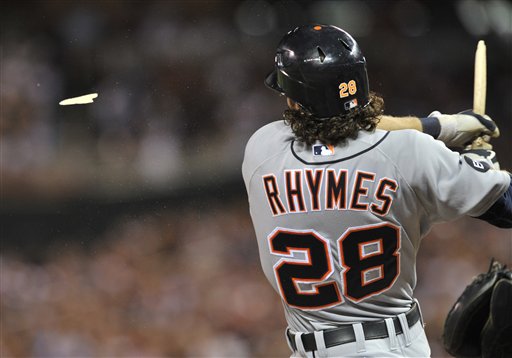
On July 25th, the Tigers called up a player to whom I immediately paid attention for two reasons: his awesome hair and his awesome name: Will Rhymes. Little did I know that this player would also perform well in his first stint in the Major Leagues. Entering play tonight, Rhymes has a nearly league average .321 wOBA in 34 games and 149 plate appearances as a second baseman.

Rhymes hasn’t shown much in the way of power – only 9 XBH and no home runs – and he isn’t walking much – 6.7% of plate appearances ending in a free pass. However, Rhymes has shown an excellent ability to make contact in the majors, striking out in only 8% of plate appearances, less than half of the league average of 17%. When he has made contact, he’s done well with it too, as he has a .328 BABIP supported by an excellent 23.3% line drive rate.

As a 27 year old with a middling minor league track record, it’s difficult to see Rhymes making any sort of major step forward. His best minor league wOBA in any sort of significantly long stint was .356 in AAA this season before receiving the call up to the Major Leagues, and that was accomplished in a similar way to Rhymes’s MLB line – some walks, very few strikeouts, and good performance on balls in play.

This is the first season in which Rhymes has shown this kind of ability to make contact, and as such, ZiPS expects some regression, but not much – still a very solid 14% strikeout rate. There’s likely some regression coming in terms of BABIP too, but I would also expect that Rhymes could hit one or two home runs before the season ends as well.

It’s difficult to get a beat on Rhymes’s defense in such a short time – UZR has him as slightly below average, whereas DRS has him at +8 and TotalZone has him at +4. The safest assumption is probably to have him as a roughly average second baseman, which means that he should be able to provide some defensive value for the Tigers going forward.

Rhymes’s profile is far form a sure thing to produce at the plate going forward, but right now, he looks like he could become the next Jeff Keppinger. That’s no great shakes, but Keppinger epitomizes the high contact player at the plate and does have two 2+ WAR seasons in the last four years, and that’s despite some poor defense all around the diamond. Rhymes will be an interesting player to watch for the Tigers as they attempt to retool after a relatively disappointing 2010 season.


Contract Crowdsourcing Results: Victor Martinez

Well, we have our first Contract Crowdsourcing result that really surprises me. The votes are in, and you guys think that Victor Martinez is in line for a a pretty sweet deal.

Average length: 3.60 years
Average salary: $11.77 million

Median length: 4 years
Median salary: $12 million

Standard deviation, length: 0.88 years
Standard deviation, salary: $2.84 million

Martinez is a good player, no doubt, but I had him at something like 3 years, $30 million, and I could even see the last year not being guaranteed. Catchers age in dog years, and at 31, Martinez probably doesn’t have a ton of good baseball left in him behind the plate. He could extend his career by moving to first base, but the production isn’t enough to make him much more than an average player there.

I like Martinez, but there’s no way I’d give him 4 years and $48 million this winter. Even 3/35 is a bit steep for me, and that’s the low end of the mid-range projection for what he’s going to get. How much longer can we realistically expect major league managers to put him behind the plate? A year, maybe two? A four year deal basically guarantees that the back half of it will be a significant overpay, and you’re not even sure you’ll get much of a bargain up front.

I’d imagine that the crowd will be more accurate in estimating future contracts that I will be, so now I won’t be too surprised if he gets something close to the deal that you guys have projected. I just wouldn’t want to be a fan of the team giving out that contract, though.


A “World” Series

About two weeks ago, this Sankei News headline caught my eye:

“(Pro Yakyu) Exploratory Committee Holds First Brainstorming Session Toward a Japan-US Title Match”[1]

Reports indicate four representatives took part in the meeting: MLB VP of Asia Operations Jim Small, and three NPB representatives led by NPB International Committee Chairman Toshimasa Shimada. The agenda included whether to hold the series in spring or autumn, and whether to play in Japan, the (continental) US, or a midway point such as Hawaii. Shimada was quoted as saying “we have a number of hurdles we have to clear, but we want to advance the discussion”, while Small commented “it was a positive exchange of ideas.”

As a fan of both Major League and Nippon Professional Baseball, I heartily in endorse this idea. Moreover, I’m glad that this seems to be a priority for NPB commissioner Ryozo Kato. NPB commissioners tend to be in a lame-duck position, taking a backseat to ownership, particularly the reviled Yomiuri chairman Tsuneo Watanabe. The dynamic is rather difficult to summarize in this type of post, so I’ll point you to a July article from veteran Japan baseball writer Jim Allen.

NPB has tried to reach a little more globally in the past. A well-intentioned attempt was made at a four-country (Japan, Korea, Taiwan, China) Asia Series, but it failed to capture the attention of the public, and Japan’s representative won each year. It fell apart last year, when the title sponsor, Konami, backed out. In it’s place, a single-game Japan-Korea Club Championship was played before a crowd of about 12,000 at a minor league stadium in rural Nagasaki. As much as I would like to see the Asian leagues strengthen through collaboration, I think an MLB-NPB series will be more compelling baseball, and certainly better business.

When this series comes to fruition (and I believe it will), the NPB representative will perpetually be an underdog. It reminds me of the bi-annual US-Japan All-Star series that helped pique my interest in Japanese baseball in the 90’s. But despite that, NPB has far more to gain than to lose from this. More games against better competition should help eventually raise the level of play in NPB. More optimistically, the NPB brass may learn a few things from MLB’s marketing machine. It’s no silver bullet, but it will help.

[1] Sankei News


Jays Have a Plan and They’re Sticking to It

While many teams surprised us in 2010, few have done so like the Toronto Blue Jays. When discussing the team’s present talent in our Organizational Rankings series, it became clear that while the team had some talented players it was not yet in a position to make a run at the AL East or even the AL Wild Card. The players, especially on offense, just weren’t of the elite caliber necessary to compete with Boston, New York, and Tampa Bay. Yet the Blue Jays started strong, and unlike years past they didn’t experience a steep collapse. Even with a loss last night they’re five games over .500 with 23 games to go, beating almost all preseason projections.

Think back, if you will, to the start of the season. Try to forget what we learned about the Blue Jays players during the course of 2010. OK? Now take a look at the Opening Day starters:

C: John Buck
1B: Lyle Overbay
2B: Aaron Hill
3B: Edwin Encarnacion
SS: Alex Gonzalez
LF: Travis Snider
CF: Vernon Wells
RF: Jose Bautista
DH: Adam Lind

If Snider took a step forward, Wells bounced back, and Lind and Hill build on their 2009 seasons, this looked like a lineup that might score around 4.5 runs per game. That’s not terrible, but it’s still not enough ammo. Even with a quality pitching staff that features many young, promising arms, it’s almost impossible for a team to compete in the AL East without scoring around five runs per game.

Staying in pre-season mode, now imagine that Lind and Hill experience precipitous drop-offs from last season, and that while Wells recovers to a reasonable degree Snider continues to struggle and spends significant time on the DL. That would make the offense look considerably worse, to the point that they might even fall behind the Baltimore Orioles. But despite these shortcomings the Jays have managed a pleasantly surprising season.

As David G. noted all the way back in May, the Jays have absolutely crushed the ball this season. They were doing it then, and they continue it through today. This leaves them with the highest SLG and the highest ISO, by more than 20 points, in the AL. They also have the highest HR/FB ratio in the AL, by two full percentage points. This rate gets amplified because the team also has the highest flyball to groundball ratio. This renders their AL lead in homers, by 33, unsurprising. They are also second in the league in doubles.

This power tendency does have its drawbacks, not least of which is the team’s inability to put men on base. Their team .314 OBP ranks second to last in the AL, tied with Baltimore. This means that while they can mash, they don’t often have opportunities to do so with men on base. As David noted in his article, the Jays experienced some insane luck earlier in the season when batting with runners in scoring position, .268/.347/.537 against .232/.289/.422 with the bases empty as of May 25. After yesterday’s win they are now .249/.311/.446 with the bases empty and .247/.324/.463 with RISP.

The Jays also have the third lowest team batting average in the league, .250, and have the lowest BABIP in the league, .274. The low BABIP is at least partly due to the team’s tendency to hit fly balls, since the league BABIP on fly balls, .141, far lower than it is on ground balls, .233. A related point is that they seemingly refuse to not hit the ball hard. They might lead the league in homers and rank second in doubles, but they have hit the fewest singles in the majors — 84 fewer than the next lowest team.

For the most part this trade-off worked for the Jays hitters. Alex Gonzalez’s WAR batting component was 5.3 in just a half season, which is far and away better than any full season of his career. Vernon Wells recovered from a horrible season to produce his best on offense since 2006. John Buck’s WAR batting component, 5.5, is by far his best. Yunel Escobar has improved, especially with power, since the Blue Jays acquired him. Even John McDonald’s WAR batting component is in the black. And then there’s Jose Bautista, who needs no description.

All of this seems to result from hitting coach Dwayne Murphy’s tutelage. He has instilled a mantra in his team: Get ready, get a pitch, and swing hard. During most plate appearances a player will get something at which he can take a mighty hack, and Murphy wants his guys to take advantage. Many times it results in outs, but as the Blue Jays showed it can also result in plenty of runs. That’s Murphy’s philosophy, as Yahoo’s Tim Brown related earlier in the season:

“I think on-base percentage is an overrated stat,” Murphy said flatly. “Those guys getting on base, most of them aren’t getting them in. Give me somebody who drives them in after that. I need guys who can drive the ball.”

He certainly does have a point that putting men on base and leaving them there will not produce runs, but there is also a glaring flaw in this philosophy. In order to have guys who can drive home runners there need to be runners on in the first place. The home runs help, but all the outs the Jays hitters make hurt. After all, just like every other team they have only 27 outs per game. They’re wasting more of them than all but one other team in the league. That’s a big reason why they lead the AL in homers and are second in doubles, but are seventh in runs scored.There just aren’t enough guys aboard for those extra base hits.

Still, the strategy has worked with many of the current Jays players. We can point to Lind and Hill as examples of players who haven’t taken to it, but that could just be coincidence. Players do have down years. What I wonder is whether this will work with future teams. The Jays have basically taken previously underperforming hitters and have realized production from them. Will the same strategy work for a group of more talented hitters? This is just one question that will make the 2011 Blue Jays one of the more interesting teams in the AL.


Contract Crowdsourcing: Victor Martinez

Yesterday, the news came out that Victor Martinez had rejected a two year contract extension that the Red Sox had offered, and is now set to test free agency. In the words of his agent, Alan Nero, he’s looking for a place where he can sign “for the rest of his career.” Clearly, Martinez sees this as his last big contract, and he wants to get a deal for as many years as he can.

It will be interesting to see how the market for Martinez shakes out. He’s still one of the best catchers in baseball, posting a +2.8 WAR so far this year. He has a career average of +3.96 WAR per 600 PA, and outside of a miserable 2008 season, he’s consistently been an offensive force from a position where not many teams get a lot of punch. However, he turns 32 right before Christmas, and catchers don’t generally last beyond their mid-30s, and many break down at the point in their career that Martinez is approaching. He’s never been considered a good defender to begin with, and given his age, I wouldn’t be surprised if there were several teams interested in him as a first baseman, not a catcher.

Of course, at first base, he loses the scarcity part of his value, which makes up for a big chunk of what he brings to the plate. He can still help a team at first base, but the bat isn’t nearly as valuable there. The ideal solution is a compromise, with Martinez splitting time at both positions, reducing the wear and tear on his body while still keeping his bat in the line-up fairly regularly. But, what kind of contract will teams offer a part time catcher, part time first baseman headed into his decline years?

My guess is that he ends up somewhere besides Boston. I doubt they’ll guarantee him the years he appears to be looking for. Will he find them somewhere else?


Prospects Chat – 9/9/10


Duensing Adding Value in Twins Rotation

It took until August for the Minnesota Twins to finally remove the struggling Nick Blackburn from the rotation. Blackburn posted an FIP above 6 in all of the first four months except for May and simply wasn’t able to keep the ball in the yard nor limit walks. As a contact pitcher – career swinging strike rate of 5.4% and a K/9 of 4.25 – Blackburn simply doesn’t have that kind of margin for error.

Blackburn’s failures in the rotation opened the door for Brian Duensing, who had been toiling as a reliever for 39 appearances over the season’s first four months. Duensing was moderately successful in that role, posting a FIP near 3.50 and compiling three runs above replacement in 45 innings. His first start came on July 23rd; since then Duensing had compiled 54 innings of 3.75 FIP baseball prior to last night’s start against the Kansas City Royals. Duensing threw eight innings in that game, allowing one run on six hits while striking out seven and walking none, which will surely increase his 1.0 WAR already accrued in the starter’s role.

Duensing probably won’t keep this kind of performance up. His 2.0 BB/9 and 0.6 HR/9 are both due for regression according to ZiPS and are both below his 2009 totals. Duensing’s skills are somewhat similar to Blackburn’s in the sense that Duensing isn’t much of a strikeout pitcher (5.0 K/9) but he misses more bats (8.1% swinging strikes) and induces slightly more grounders (52% this year, 49% career) while walking more (2.6 BB/9 career against Blackburn’s 1.9). As such, ZiPS projects a 4.37 FIP going forward. That would be below the league average FIP, but certainly decent for a starting pitcher, particularly one who wasn’t regarded as good enough to crack the starting rotation at the beginning of the season.

What Duensing represents for the Twins is the great pitching depth with which they entered the season. Duensing was the one of six pitchers projected to be worth at least 14 runs above replacement. Even without Blackburn performing up to his prior levels – a projected 2+ WAR pitcher sitting at replacement level – the Twins have been able to plug in another starter without missing a beat. Duensing’s 1.0 WAR in 54 IP prior to his last start would be great for a team’s second or third starter, much less it’s sixth. Depth like that is one reason that the Twins were projected to reach the postseason out of the AL Central this year, and, with performance like Duensing’s, it’s now a reason why they hold a 5.5 game lead as we head down the stretch.


Logan Morrison Is Good Too

Before his unfortunate knee injury, Carlos Santana was on top of the rookie world. Through 192 plate appearances, his wOBA sat at .382 — an impressive number for a 24-year-old backstop. Logan Morrison is not a catcher. Nor is Morrison 24 (he will not be in his 24-year-old season until 2012), but through his first 176 plate appearances, he holds a .404 WOBA.

Morrison is posting that number through a strong walk rate (15.3%), a fair walk-to-strikeout ratio (0.87), some power (.176 ISO despite a 2.8% HR/FB), and an inflated BABIP (.397). He’s not as young or hyped as Jason Heyward or Starlin Castro, but prorating his WAR to date through 500 plate appearances – admittedly not a perfect science and one used purely for narrative purposes – results in a four-win season; not too shabby for someone lost in the Marlins’ season.

Oddly, Morrison is not without his own injury misadventure, making him a nice fit next to Heyward, Santana, and that injured rookie pitching phenom. Over the weekend, Morrison took a foul ball to the face – an injury that sounds painful and looked worse – but he missed almost no time because of it. Clearly there are only three explanations for this: 1) he has a face of steel; 2) he is the Terminator; 3) there is only one explanation: that being that both are true.

The only blemish on Morrison’s season to date is his defensive play, although that’s a bit harsh given the circumstances. Entering this year, he’d seen all of two games in the outfield, and he played in only 19 games in the minors before replacing the injured Chris Coghlan as the everyday left fielder. Gaby Sanchez has played well enough to keep his job, but Morrison is doing his part to ensure that both are in the lineup on a daily basis.