
Chris Paddack’s Strange Journey
At the start of the 2019 season, the Padres went against conventional baseball wisdom. Chris Paddack, their highest-rated pitching prospect, and Fernando Tatis Jr., their best prospect, both looked ready for the big leagues. Most teams would have left them down in the minor leagues to start the year. They’d have thrown around “working on their defense” or “learning to be a pitcher, not a thrower,” but the reason would be economics. Leave a prospect down for a few weeks, and there’s an extra year of control in it for you on the other side.
The Padres, though, weren’t in the mood for games. Their two highest-paid players lobbied the owner to have Tatis on the opening day roster. Paddack didn’t need a promotional campaign: he struck out 24 batters in 15.1 innings of spring work. His changeup looked dominant. He was ready, and the Padres saw it: he started the fourth game of the season. Skipping service time games and letting your best players play was a revelation, if an obvious one. Paddack started the season with a 1.93 ERA over nine games, Tatis was the team’s best hitter, and “your best players should play” looked like a new and exciting counter to the service-time doldrums.
On Wednesday, the Padres demoted Chris Paddack to the minors. It almost doesn’t matter which level he’s headed to (High-A Lake Elsinore), because he’s unlikely to throw many innings on the farm. The Padres have been cautious with Paddack’s workload this year, only his second season back from Tommy John surgery, and there’s no reason to put stress on his arm against Cal League batters. Indeed, manager Andy Green was quick to mention workload management when describing why Paddack was being optioned:
“Rest is part of the equation. We’ve talked all year long about understanding that Chris had some limitations when it came from pitching from the first day of the season to the last day of the season. We’re cognizant of that. This is a good time to get some work done and get some rest at the same time.”
Sending Paddack to the minors looks odd at first glance. He has a 3.15 ERA and a 3.71 FIP, and he’s probably the best starter on the Padres. Why send him down? Let’s consider a few possible explanations before jumping to any conclusions.
Rest (and Performance)
It’s right there in Andy Green’s description. Paddack is going to a resort town in Southern California, after all. Given that 2018 was Paddack’s first year back from a UCL replacement, he’s on a workload limit this year. He threw 90 innings over two levels of the minors, and told AJ Cassavell he expected to pitch between 130 and 150 innings this season.
Paddack’s 2019 suggests that the Padres are serious about managing his workload. He’s eclipsed 90 pitches in a start just three times this year, topping out at 92 pitches on May 14; every Paddack start has lasted between 79 and 92 pitches. He’s made three starts on extra rest already. Before being sent to the minors, Paddack was on pace to throw just over 150 innings on the year.
Still, is there any indication that Paddack could use a quick break? Take a look at his stats for a second, and it’s clear he’s hit a rough patch over the last three games. He’s allowed six home runs. His 6.98 FIP over those starts is nearly as high as his 7.53 ERA, and even controlling for HR/FB, his 4.23 xFIP doesn’t show a pitcher firing on all cylinders.
Results, though, don’t necessarily demonstrate fatigue. Jacob deGrom had a three game stretch where he posted a 9.69 ERA and 7.53 FIP earlier this year, and no one thought about getting him more rest. If Paddack is truly tiring, we’d expect to see it in his fastball velocity. A quick look doesn’t tell us much: his velocity was down for most of May, but ticked back up in his most recent start:
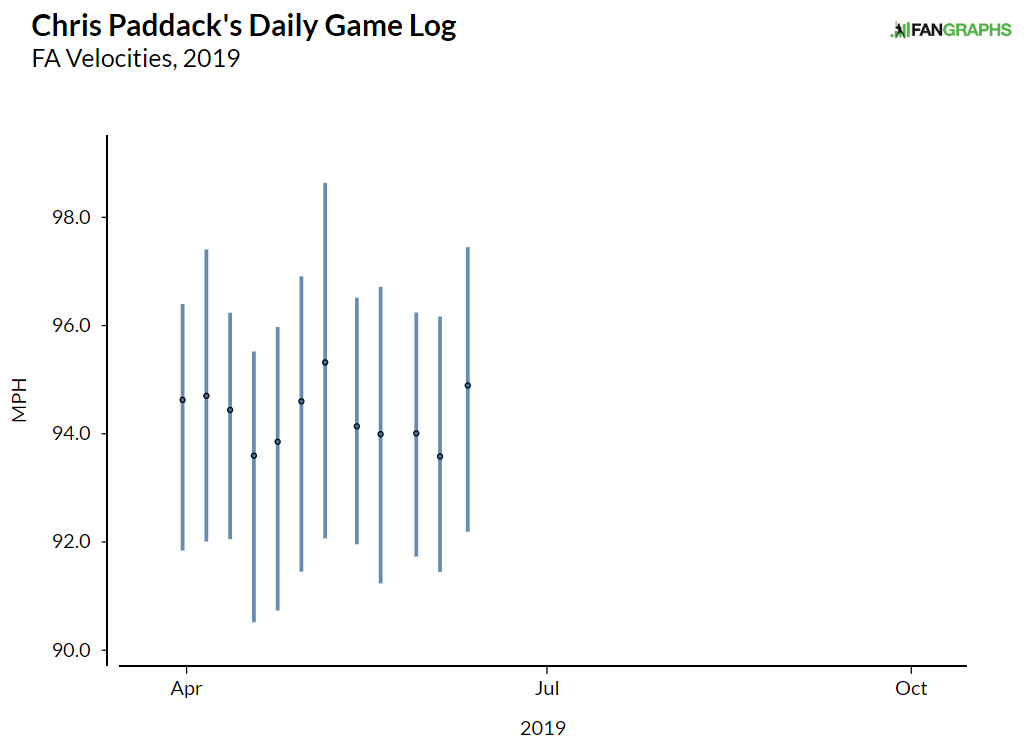
That’s a blunt metric, though. There’s a ton of variation within each start, and if Paddack threw a ton of fastballs to start one game and mostly changeups to start another, that could move the game average a bit. Let’s do a slightly fancier check — this is, after all, a fancy-math baseball website. Take a look at how much juice Paddack has lost on his four-seamer from the first 25 pitches to the 51st-75th pitches in each start:
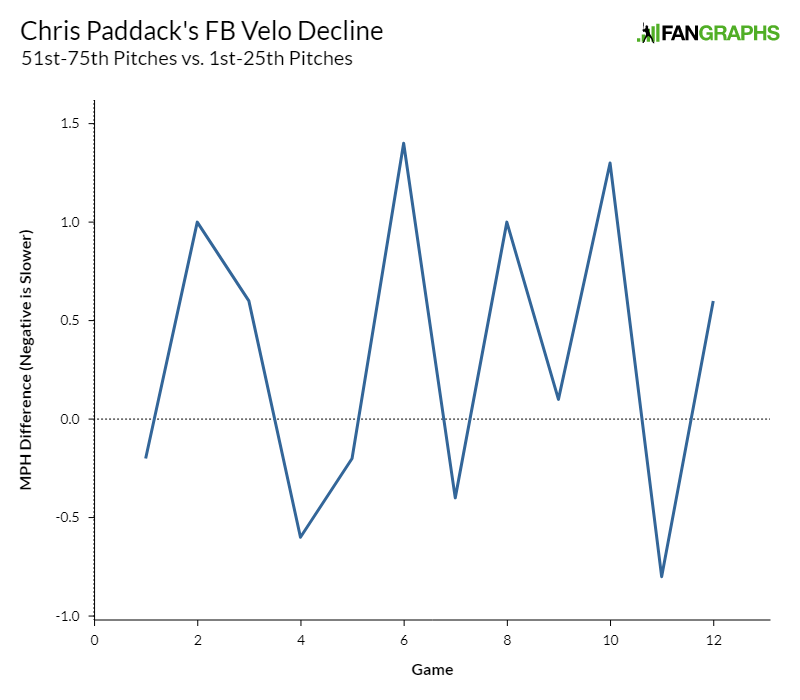
Honestly, there doesn’t seem to be much here. Two starts ago, he undoubtedly lost a little velocity as the game went on. In the two starts surrounding it, however, he actually gained velocity as the game went on. Maybe the Padres always had a plan to give Paddack extra rest mid-season, but he doesn’t appear to be tiring.
Getting Some Work In
This is the other aspect of the decision Green discussed. Paddack is going to Lake Elsinore to do some work. In case you were wondering, he’s specifically going to work on his changeup. As Green put it when referring to the pitch, “I think we’ll see him make some real adjustments.” Now, that’s a pretty bold claim, because Paddack’s changeup has been his carrying tool throughout the minors, and it was downright nasty to start the year in the majors. I had to watch this strikeout twice to make sure Paddack wasn’t throwing a Wiffle Ball:
Still, maybe something has changed about the pitch in the last few starts. In his most recent start, Paddack allowed a home run on a changeup and got only a single swinging strike with the pitch. When I looked closer, however, I didn’t see anything out of place. His changeup velocity has hardly budged all year. The separation between his changeup and fastball release points is metronomic. He’s getting the same sink on the pitch as always. In his most recent start, the changeup had about an inch less horizontal fade than normal, but prior to that, it was mostly indistinguishable from start to start. In short, nothing about the pitch’s movement and release looks amiss.
Even if you don’t limit yourself to just looking at his changeup, it’s hard to see any convincing evidence that Paddack needs to do some tinkering. His swinging strike rate is down over the past three games, to 8.8%, but that’s hardly an outlier given how much variance there is in the stat. His strikeout and walk rates have barely budged — his walk rate is even down a bit over the last three starts. Maybe batters are just crushing everything against him? Seemingly not — his hard-hit rate has declined over the last three games, and his exit velocity on balls in the air is right in line with the rest of his season.
If there’s a worrying pattern over Paddack’s last three games, it’s a decline in groundball rate. He ran an above-average groundball rate in the minors, a rarity for a vertical arm slot, high-spin four-seam pitcher. Over the last three games, however, opponents have been elevating the ball quite a bit — over those three games, his GB/FB is 0.85, a far cry from his minor league career average of roughly 1.5. Even this evidence, however, is flimsy. Paddack ran even lower groundball rates over his first six starts, and he was tremendously effective then. It looks mostly like random variation, and it’s no surprise that a pitcher who relies on a rising fastball allows some fly balls. Overall, it looks like Paddack has the stuff to be an effective pitcher right now, without going down to Single-A to work on his pitches.
Service Time
You’ll be shocked, shocked to find that there might be financial motives for demoting Paddack. The current CBA provides a strong incentive to have rookies accrue less than 173 days of service time — the dreaded demarcation line that kept luminaries like Kris Bryant and Vladimir Guerrero Jr. in the minors to “work on their defense.” The Padres’ season lasts 186 days this year, and as the season-day calculations aren’t perfectly known in advance, the team would probably need to keep Paddack down at least 20 days to ensure an extra year of arbitration and team control out of the deal. The Blue Jays, for example, kept Vlad Jr. down 30 days to start the season.
What do the Padres get out of an extra year of control? I’ll do the bare-bones economic assessment here, though there’s been plenty of debate across the internet about it already. At the most basic level, if Paddack gets less than a full year of service time this season, he’ll receive a fourth year of arbitration-based compensation in 2025 rather than becoming a free agent after the 2024 season.
In the interest of figuring out the most this could possibly be worth to the Padres, let’s be generous and say that Paddack will be a 3.5-WAR pitcher that year and that the Padres will only pay him $15 million. Both of these assumptions are pretty generous, but we’re taking an extreme case here to prove a point. Using a cost per WAR of $10 million (again, we’re being generous), the Padres could get a whopping $20 million in 2025 surplus value out of 20 days of minor league shenanigans this year. The actual number is probably substantially lower (Paddack’s mean outcome is likely lower, and his arbitration salary is likely to be higher if he is that good), but $20 million seems like a realistic high end.
Money in 2025, however, isn’t worth the same as money today. We need to estimate the time value of money to the Padres to understand the present value of this prospective arbitration windfall. Though the Padres opened some of their books in the offseason, we don’t have a good estimation of what their borrowing rate is. Because we’re just estimating here, I’m going to do some Bad Finance and assume they borrow at the BBB corporate rate. This is a huge hand-wavy approximation — trust me, I know that. I’m not even using a zero-coupon rate, like a heathen. Still, again — we’re approximating.
The present value of $20 million in seven years is $15.4 million. Another way to think about this is that if the Padres took out a $15.4 million loan today to spend on the team, they’d owe $20 million in seven years. The team should be indifferent between receiving $15.4 million today (they could use that to spend on the team rather than taking out a loan) and $20 million in seven years (they could just pay off the loan when it came due). The maximum ceiling of the value the team is accruing, in other words, is large but not gargantuan.
In truth, keeping Paddack down is almost certainly worth less than that. In seven years, we have no idea how good Paddack will be, or if he’ll even merit arbitration. Pitching careers are ephemeral, after all, and Paddack is already on a replacement ligament. Additionally, my cost per win is probably too high, and my estimate of Paddack’s fourth-year arbitration salary probably too low. The team gets real value out of an extra year of Paddack, but I’d eyeball the present-day EV of the transaction below $10 million all-in. That’s a third of a year of Machado, or nearly three months of groundouts from Eric Hosmer. Still, it’s $10 million.
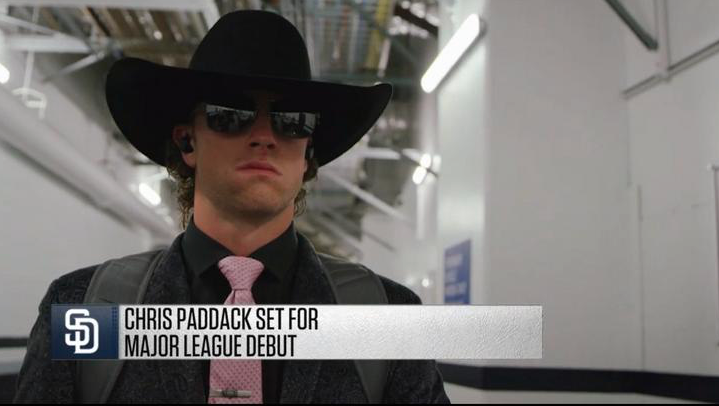
I hope that the Padres are just sending Paddack down for a single turn, and that he’ll get a full year of service time this year. His pitching has been electrifying all season, and his overall swagger has been a boon to the game. Heck, this outfit alone has given me more enjoyment than some major league teams this year:
If Paddack does stay down more than 20 days, however, I hope we think long and hard about why. Maybe it’s rest. Maybe it’s work. Maybe at the end of the season, we’ll look back on Paddack’s rookie campaign and his full year of service, and think that the Padres, having really just given him rest and having had Tatis on their Opening Day roster, have fully embraced the idea that a team’s best players should play. I hope we do. Sometimes, though, understanding a team’s motivation requires us to follow the money. I don’t want to believe it, and hope I don’t have to come October, but I’m also a realist.
Ben is a writer at FanGraphs. He can be found on Bluesky @benclemens.
There were articles a couple weeks ago about Boras approaching San Diego about Paddack’s innings (presumably to avoid a situation like Strasburg or Harvey dealt with a few years back). Since the demotion, I haven’t seen anything from Boras. That leads me to believe it’s not a service time issue, and they’re all on board with it.
It does make me wonder what happens if Paddack gets slightly injured during his minor league start though. If he tweaks a hamstring or a lat muscle, does he go on the minor league DL or the major league DL? If it’s the minor league DL, he’d jeopardize a year of service even though it wasn’t San Diego’s intent.
Pretty interesting strategy and wonder if you might see it more from borderline competitive teams. Get the fans excited by calling players up and give them an extended rest around the all-star break, or even keep them up if the team is outperforming expectations and you have a better idea of your playoff chances or lack thereof. Evaluation based on more information has to be more valuable.
If you are really concerned with the long term health of the team, it is arguably irresponsible bordering on breach of duty to NOT play the service time game.
Frankly speaking, I think the main reason why this doesn’t happen to every single prospect is because most of the GMs won’t be there seven years later.
Cubs were 5-3 before they called up Bryant. `
Bryant racked up 6.1 war in 151 games for his fantastic RoY season.
Prorating his hypothetical contribution to the eight missed games gives us 0.005 additional win.
The cost to delaying the call up is ridiculously tiny compared to the benefit of an additional arbitration-controlled year.
I mean, given that the rules are going to change drastically at the end of 2021, gaming the current rules seems a pointless exercise in pissing off your players…
Why would they change? The primary purpose of gaming arb is parity, as TungTwista says. In the next CBA, MLBPA wants something like 2% more of revenue. There are other ways of getting that and particularly to younger stars — such as raising the minimum and making arb earlier. No need to change years of control.
Paddack’s FB accuracy has diminished and hitters have been sitting on (either that or spitting on) his change up. Hence, all the homers he’s been tagged with of late. There were anecdotal reports from a couple of sources about Paddack not maintaining his arm speed consistently through his change up and new curve ball. That “cause” doesn’t necessarily show up in the stats, at least not directly other than in hits, HR’s, wins and losses.
Plus, the Padres have said that they planned a hiatus for both Paddack and Straham at some point . Green emphasized that Straham “could have gone” even through he’s been fighting sore ribs for several starts, but that now was a good time to get him some rest, which is why he was put on the IL.
This is much ado about nothing, i.e. author is grasping at straws claiming a possible financial motive for moving Paddack down. If anything this year, and the past several, the Padres owners and AJP have been consistent in prioritizing “baseball reasons” over pure financial reasons, for their moves. The Padres have “walked the walk”, money wise, and not just talked the talk.
If one looks at what’s coming over the horizon, i.e. Lamet and Richards, plus more sub-100 inning rookies on the way, this dance will become familiar over the next couple of years, simply because the Padres are moving up more rookie pitchers than almost any other team in history. The currently have a rotation of two “1 year” guys, and the rest are rookies. They have no pitcher in the rotation who can go 200 innings this year – even Lauer and Lucchesi will be restricted before that point). Later this year, or early next year, those rookies will be joined by the two TJ recovering guys. A six man rotation, “openers”, or possibly starting rookies like Gore and Patino in the bullpen for long relief and spot starts, may be the rule for the next couple of years, rather than the unexpected.
So why don’t they put him on the MLB IL for rest so he can continue to accrue service time while they can keep a close personal eye on him if it’s not about money and service time?
Because, despite all the shenanigans around how teams us the IL, it’s against the rules to claim a player has an injury he doesn’t.
And when they recall him within 20 days, he gets credited for the service time anyway.
If you’re looking to find the deep, dark, mysterious answers to what the Padres are doing this year you only have to look all the way back to… last year when they did the same damn thing with Lucchesi.
I tend to agree with all of this and would concur that the article in general suffers from analysis paralysis. As a fan of the club that loved the fact that they started off with Paddack/Tatis on the roster, I actually think sending him down was a great idea. To me, there ARE things he can work on for a few weeks – OldSaltUSN – mentions some.. and in addition.. this humbles him a little. I mean, let’s be honest… he’s been electric at times and that swagger is cool to see with the “Sheriff” motif and all, but at the end the day kid, sorry, you ain’t “all that” yet. 1/3 of a season an ace does NOT make. It’s reasonable to believe that many of us got slightly carried away with his dominance early in the year. I suspect he’ll take two or three weeks to rest, throw side sessions, throw a few MiLB innings and then come back and throw 60-80 more total innings at the MLB level right at his Steamer/ZiPS/Depth Chart rest of season projections.
i was with you until you started yelling at Chris Paddack to get off your lawn. “Humbles him.” What a joke.
That’s quite the over-reaction to allowing six HR (incl. three in Yankee Stadium) in three games. There’s nothing in his arsenal to suggest he should magically avoid HR the way he did is his first eight starts, so this whole narrative seems contrived.
When release points, velocity, and movement are all the same, but results are suddenly drastically different, it’s usually because the pitcher is tipping. That’s probably the “work” the Pads are referring to here.
Not really. Control will betray you due to fatigue well before you’ll see noticable velocity dips.
Some tipping may be in play, but the pitches they are punishing are right down main street. In his good starts, he wasn’t leaving anything over the middle of the plate. The command that established him early in the season has degraded, and fatigue may be a factor.
Usually, if we are talking about a few games of elevated BABIP and HR/FB, it’s a combination of bad matchups and bad luck.
The padres borrowing rate is not a good representation of there discount rate. The weighted average cost of capital should be a weighted average of cost of debt and cost of equity. Cost of equity exceeds cost of debt. Just something to keep in mind.
I think there’s an important factor missing in the calculations of Paddock’s present day vs future value to the Padres. The likelihood the Padres make the playoffs this year vs the likelihood of making it 7 years from now. Baseball Reference shows their playoff odds this year at 0.6%, Fangraphs has it at 6.3%. Splitting the difference makes it 3-4%. Obviously we have no idea what their odds will be 7 years from now, but it’s not hard to beat 3-4% odds. And given all the talent in the Padres minor league system, they’re practically guaranteed to be higher. So why not squeeze an extra year out of Paddock in the hopes that he’ll be able to contribute 7 years from now when your chances of making the playoffs are higher? And yeah, I get that people don’t like these sort of manipulations but it’s not like doing this is in any way irrational.
Oops….Paddack. 🙂
Love the clarity of the graphs in this one. Another thoroughly enjoyable piece – keep up the good work, Ben!
i don’t think this demotion is a conspiracy to finagle paddack’s service time. he is on an innings limit and the padres are not going to waste a roster spot for someone who they won’t let pitch. obviously, the fact that they can get an extra year of service is a benefit for them, but i don’t think it’s their main intent with this move. but, i do think we will see paddack go back down to the minors again at some point this season. Say he stays down for the minimum 10 days during this stint, they recall him and he pitches again through the all star break and if the padres are still hovering around .500 and looking like they’re falling out of the race, they’ll probably send him down again–in what will probably be a move made more so for the financial reasons. they’ll have him under his innings limit and also an additional year of team control. a win-win for them
Innings limits are a joke. Pitch counts are fine and if you want to cap him at 85-90 pitches every start to protect his arm and build that up next year then fine, but there is no reason to limit his innings.
I understand the service time rules but don’t understand how they were decided in the first place. 173 of 186 days is 93% of the season. Who agreed on the player side that 93% should round down to zero?!? I could see 67% or even 75% as a compromise, but 93% is ridiculous and is the primary reason for the service time manipulation shenanigans.
Now, I’m not for a minute (and for the purposes of this argument) going to believe that Paddack will achieve 3.5 WAR in his final arb year. And I’m increasingly disposed not to believe that the gradated $/WAR,ratio, here stated at $10M for that year, is a good match for current market conditions. And maybe Paddack can get a 4th Arb settlement at more than $15 million.
I mean, these are all baseline future judgements. They’re what we have to work off.
But … a CBA that takes a year of MLB arb away for an easily-manipulated 20 day “assignment?” That doesn’t work for me even if the assignment is for perfectly good baseball reasons.
On the assumptions as presented here, that’s $20 million of value for 20 days. Even Pyramid Salesmen would see this as something beyond their wildest dreams.
(And this for a starting pitcher, which effectively means you lose four games of present worth as against, well, that $20 million).
This is quite frankly a disgrace — it might not apply to Paddack, but it’s still staring you in the face for other players even if not — and it should be the main focus for the Union going into the next CBA.