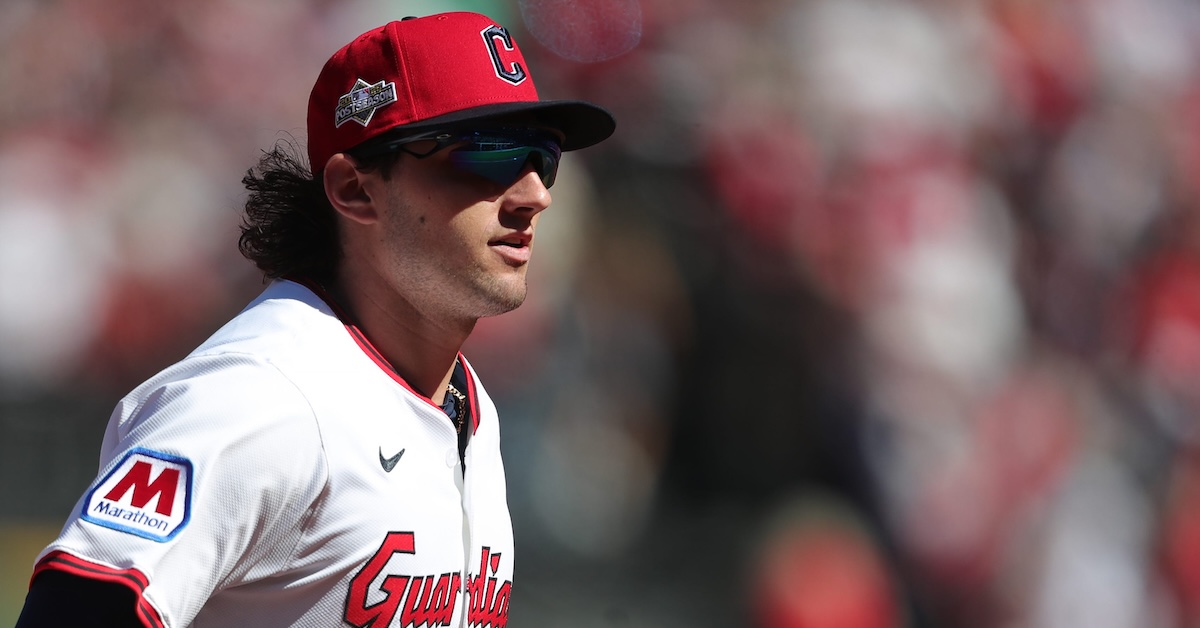
Cleveland Guardians Top 45 Prospects

Chase DeLauter Photo: Jeff Lange/USA TODAY NETWORK via Imagn Images

Below is an analysis of the prospects in the farm system of the Cleveland Guardians. Scouting reports were compiled with information provided by industry sources as well as our own observations. This is the sixth year we’re delineating between two anticipated relief roles, the abbreviations for which you’ll see in the “position” column below: MIRP for multi-inning relief pitchers, and SIRP for single-inning relief pitchers. The ETAs listed generally correspond to the year a player has to be added to the 40-man roster to avoid being made eligible for the Rule 5 draft. Manual adjustments are made where they seem appropriate, but we use that as a rule of thumb.

A quick overview of what FV (Future Value) means can be found here. A much deeper overview can be found here.

All of the ranked prospects below also appear on The Board, a resource the site offers featuring sortable scouting information for every organization. It has more details (and updated TrackMan data from various sources) than this article and integrates every team’s list so readers can compare prospects across farm systems. It can be found here.

Guardians Top Prospects
Rk Name Age Highest Level Position ETA FV
1 Chase DeLauter 24.3 MLB RF 2026 55
2 Ralphy Velazquez 20.6 AA 1B 2027 50
3 Angel Genao 21.6 AA SS 2027 50
4 Travis Bazzana 23.4 AAA 2B 2026 50
5 Parker Messick 25.2 MLB SP 2026 50
6 Khal Stephen 23.0 AA SP 2026 50
7 Braylon Doughty 20.1 A SP 2029 45+
8 Gabriel Rodriguez 18.7 R SS 2029 45+
9 Robert Arias 19.3 R CF 2030 45+
10 Cooper Ingle 23.9 AAA C 2027 45
11 Kahlil Watson 22.7 AAA CF 2026 45
12 Jace LaViolette 22.1 R CF 2028 45
13 Matt Wilkinson 23.1 A+ SP 2027 45
14 Caden Favors 24.4 A+ SP 2028 45
15 Juneiker Caceres 18.4 A RF 2030 40+
16 Jaison Chourio 20.6 A+ CF 2027 40+
17 Dauri Fernandez 18.8 A SS 2030 40+
18 Daniel Espino 25.0 AAA SIRP 2026 40+
19 Joey Oakie 19.7 A SIRP 2029 40+
20 George Valera 25.2 MLB RF 2026 40
21 Alfonsin Rosario 21.5 AA RF 2028 40
22 Austin Peterson 26.3 AAA SP 2026 40
23 Josh Hartle 22.8 AA SP 2026 40
24 Petey Halpin 23.6 MLB CF 2026 40
25 Jacob Cozart 23.0 AA C 2027 40
26 Jose Devers 22.6 A+ SS 2027 40
27 Peyton Pallette 24.7 AAA SIRP 2026 40
28 Franco Aleman 25.5 AAA SIRP 2026 40
29 Yorman Gómez 23.2 AA SIRP 2026 40
30 Jogly Garcia 22.3 A+ SIRP 2027 40
31 Juan Brito 24.3 AAA 2B 2026 40
32 Dean Curley 21.7 A 3B 2029 40
33 Andrew Walters 25.1 MLB SIRP 2026 40
34 Doug Nikhazy 26.4 MLB MIRP 2026 35+
35 Nick Mitchell 22.3 A+ CF 2028 35+
36 Aaron Walton 21.7 A CF 2029 35+
37 Will Hynes 18.5 R SP 2031 35+
38 Aidan Major 22.6 R SP 2027 35+
39 Dylan DeLucia 25.4 AA MIRP 2027 35+
40 Steven Pérez 24.7 AA SIRP 2026 35+
41 Jackson Humphries 21.5 A+ MIRP 2027 35+
42 Kendeglys Virguez 21.7 A SIRP 2027 35+
43 Nolan Schubart 21.7 A LF 2029 35+
44 Chase Mobley 19.6 A SP 2029 35+
45 Alexander Garcia 19.4 R SP 2029 35+
Reading Options
Detail Level
Data Only
Full
Position Filter
All

55 FV Prospects

Drafted: 1st Round, 2022 from James Madison (CLE)
Age 24.3 Height 6′ 4″ Weight 235 Bat / Thr L / L FV 55
Tool Grades (Present/Future)
Hit Raw Power Game Power Run Fielding Throw
50/55 60/60 50/60 40/35 40/40 60

Taken in the first round of the 2022 draft, the oft-injured DeLauter has only played 140 professional games. He’s been awesome in that time, though, and after a strong showing in 34 Triple-A appearances, Cleveland called upon him to make his debut in the Wild Card round of last year’s playoffs. It was a huge vote of confidence in his bat and just the latest sign that injuries were the only thing preventing the advanced lefty thumper from debuting much earlier.

DeLauter projects as a middle-of-the-order hitter. He’s a big guy who generates plus power with a short, controlled swing. Massive humans like this sometimes have trouble getting going quickly, but the 24-year-old’s short and direct path keeps him on time, and he’s able to guide the barrel all over the zone. This isn’t one of those pretty left-handed swings you’ll tell the grandkids about: He has a big scissor kick and oftentimes a short, almost truncated follow through that is more bluntly effective than poetic. No matter. DeLauter makes a ton of contact, hits the ball hard, doesn’t chase much, and turns it loose when balls are out over the plate. Nobody’s a guarantee, and the short track record is a bit of a risk, but on paper and visually this is what a bat-first prospect ought to look like.

We wish he had a cleaner bill of health. DeLauter broke his left foot in college, the start of a prolonged injury odyssey that has defined his career. He missed a big chunk of the 2023 season after undergoing surgery on that same foot, then fractured it again in 2024. That, along with a sprained toe and a hamstring strain, limited him to 39 games that season. A sports hernia cost him the early part of the 2025 campaign and just when he was back and raking, he got hit in the hand and broke his hamate bone. It’s a big bummer, and as subscribers to the maxim that healthy guys tend to stay healthy and injured guys tend to keep getting injured, it’s a huge concern for us, one that pushed him down the Top 100.

You Aren't a FanGraphs Member
It looks like you aren't yet a FanGraphs Member (or aren't logged in). We aren't mad, just disappointed.
We get it. You want to read this article. But before we let you get back to it, we'd like to point out a few of the good reasons why you should become a Member.
1. Ad Free viewing! We won't bug you with this ad, or any other.
2. Unlimited articles! Non-Members only get to read 10 free articles a month. Members never get cut off.
3. Dark mode and Classic mode!
4. Custom player page dashboards! Choose the player cards you want, in the order you want them.
5. One-click data exports! Export our projections and leaderboards for your personal projects.
6. Remove the photos on the home page! (Honestly, this doesn't sound so great to us, but some people wanted it, and we like to give our Members what they want.)
7. Even more Steamer projections! We have handedness, percentile, and context neutral projections available for Members only.
8. Get FanGraphs Walk-Off, a customized year end review! Find out exactly how you used FanGraphs this year, and how that compares to other Members. Don't be a victim of FOMO.
9. A weekly mailbag column, exclusively for Members.
10. Help support FanGraphs and our entire staff! Our Members provide us with critical resources to improve the site and deliver new features!
We hope you'll consider a Membership today, for yourself or as a gift! And we realize this has been an awfully long sales pitch, so we've also removed all the other ads in this article. We didn't want to overdo it.

All of that raises questions about the best path forward defensively. The Guardians ran DeLauter out in center field for his debut in the playoffs and we were surprised. He hadn’t played there all year and he’s not particularly good in right, much less center. They just about got away with it — he dropped a routine fly ball in his first action, though Detroit couldn’t capitalize, and he did have an assist later in the game — but going forward, we see his lack of mobility as an impediment to being anything more than a fringy corner outfielder. More to the point: When your offense isn’t very good and you have a big but brittle bat like this, it seems bonkers to stretch him physically in a demanding and relatively unfamiliar position. You do what you have to do in a do-or-die situation, we guess, but going forward, we hope Cleveland takes the bat in the hand here. The Guardians should do everything they can to keep DeLauter in the lineup, and if that means he’s a DH, so be it.

50 FV Prospects

Drafted: 1st Round, 2023 from Huntington Beach HS (CA) (CLE)
Age 20.6 Height 6′ 3″ Weight 230 Bat / Thr L / R FV 50
Tool Grades (Present/Future)
Hit Raw Power Game Power Run Fielding Throw
35/50 55/60 40/55 30/30 45/50 55

Velazquez was an underslot first-round pick in 2023. Selected as a bat-first catcher, the stick has always looked promising, but questions about his body and future position made him a risky proposition. Even though he’s shed the catcher’s gear, it appears Cleveland chose wisely. Velazquez has gotten himself in great shape and is on the fast track to the big leagues. He reached Double-A just a couple months after turning 20, and spent the season’s final month hammering the competition, hitting .330/.405/.589 with 12 walks and only 19 punchouts in 126 plate appearances at Akron.

Velazquez projects as a middle-of-the-order hitter. Everything looks right in the box. He starts with a wide base, his short stride and kick get him in position on time, his trigger looks natural, and he has a fast bat that’s already producing above-average exit velocities. He’s also showing signs of a mature approach, hunting low-and-in pitches early in counts and adjusting with two strikes.

As a professional, Velazquez has mostly played first base, where he projects average, though Cleveland has occasionally deployed him in an outfield corner. He has the motor to make himself playable — Velazquez was a regular and sometimes solo presence at pre-game defensive work in Brendan’s looks — but he’ll need to take to the finer points of the job because his speed will be tested out there. It’s worth a try, even if first base seems like the likely end point. Regardless, Velazquez is a hitter first. His ascension to Double-A capped off a really promising 2025 season, and he enters 2026 as an arrow-up guy with a chance to reach Cleveland as soon as this summer.

Signed: International Signing Period, 2021 from Dominican Republic (CLE)
Age 21.6 Height 6′ 0″ Weight 195 Bat / Thr S / R FV 50
Tool Grades (Present/Future)
Hit Raw Power Game Power Run Fielding Throw
40/50 45/50 40/50 60/60 40/50 70

Genao (pronounced “hen-now”) is a projectable switch-hitting shortstop with a multi-year track record of plus plate discipline, plus contact hitting, and fair power for his age. He strained his shoulder toward the end of 2025 spring training and played in just 77 games at Double-A Akron, a fairly aggressive assignment for a player who turned 21 near the start of the season. Genao only slashed .259/.323/.359 with the Rubber Ducks, a far cry for his 2024 output (.330/.379/.499), but we don’t necessarily see this as a regression so much as a one-year stagnation. The things that made Genao exciting as a prospect 12 months ago largely remain, he simply didn’t take “The Leap” in 2025 that prospects in this age range are sometimes capable of.

Genao is still a selective switch-hitter with a low-ball, gap-to-gap approach that yields doubles power right now, and who might grow into 20-homer power at peak. The length of his swing creates some risk that his early-career, above-average bat-to-ball performance (an 81% contact rate for a college-aged hitter at Double-A is quite good) will dip as he faces better velocity. Most all of Genao’s balls in play came against pitches in the lower two thirds of the zone in 2025, but he’s capable of spoiling pitches in the top third and can really only be beaten entirely by ones elevated well above it. This helps quell potential concern that he has a huge hole in his swing that’s waiting to be exposed, and hopefully his feel for both of his swings will improve as he matures, allowing him to get on top of high pitches more consistently.

Genao has the range, athleticism and arm strength to be a good big league shortstop, but his hands and throwing accuracy need polish. When he really has a grip on the baseball, his max-effort throws are sensational, but too often he fumbles his exchange in a way that impacts the quality of his throws. These blemishes are fairly common for players this age, though now that Genao is on Cleveland’s 40-man roster, the clock is officially ticking on his ability to buff them out of his game. The key developmental variables for Genao’s 2026 season are whether he can improve on the defensive side of the ball, or develop meaningful power as he matures athletically. He’s tracking like an average everyday shortstop, but his ceiling is a little better than that if both facets improve.

Drafted: 1st Round, 2024 from Oregon State (CLE)
Age 23.4 Height 6′ 0″ Weight 199 Bat / Thr L / R FV 50
Tool Grades (Present/Future)
Hit Raw Power Game Power Run Fielding Throw
40/45 50/50 40/55 60/60 40/45 40

A six-sport athlete at Turramurra High School in Australia (about 20 minutes north of the Sydney Opera House), Bazzana ran track (100m dash, long jump and high jump), played soccer, basketball, and rugby, lettered in cricket starting in seventh grade, captained a state championship team, and was on Australia’s U18 Baseball World Cup roster in 2019. He was immediately a good college hitter at Oregon State, where he slashed .360/.497/.660 throughout his career and posted a .407/.568/.911 line as a junior with 28 homers and only 37 strikeouts. The Guardians made him the first overall pick in the 2024 draft and sent Bazzana straight to High-A Lake County, then to Double-A Akron when camp broke in 2025. He slashed .245/.389/.424 on the season (with a six-week midseason absence due to an oblique strain) and reached Triple-A Columbus in August.

Bazzana is a compact athlete cut from the same cloth as Rougned Odor and Brian Dozier; he’s a smaller guy who creates big hip and hand separation, swings really hard (seemingly with more effort than when he was in college), and packs a pretty good wallop for a hitter his size. His swing is geared to generate lots of pull-side launch, so much that we’re inclined to project that Bazzana produces more game power than his raw strength would ordinarily suggest. Aiding this is Bazzana’s plate discipline. He’s hyper-selective and, no matter the count or pitch type, he chases a full two standard deviations less often than the average big leaguer. One could argue some of these look like overly passive, predetermined takes, as Bazzana only swung at 39% of pitches in 2025, which would have placed him among the 10 most patient qualified big leaguers. This tendency to run very deep counts has elevated Bazzana’s strikeout totals (he K’d in a surprisingly high 24.3% of his plate appearances last year) even though his underlying contact data has continued to be good. He’ll probably always strike out a good bit, in Bazzana’s case because of his extreme selectivity and the effort he’s swinging with. He should balance that by running high OBPs.

It’s enough offense to project Bazzana as a solid everyday player even though he’s landlocked at second base. Bazzana has gotten a little better there, and his actions around the bag looked more comfortable and routine later in 2025. He runs well and is willing to dirty his uniform, which allows him to make some tough plays at the very end of his range and perform like an average defender. This is a nice all-around player but not a franchise-altering superstar. Cleveland tends to promote prospects slowly as a means of retaining players’ rights for as long as possible, but it’s likely that at some point in 2026, it’ll be obvious that he is better than the alternatives the Guardians have on their roster, and Bazzana will get an opportunity to make his mark on another close AL Central race.

Drafted: 2nd Round, 2022 from Florida State (CLE)
Age 25.2 Height 6′ 0″ Weight 220 Bat / Thr L / L FV 50
Tool Grades (Present/Future)
Fastball Slider Curveball Changeup Command Sits/Tops
50/50 50/50 50/50 60/60 55/60 91-95 / 97

Messick is among the most stable, higher-floored pitching prospects across all of baseball. He’s worked at least 120 innings every year since 2023 and ranks second in the minors in strikeouts since then. His K% has hovered around an excellent 30% mark at Double- and Triple-A the last two seasons, and he posted a 2.72 ERA in seven big league starts at the end of 2025, not quite enough to graduate from this list.

Messick is a remarkably consistent strike-thrower whose fastball has punched above its weight since he was at Florida State. It doesn’t have a ton of carry, but it does run uphill and can garner whiffs via its angle. This held true during Messick’s big league debut, as it generated a 29% miss rate despite sitting just 93 mph. His changeup is still his best offering, and as Eric noted last cycle, the loose, whippy nature of Messick’s arm action helps sell it to hitters like a podcaster hawking dietary supplements. It has sharp, late dive and at times moves to Messick’s glove side like a slider. His two breaking balls — a mid-70s curveball and mid-80s slider — are both a shade below average and are mostly used to garner strike one. The curveball is more of a weapon against righties, while well-located sliders become Messick’s most-used secondary versus lefties (he also mixes in more two-seamers against them). Pitchers with plus command and plus changeups tend to overachieve, and the ultra-competitive, sneaky athletic Messick (who’s husky but super loose, like a pitching version of Alejandro Kirk) is in that vein. He’s tracking like a contender’s fourth starter.

6. Khal Stephen, SP

Drafted: 2nd Round, 2024 from Mississippi State (TOR)
Age 23.0 Height 6′ 4″ Weight 215 Bat / Thr R / R FV 50
Tool Grades (Present/Future)
Fastball Slider Curveball Changeup Command Sits/Tops
50/50 50/55 55/55 45/55 50/60 91-95 / 96

Traded to Cleveland in the Shane Bieber deal, Stephen had a sensational first professional season. Over 103 innings across 22 appearances, he struck out 110 hitters while walking just 20 and allowing only five home runs. He wasn’t promoted quite as aggressively as fellow 2024 Blue Jays draftee Trey Yesavage, but Stephen aced both levels of A-ball and made a handful of Double-A starts down the stretch. He projects as a mid-rotation starter and could be ready as early as this summer.

If an innings-eating no. 3 or 4 type who throws strikes with solid but unspectacular stuff qualifies as a throwback these days, well, then Stephen is a throwback. Tall and broad-shouldered with very good body control for his size, Stephen attacks with five pitches and reliably gets ahead in the count. Nothing is regularly plus — his curve and slider flash — but everything projects average or better, and the complementary movement in his arsenal makes the stuff a bit more than the sum of its parts. The carry on his fastball is instrumental, helping it play ahead of the number and giving him a reliable out-generator within the strike zone.

Anyone who walks as few hitters as Stephen does is inevitably throwing strikes pretty frequently, and he has a combination of tendencies worth exploring. So far, he’s thrived by hitting the box with his fastball and racking up swinging strikes on secondaries that dart out of the zone. Early in counts, he’s trying to coax hitters to chase those pitches off the plate; when he gets to three balls, his zone percentage increases significantly and he’s almost always at least in the shadow zone. It’s a smart way to pitch, but there’s a risk it gets a little predictable, and the approach will be stress tested by better bats. How will he adjust to hitters who can take close pitches and work more favorable counts? And can he get away with so many strikes when he falls behind?

The guess here is that Stephen makes it work. He’ll likely either sport a fluffier walk rate or be fairly dinger-prone, but the stuff is good enough to miss bats, and his plus command gives him the luxury of choosing how to manage the walks-and-hard-contact tradeoff. Bryce Miller has to navigate the same dilemma, and while he and Stephen go about their craft a little differently, a successful version of the latter could resemble the former’s first couple of seasons.

45+ FV Prospects

Drafted: 1st Round, 2024 from Chaparral HS (CA) (CLE)
Age 20.1 Height 6′ 1″ Weight 196 Bat / Thr R / R FV 45+
Tool Grades (Present/Future)
Fastball Slider Curveball Changeup Command Sits/Tops
40/45 50/60 55/60 40/50 35/60 91-94 / 97

Doughty was arguably the most polished high school pitcher in the 2024 draft and certainly performed like it during his 2025 pro debut, during which he tackled 22 starts as a teenager in full season ball and walked just 6.4% of opponents. He carried a 3.48 ERA (his FIP and xFIP were both around 2.85) across 85.1 innings and threw each of of his three most-used pitches for strikes at least 69% of the time.

Impressive balance and release consistency allow Doughty to throw quality fastball strikes and command both of his breaking balls with precision, all while toying with hitters’ timing via Cueto-like changes in his delivery’s pace. Doughty’s fastball was briefly in the 93-97 mph range during spring training, but then settled into the 91-94 area throughout most of the 2025 season, which was basically his high school fastball velo. Though both of his breaking balls feature plus-plus spin and sometimes bite really hard, the movement of his curveball and slider lack demarcation. Both are more vertically oriented and run together a fair bit, and some of Doughty’s in-zone curveballs are easy to spot popping out of his hand. As such, his breaking pitches played more like above-average offerings overall in 2025 even though they both flash 70 on the scale. Doughty’s changeup feel is impressive for a teenager’s fourth pitch. He’s better at locating it than he is at creating consistently good action on it, but his arm action is clean and his overall feel for pitching is great; his changeup is going to be a weapon down the line. The vertical nature of his breaking stuff will combine with his changeup to give him different ways to attack lefties. This isn’t a pitcher with huge arm strength or projection, more a high-floored teenager than a high ceiling’d one, although if Doughty ends up with 70- or 80-grade command, he could be a Shane Bieber sequel.

Signed: International Signing Period, 2024 from Venezuela (CLE)
Age 18.7 Height 6′ 1″ Weight 175 Bat / Thr L / R FV 45+
Tool Grades (Present/Future)
Hit Raw Power Game Power Run Fielding Throw
25/55 35/50 20/45 60/50 40/50 55

The Guardians’ 2025 extended spring training and complex level group was chock full of toolsy and interesting position player prospects, and the one with the most complete profile is Rodriguez, a high-waisted, 6-foot-1 shortstop with plus defensive actions and a sexy low-ball swing.

Rodriguez slashed .294/.393/.402 in a 28-game season shortened by a hamstring injury. He has a shot to do a little bit of everything, including play a quality big league shortstop. His quick, comfortable actions and feel for making accurate, off-platform throws allows for cozy long-term projection at the position even as he fills out. And Rodriguez filling out is an exciting proposition because with several other offensive ingredients — on-base skill, contact feel — already in his pantry, there are a few different ways to cook up an everyday shortstop once you start sprinkling in some power. The finish of Rodriguez’s best swings evoke Ken Griffey Jr. in silhouette, and he’s geared for golfing low pitches in this manner. His swing can get long at times because his bottom hand is doing the driving, but Rodriguez has shown feel for altering his posture to flatten his path and get on top of higher fastballs, which he sprays the other way.

Whether that will continue against upper-level velocity is uncertain. Rodriguez’s problem right now is that he’s often a little late to the contact point due to his lever length, something that will hopefully be remedied by added strength, which should allow him to shorten up. He drives the ball into the ground a little too often to make a real offensive impact, and if that continues, then his overall output could play below his talent level. We’re probably not talking about multiple 60- and 70-grade tools here, but there are right-tail outcomes where Rodriguez is average or better at everything. Had he been a domestic high schooler last year, we think he would have been a mid-to-late first round pick, and this FV grade reflects that. He’s a potential everyday shortstop who is still several years away.

9. Robert Arias, CF

Signed: International Signing Period, 2024 from Dominican Republic (CLE)
Age 19.3 Height 6′ 2″ Weight 180 Bat / Thr L / L FV 45+
Tool Grades (Present/Future)
Hit Raw Power Game Power Run Fielding Throw
25/60 40/50 20/40 60/60 40/50 50

Arias signed for $1.9 million prior to the 2024 season, receiving the largest bonus in Cleveland’s international class that year. Per their custom, Arias has a promising hit tool, with strong bat-to-ball skills and a keen sense of the strike zone. Befitting his bonus, Arias is a projectable version of the prototype. He’s a plus athlete, lean and twitchy with burst and a frame that has plenty of room for additional mass. For an 18-year-old, his 90th-percentile exit velocity was a healthy 101.7 mph, and he has a chance to grow into average raw. If he can do so while maintaining his speed and defensive projection in center, we’ll be talking about a first-division regular.

Arias has a twitchy, energetic presence in the box. His movements are quick and almost jittery, and there’s a little noise to his actions in the box. But he’s able to get his bat all over the zone, and the way he can flatten his path to meet pitches at the top rail is a sign of a promising hit tool. You’d like to see him square it up more often — his 25% hard-hit rate was nothing special — but for now, his volume of contact, top-end exit velos, and discerning eye are encouraging.

Arias’s feel for the outfield is raw but developing. He doesn’t always get great jumps — the Arizona sky can be an impediment — or take the cleanest routes, but he has a ton of range when he does, and our gut here is that he just needs time and reps before he turns into a pretty good center fielder. You can dream on all of this coming together in a leadoff hitter sort of way, and he has a shot to blossom into a five-tool player at maturity. Were we projecting for a club, we’d put an everyday grade on him, with all of the obvious caveats his age and lack of proximity imply. For us, he slots in here as a promising player we’re eager to monitor in full-season ball.

45 FV Prospects

Drafted: 4th Round, 2023 from Clemson (CLE)
Age 23.9 Height 5′ 10″ Weight 190 Bat / Thr L / R FV 45
Tool Grades (Present/Future)
Hit Raw Power Game Power Run Fielding Throw
50/60 35/35 30/35 50/50 35/45 45

Ingle is twitchy, athletic, undersized catcher who has excellent feel for contact and a long track record of exceptional offensive performance. He’s a career .281/.407/.442 hitter in the minors, and in 2025 had an .808 OPS across 510 Double- and Triple-A plate appearances. Ingle’s bat is really quick and his levers are short, allowing him to wait until the last possible moment to decide whether or not to swing. He parlays this feature into long, tough at-bats, as he spoils borderline pitches until he either walks or puts one in play. Though Ingle has definitely gotten stronger as a pro, he’s still mostly a choosey singles hitter. He can access his pull-side pop against middle-in pitches, but is probably going to hit a lot of line drive singles against big league pitching.

It’s possible, albeit uncommon, for smaller, contact-oriented catchers to be among the top 20 guys at the position, so long as they’re excellent defenders. It’s in this area where Ingle is still lacking. His added strength (he looks like he’s added 15 pounds or so the last couple years) definitely gives him a better shot of withstanding the physical erosion created by the grind of catching, but it hasn’t helped him frame borderline pitches more skillfully. Per TruMedia data, Ingle generated -16 framing runs in 2025, which would have ranked last among big league catchers with at least 150 PA. Ingle’s average arm and quick exchange are undercut by a lack of accuracy created by his haste to get rid of the ball, and his CS% dropped to 17% in 2025. He is not so bad back there that he needs to revisit second base or an outfield corner (positions he moonlighted at in college), but it’s becoming clear that the defense piece of Ingle’s skill set is sketchy enough to round down on his profile and consider him more of a top 40 catcher rather than one in the top 20 at the position.

11. Kahlil Watson, CF

Drafted: 1st Round, 2021 from Wake Forest HS (MIA)
Age 22.7 Height 5′ 10″ Weight 178 Bat / Thr L / R FV 45
Tool Grades (Present/Future)
Hit Raw Power Game Power Run Fielding Throw
30/40 50/55 40/55 55/55 30/45 70

It’s been a turbulent ride, but the enigmatic Watson is now on the doorstep of the big leagues. Once a potential top five pick as a tooled-out shortstop, he slipped to Miami in the middle of the first round back in 2021 and proceeded to wear out his welcome; while battling through a couple of statistically middling campaigns, on- and off-field incidents spurred the Fish to unload him in the Josh Bell deal at the 2023 deadline. Meanwhile, things haven’t always been easy performance-wise, as he started his career with a whopping 35% strikeout rate in Low-A and has moved off the dirt entirely in the Guardians’ system.

But after three years of uneven play, Watson had his best professional season in 2025. His in-zone contact rate jumped during his second spin through Double-A, and then he lowered his strikeout rate further while putting up the best triple-slash line of his career following a promotion to Triple-A. He did that alongside improved play in center field, all of which pushed the Guardians to add him to their 40-man roster following the season.

Even with those improvements, Watson is a power-over-hit prospect. He struck out 27.7% of the time across the two levels last year — his swing is grooved, and he chases and misses frequently on spin — and has not handled lefties well enough to project as a true everyday player. But he has enough pop to be very dangerous against righties, and he’s good enough in center to play there in a part-time role. The way he’s taken to the position deserves a nod, because both his reads and instincts are noticeably good for someone with such little outfield experience. He’s not perfect there or in the box, but Watson does enough on both sides to be a solid fourth outfielder, and has the physicality to blossom further if he can find a way to make more contact than we’re projecting.

12. Jace LaViolette, CF

Drafted: 1st Round, 2025 from Texas A&M (CLE)
Age 22.1 Height 6′ 5″ Weight 225 Bat / Thr L / L FV 45
Tool Grades (Present/Future)
Hit Raw Power Game Power Run Fielding Throw
30/35 60/60 35/55 55/55 40/50 60

LaViolette entered his draft spring as a career .297/.433/.683 hitter with 50 homers in two seasons at Texas A&M, then struggled as a junior. He posted a contact rate (69%) much worse than the college average and his body seemed bigger, stiffer, and less explosive than it did in 2024. His measurable power took a dip and he wasn’t tracking pitches well, just mashing mistakes in the middle of the plate. His performance regressed from a 146 wRC+ in 2024 to a career-low 120 wRC+ in 2025, and after he entered the spring as the potential top pick, LaViolette fell to the back of the first round.

This is a classic Cleveland buy low, as the club has ended up with other prospects who had better underclass seasons than platform springs, which is how Chase DeLauter and Shane Bieber became Guardians. One could be inclined to regress LaViolette’s performance to his career mean, and weigh his two prior years of performance more heavily, as if his junior year is an anomaly and not the start of a declining trend in ability. But LaViolette sure looked like he had backed up; it wasn’t just a tough-luck year for him in a BABIP sense or something like that, he was clearly worse. Whether Cleveland has preconceived notions about how he can be developed to return to peak form we don’t yet know because LaViolette didn’t play at an affiliate after the draft. Here he’s projected as a corner platoon bat who provides value on defense because of his size and ball skills around the warning track.

Drafted: 10th Round, 2023 from Central Arizona College (CLE)
Age 23.1 Height 6′ 1″ Weight 270 Bat / Thr L / L FV 45
Tool Grades (Present/Future)
Fastball Slider Changeup Command Sits/Tops
50/55 50/50 40/55 40/50 89-91 / 92

More than it is a nickname, “Tugboat” is an apt metaphor for Wilkinson’s fastball, a slow-moving “heater” that’s pulling his entire profile. It’s a slow-but-mighty offering that has allowed him to strike out a batter per inning each of the last two seasons. Though his 2025 fastball performance wasn’t as incredible as his dominant, breakout 2024, the pitch still managed to generate plus miss and chase even though it only sits 90 mph thanks to its secondary traits and Wilkinson’s ability to execute it to effective locations. Wilkinson’s drop-and-drive delivery gets him so low to the ground that his left shin is almost scraping across the top of the mound as his weight shifts into his landing leg. His release height is a shade under five feet, which helps create uphill angle on his fastball that’s tough for hitters to match. The fact that Wilkinson can power down the mound like this, generating six-and-a-half feet of extension at roughly 270 pounds, is remarkable.

Wilkinson’s approach to pitching with his slider changed dramatically in 2025, when he used it as an in-zone offering much more often than his chase-heavy style in 2024. Because he’s so often trying to elevate his fastball, it’s good for him to have something he can land in the zone when he needs to throw a strike, and it looks like that’ll be his slider. This pitch has tight lateral action, but it lacks the vertical finish of a bat-misser, and it should play close to average against mature hitters. He is still trying to find a way to create consistent action on a changeup that will flash bat-missing sink on occasion; you can project that pitch to average based on the quality of Wilkinson’s arm action. If Wilkinson falls short of this projection, it’ll be because his lack of raw fastball velocity becomes more consequential against big league hitters. It’s possible he’ll be homer-prone at that level; this is an older guy who has only pitched well against A-ball competition to this point. But he’s only about a year from debuting, and we believe in Wilkinson’s athleticism and secondary pitch projection enough to think he will soon have more than just a good chase fastball. He grades here as a no. 4/5 starter on a competitive team.

14. Caden Favors, SP

Drafted: 6th Round, 2024 from Wichita State (CLE)
Age 24.4 Height 6′ 3″ Weight 205 Bat / Thr L / L FV 45
Tool Grades (Present/Future)
Fastball Slider Curveball Changeup Command Sits/Tops
45/55 50/55 55/55 40/50 40/50 91-94 / 97

A $75,000 senior sign back in 2024, Favors checks a lot of the boxes you want to see in a backend starter. An average athlete, the Wichita State grad is well built and has topped 100 innings in each of the last two seasons. He’s gained a few ticks in pro ball and is now sitting in the low 90s and touching 97 with bat-missing cut and carry. As you’d expect with the pitch grades above, Favors has great feel to spin the ball, and his 1-7 curve in particular stands out for its lack of hump. He hasn’t used it a ton, but he’s also got a fading change that projects average. His arm slows a tick, and he’s only a 50/50 bet to execute it in a useful spot right now, but at its best, it has late, barrel-missing tail and sink to the arm side; more consistent execution of this pitch should be a big 2026 developmental focus.

While Favors posted a mediocre 11.2% walk rate last season, we’re inclined to project on his control. To start with, he has a strong record of control and was a great strike thrower in college and during his first professional cameo. In pro ball, Cleveland has both helped him throw harder and tweaked his motion. After an uncharacteristically wild start to the season, Favors calmed down his delivery noticeably, and saw his walk rate fall alongside without sacrificing any gas. His motion is now decidedly low maintenance: It’s compact, he has good balance, his arm swing is short and repeatable, his head remains still, and his posture is good. You’d perhaps like to see Favors separate a little earlier, but otherwise he has all the markers of a good strike-thrower, and we expect him to turn into one as he gets more experience with his new mechanics.

The upside here isn’t huge. Even with his newfound arm strength, Favors’ secondaries aren’t so sharp that he’s likely to miss a ton of bats. Instead, we project him to mix and match in a useful, if not especially sexy, twice-through-the-order backend role. He has middle relief to fall back on if the strike-throwing falls short of our forecast.

40+ FV Prospects

Signed: International Signing Period, 2024 from Venezuela (CLE)
Age 18.4 Height 5′ 10″ Weight 170 Bat / Thr L / L FV 40+
Tool Grades (Present/Future)
Hit Raw Power Game Power Run Fielding Throw
25/60 45/50 20/40 50/50 40/50 50

Caceres ripped through the ACL last summer and then held his own for a month as the youngest player in the Carolina League. His big, coiled leg kick stands out immediately, and while it’s a little unconventional, it works for him as a timing mechanism: His foot is down on time, his head stays level, and it’s not the start of a huge move, as it is for many boom-bust power hitters. Far from it, in fact, as excellent bat control and a short, quick-to-the-ball cut are the genesis of his lofty hit tool projection. Caceres’ instincts and feel at the plate merit mention as well. He can hit the ball where it’s pitched, shortens up with two strikes, and has shown an aptitude for mid-AB adjustments on both high fastballs and same-sided spin. The latter is impressive for any minor leaguer, much less a kid who played most of the season as a 17-year-old.

Were we more confident that Caceres would hit for average power, our topline grade would’ve looked almost irresponsible. But despite visual and statistical evidence that he’s got pop — his 104.6 mph 90th-percentile exit velocity is outstanding for his age — he has questions to answer. You can explain away the lack of in-game power so far as a product of inexperience, but it’s actually the swing itself that limits the projection above. His bat path is geared for line drives and groundballs, and the way his hands work suggests that some of the simpler things guys do to lift the ball more, like trying to hit it out front, may not work here. He’s also not especially projectable, so while there might be more power coming, it probably won’t be a ton. Taken together, Caceres has the bat speed and hand-eye coordination to think he could trade some contact for power, but it’s not clear that the juice will be worth the squeeze. The sweet spot may be a subtler adjustment, one that lets him turn it loose in certain zones without sacrificing his knack for quality contact all over the zone.

Defensively, Caceres has seen more time in a corner than center. Some of that is due to his teammates, as Robert Arias in particular is just a better defender and understandably swallowed center field reps on the complex. Long-term though, Caceres will likely lack the foot speed to be more than a solid defender in a corner. That puts a lot of pressure on the bat, as there aren’t many everyday league-average corner guys without big power or really slick leather: Modern defensive alignments and outfield party decks have cut down on the amount of grass hitters have to aim at, and it’s become really difficult to be a doubles hitter in this environment.

Caceres has the skills to be an exception, though. The barrel feel speaks for itself and based on the early evidence, it’ll come with a solid approach. Still, we’re not quite ready to go all in on him yet, and we think he’s one of those guys who looks a little rosier on the spreadsheet than in real life. The high end is something like Alex Verdugo, who had a 50-FV peak for a few years as a similar kind of hitter.

Signed: International Signing Period, 2022 from Venezuela (CLE)
Age 20.6 Height 6′ 1″ Weight 175 Bat / Thr S / R FV 40+
Tool Grades (Present/Future)
Hit Raw Power Game Power Run Fielding Throw
30/50 40/50 30/40 55/55 40/45 40

Chourio is one of the more divisive players in the minors right now. A good athlete with speed and a chance to grow into average power, he offers both scouts and analysts something to like — and also plenty to pick apart.

At the heart of Chourio’s profile lies a familiar tension about what “good swing decisions” look like for a 20-year-old at High-A. On the surface, Chourio’s ability to take a free 90 suggests a mature approach. His career walk rate is nearly 20%, and he’s walked nearly as often as he’s struck out across both levels of A-ball. In a vacuum, that’s good. In this particular case, though, perhaps not. Chourio’s 36% swing rate is among the very lowest in the system, a figure that is almost always a harbinger of passivity, and sure enough his 61% swing rate on balls in the heart of the plate indicates as much. Between that and a chase rate that nearly doubles when he reaches two strikes, it’s not clear to us that he’s a discerning hitter at all. And while ranting about passive hitters is traditionally a hobby horse for scouts, we’ve spoken with analysts who think Chourio’s swing decisions aren’t just passive but actually bad. A scout friend of Brendan’s likes to say that “patience is not a carrying tool” and that seems to apply here.

Stripped of the walks, there’s not much carrying the profile here yet. Chourio notched a 103 wRC+ last year but did so while hitting .237 and slugging .286. His 77% contact rate is good but not special, and is actually a little concerning for someone with all of nine homers in 1,200 career plate appearances. He may grow into average power, but even if he does, his tendency to hit balls on the ground dampens the impact, in part because he’s a late decider with bat speed that’s just okay. Any path adjustment likely comes with additional swing and miss. On the defensive side, Chourio has enough speed for center, but his instincts and arm are well below average and match the round-down nature of his offensive game.

The saving grace here could be good old fashioned physical projection. Thanks in part to all the walks, Chourio has performed at both A-ball levels and has advanced through the system well ahead of schedule, albeit with a tweener’s collection of tools and underbaked strength. Perhaps giving him a chance to dominate, rather than succeed, could help. He’ll still be 20 on Opening Day and it might be worthwhile to let the next phase of his physical development coincide with a goal to swing and elevate the ball more often in an age-appropriate setting. And who knows? If Chourio shows better barrel feel or gets to a surprising amount of damage, we may need to revisit our current projection, which is that of a fourth outfielder.

17. Dauri Fernandez, SS

Signed: International Signing Period, 2024 from Dominican Republic (CLE)
Age 18.8 Height 5′ 9″ Weight 155 Bat / Thr S / R FV 40+
Tool Grades (Present/Future)
Hit Raw Power Game Power Run Fielding Throw
25/60 30/35 20/30 55/55 40/50 55

Fernandez is an extreme version of the smaller, “high-contact, good plate discipline, we’ll see on the power” middle infield types that Cleveland gravitates toward in the international market. He’s a switch-hitter with strong bat-to-ball skills from both sides and a knack for squaring up pitches in different parts of the zone. He isn’t explosive, his bat isn’t exceptionally quick, and he has a bat wrap that lengthens his path even further, but he hits a ton of live drives anyway, aided by mature pitch recognition skill and strike zone judgment. Fernandez was way too advanced for complex arms last summer: He hit .333/.398/.558 with only 22 strikeouts in 176 plate appearances. That’s a good start, particularly for an above-average runner who projects to stay at shortstop.

The fly in the ointment is Fernandez’s lack of physical projection. He’s a lean kid, and it’s hard to see a path to even fringy pop with his narrow frame; the six homers he hit last year were more a reflection of his ability to take advantage of a friendly hitting environment than anything else. He needs to get stronger, as even 35 impact could be enough to let all his other skills play in a utility role, and there’s everyday upside if we’re just wrong about how much development he has in front of him. This is a volatile profile. You can dream on an everyday shortstop but absent significant strength gains, Fernandez may just get the bat knocked out of his hands against better pitching.

18. Daniel Espino, SIRP

Drafted: 1st Round, 2019 from Georgai Premier Academy (GA) (CLE)
Age 25.0 Height 6′ 2″ Weight 215 Bat / Thr R / R FV 40+
Tool Grades (Present/Future)
Fastball Slider Command Sits/Tops
60/65 60/65 40/45 94-97 / 99

Born in Panama, Espino had the best arm strength among the high school pitchers in the 2019 draft and was selected 24th overall. His stuff got even better under the tutelage of Cleveland’s player dev system, and at the onset of 2022, he looked like maybe the best pitching prospect in the entire sport, sitting in the 98-102 mph range with a fastball that sometimes had 20-23 inches of vertical break that spring. Then Espino’s health began to spiral. He was shut down with a knee injury early in 2022 and started having shoulder issues during his rehab. Those shoulder issues snowballed and Espino had surgery for a capsule tear in May of 2023, then was revealed to have more capsule and rotator cuff issues at the start of 2024 that required yet another surgery, which kept him out until late in 2025. When Espino returned (he pitched in one game at Columbus and then in four Arizona Fall League outings), his fastball was miraculously back in the mid-to-upper 90s. He bumped 99 mph with the Clippers and was more in the 94-97 range during the Fall League, and operated with a plus slider. He looks, physically and mechanically, a lot like Ryan Helsley.

Espino was on the 40-man roster during a lot of his injury time. The Guardians may be given an extra option year for him, but even if they are, it’s likely we see him in the big league bullpen very quickly, perhaps even when 2026 camp breaks. If he can sustain the peak stuff he showed in his limited 2025 look, Espino could be a set-up man and have a career reclamation like Hunter Harvey has been able to. Espino’s injury history demands that we round down on his grade here a tad, but he looked good at the end of 2025 and has persevered through a lot.

19. Joey Oakie, SIRP

Drafted: 3rd Round, 2024 from Ankeny Centennial HS (IA) (CLE)
Age 19.7 Height 6′ 1″ Weight 195 Bat / Thr R / R FV 40+
Tool Grades (Present/Future)
Fastball Slider Changeup Cutter Command Sits/Tops
55/70 40/55 30/50 20/55 20/40 93-97 / 100

Selected in the third round of the 2024 draft, Oakie signed for first round money. He’s a power pitcher with enviable traits and plenty of work ahead to fully unleash them. He’s a physical presence on the mound, with a strong right arm and a developed, powerful frame that belies his young age. Working mostly in three to four inning stints, he sat in the mid-to-upper 90s and touched triple digits with both fastballs. On his best days, he can execute a two-plane, low-to-mid-80s slider and flash a changeup with sharp tail and fade. Inconsistency abounds, though, as a long arm path and an effortful delivery lead to deep counts and plenty of errant tosses.

Early in 2025, Oakie looked much more like a thrower than a pitcher. His first handful of starts on the complex were a disaster, and even after a strong end to the ACL season, he left Arizona with his ERA in the sevens and his walk rate not far behind. He had trouble working both sides of the plate, his fastball was playing well below the number despite good secondary traits, and he looked understandably frustrated as long innings spiraled into merry-go-rounds on the bases.

But Oakie got better throughout the season. He was still wild, but both the arm speed and release on his slider, as well as his ability to locate his fastball and slider, improved markedly down the stretch. The on-field results leapt forward, particularly following a late-season promotion to Low-A, where he registered a 2.22 ERA and 11.47 K/9 in 24.1 innings. We still think he’s a reliever, as even with modest improvement, we expect his control problems to limit his ability to get deep into games, and his best sliders are more “good” than “nasty” anyway. But the progress he made throughout the year was highly encouraging and warrants further development as a starter in case he has another, similarly lofty jump still in him. He projects as a seventh- or eighth-inning reliever with a mid-rotation outcome still in play if absolutely everything breaks right.

40 FV Prospects

Signed: July 2nd Period, 2017 from Dominican Republic (CLE)
Age 25.2 Height 6′ 0″ Weight 200 Bat / Thr L / L FV 40
Tool Grades (Present/Future)
Hit Raw Power Game Power Run Fielding Throw
40/40 55/55 50/50 45/45 50/50 60

Like a college football player on his fourth medical redshirt, Valera just keeps hanging around. This is the eighth time he’s appeared on one of our lists, and by now, the oft-injured outfielder’s career arc is a familiar story. A big-bonus signee out of Latin America, Valera once projected as a five-tool center fielder. There was always risk in the hit tool given his unique and high-maintenance swing, and those concerns have come to pass. We’ll never know how much the pandemic and a litany of injuries — he’s played 100 games in a season just once — stagnated his development, but he’s arrived at the big leagues as a flawed, if still potent, player. His low contact rate and inability to hit lefties will limit him to reserve duty, and his days in center are long gone.

This is starting to sound gloomy, so let’s end on a positive note. Valera has big power and has shown enough ability to bring it into games to project as a platoon right fielder. If last year’s postseason is any indication, he’ll be dangerous against righties and no moment will be too big for him. It’s not what we all hoped for five or six years ago, but it’s worth periodically remembering that just getting to the big leagues at all is a huge accomplishment. Plenty of guys ahead of Valera on this list will never have a moment as big as his first-inning dinger in Game 2 of last year’s Wild Card round.

Drafted: 6th Round, 2023 from P27 Academy (SC) (CHC)
Age 21.5 Height 6′ 1″ Weight 210 Bat / Thr R / R FV 40
Tool Grades (Present/Future)
Hit Raw Power Game Power Run Fielding Throw
20/30 60/65 25/55 45/45 30/50 70

Rosario is a rare power-over-hit Guardians prospect. He has big juice: His 90th-percentile exit velo was nearly 108 mph, fourth-best in the org, trailing only power goofs like Jhonkensy Noel and Johnathan Rodríguez. And unlike those guys, Rosario’s a pretty good athlete, destined for a corner eventually but still seeing time in center field. He isn’t cheating to get to his power, either, as he only needs a small move to generate huge bat speed.

While Rosario’s hands are fast enough to catch (at least some) fastballs at the top of the zone, there’s still a ton of swing and miss here. His 64% contact rate was among the laggards in the system, and arguably the lowest of anyone considered a real prospect. His bat path is steep, and there’s no manipulation or slowing down once he gets going. He’s thus highly vulnerable to the soft stuff, particularly given his aggressive and sometimes expansive approach.

Despite that, there’s some reason for optimism. Rosario shows signs of discernment here and there, and his contact rates actually looked scarier a couple years ago at lower levels; this isn’t a hopeless hacker getting more and more exposed with each promotion. We suspect that the contact feel winds up a little too light for everyday duty, but there’s so much power here that we think Rosario will be useful in some capacity, and it’s not out of the question that he has a productive run as a regular, like Jack Suwinski did, before the book gets out on him.

22. Austin Peterson, SP

Drafted: 9th Round, 2022 from Connecticut (CLE)
Age 26.3 Height 6′ 6″ Weight 234 Bat / Thr R / R FV 40
Tool Grades (Present/Future)
Fastball Slider Curveball Changeup Cutter Command Sits/Tops
40/40 50/55 45/50 35/40 50/50 50/55 90-93 / 95

A ninth rounder in the 2022 draft, Peterson has steadily progressed through Cleveland’s system and is now on the brink of the big leagues after a successful half season in Triple-A. He’s a tall drink of water with good extension, but otherwise there’s not much deception here, as he’s a slow-twitch guy whose hips open early. Peterson is adept at executing his breaking stuff to the glove side, but the way he falls off the rubber limits his ability to work the other side of the plate. The blend of softer stuff and predictability limits the utility of his control, which is solid average; the lack of a good changeup is also a blow. The best fit for him is in some kind of multi-inning role against righty-dominant lineups. He projects as an optionable length guy who can spot start.

23. Josh Hartle, SP

Drafted: 3rd Round, 2024 from Wake Forest (PIT)
Age 22.8 Height 6′ 5″ Weight 200 Bat / Thr L / L FV 40
Tool Grades (Present/Future)
Fastball Slider Changeup Cutter Command Sits/Tops
35/40 45/50 50/55 45/50 40/55 89-93 / 94

Hartle came over from Pittsburgh as part of the infamous Luis Ortiz trade. His slender frame, low release, easy-going delivery, glove tuck, and high socks all bear an uncanny visual resemblance to Andrew Heaney, though the youngster’s arm path is longer and he’s not quite as deceptive overall. Like the recently retired soft-tosser, Hartle sits in the low 90s and isn’t going to blow anyone away. The angle and shapes on his fastballs are unusual enough to miss barrels, but he’ll need to rely on his slider and change to punch tickets. As was the case for Heaney, Hartle’s low slot is perfectly geared to throw a late-fading cambio, one that should help him limit platoon splits. He deftly suppressed hard contact in High-A last year, but his secondaries aren’t so good as to think he’ll be able to do so against big leaguers. He projects as a no. 5 starter, a lite-beer version of… well, you can probably guess by this point.

Drafted: 3rd Round, 2020 from St. Francis HS (CA) (CLE)
Age 23.6 Height 6′ 0″ Weight 200 Bat / Thr L / R FV 40
Tool Grades (Present/Future)
Hit Raw Power Game Power Run Fielding Throw
35/40 45/45 30/35 60/60 50/55 70

Halpin has tracked like a future fifth outfielder for practically his entire pro career based largely on his speed and defense. Even though he has drastically altered his swing multiple times since entering pro ball, his offensive profile is very similar to his amateur scouting report. Halpin’s swing is uphill in the extreme, and he averaged 23 degrees of launch in 2025 while also pulling the ball more often than he was before he started using his current cut. He doesn’t have the bat speed necessary to weaponize that in a meaningful way, and he’s still likely to have a sub-.400 SLG at the big league level. Halpin’s role is going to be facilitated by his speed and defense, which is highlighted by an incredible throwing arm. He’s a plus runner whose guile and pure speed make him capable of playing center field despite middling instincts and feel for the position. He should play a fifth outfield role for the next several years.

Drafted: 2nd Round, 2024 from North Carolina State (CLE)
Age 23.0 Height 6′ 3″ Weight 216 Bat / Thr L / R FV 40
Tool Grades (Present/Future)
Hit Raw Power Game Power Run Fielding Throw
20/30 45/50 30/40 30/30 45/55 70

Cleveland’s third pick in the 2024 draft, Cozart was a second rounder who signed for a smidge over slot. Somewhat strangely for a 6-foot-3 backstop, he’s a glove-first guy by reputation and performance. His power is on the fringe/average line, his bat speed is below average, and he’s going to struggle to get to his power given his proclivity for swing and miss (29% whiff rate last year) and a bat path that doesn’t cover the zone well. There’s some power here, but this looks like a backup catcher’s bat.

The glove, however, is quite good, as Cozart has a couple of standout traits behind the plate and a chance to turn into a plus defender. If you’ve wondered what a catcher with “strong wrists” looks like, you should watch this guy effortlessly funnel all manner of pitches toward the middle of the plate. Per Statcast, his framing numbers weren’t great, but those can be messy at the minor league level and we’re comfortable trusting the eye test here. He also has plus arm strength and can get the ball out very quickly, and from whatever angle the play dictates. Cozart’s stolen base numbers are more good than great because he can get a little wild; as with the framing, we suspect reps and experience will work their magic. Guardians fans accustomed to watching Austin Hedges will be familiar with the orientation of Cozart’s skill set and perhaps a bit relieved that the specs aren’t quite so extreme.

26. Jose Devers, SS

Signed: July 2nd Period, 2019 from Dominican Republic (CLE)
Age 22.6 Height 6′ 0″ Weight 145 Bat / Thr R / R FV 40
Tool Grades (Present/Future)
Hit Raw Power Game Power Run Fielding Throw
20/30 40/45 30/40 60/60 50/60 70

Devers shares a name and a hometown, though not a skill set or direct lineage, with former Marlin José Devers. This Devers is a defensive wizard, a slick and rangy shortstop with a huge arm and a collection of highlight reel plays on tape. The leather has to compensate for the lumber here, as he lacks the barrel feel to get away with his very aggressive approach. He struck out 27.5% of the time in his second spin through High-A, with plenty of weak, out-of-zone contact softening the topline numbers alongside. Devers has enough power to run into a homer here and there. His raw pop is fringy and could be average at maturity if he belatedly adds mass to his skinny frame. The ceiling is something like Freddy Galvis, who maxed out on offense with a similar skill set, but Devers has less contact ability, so the safer projection is an up-down guy who could have a peak as a glove-mostly utility infielder.

27. Peyton Pallette, SIRP

Drafted: 2nd Round, 2022 from Arkansas (CHW)
Age 24.7 Height 6′ 1″ Weight 175 Bat / Thr R / R FV 40
Tool Grades (Present/Future)
Fastball Slider Curveball Changeup Command Sits/Tops
45/45 50/55 55/55 55/60 35/40 94-96 / 97

Pallette was Cleveland’s Rule 5 pick and will head to spring training vying for a spot in the bullpen. You can interpret that as a sign of how far he’s fallen in recent years — he was a potential mid-first round pick in 2022 prior to tearing his UCL and dropping to the White Sox in the second round — but we see the glass as half-full here. While Pallette’s results were never spectacular in Chicago’s system, the ingredients still look intriguing, and Cleveland’s history of shrewd work with pitchers makes this a promising match.

To start with, Pallette sits in the mid-90s and touches 97. He also has great feel to spin two breaking balls, averaging nearly 3,000 rpms on both his slider and curve. Guys with Pallette’s ability to spin it often struggle to throw a good change, but that’s not a problem here, as his cambio actually generated the best whiff rate out of his entire arsenal. Missing bats hasn’t been an issue: He punched out 12 per nine last season, and his strikeout percentages have risen as he’s progressed up the minor league ladder.

All of that’s good, and there’s still a little meat left on the bone. First, he’s throwing his fastball more than half the time, on the high end for guys with round-down shape like Pallette’s. There might also be more to coax out of the slider. It has less of a hump than the curve and is already missing plenty of bats, but it has similar break and is on the slower end for a slider (about 10 mph less than the fastball). Might a firmer version turn into a real out pitch? And might a couple toggles like that transform this middle relief prospect into more of a seventh-inning guy? We should know more pretty quickly here.

28. Franco Aleman, SIRP

Drafted: 10th Round, 2021 from Florida (CLE)
Age 25.5 Height 6′ 6″ Weight 235 Bat / Thr R / R FV 40
Tool Grades (Present/Future)
Fastball Slider Command Sits/Tops
60/60 60/60 35/40 94-97 / 99

If Aleman’s arms were any longer, the 57 punchouts he registered last year would have looked a lot more violent. That lever length plays a central role here. It helps him generate nearly seven feet of extension — among the highest in a system that likes this sort of thing — which in turn allows his upper-90s fastball to play like one despite mediocre shape. Paired with a hammer of a slider, a tight breaker in the upper 80s that draws whiffs from lefties and righties alike, Aleman has two plus pitches and a chance to work high-leverage innings.

Aleman isn’t a bad athlete, but those arms take time to unwind. Between the long stroke and a relatively high-effort delivery, it’s hard to project much on his command. The stuff’s good enough to support a mid-leverage role even factoring in the wildness, and his production may exceed that forecast in spurts when he’s running right. In the long run, though, he looks like the sixth or seventh guy out of the bullpen. He should be ready to contribute in some fashion right out of the gate.

29. Yorman Gómez, SIRP

Signed: July 2nd Period, 2019 from Venezuela (CLE)
Age 23.2 Height 6′ 1″ Weight 230 Bat / Thr R / R FV 40
Tool Grades (Present/Future)
Fastball Slider Curveball Cutter Command Sits/Tops
50/60 50/55 45/45 50/50 30/40 93-96 / 97

Gómez has mostly worked as a starter thus far in his career, but his shallow arsenal is likely ticketed for relief in the end. Even in a length role, the fastball is promising. It touches 97, sits 93-96, and has bat-missing carry when he locates up top. There’s a lot going on with the spin here. Gómez throws a curve, a slider, and a cutter, and his breakers don’t always behave the same way, particularly the slider. He’s flashed both a good north-south and sweeping slider, though the former seems like a better fit for his slot and release angle. The curve is fringy and he barely throws a change, so the path forward is probably predominantly as a fastball-slider reliever. You can dream on a seventh-inning guy if Gómez gets any more velocity in short stints, particularly if narrowing his repertoire helps him execute one or both of his power breaking balls more consistently.

30. Jogly Garcia, SIRP

Signed: International Signing Period, 2022 from Venezuela (CLE)
Age 22.3 Height 6′ 1″ Weight 170 Bat / Thr R / R FV 40
Tool Grades (Present/Future)
Fastball Slider Curveball Changeup Command Sits/Tops
45/55 55/65 40/40 35/40 30/40 91-95 / 97

Garcia’s second stint in Low-A was a huge success. He fanned nearly 16 per nine across 30.2 innings and, following a several month layoff due to an unspecified injury, he earned a promotion to High-A to finish out the year. The Maracay, VZ native works his fastball into the mid-90s but leans on his breaking balls, especially his slider. He’ll also throw an occasional curve and an even more occasional change, neither of which figures to be a big part of the package if and when he moves to the bullpen. Everything here points to a relief future: Garcia is a little stiff, he has a couple injuries on the ledger, his career walk rate is above four, the arsenal is pretty shallow, etc.

We usually think it’s beneficial for teams to develop even high-probability relievers as starters for the extra reps, but in this particular case, it might make sense to cut to the chase. Garcia isn’t particularly stretched out, and the gap between his good stuff and everything else is vast enough to think the latter offerings aren’t going to be up to snuff; you might as well see if the better parts of his repertoire can facilitate a quick climb through the upper levels in short stints. Garcia could be pretty effective in bursts, as even an average velo uptick gives him a chance for a 55 fastball and a great bender.

31. Juan Brito, 2B

Signed: July 2nd Period, 2018 from Dominican Republic (COL)
Age 24.3 Height 5′ 11″ Weight 202 Bat / Thr S / R FV 40
Tool Grades (Present/Future)
Hit Raw Power Game Power Run Fielding Throw
45/45 45/45 45/45 40/40 40/40 40

Brito is a switch-hitting utility player who was originally a middle infielder in Colorado’s system before coming to Cleveland in exchange for Nolan Jones a few years ago. For a while, it looked like he had a shot to do a little bit of everything: play a passable second base and hit for roughly average contact and power from both sides of the plate. But since joining the Guardians org, Brito has tumbled down the defensive spectrum, and after experimentation at third base and in the outfield, it’s starting to look like his best position is first base. He’ll still play second, but not particularly well. While Brito’s lefty swing is geared to lift the ball, he lacks the raw power to make a serious offensive impact as either a first baseman or a below-average second baseman. He hits righties well enough to play a small role, and we think Brito would generate about above-replacement performance were he given prolonged big league run, which might finally happen in 2026 if Cleveland decides they’re done watching Gabriel Arias strike out a third of the time.

32. Dean Curley, 3B

Drafted: 2nd Round, 2025 from Tennessee (CLE)
Age 21.7 Height 6′ 3″ Weight 200 Bat / Thr R / R FV 40
Tool Grades (Present/Future)
Hit Raw Power Game Power Run Fielding Throw
30/45 55/60 30/50 50/50 30/35 70

Curley hit .285/.386/.502 as freshman shortstop in the SEC and entered his draft-eligible sophomore season as a potential top 15 pick. But he really struggled on defense, at times even with routine plays, and he roved all around Tennessee’s infield searching for a fit, finishing the season at second base. Barring improvement, he might not be an infielder at all, though Cleveland played him at shortstop and third base in nine games after the draft. Curley slashed .315/.435/.531 with nearly as many walks as strikeouts at Tennessee in 2025, but he has some scary mechanical and batted ball markers. His swing triggers late and is quite long, leading Curley to pepper the opposite field, consistent with a hitter who might have issues with tardiness versus pro fastballs, though this is a strapping 6-foot-3 guy with strength and verve in his wrists, so he’s capable of hitting for oppo power even when he’s late. This is another “buy the dip” college hitter in Cleveland’s system who has exciting physical ability but badly needs polish and development, especially on defense.

33. Andrew Walters, SIRP

Drafted: 2nd Round, 2023 from Miami (CLE)
Age 25.1 Height 6′ 4″ Weight 220 Bat / Thr R / R FV 40
Tool Grades (Present/Future)
Fastball Slider Splitter Command Sits/Tops
70/70 55/60 30/40 20/30 96-98 / 100

Walters dominated the upper minors in 2024 and earned a spot on Cleveland’s postseason roster when his success carried over to the big league club that September. His 2025 was mostly a lost year. The right-hander battled shoulder soreness in spring training and then tore his right lat tendon in May, which required season-ending surgery. He should return sometime this year, but will likely miss part of the season.

There isn’t much to change from last year’s report, which was published nine days before the lat injury. Walters remains a hard but oft-wild thrower with a dominant fastball and an above-average slider. He projects as a mid-leverage reliever with upside if the strike-throwing exceeds expectations.

35+ FV Prospects

34. Doug Nikhazy, MIRP

Drafted: 2nd Round, 2021 from Ole Miss (CLE)
Age 26.4 Height 5′ 11″ Weight 205 Bat / Thr L / L FV 35+
Tool Grades (Present/Future)
Fastball Slider Curveball Changeup Command Sits/Tops
45/50 55/60 50/55 45/45 35/40 90-93 / 95

Selected in the second round of the 2021 draft, Nikhazy has undergone a transformation in Cleveland’s system. At Ole Miss, he was a high-slot guy who did his best work with a big, looping curve that paired well with a slow but effective carrying fastball. He ran average walk rates in college despite a ton of deep counts, and projected as a sneaky-fast command/control backend starter.

The lefty has dropped down considerably in pro ball. His fastball now misses bats due as much to the flatter angle of the pitch as its increased velocity (he can touch 95 mph now). Nikhazy still has an effective curve, but the slider — thrown nearly as hard as the heater he had in college — is now his bread and butter. Alongside, he’s added an occasional sweeper, and made mechanical and tempo adjustments. Besides his short and loose arm stroke, he’s barely recognizable.

For all of these developments, Nikhazy has wound up in a pretty similar place to where he started: a depth starter prospect, one with better but still somewhat vanilla stuff who lacks the command to consistently nick the corners. Might it be time to see how this all plays in relief? Any velo bump at all out of the bullpen would make his package pretty interesting, particularly if Cleveland is inclined to capitalize on his ability to offer length and flex him in and out of multi-inning stints. Hopefully Nikhazy has come to embrace a career of reinvention; his future could look as busy and varied as his past.

35. Nick Mitchell, CF

Drafted: 4th Round, 2024 from Indiana (TOR)
Age 22.3 Height 5′ 10″ Weight 185 Bat / Thr L / R FV 35+
Tool Grades (Present/Future)
Hit Raw Power Game Power Run Fielding Throw
35/55 40/40 30/30 60/60 40/50 50

The umpteenth undersized position player prospect with bat-to-ball skills in this system, Mitchell falls into the familiar contact-over-power profile at the plate. He has the long, looping hand load that bedeviled top prospects like Keston Hiura and Carter Kieboom, but Mitchell’s feel for contact and ability to flatten the bat head on fastballs up suggests that he has the contact ability to make it work where others have struggled. The bigger question is how often he’ll be able to get on base. He’s been an OBP machine so far and walked as often as he whiffed in A-ball. His patience is a potential separator for him, but a lack of impact and a tendency to expand with two strikes portend regression; the Double-A test looms large here.

Mitchell is a plus runner with a strong arm, which gives him time to grow into an adequate center fielder. He played mostly in a corner in college, and his routes and reads in center are a work in progress. His development there will have much to say about whether he’s more of a fourth or fifth outfielder at maturity.

36. Aaron Walton, CF

Drafted: 2nd Round, 2025 from Arizona (CLE)
Age 21.7 Height 6′ 3″ Weight 219 Bat / Thr R / R FV 35+
Tool Grades (Present/Future)
Hit Raw Power Game Power Run Fielding Throw
30/40 40/45 30/40 60/60 45/60 40

Walton spent two seasons at Samford before transferring to Arizona for his draft year, and he had his best offensive season in Tucson (.320/.437/.589) while setting a career-high in homers (14) and steals (19). The Guardians drafted him 66th overall and gave him a little over a million bucks to sign, then sent Walton to Low-A Lynchburg, where he struck out at a 29.6% clip for the final few weeks of the season, more than twice as often as he had at U of A.

Walton’s carrying tool is his center field defense. He’s a plus runner with above-average gap-to-gap range, he’s comfy going back on balls hit over his head, and he goes full tilt even as he approaches the wall. It gives him the skill floor of a fifth outfielder. Whether or not Walton’s steady offensive improvement in college will continue in pro ball is another matter. He has a big leg kick and pretty extreme closed-off style of footwork in the box, a version of what Jose Altuve is doing with his swing. Short levers keep Walton on time to pull the baseball, but his style of hitting leaves him vulnerable to stuff away from him. Though he was an above-average contact and power hitter in college, he has a potentially exploitable hole lurking and, overall, an extra outfielder’s look.

37. Will Hynes, SP

Drafted: 2nd Round, 2025 from Lorne Park SS (ON) (CLE)
Age 18.5 Height 6′ 2″ Weight 180 Bat / Thr R / R FV 35+
Tool Grades (Present/Future)
Fastball Slider Changeup Command Sits/Tops
40/50 45/55 30/50 20/50 90-94 / 95

Hynes is a loose, athletic, undersized Canadian righty whose fastball sat in the upper 80s in 2024, then was 93-94 mph at the 2025 Draft Combine. It took just shy of a million bucks to coax him away from his Wake Forest commitment, and he didn’t pitch at an affiliate after the draft. This is a smaller pitching prospect who has a beautiful delivery, the kind that might be mechanically efficient enough for him to carry a starter’s load of innings despite his size. Hynes generates lovely hip/shoulder separation and has a great-looking arm action. His hand position on release appeared more vertical at the Combine than it did the prior summer, and his breaking ball depth looked better, too. These are exciting characteristics, but Hynes is small enough that we want him to show that he can sustain average pro velo and throw strikes over at least a few dozen innings before stuffing him in the 40+ FV tier or above. He’s an early-career athletic dev project.

38. Aidan Major, SP

Drafted: 5th Round, 2024 from West Virginia (CLE)
Age 22.6 Height 5′ 11″ Weight 200 Bat / Thr L / R FV 35+
Tool Grades (Present/Future)
Fastball Slider Changeup Command Sits/Tops
50/55 45/55 40/50 30/40 92-94 / 97

Major is a three-pitch starter prospect who struggled to throw strikes in his transition from the bullpen to the rotation as a junior at West Virginia; he blew out at the very end of the 2024 college season and missed all of 2025 recovering from TJ. Across the entire 2024 season, Major sat 93-94 mph with plus vertical break, but he was throwing harder than that in high-leverage spots during the postseason, right before he blew out. He was young for his draft class and is a good athlete with a great looking arm action, and it’s plausible he was actually improving in the window before his injury. Major’s slider and changeup flashed plus in college. The cambio sits 84-87 with more consistent location than his 82-85 mph slider. He’s an athletic flier who should be a high-profile scouting target for teams on the Goodyear backfields early in 2026, just to see where this guy’s stuff is at and if he’s changed his approach to fastball location, which was too often low in the zone when he was last pitching.

39. Dylan DeLucia, MIRP

Drafted: 6th Round, 2022 from Ole Miss (CLE)
Age 25.4 Height 5′ 11″ Weight 220 Bat / Thr R / R FV 35+
Tool Grades (Present/Future)
Fastball Slider Changeup Command Sits/Tops
40/45 50/55 50/55 45/55 91-95 / 96

DeLucia was in Ole Miss’s rotation when the team won the 2022 College World Series. He tore his UCL in the spring of 2023 and thus didn’t debut professionally until the following year, when his workload was managed carefully. DeLucia had a weird 2025, as he was effective at both High- and Double-A in very different ways. In Lake County, he struck out 10.5/9 but also surrendered 11 homers in 46.1 innings, a lofty total in any environment, much less the colder months of Midwest League play. That problem vanished following a promotion to Akron, where the three long balls he permitted across 13 starts coincided with a sharp reduction in his ability to miss bats.

We’ll chalk it up to noise, as DeLucia himself looked pretty similar throughout. He has a broad, mature build and repeats his drop-and-drive delivery well. There’s no out pitch here; instead, he succeeds with average control of a deep, if generic, pitch mix. There are little things he does well, like working his slider to both sides or maintaining arm speed on the change, that speak to his pitchability, but the overall package looks light for a backend starter. DeLucia projects as a no. 6/7 type, and could also find his way into a middle-relief role if everything looks crispier in short stints.

40. Steven Pérez, SIRP

Signed: July 2nd Period, 2018 from Venezuela (CLE)
Age 24.7 Height 6′ 0″ Weight 200 Bat / Thr L / L FV 35+
Tool Grades (Present/Future)
Fastball Slider Changeup Command Sits/Tops
55/55 50/55 40/40 45/50 93-94 / 96

Pérez has been in Cleveland’s system forever, but it’s only in the last year or two that he’s looked like a real prospect. His velocity is up several ticks from early 2024, and he’s managed to throw harder while also hitting the box a lot more often, the latter of which seems to stem at least in part from some mechanical tweaks that have made his delivery simpler and more fluid. While he’s never had bad control, his strike-throwing jumped forward last year; he walked just 2.6 per nine, easily a career best.

Pèrez is predominantly a two-pitch guy with above-average stuff and command. His four-seamer touches 96 mph and, like seemingly everyone else in this system, it plays up due to its carrying shape. His slider missed a ton of bats, and is a tight, two-planer that he can use as both a strike and chase pitch. The Venezuela-native also has a change, though he rarely uses it and the way he slows his body on release makes it easy to identify. The fastball-slider combo should be enough to get him to the Show. The ceiling isn’t high here, but lefties who throw strikes like Pérez did last year sometimes carve out long careers in middle relief. Even a more modest up-down role would be a big win for a pitcher who looked like an org guy for most of his time in pro ball.

41. Jackson Humphries, MIRP

Drafted: 8th Round, 2022 from Fuquay-Varina HS (NC) (CLE)
Age 21.5 Height 6′ 1″ Weight 200 Bat / Thr L / L FV 35+
Tool Grades (Present/Future)
Fastball Slider Curveball Changeup Command Sits/Tops
45/45 50/55 50/55 55/60 20/30 89-93 / 96

Humphries is a handful to evaluate. He’s a tall, downhill thrower with a short stride and very high release. It’s an unusual look, but it hasn’t helped his fastball, which, despite 19 inches of vertical break and playable velo, got whacked around by High-A hitters last season. Some of that stems from 20 present control and command: Humphries is just a fair athlete, and a violent head whack at release limits his ability to hit a region, much less a spot. While all that sounds untenable, the secondaries are good enough to salvage an otherwise messy profile. Distinct breaking balls both flash above average, and the change is a dandy with late fade and identical arm speed to his heater.

Still, it won’t matter if the Guardians can’t find a way to get Humphries in the strike zone significantly more often. The 21-year-old walked 91 hitters in 96.2 innings last season, and even when he inevitably moves to a short-stint role, he’ll need to make an adjustment in his delivery to reach competitive locations often enough to profile. We’re less concerned about his fastball issues — plenty of guys live and die with their offspeed these days — but his control isn’t viable right now. That said, we’re staying on a lefty with good stuff. We think there’s enough athleticism to dream on 40 control, and we still see a path to a middle-relief outcome, but the arrow is pointing down here.

42. Kendeglys Virguez, SIRP

Signed: International Signing Period, 2022 from Venezuela (CLE)
Age 21.7 Height 6′ 2″ Weight 185 Bat / Thr R / R FV 35+
Tool Grades (Present/Future)
Fastball Slider Command Sits/Tops
55/70 45/55 30/40 95-98 / 101

Virguez will enter his fifth professional season with all of 19 innings on the ledger outside of the complexes. Injuries have limited him to 109 total frames in that time, and he didn’t throw much in 2025, either. But he’s a good athlete with a slider that flashes above average and — sorry for burying the lede — he hits 101 mph with his two-seamer. He’s loose within the zone despite the athleticism, and between that and the missed reps, it’s hard to project more than a middle relief outcome. If he’s ever healthy for an extended stretch, Virguez could move quickly, as he’s hard to lift and low-level hitters have really struggled to make quality contact against him.

43. Nolan Schubart, LF

Drafted: 3rd Round, 2025 from Oklahoma State (CLE)
Age 21.7 Height 6′ 5″ Weight 223 Bat / Thr L / R FV 35+
Tool Grades (Present/Future)
Hit Raw Power Game Power Run Fielding Throw
20/30 70/70 35/60 30/30 30/40 40

Schubart was a prominent college hitter during his sophomore and junior years in Stillwater because of his deafening power, but it was tough to be totally on board with his draft prospectdom because of how much he swings and misses. This is an incredibly strong, XL-framed left fielder (and maybe first baseman) with loud, all-fields juice — Schubart hit a ball 115 mph in 2024 and 116 in 2025 prior to the draft — whose swing is geared for lift in the extreme, as he had only a 20% groundball rate at Oklahoma State last year. Schubart doesn’t need to overswing to create huge power, but he often does anyway, and his contact data has been a red flag for multiple seasons, which is corroborated by his visual look. He struggles to cover the upper and outer thirds of the zone, and K’d at a 24% rate in college, then at a 36.4% clip in A-ball after the draft. Still, there’s enough pop here to give Schubart prospect value even though he’s a lower probability guy right now because of the strikeouts.

44. Chase Mobley, SP

Drafted: 10th Round, 2024 from Durant HS (FL) (CLE)
Age 19.6 Height 6′ 5″ Weight 205 Bat / Thr R / R FV 35+
Tool Grades (Present/Future)
Fastball Slider Changeup Command Sits/Tops
50/60 55/60 30/45 20/30 92-96 / 99

Mobley is an XL-framed, 6-foot-5 righty who brings big heat in the 93-98 mph range. He signed for $1.8 million in 2024 rather than head to Florida State and spent most of 2025 on the complex in Arizona before a brief stint in Lynchburg to end the year. Mobley’s has a super short arm action in an effort to make his release more consistent, but he still struggles with his feel for location, and he walked a batter per inning in 2025. His lack of control made it tough for either of his secondary pitches to shine from a pitch performance standpoint, but his slider still flashes plus and often freezes hitters even when it backs up on him. Mobley looks like a relief-only prospect who is rather far from the bigs.

Signed: International Signing Period, 2024 from Venezuela (CLE)
Age 19.4 Height 6′ 0″ Weight 165 Bat / Thr R / R FV 35+
Tool Grades (Present/Future)
Fastball Slider Changeup Command Sits/Tops
50/60 45/50 30/50 20/40 91-95 / 97

Garcia has the look of a young power reliever, an explosive (but not especially coordinated) athlete with big arm speed and good velocity for his age. He’ll work with a hairy 94-97 mph fastball early in starts, but then back into the 91-94 range deeper in games, a thing we only know because Garcia successfully worked deeper as the 2025 DSL season (his second stint) wore on, culminating in some great six-plus inning outings at the end of the year.

Garcia’s underlying strike-throwing data suggests his walk rate (9.7% in 2025, across 47.2 innings) will regress, and so does visual evaluation of his feel to pitch, but the trajectory of his stamina and performance suggests it’s worth trying to develop him as a starter. This guy’s fastball plays, and the cement on his arm strength isn’t dry. Neither of Garcia’s secondary pitches — a roughly average 78-84 mph slider, and a changeup he throws just couple of times per start — is especially devastating right now. We’re dreaming a little extra on his changeup here because of the quality of Garcia’s arm speed and think that pitch has a better chance of developing if he is deployed as a starter for the next couple of seasons. This is a probable bullpen prospect who’s still a few years away.

Other Prospects of Note

Grouped by type and listed in order of preference within each category.

Enigmas
Welbyn Francisca, 2B
Justin Campbell, RHP

Francisca was once a Top 100 prospect here because of his elite hit tool projection. He has struggled to carry premium contact rates to full season ball (he’s still a pretty good hitter, just not an elite one), and he continues to struggle with throwing accuracy on defense at shortstop. Once a player’s defensive fit is limited to a lesser position or two (in Francisca’s case, that’s looking like second base and, speculatively, third), they lose the possibility of a utility player outcome, and either sink or swim as an everyday guy at their primary position. Without a rebound into elite contact territory, Francisca’s profile looks more like Domingo Leyba’s than, say, Ernie Clement’s. Campbell was the 37th overall pick in 2022 but hasn’t pitched in pro ball yet due to a litany of injuries. We liked him coming out of Oklahoma State and are curious what he’ll look like when he pitches again, but it’s tough to consider him a rankable prospect at this point when he hasn’t pitched in a game for nearly four years.

Depth Starters
Ryan Webb, LHP
Will Dion, LHP
Rodney Boone, LHP
Rafe Schlesinger, LHP
Michael Kennedy, LHP
Erigaldi Perez, RHP

Webb is a lefty depth starter who leans on his slider and change. He manages to keep the ball in the yard despite softer stuff and could get a few spot starts. Dion has below-average arm strength and a mix of average and fringy stuff. He’s a depth option from the left side. Boone gets 20 inches of vertical break on his fastball and can really pitch, but the stuff is very light. Schlesinger was a fourth rounder out of Miami in 2024 and had A-ball success in 2025. He’s a really loose-armed lefty (he looks like Kyle Nelson) who throws strikes with below-average stuff. Kennedy’s strike-throwing backed up a good bit in 2025, and he needs to have plus command if he’s going to root into a steady big league role. Last year, he looked more like a potential depth starter. Perez, 19, is a well-built 6-foot-2 righty who spent 2025 in Goodyear. He has a gorgeous delivery that generates over six-and-a-half feet of extension and throws a ton of strikes with an average fastball.

Fringe 40-Man Hitters
Milan Tolentino, INF
Jake Fox, CF
Joe Lampe, OF
Guy Lipscomb, CF
Wuilfredo Antunez, OF
Christian Knapczyk, 2B/3B
Jonah Advincula, 1B/OF

Tolentino has average power and an above-average glove at short. He’s at Triple-A, but his contact rates and swing decisions are alarming and indicative of a guy who needs more seasoning. Fox plays a strong center field, but we can’t leave a 50 hit projection on a guy who dipped below the Mendoza Line in Double-A (and hit just .218 in High-A in 2024). We’re not going to hang our hats on batting average very often, but it’s relevant for guys with 30 pop. He’s still young enough to develop into a glove-first depth outfielder. Lampe can run and throw well enough to make a situational impact on a big league game, but we don’t think his hit/power combo is sufficient to play a sustained role in the bigs. Lipscomb is fast with strong contact skills, and he looks more hitterish on tape than the numbers imply. A lack of power likely limits him to an up-down role. Antunez put up video game numbers in A-ball in 2025 because his swing is geared to launch in the extreme (23 degrees on average), which allowed him to pepper the right field foul pole with contact. His physical tools are in the 40- and 45-grade area. We don’t see his surface stat performance holding up at the highest levels, and consider him more of an eventual fringe 40-man piece. Knapczyk, a 2023 fifth rounder out of Louisville, is a lefty-hitting infielder with above-average barrel feel but 30-grade power. Advincula, 25, is a slender contact-hitting corner guy who has had success in A-ball. This dude buttons fastballs, but he’s been old for his level and lacks overt big league physicality.

Classic Cleveland Types
Jonathan Martinez, INF
Angel Abreu, INF
Johan Rodriguez, INF
Yeiferth Castillo, OF
Israel Alvarez, INF

It’s common knowledge that Cleveland’s approach to international scouting gravitates toward a good number of compact, contact-oriented hitters. There are a growing number of exceptions (just look at the 45+ FV tier), but there still plenty of guys like that in the system. Martinez is another smaller, hit-over-power middle infielder, one with a little less barrel feel than some of the youngsters on the complex who made the main section. Abreu was the youngest hitter on the DSL roster and posted a single digit strikeout rate thanks to his excellent in-the-box timing and short levers. He rotates pretty well for a stout lad. Rodriguez is a Cuban infielder who played rookie ball in Arizona throughout 2025 and looks like a chase-prone reserve infielder. Castillo is a barrel-chested, 5-foot-8 Venezuelan outfielder with a really sweet swing but basically no physical projection. He’s been a low strikeout performer in rookie ball. Alvarez is a versatile Venezuelan teenage infielder with great hand-eye coordination in the batter’s box, he’s just making lots of very soft contact.

Rookie Ballers With Projection
Heins Brito, SS
Gustavo Baptista, C/1B
Daniel Gentile, RHP
Rodny Rosario, SS/3B
Hiverson López, C
Luis Garcia, INF

Here are some other notable counter examples to the prior group. Brito is a switch-hitting shortstop who was one of the higher-bonus Guardians signees in 2025 ($825,000) and then really struggled in his DSL debut. He posted a roughly average contact rate, but the quality of the contact was lacking, and he had a .614 OPS last year. Still, we really like the verve in Brito’s hands and swing, as well as the overall quality of his athleticism, and think he’s someone to know of and monitor for improvement in 2026. Baptista is a physical lefty-hitting catcher who had an .880 OPS in his 2025 DSL debut. He has good power for a 17-year-old, but his swing is grooved and his contact rate was in a red flag area for a DSL hitter. Gentile, who turned 17 in August, is a loose-armed, if undersized, righty with an upshot fastball and enough feel for location to develop as a starter. It’s tough to project better velocity and breaking ball power on an athlete this slender, but he’s so young that the error bar on this piece of his profile is admittedly pretty large. He was in the DSL in 2025. Rosario cuts against the grain of Cleveland’s international tendencies a bit, as he has more mature physicality and length than most of the team’s switch-hitting infield prospects. His strength and speed helped facilitate lots of doubles and triples at the DSL level in 2025, but his contact performance was in a red flag zone. López ($900,000) and Garcia ($775,000) were also among Cleveland’s top 2025 signees who had tough DSL debuts.

Potential Up/Down Relievers
Jack Leftwich, RHP
Matt Jachec, RHP
Angel Perez, RHP
Sean Matson, RHP
Javi Torres, RHP

Leftwich tunnels a four-seamer and a power curve. It’s a functional, if lower impact, approach, and he’s a candidate to yo-yo between Columbus and Cleveland this year. Jachec gets a ton of groundballs and has a good slider, but his fastball was very hittable in 2025 and his strikeouts dipped way below his 2024 output. Perez hides the ball well and sits 93-96. He ripped fastballs past complex and Low-A hitters in 2025 and struck out 36% of opponents. His command and repertoire depth need to develop. Matson is an older reliever out of Harvard who K’d a ton of A-ball hitters with a Bugs Bunny changeup. Torres was a Texas State commit and two-way high schooler who signed as an undrafted free agent in 2023, and spent 2024 recovering from elbow surgery. He returned to the mound very late in the 2025 ACL season and sat 95-97 with scattershot command. If that’s because of rust and he can locate better in 2026, he could move into the main section of the list.

System Overview

As was the case last year, Cleveland has an above-average system. There are six top 50 guys in the org and a couple of others who were in contention. Guardians fans should be enthused to see nine hitters among the top 12 here, some of whom are poised to infuse much-needed life into the lineup early in 2026. It’s a healthy balance of bats and arms for any team, all the more so for an organization that traditionally develops pitching very well.

About that. Inspired by the lack of impact arms near the top of the 2025 list and the dearth of recent breakouts on the farm, Eric rhetorically asked “(h)as the bloom come off the pitching development rose a bit here?” in this space last year. Perhaps they’re just suffering by comparison to the lofty standard they’ve set for themselves. As other teams have emulated Cleveland’s habits, from the way the team has graded and prioritized fastball shape to how it has developed promising spin ingredients into monster breaking balls, there may not be as many breakout candidates for the Guardians to select up and down the draft.

There were still successes in 2025. Joey Oakie’s in-season development from a pure thrower to a Pick-to-Click candidate is clearly a positive. It may seem like a small thing, but the way they’ve helped turn a low-level lifer like Steven Pérez into a solid lefty pitching prospect is also a healthy sign of a pitching group that can find paths forward even where none seem apparent. The acquisitions of Peyton Pallette and especially Khal Stephen also indicate that the club’s aptitude for finding talent on the scouting/front office side hasn’t dimmed. And of course, we’d be remiss if we didn’t note that Parker Messick and Joey Cantillo were big contributors down the stretch. It’s perhaps not as exciting as when they dug up a Shane Bieber or a Tanner Bibee every year, but to the extent that the bloom has come off the rose, it’s less a story of the Guardians slipping than others catching up.

On the other side of the ball, a couple of trendlines have emerged. Cleveland’s affinity for high-contact, up-the-middle bats with lesser physicality is well documented, and that still describes most of their international signees. Perhaps quietly, they’ve taken another path domestically. Three of their last four first rounders — Chase DeLauter, Ralphy Velazquez, and Jace LaViolette — are power hitters, and the last one especially indicates an appetite, or at least tolerance, for strikeout risk. The 2025 draft in particular, with LaViolette, Dean Curley, and Nolan Schubart at the center, speaks to this trend, as do toolsy but risky recent trade acquisitions like Kahlil Watson and Alfonsin Rosario. It’s almost like an inverted version of the Yankees’ approach, which targets upside in Latin America while playing it safe in the draft.

Perhaps it’s all a coincidence. Cleveland, a model-heavy team if there ever was one, may just be mining for undervalued talent whatever its shape. The Guardians have also been willing to regress heavily on hitters with early-career performance but poor draft-year seasons, and plenty of the names above fall into that bucket as well. But might there also be a slight philosophical change? Steven Kwan aside, a lot of the punchless hitters they’ve developed in recent years have come up short at the highest level. You can understand why they might be searching for a cleanup hitter to go with all the leadoff and nine-hole types they’ve assembled for years.


30 Comments
Oldest
Newest Most Voted
Inline Feedbacks
View all comments
DistantWanderingMember since 2024
11 hours ago

A 55 on a bulky platoon COF who’s healthy like 6 weeks a year is wild

sadtromboneMember since 2020
11 hours ago

I buy a “55 when healthy” because he can hit and has enough raw power to make pitchers pay. But he’s not going to put up 55-level production by only averaging 300 PAs a year before the injuries sap his athleticism so much he goes into coaching.

CromulentMember since 2017
4 hours ago
Reply to  sadtrombone

Interesting. I was thinking some health risk must be baked into the 55, so maybe they see him as a 60 when healthy? Or maybe even more?

carterMember since 2020
3 hours ago
Reply to  sadtrombone

I mean a lot of people are injury prone until one day they randomly aren’t…but def isn’t a good start