
Cody Bellinger Has Made Some Adjustments
To calm everyone down from that saucy title, we’re going to start with a few simple facts. Starting in the postseason, Cody Bellinger has made a few adjustments. He’s shifted his position in the box, he’s striding more toward the pitcher (as opposed to the first base dugout), and he’s shown an ability to flatten his bat path on high fastballs. Anecdotally, he looks a little less stiff to me and his swing decisions seem better, but let’s ignore those last two for today and focus on the mechanical aspect.
Alongside these adjustments, Bellinger has been a better hitter in the playoffs. In 28 plate appearances, he’s batting .291/.392/.458, all against very good pitching. It’s not vintage Bellinger or anything, and it’s worth noting that he’s struck out plenty, nine times in nine games thus far. Still, it’s a heck of a lot better than the 48 wRC+ he spewed up in the regular season.
Let’s take a closer look at what he’s been doing lately, how it differs from his setup in the regular season, and why it may actually be significant.
First, the box. Like many hitters, Bellinger has traditionally stood toward the back of the box. He did so in Little League, as a rookie, and in his MVP season, and he was still doing so last year and all the way through this regular season. To wit, here he is standing beside the plate in the regular season’s final week:
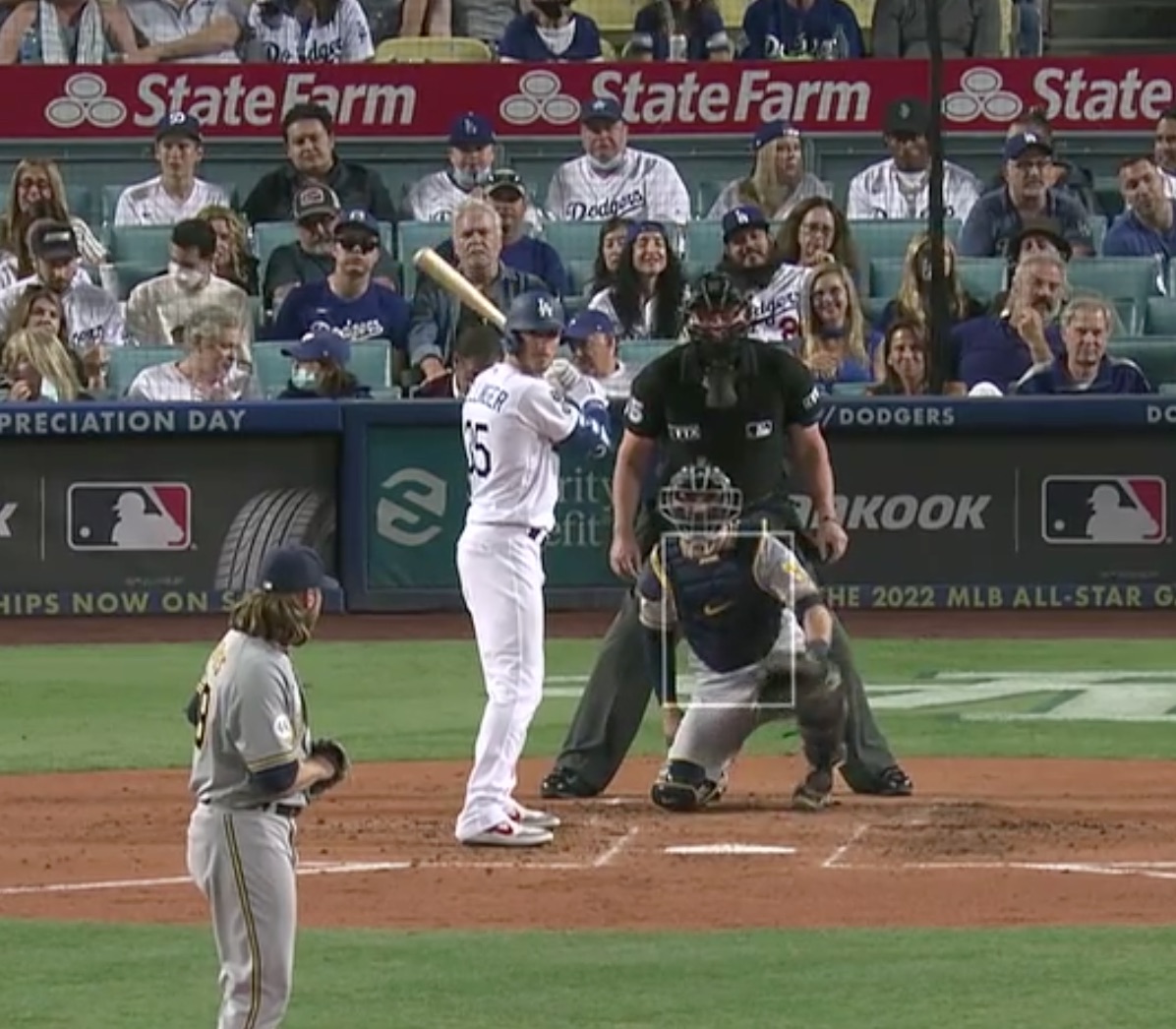
And here he is in video form from a mid-September game:
In the NLDS, things looked different. While the change isn’t enormous, you can clearly tell that Bellinger is a little closer to the pitcher. Here he is standing in for his first at-bat in Game 1:
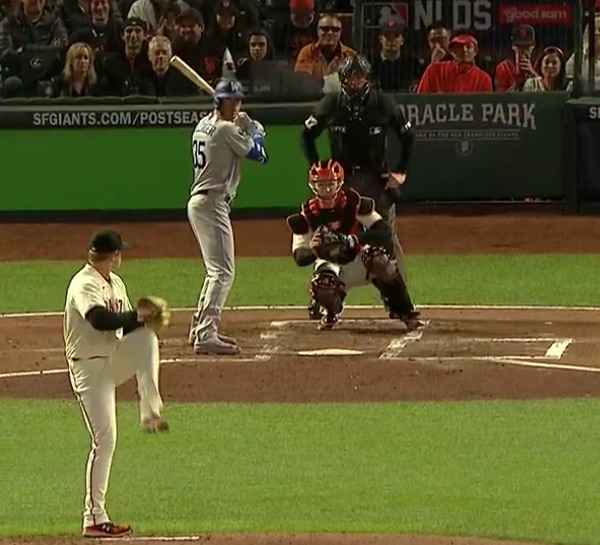
Now when he swings, it’s his front foot that reaches the edge of the box. Why does it matter? It depends on the hitter, but one advantage to being a little closer is that it gives breaking balls a little less time to bite. The difference isn’t large, of course, but there are plenty of hitters who like to be further forward so they can get out ahead of off-speed stuff. For all the (correct) discussion about how Bellinger couldn’t hit velocity, his numbers against breaking balls and changeups were miserable as well. That’s new for him: he usually handles off-speed very well, and even did so last year, in what was a down season overall. I can’t help but wonder if that adjustment made a world of difference in a very big moment:
The second change is in his stride. If you look at any of the above videos from earlier this year or in previous seasons, you’ll notice that he has a slightly open stance and that his weight naturally goes toward the first base dugout. While not concerning on its own, that tendency perhaps got a little more pronounced in 2021. To show what I mean, here’s how his legs looked as he finished his swing in a game back in August:
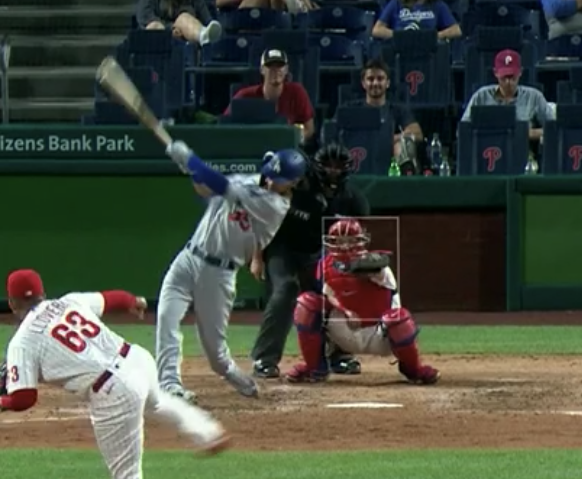
And here’s his finish from the homer he hit yesterday:
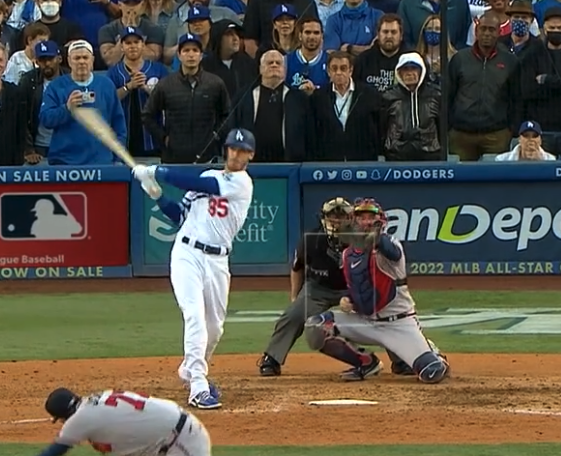
He seems to be starting in a more closed-off stance, perhaps as a cue to change his stride as he gets ready to swing. I’m not entirely sure what the impetus behind the change was here, but in theory it should help him cover the plate a little better and give his bat more time in the hitting zone.
We should also talk about that homer yesterday a bit more. Bellinger, as you’re probably aware, swings with a vicious upper cut. His launch angle has always been significantly loftier than average, and it got steeper this year, all the way up to 22 degrees. As you’d imagine, that positions him well to drive low pitches, but it also leaves him vulnerable to balls above the belt. Of his 133 career homers, only six have been near the top of the zone. And yet yesterday, with the stakes as high as they’ve been all year, Bellinger got a heater at the letters and he hit the tar out of it:
It’s an impressive piece of hitting. He’s almost certainly cheating fastball in that situation but whether or not he is, keeping the bat head flat enough to line a ball that high is extremely difficult to do, particularly when your normal swing looks nothing like that. I don’t know how repeatable that kind of swing and swing result will be for him, but the fact that he’s got the capacity to do so will make the next pitcher think twice before heading upstairs in search of a whiff, and there’s some value in that.
Now for some long-awaited and probably overdue caveats. We don’t know how intentional all of these changes are, nor how responsible they are for his recent success. Even in a miserable season, you can find 28 PA samples where Bellinger knocked the ball around the yard in 2021. Perhaps he’ll keep using these mechanics and revert back to whiffing on fastballs and dribbling everything else weakly, as he has all year. Moreover, we don’t know how he’ll look if pitchers in turn adjust to him. Even if Bellinger’s adjustments have been a real difference maker, it’s possible that they also open new vulnerabilities that opponents will mercilessly exploit in due time. I don’t want to give the impression that he changed his stance and altered his stride and now he’s ready to compete for MVPs again. It won’t be that easy.
That said, Bellinger has legitimately looked like a more dangerous hitter lately. He’s getting to pitches that gave him fits this season, he’s fought off plenty of tough offerings, and his at-bats have been much more competitive than they were down the stretch. The Dodgers don’t need Bellinger to return to peak form to win, but as the club tries to come back from a 2-1 series deficit, it sure would be helpful if he wasn’t a zero at the plate. Increasingly, there are signs that he’s got something to offer.
Brendan covers prospects and the minor leagues for FanGraphs. Previously he worked as a Pro Scout for the Pittsburgh Pirates.
Thank you for the explanation and also putting it into perspective
Yeah, for all of the chatter about Bellinger “trying things,” this is a really clear and empirical explanation that doesn’t overreach but still delivers. Would be great to see you come back to this in May/June next season!
for his whole career, Bellinger has been notorious at tinkering with things at the plate. Makes sense that he’d keep doing it now.
I can’t blame Jackson for this one at all. He put the pitch exactly where you would want to put that pitch in that count. The fact that Bellinger was able to make solid contact with it……well, it was just really really unlikely. Hats off to Cody on that one.
Post game Jackson said “sadly, it was where I wanted and I’d throw it again”
Exactly. I feel if you ran a controlled experiment of that pitch 100 times, he hits an HR maybe once. That is exactly the type of pitch he typically cannot handle well, especially this year. I guess he cheated (meaning selling out on FB), guessed correctly and executed incredibly well.
I am leaning towards the Braves (disgruntled Padres fan but not intensely anti-Dodger as many are) but the Dodgers really, really needed that swing. Without it, they are probably done.
Also, game of inches, but the Pollock’s foul ball preceding his seeing eye single which preceded Bellinger was barely foul and almost an out, literally inches. That ball stays fair or called fair, Braves most likely win.
I knew it was called foul, but I could have sworn Pollock beat the throw. I never saw a replay of that part, but it might have gone to a review.
cool article, i’d love to read more of them about mechanical changes on fangraphs
After the hit, I kept thinking ‘if the guy in the broadcast booth ever learned to do what Bellinger did just once in a while, his career might have been COMPLETELY different.
I know I’m being an old, mean fart. I couldn’t help it.
Seems like he’s choking up more too. Not sure if that’s only with two strikes or generally though.
Everything I hoped for and more.
I teach every Little League to step just like that… hope he can make it back.
Awful lot of words to say he ran out of pot and decided to give a shit about baseball again.
“but one advantage to being a little closer is that it gives breaking balls a little less time to bite…”
But presumably also less time to react to the pitch? I’d be curious to see the numbers behind this tradeoff.
That bail out of the box is almost Ichiro-esque, other than the weight distribution being all wrong. I got into a very similar rut when I played, where my front foot just automatically shot towards first right before the hip torsion. Is that something particular to lefties? I can’t remember ever seeing a righty batter plant towards third outside of flukes like swinging at a pitch a foot inside.
Regardless, if he can plant his front leg more square to the pitcher he’s not going to roll over everything on the outer half and his balance to go get stuff up/down will be a lot better. Might open up the inner half more with as long as he is though.