
Cubs Should Keep Starting Jason Heyward in the World Series
Would you believe me if I told you Jason Heyward’s play hasn’t cost the Cubs anything this postseason? You might. After all, following their victory over the Dodgers on Saturday, the Cubs are now heading to the World Series. That said, you might be more inclined to believe that the Cubs advanced to the World Series in spite of Jason Heyward’s poor play. After all, in 30 postseason plate appearances, he’s reached base just four times — and one of those four was the product of an intentional walk. Heyward has followed up a very poor regular season at the plate with an even worse postseason, and after several benchings in the earlier rounds of the playoffs, there’s a question as to whether Heyward should start a game in the World Series. And there’s not an easy answer.
In the games during which he’s been benched, Heyward’s replacements, Jorge Soler and Albert Almora, have combined for an overall 0-for-17 mark with two walks, a sac bunt, and one double play (including all PA from Soler and Amora). Heyward hasn’t had too many big opportunities in the field, but his 90 mph throw to nab Adrian Gonzalez at the plate in Game One of the NLCS was an important moment in that contest. And for as poor as Heyward’s been offensively, he’s at least been timely: two of his four hits have been of the leadoff, extra-base variety in one-run ballgames, so his WPA in the playoffs is actually the same as Ben Zobrist‘s (at -0.32) and not too far off of Dexter Fowler’s -0.15 — to say nothing of the defensive plays not counted in WPA. Of course, looking at the past 10 games and counting a couple timely hits as worth more due to sequencing is a very poor way to make future decisions. If the Cubs knew in advance Heyward would hit that poorly in the first two rounds, they likely wouldn’t have played him.
Arriving at an accurate estimate of Jason Heyward’s true talent level right now is pretty difficult. Over the course of a long season, Heyward’s hitting has been dreadful. In July, August Fagerstrom examined how Heyward had lost the ability to hit low strikes, which he had done quite well previously. The month after that, Jeff Sullivan noted that Heyward’s problem wasn’t one of luck; Heyward’s exit velocity was down and he making less hard contact, especially relative to his rate of soft contact.
Heyward has put the ball in the air more this year, which was likely a goal for Heyward and the Cubs coaching staff this spring, but that adjustment hasn’t yielded positive results. Heyward, who has tinkered with his stance and swing at the plate nearly every year in the big leagues, added a double toe tap to his swing with the idea that he would get to more fastballs on the hands.
Here’s his swing last year without the double toe tap:
Look at the movement of his feet and the location his hands when he starts his swing. Now here’s what Heyward looked like for most of this season.
The idea behind the toe tap is to get Heyward started a little bit earlier — and potentially to eliminate the hole inside on his hands — so he can (theoretically) pull those balls in the air with power. Getting his hands a little lower and in a bit better position to swing also (theoretically) provides him a better opportunity to get under the ball. Generally speaking, fly balls and line drives have higher exit velocities, so getting the ball in the air more should increase exit velocity.
Whatever the idea behind Heyward’s mechanical adjustments entering the season, they seem to have produced the opposite effect. He went from one recording one of the highest exit velocities on ground balls in all of major-league baseball to a merely middle-of-the-pack figure, per Baseball Savant. While putting the ball on the ground sacrifices power, those balls are more likely to go for hits. Doing a poor job when putting the ball in the air compounded the issue.
Heyward has since abandoned the toe tap, and gone back to a stance and swing closer to what he exhibited last season.
Perhaps keeping his hands higher is what helped provide power on those low pitches before this season — and, with his large frame and long arms, adding a toe tap didn’t end up helping his timing. Heyward saw more fastballs this season than in any during his career, and only Angel Pagan and DJ LeMahieu saw a higher percentage of fastballs in the majors. It would seem, in other words, that opposing pitchers haven’t been hesitant to challenge him. His change back to his previous stance hasn’t yet proved fruitful, his struggles continuing into the postseason.
So what is Heyward now? His projections currently put him at a 100 wRC+, not quite splitting the difference between his terrible 2016 and his solid 120 wRC+ from the 2015 season. We can’t discount the fact that Heyward’s wrist, which was injured in the second series of the season, might have sapped some of his power, regardless of stance or mechanics. Let’s say we think Heyward in his current form is compromised, and that his 72 wRC+ over the course of the season represents his current talent level. His defense, which was seemingly unaffected by his struggles at the plate, was great as usual. So even with the batting deficiencies, Heyward was worth 1.6 WAR over roughly 600 plate appearances.
Heyward has a few potential replacements. In the first few games in Cleveland, the designated hitter will be used and David Ross is likely to catch Jon Lester. Perhaps Miguel Montero will catch Jake Arrieta in Game Two. Willson Contreras is an option who projects as an average hitter — therefore profiling as a good to very good player at catcher — but he doesn’t provide the same benefits as Heyward in the outfield. Even if Contreras is average defensively in the corner outfield, which might be a stretch, that makes him a 1.3 WAR player over 600 plate appearances.
If Kyle Schwarber makes a return to the Cubs and serves as Chicago’ designated hitter, that means Jorge Soler could be freed up to play outfield. Right now, Soler is a slightly above-average hitter, and even if we give him the benefit of the doubt and say his defense is average in left field, he still projects as just a 1.5 WAR player over 600 plate appearances. Joe Maddon’s other option, Albert Almora, only projects for a 75 wRC+, essentially at Heyward’s 2016 regular-season level. He likely plays above-average defense, but it’s unlikely that he’s as good right now as the best right fielder in the game, putting him closer to a 1.0 WAR per 600 plate appearances.
While Heyward has been lost all year at the plate, and he certainly hasn’t helped himself with his performance so far this postseason, it’s not clear that he isn’t still the best option for the Cubs in the World Series. The other factor going in Heyward’s favor are the pitching matchups. When Heyward was benched, the starting pitchers were Madison Bumgarner, Rich Hill and Clayton Kershaw, all left-handers. In addition, two of Heyward’s starts were against lefties in Matt Moore and Clayton Kershaw. Cleveland isn’t likely to present a platoon advantage for Almora, Contreras or Soler — and Schwarber seems unlikely to be ready to start the outfield.
It hasn’t been easy to watch Heyward struggle at the plate during the regular season or playoffs, but with a very talented and deep Cubs offense, carrying Heyward’s bat to get his glove is probably a worthy trade. He’s likely to continue struggling at the plate and there are going to be a few mid-game plate appearances against Andrew Miller that figure to be nearly hopeless, but the alternatives and circumstances don’t present the same any obvious alternatives. Neither Heyward’s contract nor manager loyalty should be enough to justify a start, but even a compromised Jason Heyward is likely a better option for the Cubs than the rest of the corner-outfield options.
Craig Edwards can be found on twitter @craigjedwards.


No matter what decision is made, everyone everywhere will be proclaiming why it’s wrong
…not that you haven’t changed my mind. Great article, thanks for some solid numbers. How does Coghlan compare? Pretty similarly I imagine?
Thanks. Coghlan is roughly a replacement player at this point.
Solid numbers and points but as a Cubs fan I’m hoping Contreras gets the reps out there instead of him. Don’t think it’s fair to use the 0-17 on Soler and Almora with such a small sample size and definitely don’t think Heyward deserves any credit for that throw to get Gonzalez at the plate. A hard hit ball directly at him with Gonzalez running the bases, he took his time and still threw the ball far up the line where Contreras had to make a diving attempt to get Gonzalez at the plate where somehow replay review upheld the call. There’s no doubt in my mind any of the alternatives make that throw.
I’m with the premise, although when you’re talking about the performance of Soler/Almora in Heyward’s absence, it’s probably fair to reiterate that those two guys started against MadBum, Kershaw, Rich Hill, and Kershaw again. Those are tough assignments even if they do bat right handed.
Heyward actually started and played the entire game of Kershaw’s first start against the Cubs, neither Soler nor Almora started that game.
Ah, that’s right, I remember being dumbfounded by it. Regardless, I don’t think either of them have started against anyone not named Bumgarner, Kershaw, or Hill. That’s tough for guys who haven’t been getting consistent playing time.
The premise of this article rests almost entirely on an estimate of Contreras of 1.3 fWAR/600 and him being an “average hitter”. Why would we/the projections assume that he is worth so little when he was the best hitting catcher with 250 PAs or more this year? He was worth 4.7 fWAR/600, but the projections say he is worth a quarter of that? Why would we assume a player would completely tank at the plate after doing so well as a rookie?
Moving him away from catcher to a corner outfield spot blunts a lot of that WAR/600. Projections don’t have him continuing his 126 wRC+ that he amassed in just 283 PA this year.
Isnt it actually 130 Wrc+ in over 300 plate appearances when including postseason?
Projections are kind of jaded against rookies without incorporating tools. Even lindor projects for a 103 Wrc+ despite being better in over 1100 pa’s. They are great for vets but not really great for anyone under 3 yrs service time.
I’m with buckeyewalker on this one, what do the projections say if you exclude data <=2014, or in some other way compensate for the true talent shift he appears to have undergone sometime in late 2014/early 2015? I'd bet the current projection is dragged down by his pre-2014 numbers, which seem to no longer be representative of his true talent.
Projections obviously aren’t great at figuring out if a player had an inflection point for some reason, either upward or downward. In this case, a big part of skepticism from the projections is over a partial season ISO that’s well above what Contreras ever accomplished in a full season in the minors.
Since azl a year ago he has a ~.225 iso in 605 plate appearances including postseason. A lot of that power is center and right field which is an awesome sign for a still young hitter. Its unfortunate Projections won’t take that in full account until another year and a half. Its slow reacting and cautious which is understandable but I think we can incorporate scouting and realize guys like swanson, lindor, contreras, bryant, bregman, benitendi, correa are likely to outhit their projections.
The projections actually say he is worth half that, and as Craig said, at catcher, not OF.
And at the others, projections take into account that old stats are less representative than new stats. But there are plenty of great minor leaguers who sucked in the MLB as well.
They don’t take scouting in to effect. They still weigh the stats, it’s true the break down is more 40, 35, 25 (not actual numbers) in weighting but it’s certainly still weighted.
The Cubs were in such good position in the standings early on that by mid-season I was rating games based off of Jason Heyward’s batting performance.
“Sure we lost, but did you see the fly-out Jason Heyward ripped to the warning track? The exit velocity on that ball looked to be 95!” And that would be a good day. Perhaps an even better day and a bigger win than an actual team victory and Heyward going 0-4. 0-4 with a chopper two-hopper to the second baseman, followed in his next at-bat by a strikeout, then a chopper two-hopper to the first baseman, and finally a pop-out to the shortstop. Because all we needed was to get Jason going!
But he never got going. And that projected wRC+ of 100 moving forward is absolutely frightening.
Here’s a fun one: If he was a FA after the season, what do you think he signs for?
This is sort of a cop out answer to that hypothetical, but I believe at his age that he’d sign a 1 year deal, thinking that he could re-establish value if next year’s batting line looks a lot more like pre-2016 Jason Heyward.
If he did rebound in 2017, then there’s a good chance that at least one team would view this year as an aberration – perhaps focusing on the wrist injury that Craig mentions in this post – and offer him a contract over $100 million after 2017 (though not quite as lucrative as his current deal).
So I think he’d be a rare case of a player who would take a qualifying offer, and I believe that he would get a QO. If not, maybe something like 1 year for $10 million, because the lack of a QO would be an extremely negative signal that his current team (who should know him best) believes that 2016 isn’t an outlier.
Call me crazy, but I trust Willson to beat those projections more than I trust Heyward to not fall short of them.
Can you imagine how much discussion there would be of Heyward’s contract if the Cubs hadn’t been so successful in spite of his struggles? This has the appearance of a Pujols-type disaster given how defense typically declines. Cubs fans understandably won’t care about any of it as long as they win a World Series, but this graphic from Jeff Zimmerman has to be somewhat terrifying until then: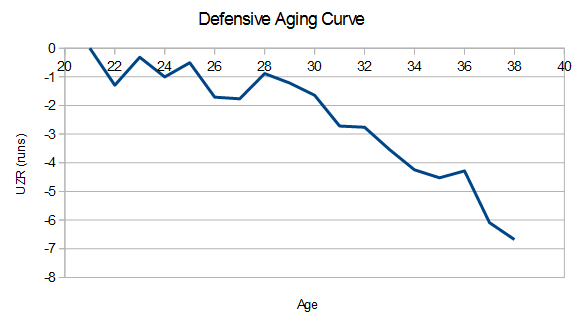
Which is a swing of like 4 runs until the end of his contract…terrifying is not quite the word I would use.
Keep in mind that this is an average. Players at the upper end of the defensive spectrum will lose more runs saved than those toward the bottom who were already poor defenders. The point is that Heyward’s defense is expected to start declining significantly as soon as next season and should continue to decline even more rapidly from there.
Because they have more total runs to lose does not mean they will lose them more rapidly however. Look at ichiro who is probably one of the more similar players. Beltran had his best defensive season at 31 before injuries killed his defense.
5 runs is half a win. So he will lose half of 1 war in year 6 of the contract? Yeah I don’t think the defensive age curve is the worry. Its all about retooling the swing.
Do you have any research or evidence that it is “harder to project Heyward’s true talent level” than any other player? In other words is a player who projects at .323 and has had .320-.330 or so the past 3 or 4 seasons any easier to project than a player who was .329, .346, and .282 the last 3 seasons? The projections of course weight the .282 much more heavily than the prior seasons.
And let’s say that the error bars around Heyward’s .322 are larger than someone who was around .322 for the last 3 years, does that make a difference in terms of what we would expect in the next 30 PA or so? Does it make a difference in terms of decisions to be made about whom to play in the series? IOW, do we care in 30 PA whether we know a player is .323 or whether he might be .300 and he might be .350?
If I told you that we have two players to choose from, one of them with a .300 projection (e.g. Coghlan) with a certain error bar around that and another player who we projected at .323 but with a larger error bar around that, which player would you choose to play for the next 7 games and why?
Have you looked at similar players especially age-wise who had a few years of wOBA around .340 and then one year around .280 and see what they hit subsequent to that? Wouldn’t that give us a pretty good idea as to what Heyward is projected to hit in the next 7 games (I’ll guarantee you that the number is around .320).
Just saying…
I wasn’t crazy with the team’s approach to him, trying to extract more power, and get more loft in his swing. I thought the version that STL had last year was just fine. It was a quick, level stroke and produced a lot of line drives. That version would have worked just fine in our lineup.
” in 30 postseason plate appearances, he’s reached base just four times — and one of those four was the product of an intentional walk”
He is not starting tonight….
Have you watched the games? He swings at balls in the dirt and watches upper 80s change ups float right over the middle of the plate.
He might start one or two games in the world series but he won’t be starting next year. He tanked as soon as he got his contract plain and simple.
Most of Cubs twitter noticed the Heyward double tap early this year and wondered what the purpose was. He didn’t have it in spring and didn’t even have it early in April, but right around April 14-15 he started doing it and his hands just lagged through the zone.
A few people thought it might have been an attempt by the Cubs to unlock some of the power he displayed early in his career, but as the season went on and he kept flailing late at anything hard up it was tougher to understand. He sees more fastballs than anyone in baseball and I’m not sure he’s hit a single one (hyperbole, but it sure seemed like it).
I know Heyward tinkers a lot but when it is something *this* obvious you have to wonder how it didn’t get fixed sooner. I tend to agree that his defense alone is reason to keep him starting and it isn’t like the other options are better, it’s a coin flip at this point.