
Dodgers Say, “Buenos Díaz”
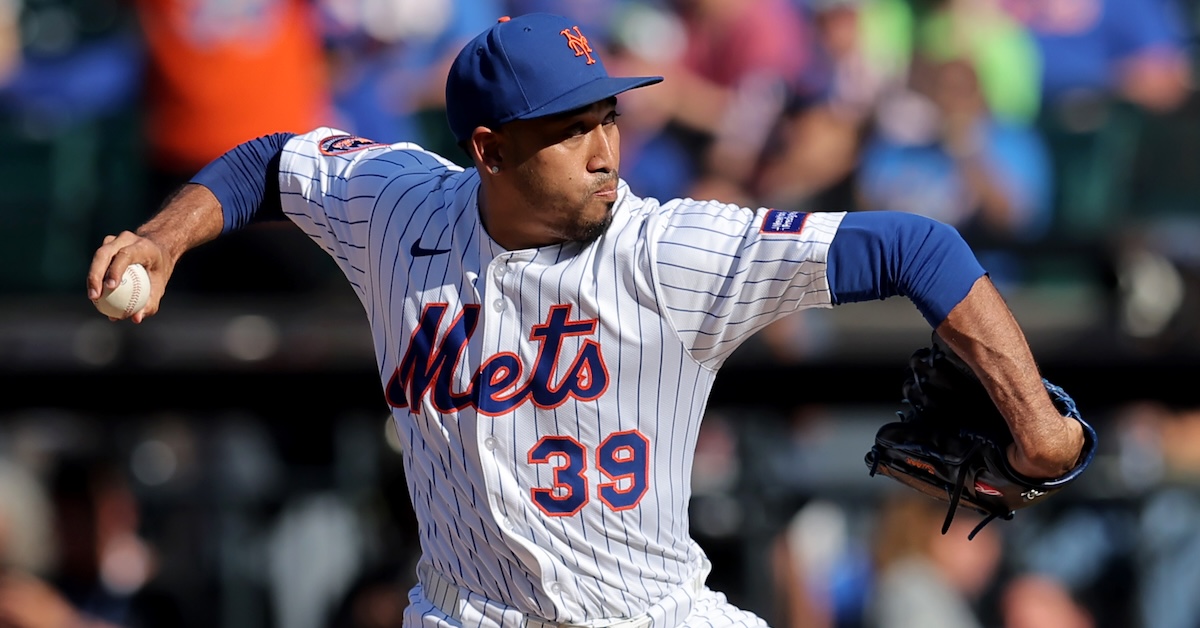
In the last competitive major league baseball game of 2025, the Dodgers used six pitchers, five of whom had spent most or all of their careers as starters. They used all four pitchers from their playoff rotation, most notably getting eight outs from Yoshinobu Yamamoto on zero days’ rest to close out the 11-inning contest. Manager Dave Roberts had run out of patience with his high-leverage bullpen, a group that had already been reinforced with starter Roki Sasaki late in the regular season.
The Dodgers, the best team in baseball, a force so immutable it got the American public to turn on capitalism, had a crappy bullpen.
On the second day of baseball’s Winter Meetings, the Dodgers signed Edwin Díaz to a three-year, $69 million contract.
There’s great beauty in the simplest solution.
In 2025, the 31-year-old Díaz saved 28 games, with an ERA of 1.63. There’s been a lot of chatter recently about how it’s a bad idea to use single-season ERA to evaluate relievers, with the trade of Jose A. Ferrer and the Mets signing Devin Williams as Díaz’s heir presumptive. OK, then: Díaz was eighth among qualified relievers in FIP-, second in strikeout rate, third in K-BB%, and fourth in xERA. Nobody who’s ahead of him in any of those categories is a free agent this season.
Díaz is, therefore, our no. 10 overall free agent and top free agent reliever this winter.
The Dodgers, of course, have shopped at the top of the relief pitcher market before, and with disastrous effect. In 2025, the Dodgers spent roughly $30 million on Tanner Scott, Kirby Yates, and Brock Stewart — their two big reliever free agents and their big deadline acquisition — and got zero playoff innings out of the trio. Incumbent relievers Evan Phillips, Michael Kopech, and Brusdar Graterol were all hurt. Blake Treinen might’ve done less damage to the cause if he’d been hurt too. So the Dodgers know better than anyone that Díaz is not a sure thing.
But, like, he’s about as close as you can get. Over a decade in the majors, between stints in Seattle and New York, Díaz has consistently been one of the best relief pitchers in baseball. Since 2020, he’s second among qualified relievers in FIP- and K-BB%. Since his rookie season of 2016, he’s third and eighth in those categories.
There have, of course, been hiccups. Díaz blew out his knee while celebrating a Puerto Rico win at the 2023 World Baseball Classic, forcing him to miss the whole of that major league season. Since his return, his fastball has been more in the 97 mph range rather than 99, but with that kind of velo and consistent strikeout rates in the high 30s, he’s lost very little in terms of performance.
Díaz was also messy and walk-prone during the Mets’ run to the 2024 NLCS. He famously allowed three runs in a five-batter span in Game 2 of the NLDS in Philadelphia — though not as famously as it would’ve been had the Mets dropped any other game of that series. He’d previously blown a save in an equally chaotic final-day clincher in Atlanta.
Those failings, if repeated in the playoffs in Los Angeles, would surely lead to much consternation in Dodgers World, but I’m inclined to cut Díaz a little slack given the circumstances. Díaz, a one-inning closer for his entire career, was being stretched to cover multiple innings as manager Carlos Mendoza white-knuckled his team over the line. Díaz threw 96 pitches over his final three regular-season appearances of 2024, then 39 more in his first playoff outing, and then at least 22 in every appearance that followed. More than anything, Díaz looked gassed, and the extent to which he bounced back in the 2025 regular season supports such a reading.
Liberating Díaz from Mendoza will do the former good. Surely the Dodgers’ manager doesn’t have a history of weird high-leverage bullpen decisions…
As gaudy as Díaz’s achievements have been over the past decade, I do think it’s fair to worry about the future of a power pitcher who’ll turn 32 in the week before Opening Day. Díaz also has highly limited postseason experience — and not much to brag about when he has pitched in October — which might matter, or it might not. Even if Díaz can only serve as a traditional closer, that’ll solve a lot of problems for the Dodgers’ bullpen downstream, but such a limitation isn’t ideal for a high-profile relief ace.
The yellow flag I’m actually worried about with Díaz is his quality-of-contact numbers. The thing that made him the best reliever in baseball in his prime was not just that he missed more bats than a homesick vampire; Díaz also had terrific quality of contact-suppression numbers. But a 97th-percentile hard-hit rate in 2024 turned into a 57th-percentile hard-hit rate in 2025 — not exactly alarming, given the still-elite whiff rate, but worth monitoring.
That number would’ve dissuaded me from offering Díaz another $100 million contract, but the Dodgers didn’t have to do that. Ben Clemens predicted a three-year, $75 million contract; our median crowdsource estimate was four years and $84 million. To get Díaz for three years and $69 million seems like a tidy piece of business for Los Angeles.
You’d expect ZiPS to hate a relief pitcher in his 30s signing for big money, but that’s not really the case; ZiPS projects Díaz to be worth $58 million over the next three seasons:
| Year | W | L | ERA | G | GS | IP | H | ER | HR | BB | SO | ERA+ | WAR |
|---|---|---|---|---|---|---|---|---|---|---|---|---|---|
| 2026 | 6 | 2 | 2.93 | 57 | 0 | 58.3 | 41 | 19 | 6 | 20 | 84 | 147 | 1.3 |
| 2027 | 5 | 3 | 3.21 | 55 | 0 | 56.0 | 40 | 20 | 6 | 21 | 78 | 134 | 1.1 |
| 2028 | 5 | 3 | 3.42 | 54 | 0 | 55.3 | 42 | 21 | 6 | 22 | 74 | 126 | 0.9 |
It’s worth noting that Los Angeles is getting back on the expensive closer carousel just one year into Scott’s four-year contract. Even with approximately $48 million (accounting for deferrals) still owed to Scott, the Dodgers haven’t waited around to see if he can be salvaged. With this much money available, and so much of the lineup and rotation already set, they’re not going to risk their 2026 playoff ambitions by tempting the sunk cost fallacy. If Scott wakes up tomorrow and decides not to be as ludicrously hittable as he was in 2025, so much the better. But Andrew Friedman and his merry band are wise not to bet the season on that happening.
Spare a thought, also, for the Mets, who just lost their franchise closer. Replacing Díaz with Williams was a smart move; I’d rather have Díaz for 2026 in isolation, but given the choice between Díaz at $23 million a year or Williams at $15 million a year, I’d take Williams and reallocate the savings elsewhere.
And the Mets do have bigger needs than the bullpen. Either re-signing or replacing Pete Alonso has to be the top priority; the Mets’ lineup thins out very rapidly as currently constituted. The rotation has some depth, but no bona fide no. 1 starter unless the messianic hype surrounding Nolan McLean comes good quickly. With those holes still to fill and Williams already under contract, the Mets could afford to let Díaz walk.
It makes sense that Díaz is moving from one of the two richest teams in the league to the other; an elite closer is a luxury player, becoming more useful the better his 25 teammates are. It’s possible to win a World Series without one, of course, but it’s tough. The Dodgers just showed that; it’s quite reasonable that they aren’t eager to repeat the experiment.
Michael is a writer at FanGraphs. Previously, he was a staff writer at The Ringer and D1Baseball, and his work has appeared at Grantland, Baseball Prospectus, The Atlantic, ESPN.com, and various ill-remembered Phillies blogs. Follow him on Twitter, if you must, @MichaelBaumann.
Lmao. Great title. We all know you’ve been sitting on this one for a while
i hate what the dodgers are doing, but this feels like all the other owners are essentially colluding to not spend. the owners are letting the dodgers do this so they collect on luxury tax proceeds and maybe even get their salary cap so they wont have to pay players as much any more. who cares about competitive balance! not the other 29 teams!
Neither the players nor the owners care about competitive balance. That much is abundantly clear.
I am curious: Why should players care about competitive balance when mgmt determines their own priorities? What do you expect Shohei Ohtani to do to encourage Bob Nutting to spend money?
The players and the owners, as groups, should care about the long term health of the league.
The players have been trying.
Unfortunately, they don’t own any baseball teams.
{Olde English Peasant Voice): WE SHOULD ALL CARE ABOUT THE LONG TERM HEALTH OF MI’LORD AS HE KEEPS ALL THE PEASANT FOLK SAFE
“HOW DO YOU KNOW HE IS THE KING?”
“Because he’s not covered in shit…”
Thank you for keeping Monty Python alive.
I don’t think this deserves downvotes, because this is correct. All parties should care. That is separate from who has the power to change things.
For one thing there would be more bidders for their services
I think the players should care, but it really isn’t up to them. Just as I care about helping people via donations, but I don’t have money and the reason people need donations is because the billionaires and the government have put the screw to people, so it should be the people with the vast resources and power who solve the problem.
This is a deep misunderstanding of labor relations.
Really? Last time I checked, there are two parties at the CBA table and one of them is MLBPA.
Clearly MLBPA is not willing to bargain for increased competitive balance. Do you disagree with that? I’m not saying it’s a moral failing on MLBPA’s part. I’m saying nobody at the table gives a damn.
It’s a deal several other teams should have gone for. Why did the Braves bring back Iglesias instead of matching this? Diaz could put the Cubs or Yankees over the top in tough divisions, these are teams that can afford to pay $300,000 an inning. He’s a huge upgrade for mid market teams like the Brewers, Guardians, Royals, and A’s who are a few moves away from being true contenders.
Not every team should be in on an expensive closer, it’s a win now move and plenty of teams have a good closer in place, but yeah there are easily half a dozen teams that would be much better with Diaz on their roster with this contract.
I am not disagreeing with the main point of your argument, but I am more than a little curious about the thought process that put both the Brewers and A’s in the same bucket of “a few moves away from being true contenders.”
Brewers: Could use a dominant starter and left-handed bat
Athletics: Need three playoff-level starters, three high-leverage relievers, an MLB-level stadium, and a city.
As long as we’re dreaming, the A’s could use a competent owner, a and a Nick Kurtz extension. And if we’re really dreaming, my younger self wouldn’t mind if we got a do-over on the 1988 World Series.
The A’s played winning baseball in the second half and have a bright future on the field, even if we don’t know which field that’s going to be!
Yeah they’re nowhere close to the Brewers, they both have ownership that would balk at paying that much for a reliever which is why I grouped them together.
The Braves brought back Iglesias because the second half of the year he rebounded and was a top 10 reliever. Not saying they shouldn’t have gotten Diaz as well though.
The Brewers are a mid market team? They are the smallest market in the league.
The A’s now have the smallest market, but that was entirely self inflicted.
I don’t think there are a ton of obvious “mid market” teams except for the Twins, Tigers, and Rockies. Maybe the D-Backs, Mariners, and Cardinals but they’re larger than they look. The Rays and Marlins *should* be mid market too, but they haven’t really been able to cultivate a fan base, for both good and not so good reasons.
“Big Market” is a misleading term. NY metro is twice the GMP as LA and SF-SJ.
Those are 40%-70% larger than Chicago, Bal-Wash, Houston, Boston, Atlanta, Philadelphia, Dallas, Miami.
Those are 70%-100% bigger than Phoenix, Minneapolis, Detroit, San Diego, Denver
Those are 50%-100% larger than Tampa, St Louis, Cincinnati, Pittsburgh, Sacramento, Las Vegas, Cleveland
Milwaukee is 30%-50% smaller than those, and 1/20 the size of NY and 1/10 the size of LA and SF-SJ
This is an excellent and well-made point, but just wanted to add the caveat that metro size and market size may not always align.
As an example, I have the impression that Atlanta’s fandom spreads much more widely over its region as compared to the east coast, where rivalries are more densely packed.
And then you have depth of fanbase commitment, with places like Boston where fans would kill or die for their local sports team, and LA where (at least before all this recent success) fans mostly wanted to be seen and then escape the parking lot by the 7th inning
One thing about the Dodgers that rarely gets mentioned while people are throwing apoplectic fits about “signing everybody” or “ruining baseball”: they’re always in win-now mode. Their ownership will never be ok with a interregnum of a year or two while prospects are coming up and working their way into the lineup. They will always sign the people they need immediately to win a title immediately. And it doesn’t matter how many they win, they will continue to behave as if next season’s goal is another title, indefinitely.
This isn’t an argument for a salary cap, btw, because they will continue to act like this even if one gets put in place. And because they are so single-mindedly focused on championships, players will sign with them just to be part of that, even if a better deal is implied or offered elsewhere.
I don’t know. Relievers are inherently volatile, and teams seemingly find good relievers out of thin air every season. So, spending lots on a reliever is not IMO where most teams should be spending, unless spending that money does not lead the owner to cry poor on spending on talent elsewhere for the roster.
I don’t think it’s nearly as complicated as that? Diaz chose to sign with the two-time defending champions who also had the best offer. Of course he did!
Was this really the best offer? It’s December 9.
Seems more like it was an acceptable offer and Diaz really wanted to be a Dodger.
Why wouldn’t this be the best offer? Even the top end relievers aren’t going to have as many teams competing for them in FA compared to batters. For the best reliever on the market you’ll have even fewer willing to pay that +$20 mill/year or more to a closer.
It’s below Clemens’ guess (3/75), below the median crowdsource (4/84) and below MLBTR’s estimate (4/82). The deal came together so quickly that it seems unlikely the other usual suspects were invited to top it. It doesn’t seem like Diaz was trying very hard to get that last $10m or so.
So the Dodgers REAL secret sauce that when an ownership group shows that they ACTUALLY CARE about creating value rather than rent-seeking, players want to play for them?
And you this is something the players need to collude with the rent seekers in order to put a stop to?
Show me how actually caring (by which I can only assume you mean winning games) has improved revenues for the 2000s As, or the 2010s Rays, or the current Brewers.
The markets are fixed by MLB. This is not a free market situation. Tampa Bay can’t sell broadcast rights to the New York service area.
The league needs real revenue sharing. Quit pretending it’s a consequence of virtuous ownership that the biggest money teams spend the most.
Note that it might not be just Championships that made him want to be a Dodger.
His brother, Alexis Diaz, was on the Dodgers for a bit last year. Perhaps big bro had good things to say?
Its his right to want to be a Dodger for whatever reasons please him. All I said was that this is probably not the largest contract he could have received.
This is just as wrong as “the Dodgers are ruining baseball!” narrative. Nutting, Fisher, and Sherman are cheap. Cohen is at the complete other end of the spectrum was the only owner willing to lose $100+ million every season, which makes sense as he’s wealthier than the third, fourth, and fifth wealthiest MLB owners combined. He paid a fine of $900 million to the SEC for insider trading without even blinking.
Every other club in baseball spends according to what they make. Some are a little more aggressive (Blue Jays & Phillies) while some are a little less aggressive (Cubs & Red Sox), but for the most part payroll is guided by revenue.
The problem is MLB is that most of their media revenue comes from team specific deals, not national deals like the NFL. That means that the Dodgers’ annual revenue is more than the Athletics, White Sox, and Rays combined. It’s a disparity that other North American leagues don’t have to deal with. For comparable situations you need to look across the Atlantic to European soccer leagues.
That’s part of the problem. A significant factor is also that a lot of teams are making good money and not spending it.
The reason Cohen is willing to lose that much money every year is because he knows that if he builds up the team to be competitive their sale will more than pay for it. The Dodgers became the Dodgers by spending more than they were bringing in and it paid off. The problem with most teams is that they don’t have owners willing to do the same despite being able to afford it. For most of them their only goal is owning a sports team and collecting the income. They don’t care how they perform so long as they can claim they own a major sports franchise in the US.
The reason Cohen loses that much money is because it has absolutely no impact on his bottom line.
I think he really is an outlier among owners in that he genuinely treats the team like a civic institution (to use his own words) and doesn’t care about the finances
Meanwhile, the Yankees spend a lower proportion of their operating income on payroll than Tampa, even as KendHal tries to cry poor.
Yes, good. That’s what it is, a big benevolent vanity project that prints money.
That is utterly delusional and completely wrong. Steve Cohen has no intentions of ever selling the Mets. He bought them as a vanity play to whitewash his reputation after the insider trading scandal.
The only reason he doesn’t care about losing $100+ million every season is because he’s worth $21.3 billion.
The Dodgers became the Dodgers by being the first team in the country’s second largest city. Andrew Friedman has run the organization incredibly well and deserves immense credit for doing so, but they have systemic advantages that other clubs except the Yankees can’t match. Speaking of which, the Yankees consistently run second in revenue annually despite being largely incompetent since 2009.
Again, this is utterly delusional. Sports franchises in North America are immensely valuable due to stable revenue streams and the absence of relegation. But they’re still businesses. Expecting any team to be run with massive losses just because the owner is “able to afford it” is naive in the extreme. Business owners aren’t indifferent to massive losses unless they live in the Cohen / Musk stratosphere. 90% of clubs in all North American sports spend based on the revenue they generate.
Object example – the Dodgers and the Angels share the same media market. Why do the Dodgers make (and spend) so much more? Because they spent the last 50 years investing in their team. They’ve grown the pie.
The Angels might have had a chance to grow their pie in the 2010s, which started with the Dodgers going through bankruptcy and included the Angels signing Ohtani. But the Angels’ ineptitude prevailed. And they remain the Angels.
Granted that the NFL has national TV revenue sharing, but look at the fandom of the Steelers. Every city seems to have a “Steelers Bar” if not ten of them. The team’s ability to drive fan-driven revenue is not related to their hometown market. It is based upon decades of investment. Pirates have the same market. Same colors! Same cool 1970s success. No significant diaspora of fans.
Yeah I disagree with some of the details but if we are talking about having teams who don’t spend up to their revenues it’s the Yankees, Cubs, Giants, and Red Sox that are the most egregious situations. It’s more obvious with the Pirates / Athletics because they don’t pay anyone anything. If you want teams to spend more you have to figure out how to get more money into the hands of the Padres, Brewers, and Royals.
The Toronto Blue Jays spent over 3-times as much on one player than the LA Dodgers did on Diaz. But sure, keep telling yourself no other team will spend money.
I wonder, in a case like this, if Baumann had this title in his pocket for weeks or if he comes off with it in a spur of the moment.
The people demand to see Baumann’s Notes app!
It’s the “missed more bats than a homesick vampire” line that really got me
Hear, hear.
That’s some nice money for Diaz.
Whether they should’ve re-signed him or not, it seemed like after Williams the writing on the wall was pretty clear about the Mets’ interest in paying him this money. This doesn’t even seem like a lot more than New York was rumored to be offering.
I don’t really understand why the Mets wouldn’t do this. It’s only a 3 year deal.
One thing I’ve always said about giving out extremely large contracts is that it’s great as long as the team (usually the owner) doesn’t start backing down when it makes sense to spend. If you’re going to ignore opportunity cost when you spend money on deals for Sean Manaea you shouldn’t use that as a reason to not pursue opportunities that are presented later.
Maybe there’s something in Diaz’s medical file that is really scary. Maybe they spend a bunch to bring back Pete Alonso and bring in Robert Suarez. And maybe Edwin Diaz just really preferred a situation where he was the clear-cut closer. But if not, there’s really no reason at all to just pay Diaz. This deal is not that much more expensive than Devin Williams’s deal is.
Edwin Diaz is not that much better than Devin Williams, either.
I think Williams’ contract is pretty clearly better than Diaz’s.
Diaz and Williams are essentially the same age.
The main differences are:
Edwin Diaz was much better at pitching ten years ago.
Edwin Diaz was much better at pitching last year.
They WERE similar pitchers 5 years ago, in fairness!
I wouldn’t be surprised if Williams outperforms Diaz in 2026 because everything with relievers is a small sample size in a single year. But it would not be something I would predict either.
The Mets were adamant that they were not going beyond three years, which I was fine with but getting outbid is surprising. They put out a we tried leak that we had wiggle room on the offer and that he never circled back to us. I guess it is possible and maybe probable that he preferred the Dodgers. Diaz has lost velocity and his K rate dropped some from his peak season in 2022 but it is still pretty great. I could stomach this better if he left for a team giving him five years.
I wonder if it’s a bad timing thing – if they have a salary cap or limit in mind that they don’t want to breach, and with Pete and Tucker (among others) still out there, they thought matching the LAD contract now would hamstring them against going all out to get an additional bat while there are still available options.
I agree with your assessment – and it puts a lot of added pressure on Devin because he will (unfairly) take a lot of heat from the fanbase if he struggles out of the gate, especially if Diaz starts well in LA.
As a Mets fan, I’m not sure what hurt more reading this: the sting of losing Diaz or “he missed more bats than a homesick vampire”
Probably Diaz. Tong will miss more bats than a homesick vampire next year.
Baumann loves unnecessary analogies and niche references
What if the analogies are amusing?
Bravo for this joke
Came here to say just this. Just when I thought I was out, they pull me back in, etc.
This is what the Dodgers should be doing because they have an absolutely enormous revenue advantage* over almost ever other team in the National League, and when you have that advantage you should use it.
But it is really hard to ignore that per Forbes there were 14 teams with estimated revenues under $350M (presumably in 2024) and the Dodgers estimated payroll is $359M.
—-
—-
*(The gap between the Dodgers and the Phillies–the 1st and 3rd highest revenue teams in the NL–is roughly the same gap between the Phillies and the Marlins, who are dead last in the NL)
I mean: This is likely a good deal for the Dodgers. They’re committing what appears (I’m not sure if the details are out yet) to be roughly the same amount of money to Edwin Diaz as what they gave to Tanner Scott last year, except that Scott’s payout is more spread out.
But maybe we can stop pretending that a huge part of the Dodgers’ success isn’t straight out outspending everyone else? They are certainly good at their jobs, and the simplest solution is sometimes the best one. But this similar money as Scott–but Scott also was replacement level last year. Getting do-overs until you get it right is not particularly interesting.
I remember after the Scherzer and Verlander trades everyone was talking about Steve Cohen’s ability to recognize sunk costs and move on, like oh shit, he’s going to be unstoppable if he’s willing to eat $50M without blinking. But the Dodgers are the team that’s actually doing it, consistently and with a machine-like degree of rationality. No one even cares about the expense of Tanner Scott’s deal enough to notice it anymore!
It’s not even really their money. They spend a lot of money but there are other clubs who do that, and a few others that would if people would actually sign with them (SF and TOR)
It’s that Ohtani signed with them. Then downstream of that they also got Yamamoto and Sasaki. They won this year because of Ohtani and Yamamoto
It’s definitely their money. The Dodgers without the money are the Brewers, or the Rays, or Cleveland.
It’s all of it, man. If it was this easy, why can’t the Mets seem to find the proper lane? Why do the Yankees seemingly lack fundamentals in their system, to ruinous effect? Why aren’t the Angels battling for their division every year? Why are the Giants mired in a decade-long mediocrity only briefly interrupted by an alien visitation?
The Dodgers are the Dodgers because they’ve figured out how to do all of this. They’re the Showtime Lakers or Brady-Belichick Pats. Your team, given the same advantages, would not be able to duplicate it. Not right now.
The Belichick Pats were famously cheapskates (by comparison to other contenders). I agree that the Dodgers spend more money that everyone *and* spending money on its own is no guarantee of success. The Dodgers spend more money than anyone, but to your point it needs to be wisely spent. Which the Dodgers have been doing.
I worry that the combination of spending and savvy results in a noncompetitive championship season, but I don’t know how true that is. There are more wildcards than ever, and even for the Dodgers, a five-game series decides who advances. Of course, the Dodgers know this and work to ensure they are loaded enough to sway even a short series.
They signed Ohtani and Yamamoto to an already good roster to create a competitive tunnel. The Dodgers are Japan’s team now, all in for championships these last 2 years was a business decision that they think will pay for itself with the additional revenue.
Amazing books will be written about this in the near future.
Cool contribution bro
I guess we are still pretending the Dodgers are geniuses because they can outspend anyone else. They’re good at their jobs but I agree with cowdisciple on this. We have seen what happens when smart front office executives don’t have this money and it’s like the Rays and Brewers.
Signing the best player to the largest contract at a position of need is not genius or innovative or whatever. I am surprised anyone is still taken in enough by the mystique to think that it is.
Edit: I re-read the comment this is responding to and mine is really more to a different comment than Placidoo. Whoops.
That’s the difference between big market and small market teams. Big markets have enormous margins for error and can endure mistakes without meaningfully affecting the following offseason. If the Orioles had given Scott that same contract, they wouldn’t have signed a closer this winter.
They wouldn’t have signed *anyone* this winter. The resource disparity is somewhere between enormous and stupefying.
Eh – it depends on whether the owner’s framework is built on creating wealth or extracting it.
Baltimore clearly sold to the latter, so they won’t invest for a few years to build the team into an asset, despite having a 3m metro area, TV exclusivity, and zero contest between Potomac and Wilmington.
The way to create wealth in MLB is to do exactly what John Angelos did: slash costs as much as possible and then sell.
Actually running a team doesn’t create wealth unless you’re able to tap into a new market. The Dodgers did that by convincing Ohtani to sign with them, but that’s not something that anyone else can replicate. Maybe there will be a massively popular Chinese player in the next ten or twenty years that can produce a similar effect, but it’s such a remote possibility as to be irrelevant.
Baltimore, post-Nats, is a small market. It is wedged between the Phillies and Nationals and ranks 31st in GDP per capita. Nothing that Rubenstein does can meaningfully change his market, and as such, what the team spends will be constrained by their middle of the pack revenue stream.
All Angelos did was cash out.
Spend a decade actually investing in the organization, and there’s no reason they can’t get to a $2.5-3B valuation…except perhaps the determination of the other owners to kill the game.
The history of Major League Baseball conclusively proves you wrong. Teams sell based on their revenue and market, not their on-field success. The Athletics won three World Series titles in a row in the 1970s, but Charlie Finley tried to sell the team and struggled to find a buyer due to the team’s low attendance and revenue. When he eventually did sell in 1980, they went for $12 million. The White Sox, who were one of the worst teams in baseball during the ’70s, went for $20 million a year later in 1981.
This is probably much too soon to say that about Orioles ownership specifically but the problem isn’t that individual owners are rent-seekers, it’s that the owners as a *group* are rent seekers that would rather squeeze every last drop out of TV money for doing nothing than to compete with the NFL and NBA.
This whole thing about owners not wanting to spend more on players is kind of irrelevant in the big picture. Of course they don’t, they’re owners. The big picture is that spending more money may make an individual team more attractive but it is usually at the expense of another team. What they need to do is find a way to make the *league* more attractive to fans. And the blackouts, contraction of the minor leagues, and unaffordable ticket pricing has already turned off an entire generation of potential fans and could do it for another.
And the league should have had another six major league teams by now, but that would dilute shared revenue / encroach on established team’s territory while those teams got started. It would dampen increases to franchise valuations. It would take away their major lever they pull to get publicly funded stadiums. So they don’t do it.
A team not spending more money to get Edwin Diaz…that doesn’t increase the value of the sport and league. It does nothing.
Six new teams? Too much, too quickly. Let’s stick with two and have eight four-team divisions (meh) or four eight-team divisions (better!)
They should have been doing another two teams basically every decade. I’m serious.
It’s also a difference between smart ownership groups run by adults, who view their acquisition as an asset which they can grow, as opposed to failsons and rent seekers who cry poor while sucking any and everything they can out of the communities they pretend to serve.
Congrats on trading the cash poor failson for a vampire!
When the Yankees were owned by an adult who’d ever had a job (Hal Steinbrenner: Logan Roy’s nightmare), their secret sauce wasn’t wild overspending.
It was being able to write off a botched signing without engaging in the sunk cost fallacy.
And also wild overspending.
Relative to what?
They ran a lower payroll than the Orioles in the mid-90s.
Pretty surprised he was willing to take just a three-year deal, I was expecting some team to cough up a fourth (or even fifth!) year. Seems somewhat likely to me that he just really wanted to be a Dodger and who can blame him really.
“ZiPS projects Díaz to be worth $58 million over the next three seasons”… then the table shows him being good for 3.3 WAR.
Is the $/WAR these days really ~$17.576MM? That seems outrageously high. Wasn’t it just about $10MM a couple years ago?
WAR accumulation is neither linear nor positionally-agnostic
I think it’s more that WAR is straightforwardly not that meaningful a tool in estimating leverage reliever value.
WAR does not do a very good job of modeling how teams value high leverage relievers, anyway.
It’s basically K-BB
If a reliever enters the ballgame with the bases loaded and one out, fWAR thinks that a GIDP is less valuable than a double and two Ks.
This is really the perfect Dodgers deal
They like signing pitchers who have upside because they can just discard the downside (and Diaz has both) and they also like just taking the gift horse of other teams’ top players when they decide to cheap out and not pay them, as they did with Betts and Freeman
This should not be a precursor to a Glasnow trade hopefully
I feel like Sheehan is the more obvious goner. Packaged with a top 20 prospect if they want someone like Lars Nootbaar, maybe a couple if they’re going after Kwan, etc.
Maybe this is a crazy take in the CW, but Sheehan alone is worth far more than Nootbaar.
the smartest front office in sports weaponizing their financial asymmetry to snag diaz. they simultaneously plug their biggest leak with a luxury enhancement asset while sabotaging one of their few fiscal peers. really smart and aggressive front office hedging.
the dodgers i think have bent to recognizing that bullpen volatility is the roster’s biggest game of chance, so they use their economic muscle to simply buy the house. by hoarding elite arms, they’re brute-forcing the probabilities with so much talent that the variance ultimately hopefully has to surrender.
What is the point of posting AI slop comments? All you’ve said is the Dodgers are spending a lot of money to build a strong roster, but with the most pseudo intellectual verbiage possible
perhaps you should try to improve your vocabulary instead of assuming that people who are smarter than you are are using “ai slop”.
Improve my vocabulary so I can say the same thing in two different paragraphs, but using different words? No, I think I got out of the habit of being needlessly verbose when I was 15. You didn’t do anything as ‘smart’ as you want to think
Your handle is in all lowercase, was that AI?
“But a 97th-percentile hard-hit rate in 2024 turned into a 57th-percentile hard-hit rate in 2025 ”
Have I missed the article that talks about how predictive this is?