
Postseason Managerial Report Card: Dave Roberts
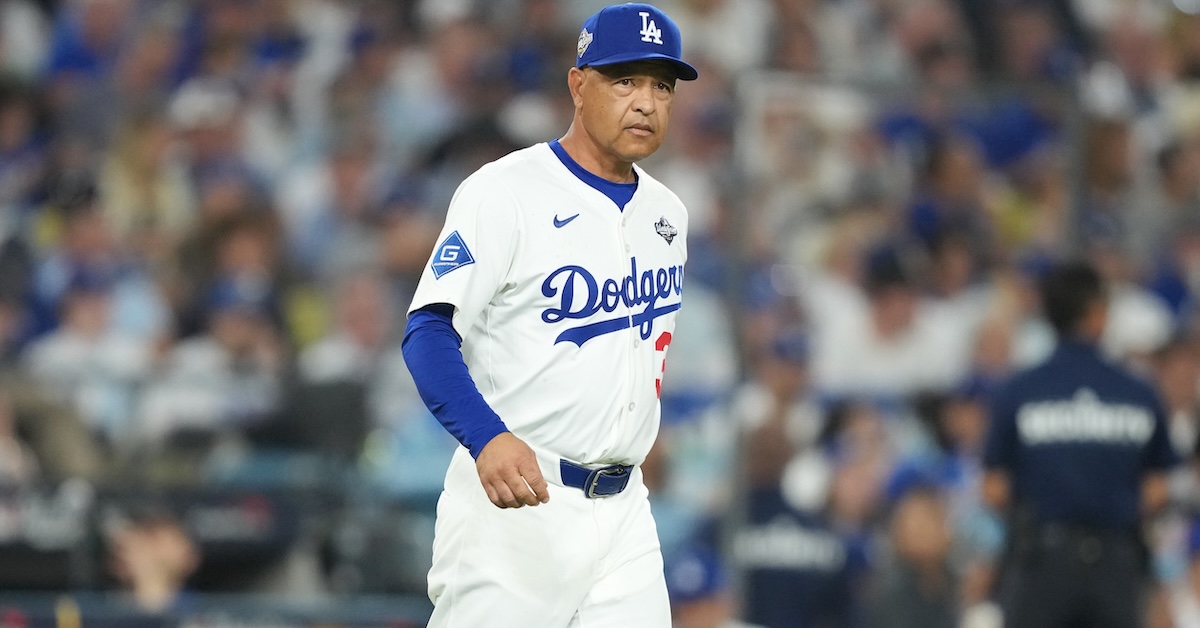
If you’ve been assiduously following the managerial report card series, you’ve no doubt been waiting for this one. I apologize for keeping you in suspense. I’ve been dragooned into service here because Ben Clemens, the normal custodian of this series, is also an inveterate overachiever and saddled himself with the Top 50 Free Agent list at the same time. Even he is only one man.
You can find a précis of Ben’s philosophy on grading managers at the top of any of his report card posts, and I’ll try to follow that blueprint as best I’m able. (You can also find, at the top of Dan Szymborski’s Pat Murphy report card, the substitute teacher gag I wanted to use for this post.)
Why the five-day delay on this final installment in the series? Well, this being my first time writing a managerial report card, I wanted to do right by Ben and his creation. But also, the guy I was tasked with grading — Dodgers manager Dave Roberts — managed a lot, man. There’s just so much to unpack.
Over 10 seasons as the Dodgers’ bench boss, Dr. David R. Roberts has amassed a genuinely unmatched statistical record. He’s made the playoffs every year of his tenure, won five pennants and three World Series. He has the best regular-season winning percentage in AL/NL history, and he’s already tied for sixth all time in postseason appearances and has sole possession of third in postseason games won.
Much of that success comes from the immense collection of talent Roberts has to manage with; few skippers in baseball history have had better tools than Roberts. Nevertheless, it takes some managerial skill — in the sociological, workplace sense of the word — to keep a room full of superstar egos pulling on the same end of the rope for 10 years, without incident. This is both Roberts’ greatest strength, and outside the scope of the managerial report card, which focuses almost exclusively on in-game tactics.
Here, the normally serene Roberts is a bit of a wild man. He’s an incorrigible fiddler, a platooner the likes of which would startle Casey Stengel. He loves using starters in relief, and sometimes manages his bullpen in such a fashion that it looks like he’s trying to line up the most affecting game-ending photo for his star players, rather than making the move that has the greatest probability of producing an out.
Even within that context, Roberts had a tricky job. Globally, the Dodgers didn’t have it any worse on the injury front than their opponents. The Phillies were without ace Zack Wheeler; the Brewers were missing Brandon Woodruff and dealt with mid-playoff bumps and bruises for Jackson Chourio; the Blue Jays were trying to stay alive long enough to get Bo Bichette’s bat (if not his legs) back in the lineup, and George Springer kept making noises like a badly underlubricated two-stroke engine when he swung the bat.
The Dodgers were missing would-be high-leverage relievers Brock Stewart, Michael Kopech, Brusdar Graterol, and Evan Phillips from the start. But Max Muncy (general malaise), Tommy Edman (ankle), and Will Smith (broken hand) all carried some form of nagging injury into the playoffs. Tanner Scott had to be dropped from the NLDS roster with an abscess in an unidentified spot on his lower body (gross), though given his performance down the stretch, removing the temptation to use Scott in a leverage situation might’ve been good for Roberts on balance.
Finally, Alex Vesia, Roberts’ best left-handed reliever (and maybe his only trustworthy reliever overall) had to be dropped from the World Series roster at the last minute to tend to a family emergency.
I’m going to invoke Donald Rumsfeld twice in two paragraphs here, so strap in. Roberts didn’t have to plan from the start for life without a player as crucial as Wheeler or Bichette. But those are known unknowns. Reintegrating a star catcher into the lineup, finding a bullpen workload pattern for Roki Sasaki on the fly, and testing out Edman’s ankle — can he handle the outfield or is he limited to second? — are unknown unknowns.
Writing off a star player, well, it happens. You go to war with the army you have. Making mid-series or mid-game fitness decisions is a high-wire act. Get it wrong and you imperil not just the player, but the whole playoff run. Add in three extremely perilous extra-inning games, and there was a lot for Roberts to do, even if he had the more talented roster in at least three of his four series.
Batting: A
Roberts played things pretty straight in the first two rounds of the playoffs, and with good reason. His offense beat seven shades of you-know-what out of the Reds’ starters and batted .373 with five home runs and seven doubles over two games. Not much to manage in those situations.
The Phillies’ pitchers were much more successful, and the staff being so overwhelmingly left-handed would ordinarily present a challenge to a manager who likes to platoon so much. But a lot of the Dodgers players you’d platoon for — Enrique Hernández, Alex Call, Miguel Rojas — are right-handed hitters with big platoon splits.
Hernández’s defensive versatility allowed Roberts to work a de facto Call-for-Muncy platoon early in this series. Smith, his hand still of questionable integrity, started the first two games on the bench but pinch-hit early for Ben Rortvedt in both cases as the Dodgers needed runs mid-game: top of the fourth, trailing 3-0, in Game 1; leading off the sixth, tied at 0-0, in Game 2.
Muncy also started Games 1 and 2 on the bench against Cristopher Sánchez and Jesús Luzardo, respectively, but entered both at the earliest opportunity. Truly; when Rob Thomson lifted Sánchez for a right-handed reliever in Game 1, Muncy was the first batter David Robertson faced. In Game 2, Orion Kerkering came in to relieve Luzardo, and Muncy came off the bench within three batters.
Once the Dodgers got to the home leg of the NLDS, a lot of the shuffling stopped as their starters recovered from nagging injuries. Smith started every game from Game 3 of that series to Game 7 of the World Series. Muncy started every game except Game 4 of the NLDS, against Sánchez; it seems the Dodgers had a normal anti-lefty lineup, and then an “Oh Jesus, It’s Cris Sánchez” one, which substituted Call for Muncy until the bullpen took over.
It helped that in the 11 combined games of the NLCS and World Series, the Dodgers faced a right-handed starter eight times. In the other three games, they faced a left-handed opener, followed by a right-handed bulk reliever.
Apart from shielding his semi-injured starters, Roberts’ position player tinkering mostly involved some pretty straightforward platoon and defensive replacements. And unlike certain managers I could name, those defensive and pinch-running replacements never came back to bite him: Justin Dean appeared in 13 games, Hyeseong Kim in two. Neither one needed to so much as pick up a bat. Call, the lefty-killing outfielder, didn’t face a right-handed pitcher until the NLCS, and by the time that happened he’d recorded six plate appearances against lefties and reached base every time. I know we’re supposed to judge process, not results, but that factoid was so remarkable I couldn’t help myself.
Once Smith, Muncy, and Edman healed, Roberts faced two conundrums: First, the three aforementioned extra-inning games.
In these, the legendary tinkerer was remarkably conservative. In Game 4 of the NLDS, Roberts made just three position player subs: First, he pinch-ran for Call with Dean in the seventh. Thomson took Sánchez out at the same time, so Roberts knew Call was never going to hit again anyway. Why not add a little speed to chase the tying run, and some improved outfield defense for the next couple innings? Sure enough, Muncy came to the plate the next time this spot in the order came around.
He also pinch-ran for Edman with Kim in the 11th. Managers will face few situations with a clearer “There Is No Tomorrow” sign; Roberts would’ve been foolish not to replace Edman’s compromised ankle with a faster runner. Sure enough, Kim came in to score the winning run.
In Game 3 of the World Series, Roberts kept his hands in his pockets until the 13th inning, specifically calling on Rojas to bunt the potential winning run from second to third. One batter later, he pinch-hit for Andy Pages with Call, who had only to get the ball to the outfield against the left-handed Eric Lauer to end the game. The pinch hit-and-bunt was a little cute for me, but entirely defensible, and once Roberts had pulled that lever, introducing Call was a no-brainer.
Those were the only two position player moves Roberts made across 18 innings of play, and they came after Schneider had completely emptied his bench.
In Game 7, Roberts again made three position player moves: First, Pages as a defensive replacement for Edman when Yoshinobu Yamamoto entered the game with two on and one out in the ninth. Pages was a middle-way choice between Edman and Dean; better defensively than the first, not as hopeless at the plate as the second.
It was a slightly curious move to me, given that Pages had just hit (or not, actually) his way out of the lineup, and that the best-case scenario involved sending him to the plate in the top of the 10th. Is the right move to slide Edman to left and send Enrique Hernández to the bench? Maybe not, if Edman was still at all physically compromised. In the end, Roberts got the breaks, and his only remaining substitutions were to introduce Dean and Kim for defense when protecting a one-run lead in the bottom of the 11th.
Even though the Dodgers healed their way into relative stability as the postseason wore on, Roberts used 13 different starting lineups across 16 playoff games, never using a single lineup more than twice. That’s because two of his starters, Pages and Mookie Betts, went absolutely ice cold. In Game 5 of the World Series, Roberts benched Pages and slid Betts down the lineup, first to third in the order, then to cleanup for Games 6 and 7.
Pages’ struggles were severe; he ended the postseason 4-for-51 with zero walks and only one extra-base hit. But I don’t know what better option Roberts had. He took a defensive hit to put Call into the lineup against the right-handed Trey Yesavage in Game 5; Call went 0-for-2 with a walk and was never heard from again. In came Rojas to play second in Games 6 and 7, with Edman moving to center. Rojas had a 67 wRC+ against right-handed pitchers this year, but what’s the better option? Dean? Kim?
This is why Rojas remained in the lineup against Jeff Hoffman with one out in the ninth inning of Game 7. I lamented at the time that no better option was available, then was immediately made to look like a fool when Rojas hit one of the most unlikely clutch home runs you’ll ever see.
At the same time, moving Betts down the lineup was equally necessary and arguably even more belated. If you take out the two-game turkey shoot against the Reds, Betts hit .164/.282/.213 over 15 games this October. When the Phillies and (for a time) the Brewers were shutting Shohei Ohtani down too, the Dodger offense was truly anemic; and not much better after. The Dodgers averaged just 3.6 runs per game over the last three rounds of the postseason. After the end of the Cincinnati series, they scored more than five runs only once in a game, and they needed 18 innings to do it.
Lineup protection doesn’t have any impact on hitter performance in general, but who’s on deck is the important factor when a manager decides to pass a specific batter along. Ohtani got intentionally walked nine times this postseason; the previous record for a single postseason was five. To me, that’s not a matter of Ohtani being uniquely great or scary; it’s a matter of Betts not only failing to produce, but also looking lost and punchless in doing so.
Roberts doesn’t like to stack same-handed hitters in his lineups, and his second-best right-handed hitter, Teoscar Hernández, was not much less lost than Betts for most of the postseason. Hernández saw more right-on-right splitters this World Series than he’d probably seen in his entire life to that point, and he did not take it well.
But once Smith was healthy, it made all the sense in the world to put him, and not Betts, behind Ohtani.
Why didn’t Roberts do it sooner? Two reasons. First, over a long enough timeline — “long enough” here meaning as brief a period as 16 games — you’d expect a hitter of Betts’ extensive track record to unknot himself. Making the move too soon would’ve looked like panic.
It’s also hard to overstate how radical a move it was to drop Betts in the order at all. Game 5 of the World Series marked the first time in four years that Betts had started a game hitting lower than second in the order. Game 6 of the World Series marked the first time Betts had hit as low as fourth since Game 4 of the 2017 ALDS.
Ohtani and Betts as a top-of-order duo has been Roberts’ one unbreakable article of faith. They hit 1-2 in that order 134 times this year, and 11 more times with Betts first and Ohtani second. Before Game 5 of the World Series, the last time Ohtani and Betts started the same game and either of them batted lower than second was June 15, 2022, when Ohtani batted third for the Angels.
Would a completely unsentimental manager have moved Betts down earlier? Probably, but only by a game or two. Roberts really didn’t put a foot wrong while managing his position players this postseason; where I disagreed with him, it was almost always a 50/50 decision that amounted to style or preference.
Pitching: D+
Pitching? That’s a different story.
Again, Roberts was in an odd starting position with his pitchers. The Dodgers had spent a combined $54.9 million this season on Scott, Kopech, Phillips, Graterol, Vesia, Blake Treinen, and Kirby Yates. They also sent James Outman to the Twins at the deadline to acquire Stewart. That’d be one hell of a bullpen, if they were all healthy and performing at anything like their peak level. Unfortunately, only Treinen was available all postseason, and he (1-5, 9.64 ERA in September, with more walks than strikeouts) was in the midst of a total meltdown.
In September, the Phillies came to Dodger Stadium for what was obviously either an NLDS or NLCS preview at the time. They got absolutely crushed by the Dodger starters: Blake Snell threw seven scoreless innings and struck out 12; Ohtani no-hit the Phillies over five innings; Emmet Sheehan, acting as a bulk reliever, allowed a single run in 5 2/3 innings. That’s one run over 17 2/3 innings by the Dodgers’ rotation.
And the Phillies took two of three, losing only the hangover game after they clinched the NL East. That’s because they scored 14 runs in 10 1/3 innings off the Dodgers’ non-Sheehan/Ohtani/Snell pitchers.
Left to their traditional bullpen, the Dodgers would likely have suffered the same fate in the playoffs. They survived the early rounds and won the World Series because they finagled a completely healthy starting rotation for the first time in I don’t even know how long: Snell, Yamamoto, Ohtani, Tyler Glasnow, Sheehan, Clayton Kershaw, and Sasaki, who’d come back from a midseason shoulder injury and unkinked whatever was messing him up early in the year.
That’s seven starters, and there’s no realistic scenario in which a team would need to use more than a four-man rotation in the playoffs. Best of all, everyone except Kershaw has stuff that would theoretically play up in a one- or two-inning stint. Yamamoto was the only one of those pitchers to make a full season’s worth of starts, but even pitching mostly out of the rotation, the Gang of Seven had a combined 2.94 ERA, 3.25 FIP, and 26.7% strikeout rate this season.
What they didn’t have was high-leverage relief experience.
| Pitcher | RS Starts | RS Relief App. | Playoff Relief App. |
|---|---|---|---|
| Clayton Kershaw | 451 | 4 | 7 |
| Blake Snell | 222 | 0 | 2 |
| Tyler Glasnow | 128 | 39 | 0 |
| Shohei Ohtani | 100 | 0 | 0 |
| Yoshinobu Yamamoto | 48 | 0 | 0 |
| Emmet Sheehan | 23 | 5 | 1 |
| Roki Sasaki | 8 | 2 | 0 |
I worry this table, as extreme as it looks, is understating the issue. Sheehan’s major league bullpen experience, postseason included, had come as a bulk reliever. Snell’s two relief appearances came in the 2019 ALDS, when the Rays had rushed him back from a midseason elbow injury and he wasn’t stretched out all the way. Sasaki’s first big league relief appearance came on September 24, and while Glasnow did have extensive one-inning relief experience, that had come all the way back in 2018 with the Pirates.
Ohtani’s one relief appearance since coming to the U.S. was his World Baseball Classic showdown with Mike Trout, and while Kershaw had pitched out of the bullpen, this is what happened the last time he’d tried it in the playoffs.
Despite this collective inexperience, I don’t know that Roberts and the Dodgers had any other choice than to go heavy on starters in relief. Nevertheless, there are three unexpected variables that come with doing so: First, starters take longer to warm up than one-inning relievers. Second, generally, you want to get them into the game to start an inning — or at least with the bases empty — rather than to get out of a jam. Third, an odd inning on a throw day between starts is usually OK, but we don’t know how individual starters are going to bounce back from going to a full-time reliever workload. Especially pitchers with a history of injury, like… uh, everyone except Yamamoto, I guess.
Making Sasaki the closer was the right decision, but it’s not like Roberts could just declare it so and use him the way Thomson used Jhoan Duran or Schneider used Hoffman.
Roberts’ starters — especially Snell and Yamamoto — made his life so much easier than it could’ve been. Otherwise things would’ve been even bumpier than they were, and likely culminated in an outcome other than a successful championship defense.
Roberts used his seven starters in relief a total of 22 times. In 14 of those instances, they entered with the bases clear. Of the other seven, three came in Game 7 of the World Series. Two others — Sasaki in Game 2 of the NLDS and Kershaw in Game 3 of the World Series — came with the pitcher needing only one out to escape the inning.
The others were a little harum-scarum. I mean, late-career Kershaw, who’d been torched in his only previous appearance this postseason, coming in with the bases loaded in the 12th inning of a World Series game is pretty potent stuff. But it was a left-on-left matchup after the Dodgers’ high-leverage guys had already been exhausted, and I’m inclined to be as charitable as possible to managers who have to navigate a whole extra game without advance notice.
One of the three remaining starter-in-relief appearances was Sasaki’s multi-inning appearance in Game 3, when he cleaned up a two-on, one-out situation for Jack Dreyer in the top of the eighth. I think that’s an acceptable place to bend the rules. Toronto had two on and a right-handed hitter coming up, and with the game tied and runners on first and second, the Dodgers needed either a strikeout or a groundout. Sasaki’s the man to fill either of those needs, and he did.
I hated the other two decisions.
In Game 1 of the World Series, Snell was far from the unhittable monster he’d been in his first three postseason starts. Having allowed two runs in the first five innings, he loaded the bases with nobody out to start the sixth. This is the dictionary definition of a situation for a specialist reliever.
Maybe it’s too early to use Treinen — who came with the risk of walking the world anyway — but Sheehan is not the pitcher I would’ve used in that situation. The first batter up, Ernie Clement, was a righty, but with two lefties behind him, Roberts could’ve called on Dreyer, Anthony Banda, or Justin Wrobleski rather than a converted starter.
Once Roberts realized things were going sideways, he got Sheehan out quickly; the righty faced only one batter more than the minimum. But by the time that happened, he’d already allowed all three of Snell’s runners to score, and reloaded the bases while recording only one out.
When Roberts pulled Sheehan, the Dodgers were still in the game. Banda got the exact matchup he was on the roster for — Addison Barger with the bases loaded — and just got beat for the first pinch-hit grand slam in World Series history. C’est la guerre.
The final trafficky starter situation is Glasnow coming in for the save in Game 6 of the World Series, with runners on second and third (i.e. tying run in scoring position) and nobody out. I hated this move more than I hated using Sheehan in that spot in Game 1. Glasnow was entering a game with runners on for the first time since July 10, 2018; the pitcher whose mess Glasnow was cleaning up in that game was Steven Brault, and the infielder who started the inning-ending double play was Max Moroff. Just to give you an idea of how long it had been.
Roberts got himself into that situation by going to Sasaki for a two-inning save. I guess that’s not a terrible idea. Sasaki hadn’t pitched since Game 3, and he’d only pitched on consecutive days once before in his career to that point. Why not stretch him out for another inning and leave Game 7 for the starters?
Well, because Sasaki had needed 27 pitches to navigate the top of the Toronto order in the eighth, issuing a walk and running another three-ball count, and we’d already seen in Game 3 that his command gets pretty Treinen-y when he’s tired. Sure enough, the Blue Jays, who still had Alejandro Kirk, Barger, and Clement to bat in the ninth, put the tying run in scoring position. Glasnow got out of it on three pitches, but he needed some heads-up play by Hernández and some pretty awful baserunning by Barger to do it. The Dodgers should’ve lost the World Series in that inning.
And they could’ve lost it all over again the next night thanks to Roberts’ pitcher management. The DH rule being what it is — Ohtani could start as pitcher and remain in the game as a hitter, but if he entered in relief the Dodgers would lose the DH — it made sense to start Ohtani if he was going to pitch at all.
But Ohtani needed the latest in a long line of bizarre Toronto baserunning decisions to escape the first, and he loaded the bases in the second. By this point, he was missing arm-side regularly and badly, signaling fatigue. If the plan was to hand the ball to Glasnow for multiple innings, the time to make the call was to start the third.
Instead, Roberts let Ohtani face four batters in the third, including a wild pitch and a three-run Bichette homer that could’ve ended up as the defining image of the series. Only then did Roberts call for Wrobleski to face Barger.
But Wrobleski stayed in the game not just through the end of the inning, but through Nathan Lukes, four batters into the fourth inning. Only then did Glasnow come in with two men on and on zero days’ rest. He then threw two middle-middle sinkers to Vladimir Guerrero Jr. in a five-pitch at bat. That’s the kind of thing that usually results in three-run home runs; Glasnow was lucky to get out of it with an inning-ending lineout.
Sheehan got a clean start to his inning in the seventh, pitched around a two-out single, and was removed in favor of Snell after Clement doubled to start the eighth. Snell held the fort, but put two on with one out in the ninth, leading to Yamamoto having to clean up his mess.
Again, the Dodgers should’ve lost the World Series in this inning. The one out Snell recorded in the ninth was a gift; he fell behind Guerrero 3-0. Vladito then inexplicably chased a changeup outside the zone, and still hit it 377 feet with a triple-digit exit velo. Yamamoto, bulletproof as he was in the World Series overall, hit the first batter he faced to load the bases, and got bailed out on a bang-bang play at home that’s now been picked over endlessly.
Staying with Yamamoto after that steered into the ongoing criticism of Roberts as a playoff bullpen tactician: He calls on his biggest stars in big moments, even if they’re not necessarily the best person for the job.
I think it’s fair to ask what the better option was if Roberts had yanked Yamamoto after the ninth or 10th. Sasaki had thrown 33 pitches the night before and looked tired even then. More tired than Yamamoto would’ve been after throwing 96 pitches the same night? Perhaps not.
Showing a lefty specialist to Springer and Guerrero in the 10th and 11th would’ve been the kind of mistake I’d have led this column with, which left low-leverage guys Edgardo Henriquez and Will Klein, assuming Klein’s labrum had returned to its normal shape after his stupendous four-inning stint in Game 3.
Or Treinen. As much agita as Treinen causes Dodgers fans this time of year, I love to cite the fact that he’s never blown a lead in a playoff game in his entire career. Even so, Roberts had used him 10 times this postseason. He’d pitched a full clean inning twice: in garbage time in Game 3 of the NLDS and Game 5 of the World Series.
Roberts took some flack for bringing Treinen in to protect a four-run lead against the Phillies in Game 2 of the NLDS. Treinen allowed three consecutive extra-base hits and did not retire a batter, requiring Vesia and Sasaki to come in and clean things up.
I think using Treinen there was exactly the right move. A four-run lead is close enough to feel pressure-packed, but big enough to be protected by an untrustworthy pitcher. If Treinen retired the side, it would build confidence after a brutal end to the regular season, even if he allowed a runner or two. If he couldn’t do that, Roberts needed to know as soon as possible.
Treinen made seven more appearances after that incident, but only twice more did he enter a game in high leverage (gmLI greater than 1.50): Game 1 of the NLCS, when he needed to rescue Sasaki from a mid-inning meltdown, and Game 3 of the NLCS.
With all the injuries to the bullpen, Treinen was Roberts’ last hope for a right-handed reliever who could be used anything like a fireman. The next two guys on the depth chart were Klein and Henriquez, with a combined 45 innings of career major league experience. Klein, his postseason heroics notwithstanding, walked more than seven batters per nine innings in the minors this year, and has a career major league BB% of 14.8. Henriquez walked more than five batters per nine innings in the minors this year, and 4.92 in 2024. Given those options, I’d take my chances with Treinen.
I have great sympathy for Roberts’ plight, as he was trying to operate a bullpen without the single piece you can’t do without in the playoffs: Someone to bail other pitchers out of jams. Given that handicap, maybe a D+ is harsh. Nevertheless, whether through sentiment or optimism, he made a series of risky high-leverage decisions that — if not for some titanic performances by Yamamoto, some appalling baserunning by the Blue Jays, and a host of other lucky breaks — could well have cost his team the World Series.
But it all worked out in the end. Flags fly forever; managerial report cards don’t.
Michael is a writer at FanGraphs. Previously, he was a staff writer at The Ringer and D1Baseball, and his work has appeared at Grantland, Baseball Prospectus, The Atlantic, ESPN.com, and various ill-remembered Phillies blogs. Follow him on Twitter, if you must, @MichaelBaumann.
Leaving Ohtani in for the third in Game 7 was asinine. He looked gassed from the first pitch he threw that game.
Other than that, I think most of the moves were okay? Kershaw in Game 3 actually made total sense, since Lukes can’t hit LHP at all and there was nobody to PH for him. Glasnow in Game 6 wasn’t ideal, but I don’t think he had another choice.
Once Yamamoto was in Game 7, I think it was clear he was going down with the ship. Wouldn’t have done anything differently there.
Of all his bad choices, leaving Ohtani in and not bringing in Glasnow for a clean inning in game 6 were the two biggest duds. Both times I was completely apoplectic and, to this day, I still can’t believe they won both of those games.
I’m fine with not bringing in Glasnow earlier. Yes Roki looked bad, but the lead was 2 runs and you want Glasnow to be fresh for tomorrow if possible.
My problem is that it seemed pretty clear in hindsight that they had already decided to start Ohtani in Game 7 and have Glasnow be next man up. Once that decision was made Glasnow shouldn’t have even got up to throw in the bullpen. I wouldn’t have used him in a full inning. I wouldn’t have used him at all. They were tremendously lucky to get out of the game that quickly.
He was operating with a situation where everyone was gassed except maybe Kershaw who obviously they didn’t want taking the mound. But it was an elimination game and Ohtani had played a metric ton of at bats and obviously and understandably was gassed combined with him not working up to full workload until the post season he should have had a pre determined plan on if he didn’t look good he would pull him. At the same time Parker probably was thinking if they win who is going to pitch the next game. To be honest if they were not going to use him Kershaw should have been left off the roster even though I know that was likely never a option but they really need any arm they could have and to use a roster spot on someone who you know is not going to pitch except as an absolute last resort is foolish.
My only comment on Pages over Dean in game 7 is that the Dodgers were playing during 1 out at sacrifice-fly depth and Pages has A LOT more arm than Justin Dean. He ended up making that catch with the collision with 2 outs, but when he was brought in it was to create a max-arms outfield and they were playing remarkably shallow because anything too deep for them to throw a runner out at home was the end of the game anyway.
I did not think that Justin Dean even entered into the consideration there, Roberts was purely replacing his weakest OF arm with the strongest one on his roster and it made complete sense.
Yeah, I thought it was pretty obvious that Pages was there in case they needed a throw to the plate. Edman is a great relay man but can’t cannon arm it from regular fly ball depth. Obviously once Varsho forced out to second, Pages was sort of a strange artifact, but it worked out anyway with the ensuing catch.
Yes, that was obvious.
So obvious in fact, that even John Smoltz caught it & mentioned it during the broadcast.
Toronto’s radio booth identified the reasoning the moment they saw Pages coming in, as well.
My only other comment here re: pitching is that I think you’re just wrong on Treinen and you just happen to be the one person on earth who took longer to realize than than Dave Roberts. Blake looked awful all year, as someone who has watched him pitch a lot, and none of his playoff appearances inspired any faith even when he was successful. I have experienced “Treinen allows baserunners but no one can hit it” in the playoffs a lot. That’s not what he was this year, and this October. It took Dave longer to recognize that than it should have In the last 3 rounds of the playoffs, he allowed more baserunners than he recorded outs. When he did escape the jams he created, it was not with weak contact leading to popups and groundouts and a generous heaping of strikeouts, it was with great defensive plays and well struck baseballs. Blake Treinen was not himself at all this year, and he was not performing close to 100% in the playoffs, and it still took Dave like 8 tries before he recognized he couldn’t use him anymore. In his appearances this postseason, Treinen accumulated -11% cWPA. He gave up a go-ahead run in Game 3; Roberts used him only in what was effectively garbage time the rest of the way. I would have thought Treinen was Dave’s last true believer, but Michael Baumann apparently exists. He had nothing to suggest he would pitch like he usually does: not the velocity, not the movement, and not the results. If the Dodgers hadn’t already had their emergency subs on the roster because of the Vesia situation, I legitimately think he would have been removed from the roster as an injury replacement. He was clearly unusable and I think Roberts would have used Will Klein in leverage before he used Treinen in Game 7. It takes forever to lose Dave, but once you do, it’s gone.
Treinen was hurt all year and never himself, and Roberts was trusting him purely on his previous history, a thing he tends to do sometimes with relievers he’s trusted for a long time (see Kenley Jansen in 2020 for another example of this phenomenon and what it takes for a trusted reliever to lose Roberts’ trust).
I also hated Ohtani pitching the 3rd in G7, but mostly the starter use in relief is Dave’s MO and it is observable that it has had a great deal of successes (all 3 Dodgers WS titles have ended with one of his starters pitching: Urias, Buehler, Yamamoto), and the two times it’s backfired the hardest were with his oldest veteran starters (Kershaw in 2019, though Kershaw in 2016 worked out, and Scherzer in 2021 worked out, but impacted his effectiveness in the next series). He does this so often and so consistently that I cannot imagine it is not done without the blessing of his front office, and that they must expect it now. When he does it with starters who debuted in MLB in like 2015 or later, it pretty much always works out. The last 10 years of Dodger baseball are littered with it, and it happens literally every year: for years, Kenta Maeda lost his rotation spot in the playoffs and became the team’s best relief pitcher, so much so that he *left the Dodgers for a better opportunity to keep his job as a starter*. (Observably, this happened after 2019, which is probably the only time there’s been a crack in Roberts’ ability to get everyone to sacrifice in the name of the team outcome: Maeda asked for a permanent starter’s job, and several players who had been locked in Roberts’ platoons tried their hand at full-time jobs and contracts elsewhere in free agency, including Hernandez and Joc Pederson – it was the last and only time I’ve seen Dodgers make any kind of noises of that nature).
Kershaw in 2019 is memorable because of the failure, though the same thing happened in the 2016 NLDS G5 (Roberts went to Kenley for a *9* out save, Kenley couldn’t quite get there, and Kershaw relieved him). Because of Maeda, I believe that the starter-reliever play has literally been used in all 10 of Roberts’ postseasons:
The only two years Roberts didn’t demonstrate this tendency were 2022 and 2023, the two years the Dodgers lost the NLDS and played only a few games (3 and 4) due to having rotations so decimated by injury they were running out whole bullpen games and/or Lance Lynn (the same thing).
It used to be something of a sabermetric default position that relievers are failed starters and starters used in relief will play up and be even better than the best relievers, and I think Dave absorbed that and its a core part of how he views baseball. He trusts his star starters out of the pen over everyone but the most dominant relievers in history, and trusts guys like Sheehan and Wrobleski who had reasonable starter success out of the pen over most relief pitchers.
And he does this so often and so consistently that I think that the Dodgers FO would say something if they disagreed.
I had totally erased Lance Lynn, Dodger, from my memory banks.
Wisely
I love these columns except for the letter grades, which really can’t encapsulate anything and end up focusing attention on the least interesting part of the article. Maybe lose ’em next year? I appreciate the nuanced writing more than trying to fit it into a rubric that doesn’t make sense in any context, really.
The same reasoning, amusingly, that makes educators hate report cards in schools. I agree, it’s not really adding anything here. Just vestigial sports-media shtick.
Maybe the Dodgers should’ve lost the World Series in the 9th inning of game 6, but I don’t think that it should’ve been the fault of Dave Roberts turning to Glasnow. You brought it up with Yamamoto that there was no one else to turn to, but you declined to give any alternatives to Glasnow for game 6 and it’s almost an identical situation to game 7. Either you go to Treinen, a rookie low-leverage arm, or the guy who’s allowed 6.2 H/9 since escaping Pittsburgh. Even though he’s a starter, even though he’s never come in with inherited runners to prevent from scoring, I think he was very clearly the only option there.
The only huge blemish I see on Roberts’ record with his pitching management this postseason was leaving Ohtani in for the third inning of game 7. Maybe some moves relied more on luck, but you can justify basically them all.
I think the issue with Glasnow in that spot was that it was an emergency due to leaving Sasaki out too long, not that Glasnow in that spot is an issue in and of itself.
I’d even say Glasnow is THE guy in that spot. Best stuff of anyone left available, had been pitching well, misses bats. Hit hit his spot for a pop up and then broke a bat for a lucky double play. At minimum that play would result in the 2nd out. Dodgers got insane bounces that inning, but also just executed when it mattered.
Something I don’t think has been discussed enough in regards to WS Game 7 is the possibility that Glasnow was more compromised than outside observers believed. He’d been brought in the night before to close out Game 6, and while most people focused on his low pitch count, he still had to warm up quickly for a scenario that I feel confident wasn’t anticipated.
Glasnow had been slated to be the bulk guy for Game 7, but ended up only throwing 38 pitches and not even being able to cover three innings when you’d have anticipated roughly double that. My impression is that Roberts managed as if he knew that Glasnow would be significantly limited, which explains both why he took the huge risk of sending a limited Ohtani out for the 3rd and why he tried to get Wrobleski through the 4th.
“With all the injuries to the bullpen, Treinen was Roberts’ last hope for a right-handed reliever who could be used anything like a fireman. The next two guys on the depth chart were Klein and Henriquez, with a combined 45 innings of career major league experience. Klein, his postseason heroics notwithstanding, walked more than seven batters per nine innings in the minors this year, and has a career major league BB% of 14.8. Henriquez walked more than five batters per nine innings in the minors this year, and 4.92 in 2024. Given those options, I’d take my chances with Treinen.”
I’m sorry to be harsh, but this is completely insane. Thank goodness you do not manage the Dodgers. You say Klein had a career BB% of 14.8, ignoring that he had a 2.74 FIP this year. You talk about Henriquez’s walk rate and ignore his 3.40 FIP this year. On top of that, both looked pretty darn good in this World Series.
Taking your chances with Blake Treinen – who had an almost identical BB% rate to Klein (14.7%), along with a 4.75 FIP, 5 straight blown saves in September and a hard-hit rate of almost 40% – would have been malpractice. Treinen was as far from a fireman as the Dodgers had, as he was usually the one starting the fire or pouring gasoline on it.
Klein had a FIP of 2.74… in 15.1 MLB innings. He had a FIP of over 4 in nearly triple the innings in AAA.
Henriques also had a FIP over 4 in his AAA innings – and also had more minor league innings pitched than major league innings.
So, yeah, Treinen looked bad, but Klein and Henriques’ whole season stats weren’t screaming out that it is a no brainer to use them instead.
That is true, and I wasn’t even necessarily advocating for them being there in that spot – I thought sticking with Yamamoto was the right call then and now – but I’m just pointing out that cherry picking a few stats to make it seem Treinen was the obvious choice doesn’t seem fair to Roberts in the slightest.
Leaving Ohtani in for the 3rd inning of WS G7 was absolutely a mistake, and a strange one to make since — with a TRUE Johnny Wholestaff game — they had plenty of options to cover that inning when they’d already lucked into two scoreless from a clearly-not-sufficiently-rested Ohtani.
Otherwise, I think almost all his mistakes were related to his ongoing belief in Treinen, as everyone else has pointed out. Like the author, I was OK with the “let’s see if he can be trusted” outing in NLDS G2. But the answer was a quite-definitive no. Which led to what was, in my book, the single worst decision he made: bringing Treinen in to quell the fire in NLCS G1, where he was Brice Turang frankly bailed him out twice to end it. With Yelich (then Turang following Contreras) up with 2 outs in the 9th, I have no idea how Banda (if he was ready in time for Yelich) or Vesia (less extreme splits) wasn’t called in in that situation. But every subsequent non-mop-up appearance by Treinen was a mistake.
Who should the Dodgers have been using instead? It still amazes me the didn’t try to get Sheehan fixed earlier, since he was obviously a better RH option than Treinen. (I’m pretty sure the issue with Sheehan, incidentally, was that he turned himself into a mostly two-pitch pitcher as a reliever — as pitchers sometimes do — and, worse, he mistook his slider for his best secondary pitch, because it had outstanding swing-through results this year……but it’s not even CLOSE to his best secondary pitch and only works because batters have to protect against the devastating fastball-change combo. Once he reincorporated the change-up — and even the curve — his results started looking more like the regular season. But…..that presumably wasn’t Roberts’ fault.)
“He calls on his biggest stars in big moments, even if they’re not necessarily the best person for the job.”
This is exactly what happened when Roberts used Kershaw in Game 5 of the 2019 NLDS. (I have not watched and will never watch the clip you posted.) He was in a transition period in 2018-19 and hadn’t adjusted for lost velocity. Adam Kolarek should’ve faced Eaton, Rendon, and Soto. I think it’s the worst move Roberts ever made and he should’ve been fired for it.
Roberts made another error in the World Series that was foreseeable prior to Games 6 and 7. Since Ohtani was going to pitch twice in a seven-game series, he needed to start Game 3 to get an extra day of rest. Then you have him for 4-5 innings in Game 7 on four days of rest and Glasnow for two innings on three days of rest having started Game 4.
Excellent and thank you for these accurate historical references. In Clayton’s book, Doc’s decision to send Kershaw back out to face Soto and Rendon was referenced. It was a decision that contradicted what Doc had told Clayton he would ask of him. I agree, Doc should have been fired over it.
Today I learned that ‘dragoon’ can also refer to coercing someone into doing something, not just the soldier.
Thank you (and Ben) for the incredible write-ups! One thing that I think should be considered in the future is how managers line up their starting rotations. For example, should it have been Ohtani in Game 3 and Glasnow in Game 4 since you were probably going to start Ohtani in Game 7 and more likely to use Glasnow in the bullpen?
Also, should the Mariners have started Logan Gilbert in ALDS Game 1 so he’s pitching Game 5 instead of Kirby?