
Drew Rasmussen Cuts Down the Opposition

Sunday afternoon, Drew Rasmussen had everything working. For eight innings, his fastball/cutter combination kept Orioles batters off balance, with intermittent sliders only deepening their confusion. The first 24 Orioles to come to the plate walked away empty-handed. It took Rasmussen just 79 pitches to navigate those eight innings. He was on course for both a perfect game and a Maddux, and the Orioles looked unlikely to stop him.
They managed to break through. Jorge Mateo led off the ninth inning by lacing a double down the third base line. He advanced on a groundout, then scored on a wild pitch. Rasmussen didn’t even manage a complete game; after Brett Phillips reached on a dropped third strike, Kevin Cash went to the bullpen for the last two outs of the game. It wasn’t the crowning achievement for Rasmussen that it might have been, but this season has been a success nonetheless, and a near-perfecto presents a great excuse to examine what’s gone right.
I last checked in on Rasmussen after his first start this season, when he adopted a new sweeping slider and threw it a ton. In 2021, he’d been a fastball-first pitcher with a slider that changed shape as he worked on it throughout the year. In 2022, he came out featuring the slider, with a new cutter to boot. Would 2022 be the year of the sweeper for Rasmussen?
As it turns out, not so much. His first few starts represented a local high in slider usage, and he’s been leaning on the pitch less and less since. He’s filled in that gap by going back to his high-octane fastball and by trusting that new cutter:
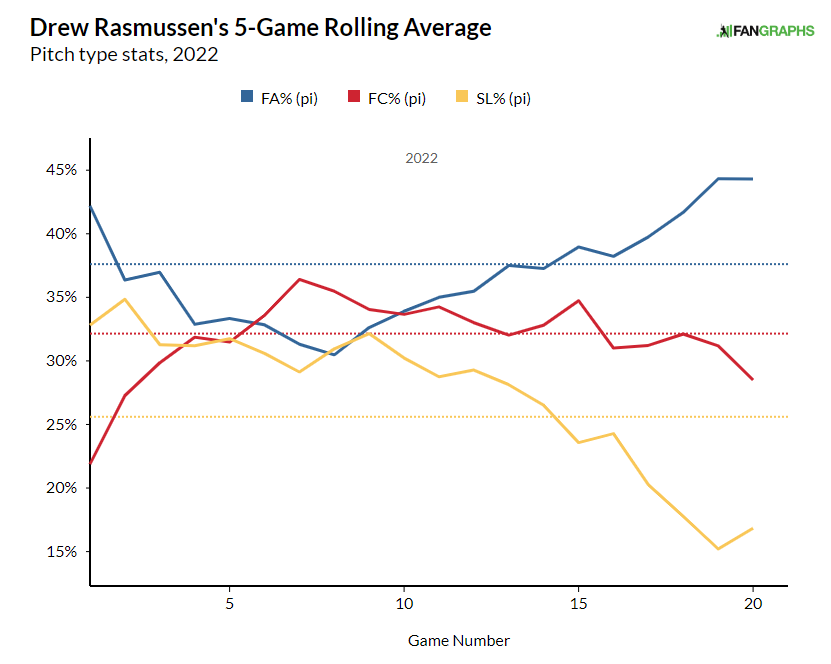
Why isn’t he using the slider as much? Put simply, it works better as an out pitch thrown out of the zone than as an all-purpose weapon. When Rasmussen throws it in the zone, batters both swing a lot and make a lot of contact, a horrid combination. Since the start of July, he’s thrown it only 8.5% of the time when behind in the count, compared to 30% of the time when the count reaches two strikes. He only threw 15 sliders on Sunday, but he made them count:
That slider works as dessert for Rasmussen’s pitch mix but it might not be up to being the main course. For that, he has his new cutter and of course his trusty fastball. We might as well talk about the fastball first because it’s an easy one to analyze. Did you know that throwing laser beams that hug the top of the zone and defy gravity thanks to otherworldly spin often leads to strikeouts? Rasmussen knows:
I’m cherry picking a bit there; despite its top-of-the-charts spin, Rasmussen’s fastball isn’t one of the best bat-missers in baseball. In fact, he’s in the bottom half of the league when it comes to whiff rate on four-seam fastballs. He’s more late-career Madison Bumgarner (19.4% whiff rate on four-seamers, just ahead of Rasmussen’s 19.1%) than current-day Ryan Helsley (32%).
Instead, he uses that fastball as a combination get-ahead pitch and rescue net. He throws it quite a bit to start batters off. Should he get behind in the count, he leans on it even more, and it’s one of the best pitches in baseball at that particular task. When he throws a fastball while down in the count, it results in either a swing or a called strike 77.1% of the time. That’s 28th-best in baseball, in the top 15% of all pitchers who have thrown 100 four-seamers this year. It does roughly as well if you expand the cohort to include sinkers. In other words, if what you want out of your fastball is to hop back into a plate appearance when you’re behind, Rasmussen has exactly what you want.
That explains Rasmussen’s excellent walk rate; if your primary pitch doesn’t miss many bats but also doesn’t produce many balls, you can go from behind in the count to ending the at-bat one way or another pretty quickly. As Rasmussen leans into his low-slider pitch mix, the fastball is now helping him make longer outings. He’s faced at least 22 batters in five of his last six starts. The lone exception was a planned short start on August 8 for innings management reasons, as Rasmussen is rapidly approaching his career high in innings pitched despite missing a few starts in June.
If you’ve been following closely, you might notice that Rasmussen has a good pitch for two-strike counts and a good pitch for when he’s behind in the count. The rest of the time? That’s for cutters. His cutter is rapidly becoming his workhorse pitch, one he can throw in every count. It behaves more like a hard slider than a cutter; per Alex Chamberlain’s pitch comp tool, it looks a lot like sliders thrown by Sandy Alcantara, Gerrit Cole, and Dakota Hudson (hey, two out of three ain’t bad).
Is Rasmussen’s cutter a good pitch? In my estimation, it’s his best one. It does two things that I consider essential: it convinces hitters to chase, and it holds its own when Rasmussen ventures into the strike zone with it. Pitching isn’t that easy, of course, but if you do those two things well, everything else gets much easier.
The key reason that Rasmussen’s cutter draws chases is simple: he throws it hard. It’s a 90 mph pitch that drops 14 inches more than his fastball on its flight to home plate. If you’re looking for a fastball up in the zone, which you should be, you don’t have a lot of time to recognize cutter before starting your swing. Plenty of those swings end up being at marginal or out-of-zone pitches. Sure, the pitch doesn’t have much movement relative to a spin-less pitch following the exact arc of gravity. But, uh, a spin-less pitch following the exact arc of gravity doesn’t exist. The neutral pitch a batter is comparing any breaking pitch to is a fastball, and the cutter ends up in a wildly different spot from the fastball, so it works quite well.
For that same reason, the cutter generates its fair share of weak contact. Some of that is deception-based, but some of it also comes down to location – batters do well on contact when they hit a cutter over the heart of the plate, but quite poorly when Rasmussen locates it toward the edges of the zone. And good news on that front: Rasmussen’s command of the pitch has been excellent so far. He’s living around the edges with it, particularly the low-and-away corner to righties. That’s a natural location for a cutter; it both pairs well with his fastball shape and ends up as a tough pitch to hit. For what it’s worth, Cameron Grove’s pitch model agrees, penciling in the cutter as Rasmussen’s best pitch.
Cutters and sliders also naturally pair well, and in fact, you can think of Rasmussen’s new slider and new cutter as simply separating his old slider into two pitches, one hard and one soft. That’s not exactly what’s going on – he’s throwing the cutter harder than he ever threw his slider and is releasing it differently – but it helps me to think about it that way. Instead of trying to differentiate between two pitches, batters have to pick and choose between three, all of which end up quite far apart from each other when they cross the plate.
It might sound like I think Rasmussen is one of the best starters in baseball right now. I wouldn’t go that far; despite a solid run of recent results, there’s still plenty holding him back. The biggest issue, at least for now, is that he’s still best suited to short stints. He’s faced 56 batters for a third time through the lineup this year, and to put it mildly, they’re doing pretty well. He’s striking out a minuscule 12.5% of them, walking 8.9%, and allowing a hard-hit rate double his overall average.
The sample size isn’t huge, but the lack of strikeouts in particular is concerning. His chase rate dips meaningfully; it’s a little bit easier to solve the fastball/cutter/slider problem when you’ve seen each of them a few times. This is more anecdotal than anything, but his command seems to flag as he goes later into starts, too; the Mateo double that broke up Rasmussen’s perfect game came on a cutter down the heart of the plate, perhaps not coincidentally one of the slowest he threw all game.
So yeah, Rasmussen probably needs a little more in the tank, both in terms of pitch variety and stamina, before we anoint him a member of the pitching elite. He could use a little more oomph on his fastball, too, either in the form of extra velocity or slightly more ride. He’s lost some of the overpowering form he showed in shorter stints; his 7.4% swinging strike rate on fastballs represents a huge drop from his previous career, likely the product of a 1.5 mph decline in average velocity and a one inch decline in induced vertical break.
But despite that weakness, Rasmussen looks like a key part of Tampa Bay’s pitching staff, both now and for years to come. If you’re looking for top-of-the-line stuff in medium bursts, Rasmussen can deliver just that. If you have a bullpen that can pick up some of the slack – long the Rays’ specialty, and they lead the majors in relief innings pitched again this year – Rasmussen fits like a glove. Whether that translates into a perfect game or not, the Rays are surely pleased with the Rasmussen-as-starter experiment.
Ben is a writer at FanGraphs. He can be found on Bluesky @benclemens.
Very insightful thank you. Now if he could teach the Rays to hit…
You mean stay healthy.
Yes that too
My favorite thing about Rasmussen is that his xStats during his time in Milwaukee are basically the same as they are in Tampa, they just get there by basically opposite means, and that only during the latter period does he actually pitch well. Goes to show that not all xStat results are created equal.
The one way he can improve, to me, is to get his curveball right and work it in more. It’s basically a perfect spin mirror to his fastball, and it has above-average movement. Since he doesn’t throw any changeups, a viable change of pace that plays well off his heat is invaluable.
The transformation of Drew Rasmussen from an effectively wild reliever who strikes out or walks a guy 2/3rds of the time to a pitch-to-contact starter who goes 5 or 6 innings at a time is something I did not have on my bingo card.
He’s definitely traded some of his velocity for command, which seems like a logical thing that more pitchers should do. But they can’t, or don’t want to. I guess Michael Kopech’s attempt to do this, you can chalk that up to him blowing out his arm and having to re-learn to pitch again anyway. But if you look at the list of guys who had lots of K’s but big strike throwing problems–Robbie Ray, Dylan Cease, Sean Newcomb, Lance McCullers, Mike Clevinger, Zac Gallen–their improvements didn’t come at the expense of velocity, or didn’t come at all.
So it’s like one of those common-sense solutions that it seems like every pitcher should do, but it doesn’t happen or if it does happen it doesn’t usually work.
*You could add Freddy Peralta and Tyler Glasnow to this list but their command issues and strikeouts were both because of the crazy extension they got, so they’re kind of in a different bucket. And it’s not like their velocity dipped either.
If you’ve ever pitched, it’s not exactly like that. A pitcher is going to work on getting his mechanics as in line as possible. It’s very possible that your best delivery leads to both the best velocity and the best accuracy. I don’t know how much there is to the idea that someone can just slow down and “aim”.
To some extent, “slowing down” does work. But it also leads to weaker “stuff”, not just a lower velocity. It’s very hard to balance your stuff with proper command if you try it that way. While some guys can compensate for that with an altered delivery or grip, it’s more involved than simply “slowing down and aiming”. You basically have to make changes to your delivery to “slow down” in any meaningful way.
I think this is also kind of what I was getting to as well. I haven’t pitched so I don’t have the physical experience of this at all to fall back on. But this “trade velocity for command” thing doesn’t really work so neatly.
I’m thinking 100% about Randy Johnson. Once he got his mechanics in line, his command went from scary to plus, his slider became an all-counts weapon, with no loss of velocity.
And as an added bonus, he stayed healthy enough to repeat this formula into his 40s.
Exactly this, Domingo. I always threw the best when I felt like my mechanics were in sync and I was in a good position. The velocity would just come naturally
I agree… Velocity comes best when it’s free and easy… when the pitcher is unencumbered physically and mentally. Get the body and mind in sync and the velocity will come, and different pitchers get in sync at different paces.
For all the times we’ve looked at a Rays trade and assumed that they always get the upper hand, I’ve felt that the Adames trade was a big exception, since they got stuck selling low on Adames because they had Franco more than ready to become their forever shortstop.
But, once again, it looks like the Tampa Pitcher Recycling Plant has identified a suitable target, acquired it, and transformed it into a controllable plus piece of pitching. So that trade might very well be close to a wash when all is said and done.
The problem with trading Adames wasn’t that they traded him in-season. It’s that they didn’t trade him when he was coming off a much better season and they knew he had a problem they couldn’t fix. Given the situation they were in when they did deal him, they did absolutely as best they could. Rasmussen could blow out his arm tomorrow and I don’t think it changes any of that one bit.
J.P. Feyereisen has been pretty good this year and last year too. Granted he’s hurt now but…pretty even deal.
Willy Adames turned into an MVP candidate, and the Rays still somehow won the trade.
As demonstrated in the two videos, what also helped Rasmussen a great deal during that game was his ability to throw so many pitches right at the edge of the strike zone… or just a bit outside. Rarely did he throw a “non-competitive” pitch and rarely did he throw a pitch that ended up in the heart of the strikezone.
Due to injuries, Rasmussen is still young in pitching years. College draftee in 2017 but didn’t sign or pitch in the summer, then TJ, then missed the whole 2018 season…. then, less than 100 innings in 2019 and 2020 combined.
The stamina is indeed an issue but the Rays were glad to manage his innings buildup. He’s already thrown 15% more innings than any other pro season in his career, and in any season since his freshman year of college..
For as much as we focus on age-relative-to-league in prospect status, Rasmussen was on my real-life radar (and fantasy minors list) because of his pro *experience* relative to league.
And while we can’t yet quantify it, this is where coachability really seems to matter. Some players are willing to listen and adapt to what the data suggests and some players insist on doing it their way until they get the results they want.
Willing and able. Some try willingly enough, but just don’t manage to do it. The coachability of the body is a real factor.