
Early Returns of the Drew Smyly Project
One of the tricky parts of this job can be finding information people might not know about. Statistical insight these days can be a challenge. One of the easier parts can be building off of somebody else’s idea, putting together a deeper dive on another person’s insight. So full credit to Ken Rosenthal, who wrote up a little section about Drew Smyly a day or so after talking about him on a TV game broadcast. Smyly’s been shut down by the Rays because of his innings total, but prior to that he looked like a much-improved pitcher in Tampa Bay, and here’s some stuff passed along by Rosenthal:
The Rays told Smyly to elevate his fastball more — sort of a counter-intuitive move for a pitcher — and they also emphasized that while he was successful getting to two strikes against right-handed hitters, he needed to find better ways to finish those hitters off.
The Rays and Rosenthal have provided the insight. I’m just here to show you some actual numbers. That’s a very informative paragraph, telling you something about Smyly and telling you something about the Rays. And as we look forward to 2015, might Smyly be a better part of the David Price return than he’s been given credit for?
This season, as a Tiger, Smyly struck out one out of every five batters he faced. This season, as a Ray, he struck out one out of every four. This season, as a Tiger, Smyly posted an adjusted FIP that was 4% worse than average. This season, as a Ray, he posted an adjusted FIP that was 15% better than average. Clearly, there are hints of improvement. Whenever we observe potential improvement, we wonder, what could be the cause? And this takes us back to the blockquoted paragraph.
The two points, it turns out, are linked. The Rays wanted Smyly to get better about putting righties away. The Rays also wanted Smyly to more frequently elevate his fastball. One way to put more righties away? Elevate the fastball. Smyly’s never had an issue with lefties. He’ll go as far as his success against righties can take him, and the Rays might’ve helped him achieve a new level.
So let’s talk real quick about that getting-to-two-strikes-against-righties thing. The Rays identified that as one of Smyly’s strengths. On average, about half of plate appearances between lefty pitchers and righty hitters end in two-strike counts. Smyly’s career at the time of the trade:
2012: 56%
2013: 61% (reliever)
2014: 59%
So, yeah, that was a good thing. But — starters and relievers combined — about 40% of two-strike counts between lefties and righties have turned into strikeouts. When the Rays traded for Smyly, he was at 29% on the year. Since the Rays traded for Smyly, he’s come in at 39%. That’s a big improvement, and this is where we get to talking about the fastball.
Smyly didn’t dramatically change his pitch mix. He just started using it differently, at the Rays’ suggestion. Smyly doesn’t blow anybody away with his velocity, and pitchers are always told to try to keep the ball down, especially if they don’t throw very hard. Low pitches, in theory, go for grounders. And the zone has gotten friendlier down low, too. But hitters are adjusting to this. Hitters are increasingly looking low. Hitters are increasingly selected for their abilities to hit low. Hitting low generally requires a swing path that makes it more difficult to hit high. So there could be a vulnerability around the top of the zone, where hitters aren’t prepared like they used to be. Probably 10 or 15 years ago, a guy like Smyly would try to stay away from elevation. But the Rays think he can succeed up there.
And so far, the Rays haven’t been wrong. Let’s first establish the pattern: This year, as a Tiger, Smyly threw 50% of his fastballs at least 2.5 feet off the ground. As a Ray, he threw 66% of his fastballs at least 2.5 feet off the ground. This year, as a Tiger, Smyly threw 25% of his fastballs at least 3 feet off the ground. As a Ray, he threw 45% of his fastballs at least 3 feet off the ground.
Smyly’s rate as a Tiger was basically exactly league average. His rate with the Rays is among the league leaders. The top of the list:
- Tyler Clippard, 48% of fastballs at 3-plus feet
- Jake Odorizzi, 47%
- Madison Bumgarner, 45%
- Drew Smyly (Rays version), 45%
- Trevor Bauer, 44%
- Chris Young, 44%
Suffice to say, that’s extreme. To put it a different way, Smyly’s average fastball with the Rays was more than five inches higher than his average fastball with the Tigers. His average two-strike fastball was more than seven inches higher than his average two-strike fastball with the Tigers. It took little time for Smyly to buy in, and the Rays, presumably, were pleased with his execution.
You can see how the high fastball connects with the desire to put more righties away. Via Baseball Savant, here are Smyly’s 2014 two-strike pitches to righties as a Tiger:

And here are his 2014 two-strike pitches to righties as a Ray:

The separation between the fastball and the breaking ball is evident. As a Tiger, Smyly threw 39% of his two-strike fastballs to righties up. As a Ray, he came in at 64%. It follows that, as a Tiger, 25% of Smyly’s strikeouts of righties came with his fastball. As a Ray, he came in at 41%. In four months with the Tigers this season, Smyly picked up 12 strikeouts on high fastballs. In barely more than one month with the Rays, Smyly picked up another 14.
This article is Smyly-specific, but the Rays’ advice might not be. You might’ve noticed Odorizzi’s name earlier. The average pitching staff throws about a quarter of fastballs at 3-plus feet. The Diamondbacks are lowest, at 19%. The Rays are highest, at 34%. Relatively speaking, the Rays love the high fastball While we can’t determine how much that contributes to the pitching staff’s success, this could well be something organizational. If the team immediately told Smyly to throw his fastball up more often, who else have they told that to? Who’s next, given how successful Smyly has been?
You knew you weren’t getting out of this without .gifs, so let’s watch a couple at bats from Smyly’s last start against the Orioles. First, a three-pitch sequence between Smyly and Adam Jones:

Not long ago, Smyly’s changeup might’ve been baseball’s least-effective pitch. Here it looked terrific, as the Rays took advantage of Jones’ willingness to swing early. And then Smyly went to work with his new approach:


Cool. How about Nick Hundley?
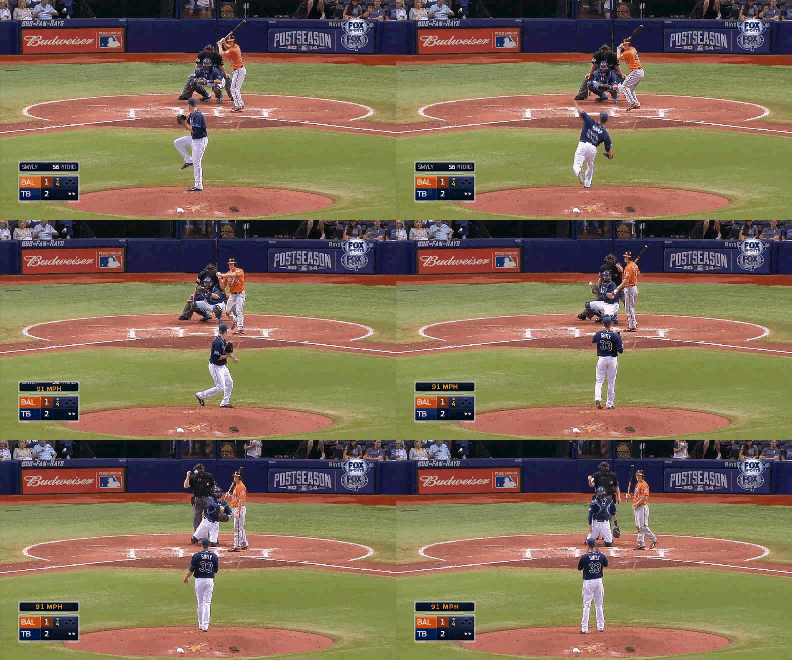
High fastball. Hundley can’t hold up.

Low breaking ball, perfectly executed. Starts up, drops down.

High fastball to try to get a swing. Smyly’s playing with eye levels.

High fastballs are tempting pitches. You can’t lay off them forever.
Drew Smyly arrived with the Rays as a mid-rotation starter with issues against righties. The Rays promptly gave Smyly some advice, and relative to his 2014 with the Tigers, Smyly subsequently doubled his K-BB% against righties while cutting his OPS allowed in half. The thing about pitching tweaks is they’re supposed to take time. We usually don’t believe in the idea of a pitcher improving almost overnight. Smyly might’ve improved, and meaningfully so, almost literally overnight. Of course we’ll have to monitor 2015, when we have a bigger sample and opponents more prepared for Smyly’s new approach. But for everyone who doubted the Rays’ end of the allegedly underwhelming trade-deadline blockbuster, perhaps they really did know something. We all saw the Rays traded for Smyly, but maybe we didn’t all see him as the pitcher the Rays did.
Jeff made Lookout Landing a thing, but he does not still write there about the Mariners. He does write here, sometimes about the Mariners, but usually not.
Rays also did this with Hodorizzzi
Hodor?
There is a very pungent hodor coming from Prince Fielder’s locker.
Methinks he left a footlong veggie sub in there, your onor.
It is hard for me to believe it was veggie.
It’s hard to believe it was only one.
Although I realize that the Rays are a special case because of their money situation, wouldn’t most teams prefer to groom younger players in this way? Logic would dictate that if you are a big name player with big successes, you will not change your habits. So the Yankees or Dodgers or Red Sox signing big name players could be counterproductive as these players will just keep their habits. Of course, if they are good players to begin with, this should not be a huge problem, but, again, the Rays are good because they get younger or undervalued players to buy into the Rays way of things.
Personally, I panned the Rays for the Price trade and thought that they should have gotten a lot more. Looking at Smyly’s numbers, I have always liked him but did not think that he was worth Price. A slight adjustment like this may be what makes Smyly an All-Star but, as Jeff said earlier, he needs to be tracked through the earlier part of 2015.
On a final note, when do you think the trends moved moreso to the higher pitches? I always remember growing up saying that a high fastball is a problem waiting to happen and now when I evaluate pitchers I mark them lower for leaving a fastball up. Reading more into the articles linked above, it would make sense that hitters are trained to protect against the lower pitches, hence leaving them vulnerable to the higher ones.
off the top of my head, this reminds me of young barry zito who didn’t throw very hard, but got alot of swinging strikes on high fastballs to righties. hitters always had to keep the curve in the back of their mind and the path of the curve/high fastball looked alike.
Buck Showalter recently commented: “We’ve been trying to get Smyly for two years.”
The Rays aren’t the only team that saw a few tweaks could make him much more effective. Buck, like most managers (!) likes strike throwers.
Early Returns on Smyly as a Ray:
1. .184babip
2. 88% strand rate
verdict: luck
make that 88.8% strand rate.
A pitcher can be both lucky and still very good. Since the trade: 3.06 FIP.
is there a Molina effect that can be analyzed as well?
re: Molina
It looks like Molina did not catch Smyly even for a single inning. Curt Casali caught Smyly for 35 IP, and Ryan Hanigan caught him for 12.2 IP.
add a hundred points to his babip and see how that fip looks.
What do those numbers have to do with his K rate?
If he is getting lucky with Babip and Strand, he is likely getting lucky with the Ks too. #clusterluck
93mph in that last gif too.I would expect that the benefit of throwing harder when he goes upstairs with a little more margin for error, versus trying to spot a fastball on the black at 91mph makes a big difference, as the stats suggest.
interesting that all of those GIFs it looks like the catcher is set up for a low and in fastball and Smyly misses the spot every time
Maybe the Rays aren’t so much calling for high pitches, but rather told Smyly to not worry about letting his pitches fly as high pitches aren’t as terrible as Smyly thinks.
Average fastball velocities, 2014:
Tyler Clippard, 91.8
Jake Odorizzi, 90.2
Madison Bumgarner, 91.9
Drew Smyly, 90.1
Trevor Bauer, 93.9
Chris Young, 85.2
One of these numbers is not like the others.