
Five Things I Liked (Or Didn’t Like) This Week, April 10
Welcome to a new season of Five Things I Liked (Or Didn’t Like) In Baseball This Week. After a slow, veteran-who-signed-late-this-spring style warmup to the year, it’s time for another dive into the little details that catch my eye each week. It’s the perfect time of year for it. Beautiful weather, early-season optimism, overheard conversations about who should bat third and who’s a bum – it all fuses together to make this one of my favorite parts of the baseball calendar. And even though the WBC whetted my appetite for the spectacular somewhat, there’s really no replacing major league games for the sheer variety of entertainment. I’m sure that Zach Lowe of The Ringer, whose old NBA column format I’ve borrowed, would say the same thing about the basketball regular season. Let’s talk baseball.
1. Ricochets
If you share my baseball consumption habits, it might seem like every weekday offers a Royals game, a Guardians game, or a Royals-Guardians game. And I love it! I’ll take any excuse to watch Maikel Garcia continue his ascent from contact hitter to do-it-all superstar, a kind of modern-day José Ramírez. And I get to watch the actual José Ramírez too? And Bobby Witt Jr.? And Steven Kwan, Vinnie Pasquantino, Bo Naylor, and old favorite Michael Wacha? Both of these teams are sneaky fun, and their series this week didn’t disappoint. Witt might be having a slow start on offense, but he’s still a defensive genius:

Lots of shortstops – pretty much every other shortstop, even – would get only one out, somewhere, on that play. But two?! Ludicrous. When Garcia’s lunging attempt caromed toward Witt, he turned from interested observer to protagonist so smoothly that it looked like he was planning on doing it the whole time. It started with his feet. Instead of charging the ricochet, Witt timed his steps to hop to a stop and get his body in as good a throwing position as he could:

That’s a tough throw to make for the shortstop, running right and throwing all the way across his body toward second. Witt cut down on the difficulty with his footwork. Then he snapped off a throw from a tough angle – side-arm slot, cross-body – and hit Jonathan India perfectly.
India read the play correctly and helped Witt out. He came toward Witt to catch the throw as early as possible and have a clean throwing lane, with Kyle Manzardo on the outfield side of the basepath. That let him step into the throw. He had plenty of oomph to get batter Rhys Hoskins. But he, too, needed a little help from a friend:

The entire Kansas City defense looked great on this play, but Witt stood out to me. This wasn’t Witt running faster or throwing harder than the competition. He just had a perfect map of the play in his head, the whole time, and knew exactly what to do instantly. He never hesitated. He moved smoothly from recovering a ricochet to a feed. He knew where India would be, and he scooped and fed the ball in one fluid motion. The timing of this play doesn’t sound possible. A ricochet, and then time to turn a double play? How? Bobby Witt Jr. is how.
2. Pitchers Being Athletes
I don’t normally use the same game twice, but this one was an exception. That’s actually due to a bylaw of the Five Things Committee (it’s just me and my dog, and she has the tie-breaking vote): When a pitcher catches a popup, I must write about it. Pitchers mostly don’t field the ball unless they have to, and pop flies are a perfect example of not having to, because on almost every popup, some other fielder has plenty of time to run to where it’s going to land. In the entire 2025 season, pitchers recorded only 22 outs this way. But this week, we got three in two days – and two in one game.
First, check out Tanner Bibee, recognizing the gravity of the occasion. When Jac Caglianone hit the most textbook weak infield fly you’ll ever see, the entire Cleveland infield converged slowly. But Bibee called everyone off and snagged it:

That’s someone who recognizes how rarely he gets to catch a fly ball. And not to be outdone, Michael Wacha went deep into foul territory to snag one of his own only two innings later:

That one was borderline hard! Generally speaking, pitchers are just cleaning up the trash when they get involved defensively, but I don’t think either Salvador Perez or Garcia was going to arrive in time to make a play. Wacha picked up the flight of the ball before either of them and got there with time to spare. I also like how he no-sold it, in contrast to Bibee. At 27, you celebrate your small victories. At 34, you act like you’ve been there before. (I’m 40, but I’m Team Bibee when it comes to celebrating.)
As if those two instances of pitchers making plays weren’t enough, they came only a day after yet another pitcher popup grab. This one was a classic of the genre. You can almost hear the fielders shouting “where is it?” as they stare fruitlessly into the sky:

The best part of this one? Catcher Edgar Quero got very demonstrative in the aftermath. Not toward pitcher Chris Murphy – I’m pretty sure I heard him saying “nice, nice” on one replay – but at his corner infielders. Quero never saw that ball, and rightly gave way to Murphy. But that’s supposed to be a first or third baseman’s ball. Good angle, no shadows, and crucially, a corner infielder is not a pitcher. But the two Sox corner infielders — Munetaka Murakami and Miguel Vargas — weren’t ready to make a play; Murphy was, and he reaped the rewards. He also got the save, his first of the year. What a delight.
3. Luis Arraez, Picking Machine
When the Giants made Luis Arraez their starting second baseman during the offseason, baseball analysts everywhere wondered what they were thinking. Opinions vary on how valuable Arraez’s contact-hitting game is, but no one was in disagreement about his defense. He slid down the defensive spectrum from second to first a few years ago thanks to years of poor results at the keystone, and he didn’t even grade out particularly well at first base. The Giants were going to move him back up the defensive spectrum? Surely this wouldn’t end well.
I’m happy to inform you that so far, it has gone extremely well. Defensive metrics don’t work all that well in small samples, but Arraez is already two runs above average per Statcast. More importantly to me, given how little hard data we have at this point in the year, he looks comfortable and rangy in the field. This is no gimme:

You better be fast to get Trea Turner on a play like this:

Here’s a nice infield-in snag to keep a runner at third:

I won’t pretend that Arraez is suddenly playing like Nico Hoerner. He doesn’t have to, though. If he can be an average defender at second base, his profile changes completely. Earlier in his career, he hit like a first baseman or DH – 130 wRC+ in 2022, 131 wRC+ in 2023. But with his offensive results down in recent years, he got stuck in no man’s land – not enough offense for first, not enough defense for second. If he can credibly play second, the offensive bar is much lower. One way of thinking about that: He’d be competing with Rafael Devers and top prospect Bryce Eldridge for the first base job. At second base, his biggest competition is either Casey Schmitt or Christian Koss. (Case in point: Schmitt, a middle infielder by trade, has made seven appearances in the field this season, all at first base when Devers was the DH. The Giants clearly don’t see him as an everyday player.)
In addition to playing a solid second base, Arraez is doing two things I absolutely love offensively. First, he’s not batting leadoff, a pet peeve of mine when he played for the Padres. His high-average game plays better with runners on base. He’s inserting a little chaos into his offensive game, too, dropping down some bunts to keep defenses off balance. In the eighth inning of Wednesday’s 5-0 win over the Phillies, he laid down a sacrifice bunt, which turned into a run-scoring two-base error when the pitcher threw it away. Then, after the next batter struck out, he bounced off of second and scored easily on a Devers single. Arraez’s singles-only offensive profile hasn’t been enough to make him an impact player in recent years. It would be absolutely delightful if he ended up finding a home as a good-fielding, slap-hitting second baseman after years as a peerless contact hitter who didn’t have a position.
4. Insult to Injury
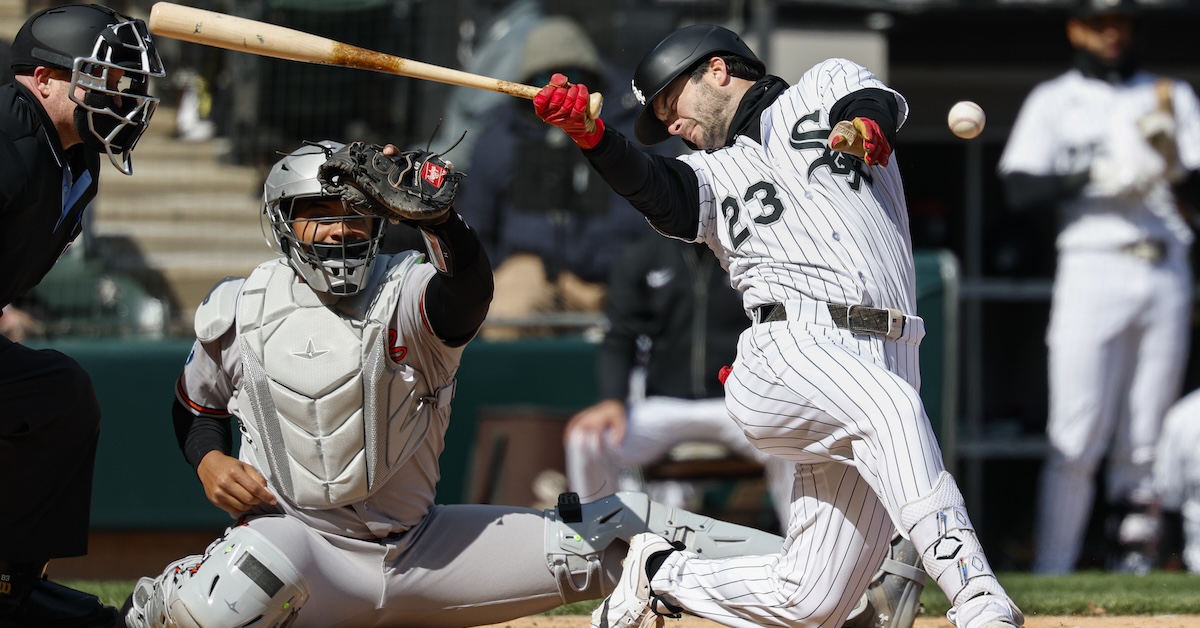
Andrew Benintendi is having a rough year. He’s striking out 44% of the time in the early going and has a 35 wRC+. A few bad defensive seasons in a row means that he’s DH’ing instead of playing the outfield. And worst of all, he got drilled in the shoulder while striking out:

Yeah, that’s a bad look. Now, with a shameless plug to our new Paired Pitches tool, you can absolutely see what he was thinking:
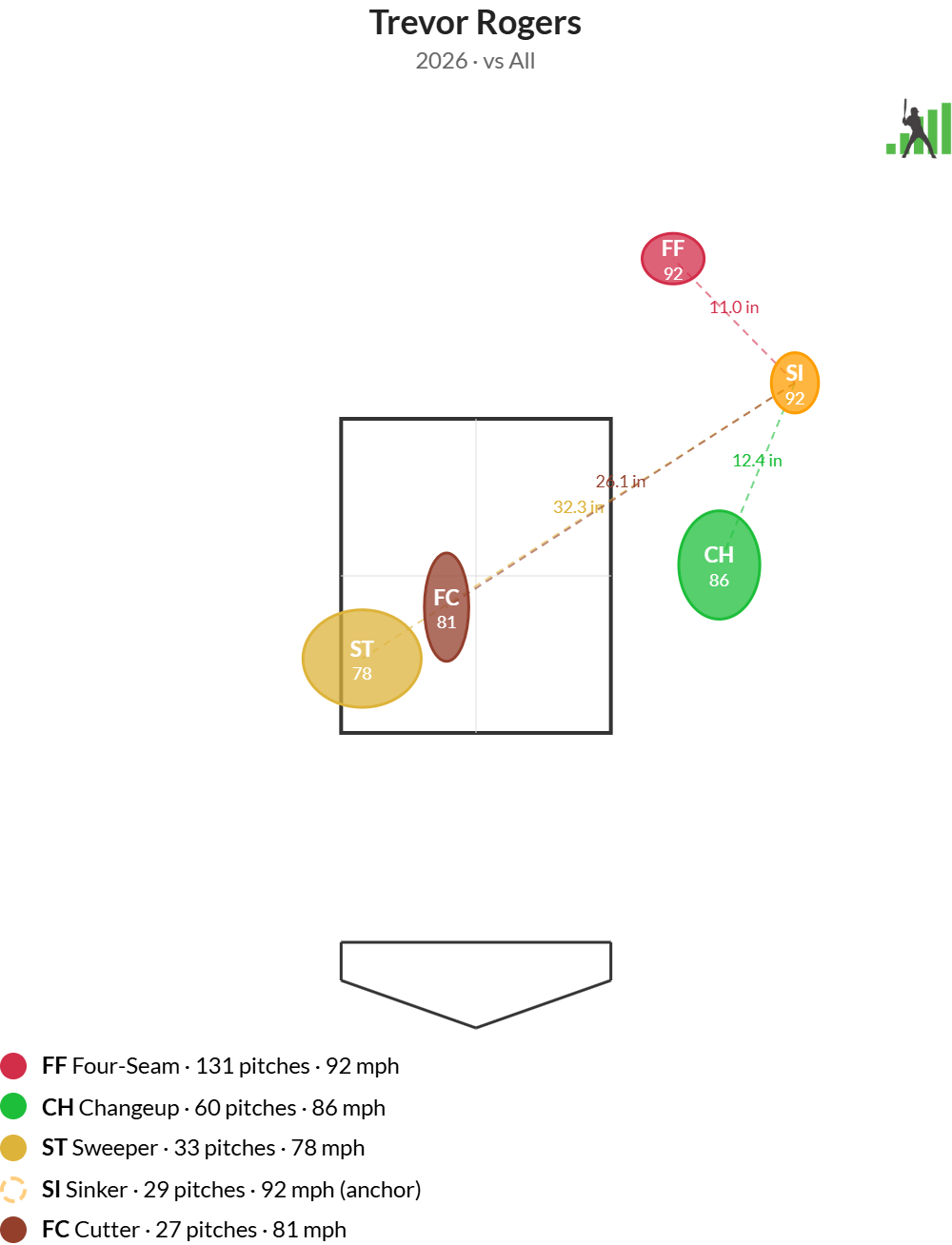
It’s tough being a hitter. Trevor Rogers gets 17 inches of arm-side movement on his sinker and 10 inches of glove-side movement on his sweeper. That’s a difference of 27 inches, and home plate is only 17 inches wide. Rogers had dotted the outside corner with a sweeper earlier in the at-bat. Benintendi was leaning out looking for it, with a classic two-strike approach: Look for a breaking ball and then adjust to a fastball if necessary.
When Benintendi started to swing, he was still expecting something soft, low and away. But as he picked up the ball’s spin and speed, you can tell from his face that he immediately realized his error:

Baseball is so hard. Benintendi is a former All-Star. He’s been paid a hundred million dollars in his career. He’s a highly trained professional athlete who has trained for tens of thousands of hours to do one specialized task. And he just tried to do that task and looked like this:

What a laughably difficult sport. I don’t know how these guys do it.
5. Ricochets, Part Two
On the other hand, sometimes baseball is comically easy. The Twins were in a pickle Monday night. Kody Funderburk walked the first two batters he faced on 10 pitches. Then he hummed one to the backstop, giving catcher Victor Caratini absolutely no chance to block it because the pitch missed above Zach McKinstry’s head. Then there was a glitch in the matrix:

Target Field is notable for the snug dimensions behind home plate. But even with a closer wall – roughly 45 feet behind the dish – the odds of this happening so perfectly are near-zero. Caratini barely had to move to get the rebound:

That almost looks like a drill. Spin around backwards, get a feed from a coach, turn and fire. Riley Greene, the lead runner, noticed the carom and slammed on the brakes. It’s a good thing he did; he would have been out by a mile at third base, and the longer throw to second gave him time to retreat.
However, Spencer Torkelson, the trail runner, got caught in between. He saw the wild pitch immediately and followed baserunning 101 by moving his eyes to Greene. When he saw Greene take off, he snuck a quick peek toward home, noticed Caratini with his back to the play, and broke for second. But his timing couldn’t have been worse. That quick peek home came just as Greene screeched to a stop:
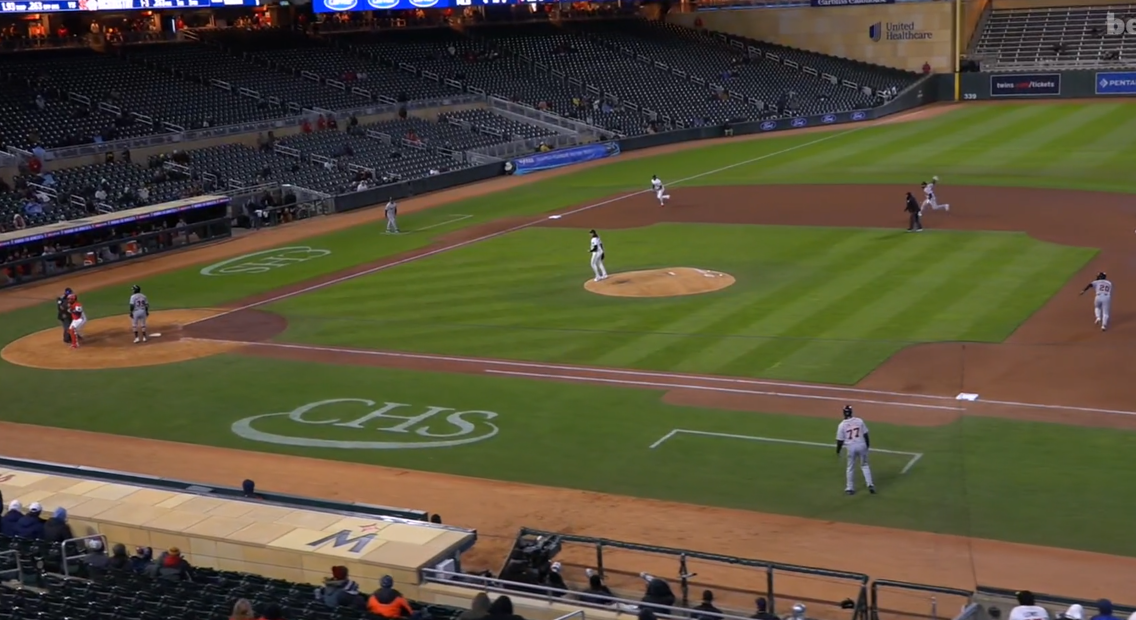
And having checked off two things in his head – lead runner advancing, catcher facing the other way – Torkelson put his head down and ran. If he’d looked back at Greene, if he’d kept his eyes on Caratini slightly longer, if he’d just had a worse read and been closer to first base, everything might have been fine. Instead, he got to second around the same time as Greene. Whoops. By the time he took another look around, it was all over:

Caratini, for his part, took all the drama out of the play. He didn’t fire wildly to second where Brooks Lee was calling for the ball. He didn’t try to make a perfect throw on the run. He just jogged toward second, surveyed the field, and then made an easy, high-margin throw to Kody Clemens that essentially guaranteed the out. Torkelson gamely tried to escape the rundown, but it wasn’t happening. Greene was in no position to break for third and cause confusion. The wall just won.
Funderburk walked McKinstry on the next pitch, but that fortunate bounce and Minnesota’s level-headed team defense had already defused the rally anyway. The Twins won the game and swept the Tigers in the series to move to 7-6 on the year, good for second place in the AL Central. It’s early in the year, and the Twins may have a long rebuild ahead of them, but no one has told the players that yet. They’re taking advantage of lucky bounces, in this case literally. Sure, it might be a long summer in Minneapolis, but if the early season is any indication, it’ll be an interesting one, too.
Ben is a writer at FanGraphs. He can be found on Bluesky @benclemens.
Great writeup! These are the highlights I’ve been looking for.