
Garrett Richards Has Had to Reinvent Himself
It’s pretty evident that Major League Baseball’s crackdown on foreign substances will have wide-ranging effects on the sport. Offense is almost certainly due to increase; that that has yet to happen (at least beyond normal temperature-related effects) may only be a question of time. But with spin rates plummeting and pitchers telling the media that they are “trying to figure out how to pitch again” as a result of the new policies, it seems that we’re bound to see broad changes sooner rather than later.
The hurler who supplied the quote above is none other than right-hander Garrett Richards, an 11-year major league veteran currently pitching for the Red Sox. Boston signed Richards this past February to a one-year, $10 million contract that included a club option for 2022, a deal meant to shore up depth for a rotation that was a weak spot for the team as it entered the 2021 season. And though he has dealt with a collection of arm injuries throughout his career — including a 2018 Tommy John surgery that forced him to miss almost all of 2019 — Richards posted solid peripherals with the Padres last season and was heralded for his league-leading spin rates.
Through Richards’ first 11 starts this season, it seemed like Boston’s gamble had paid off. He wasn’t putting up elite numbers, but a 3.75 ERA, 20.2 K%, 11.6 BB%, and a 4.06 FIP is certainly serviceable. Through his start on June 1, Richards was worth 0.9 WAR, putting him in a virtual tie with Martín Pérez and Eduardo Rodriguez in terms of value. As for Boston’s starting staff as a whole, their combined 6.4 WAR through June 1 ranked fifth in the majors, which represented quite the pleasant surprise given that their rotation ranked 16th in our preseason power rankings.
But since MLB’s June 3 warning that sticky stuff enforcement was coming, Richards has not been the same pitcher. This is by his own admission, too; he told Jen McCaffrey of The Athletic that he had to reinvent his repertoire in response to the crackdown. Richards emphasized to McCaffrey that while he used sunscreen and rosin, he never worked with anything tackier, like Spider Tack or Pelican Grip. Even still, Richards admitted that the sunscreen and rosin concoction that he used — one that is believed to be common throughout the game — likely did have an impact on his spin rates.
“It kind of opened my eyes now,” Richards said. “Do I feel a little bit like, ‘Damn we were doing something wrong the whole time?’ Yeah, I do feel that way. But in all fairness, I don’t think we knew we were doing something wrong. So we’re just a product of an era, just like any other era, there was the steroid era, now we’re the sticky era so we’re working through it.”
Richards has not seen the largest spin-to-velocity ratio decrease since the June 3 date of demarcation: among the 225 pitchers who threw at least 100 four-seam fastballs before June 3 and at least 50 since, Richards’ drop in spin-to-velocity ratio is only the 32nd-largest. But he’s been arguably one of the most vocal about how he’s needed to adapt since the crackdown.
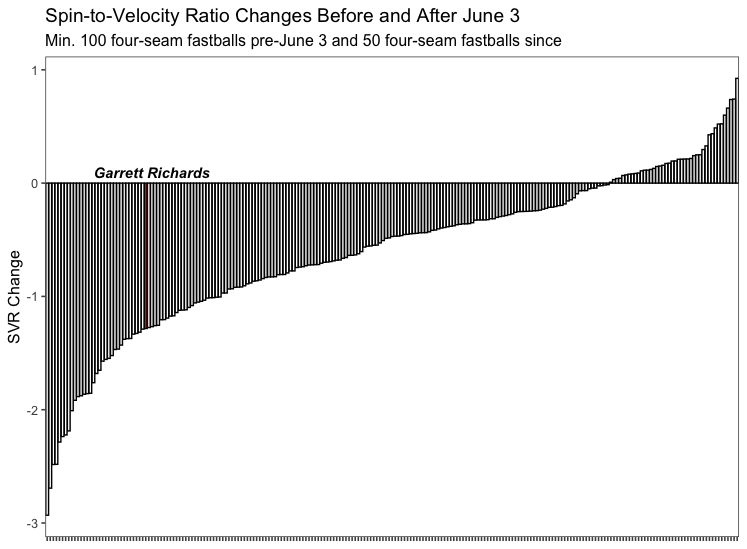
And in that time, Richards’ performance has fallen off of a cliff, going from being quite serviceable to one of the worst pitchers in baseball:
| Date | IP | ERA | K% | BB% | HR/9 | FIP | xFIP |
|---|---|---|---|---|---|---|---|
| 4/4-6/2 | 60.0 | 3.75 | 20.2% | 11.6% | 0.75 | 4.06 | 4.57 |
| 6/3-6/28 | 21.2 | 8.31 | 12.8% | 7.7% | 2.49 | 7.04 | 5.24 |
It’s hard to know how much of Richards’ dip in performance we should attribute to a presumed lack of sunscreen and rosin versus poor luck, but between the results and the quotes, it is definitely fair to assume some sort of connection. What’s interesting to me, at least, is that Richards’ walk rate has actually decreased post-crackdown. It may be because he feels as if he has little choice but to pour pitches down the middle of the strike zone due to a presumed decrease in command sans added tackiness. Indeed, Richards upped his rate of pitches in the heart of the strike zone by four points and his overall zone rate by more than seven points. That zone rate increase is one of the largest in baseball since June 3:
| Name | Before Zone% | After Zone% | Difference |
|---|---|---|---|
| J.P. Feyereisen | 37.2% | 49.0% | 0.118 |
| Sam Howard | 40.8% | 51.2% | 0.104 |
| Taijuan Walker | 52.9% | 60.9% | 0.080 |
| Tyler Alexander | 51.4% | 59.3% | 0.079 |
| Joe Ross | 47.4% | 55.3% | 0.079 |
| Will Smith | 43.9% | 51.6% | 0.077 |
| Austin Gomber | 51.7% | 59.3% | 0.076 |
| Sam Hentges | 40.8% | 48.3% | 0.075 |
| Garrett Richards | 48.0% | 55.4% | 0.074 |
| Emmanuel Clase | 44.7% | 51.9% | 0.072 |
That would explain the decreased walk rate and may also explain why he’s been hit so hard; Richards has allowed some of the loudest contact in baseball, especially post-June 3. All of his pitches have been negatively impacted. Hitters are crushing just about everything that comes out of Richards’ hand:
| Pitch Type | Before RV/100 | After RV/100 | Delta | Before xwOBA | After xwOBA | Delta |
|---|---|---|---|---|---|---|
| Four-Seam | -0.96 | 2.80 | 3.76 | .370 | .454 | .084 |
| Slider | 2.17 | 2.72 | 0.55 | .319 | .437 | .118 |
| Curveball | -1.29 | 5.35 | 6.64 | .237 | .451 | .214 |
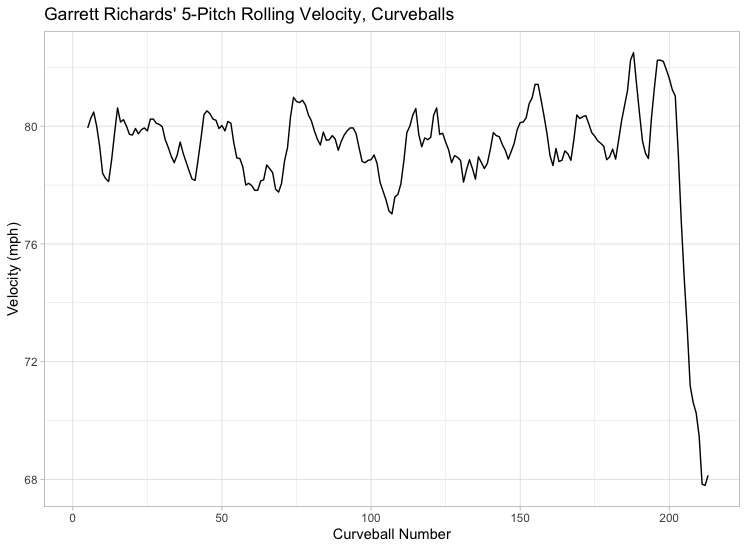
This must be why Richards is trying something new, throwing a split-changeup he learned at the end of last week. He also introduced a super slow curveball, one that averaged less than 70 mph in its introductory appearance on Monday. While his average curveball velocity on the season is muddled by two effectively different pitches, that game represented one of the slowest velocity single-game curveballs this season. There have been 1,019 instances of a pitcher throwing 10 or more curves in a game this year; Richards’ 69.7 mph average on June 28 was the seventh-slowest average single-game curveball velocity this season. It also represented a significant change from his curveball of the past, one that at times would average over 80 mph:
None of this is ideal. Asking a major league starter to change his entire repertoire on the fly in the middle of a season doesn’t make a lot of sense to me. Yes, Richards admits that he broke the rules, but it’s important to consider the context surrounding that rule-breaking. MLB opted to make an extreme change to their enforcement midway through the season in hopes of increasing offense at a time when base hits are at all-time lows and run scoring is so heavily concentrated in home runs. In the process, though, the league has effectively conducted a midseason experiment, one which has created an added burden on pitchers to comply. I’m not saying that breaking the rules was right, or that Richards shouldn’t be forced to adjust. It’s just difficult to expect major league pitchers to, using Richards’ words, “learn how to pitch again” in the middle of June.
It’s hard to know exactly what will come of Richards’ adjustments. We’ve only had early, non-significant returns; I imagine he’ll continue to keep tinkering with his pitch mix and grips. After all, he learned a split-changeup last week and immediately turned around to throw 24 of them in his first start post-lesson, his second-most used offering of the night. Whether or not he has success with it is almost besides the point, though it will obviously matter a great deal to him and the Red Sox. While MLB may get the results they desire in terms of lowered spin rates, it may come at the cost of extreme midseason experimentation. As Ben Clemens wrote in his piece breaking down MLB’s action, “The only thing that’s certain [about this new enforcement] is that there will be a host of major leaguers figuring out how to play a substantially different game in real time.” So far, no one seems more emblematic of that than Garrett Richards.
Devan Fink is a Contributor at FanGraphs. You can follow him on Twitter @DevanFink.
Good article! It would have been wiser to eliminate spin rates during the off season, but to me it makes little sense cause home-runs are not really down and we have big scoring games all the time.
The most interesting thing to me is that suncreen and rosin have almost no effect on spin rate from the articles I’ve seen on the topic, but lead to pitchers feeling like they have better grip. I’m all for eliminating spider tack, and other things of that nature, but sunscreen is a natural thing to have on in baseball, and rosin is supplied by MLB!
Has Richards used rosin/sunscreen his entire pro career? When did rosin/sunscreen become prevalent? Anyone know
It’s been around a long, long time, but I don’t think it was reported on much until Clay Buchholz infamously used sunscreen and rosin in a game played indoors in…2013? By then it was already well-established. Richards has been around for a while, but it’s entirely possible he’s used it his entire MLB career.
Thanks for the info. Didn’t realize rosin/sunscreen has been here a while. So the issue then is with the super sticky not the sorta sticky? There’s gotta be a measurement of stickiness somewhere MLB could use. Call it the Coefficient of Post-it Notes or something. If the substance will hold a baseball on the wall then its too sticky. If not, totally legal.
It’s a legitimate question how bad the rosin/sunscreen combo is.
Part of this is that we have absolutely no idea when it became mainstream. We know it was at least well-known as a trick in 2013 (and may have been common then). But the further away we get from that the less confident we are in how widespread it was. I just saw a YouTube video in 2010 where a minor leaguer from 2006-2009 was describing the rosin/sunscreen combo, but then immediately saying “if you get caught doing this you’ll get kicked out, and I *personally* have never done this”. Yeeeeeah sure. But then I did a search of Google News from 1990 to 2010 for sunscreen rosin baseball and nothing came up.
The other issue is that the frame of reference has changed. Articles reporting on the rosin/sunscreen combo before the last couple years talked about how unbelievably sticky it was. That’s because they comparing it to rosin alone; now the comparison is to spider tack, which is definitely way more extreme. And now there’s some evidence that the sunscreen / rosin combo didn’t increase spin rate, but maybe that’s not the entire advantage it gives you.
So I don’t actually know. All I know is that eventually the league is going to have to start doing lab tests of baseballs for enforcement because otherwise it is just going to be way too messy.
I would love to see the full list of spin to velocity ratio change.
Garrett Richards is lying. There is no way he was just using rosin and sunscreen.
How do I know this? Players who have documented use of rosin and sunscreen have seen far lower drops in their spin rates.
Will Smith was ejected from a game on May 22, 2015 for still having rosin and sunscreen on his arm when he came in to pitch. He was a demonstrated user of that combination. The spin rate on his four-seam fastball since June 21 has dropped an average of -73 RPM versus his average during April and May.
I’ve seen Charlie Morton apply the rosin bag in game to his arms and the back of his neck, all places where he sprayed with sunscreen earlier. That’s the nice thing about Bullfrog sunscreen: it goes on clear. Charlie Morton has also seen the spin rate on his four-seam fastball since June 21 drop an average of -70 RPM versus his average during April and May. His curveball’s spin rate dropped just -24 RPM versus his average during April and May.
In his start on June 23, Garrett Richards had a spin rate drop of -244 RPM versus his average from the rest of the season. His curveball had a spin rate drop of -477 RPM versus his average from the rest of the season. This tells us that he wasn’t using technique to spin the ball. He was using some sort of glue.
If Garrett Richards was using sunscreen and rosin, with those spin rate drops, he’d have to not even be using rosin anymore. I don’t know what he was using, but I can tell you it wasn’t just sunscreen and rosin.
tl;dr: Garrett Richards is a dirty filthy liar who was using something much stickier than just rosin and sunscreen.
You’re making a big assumption by suggesting effects of any substance are going to have the same effect on one pitcher as the next. Are you sure you are comparing apples to apples?
Richards was in the 100th percentile for spin rate. What percentile were those other pitchers in?
Perhaps the drop in his spin rates is larger because he was ahead of the field in the first place.
Do you really think there is nothing a pitcher might do, e.g. mechanics, torque, etc. – that impacts spin rate, except for substances?
Come on
There’s no assumption here. The effects of sticky substances on spin rate are mostly additive to a pitcher’s four-seam fastball spin rate.
There are multiple people who’ve discussed how to increase spin rate. With regards to four-seam fastballs, technique will take you so far, and spin rate generally increases linearly with velocity.
Spin rate doesn’t increase the same way with sticky stuff. It’s more like just adding 200-500 RPMs on top of what you already have, based on the substance. There’s an interesting experiment that Travis Sawchik did that he wrote up for theScore that demonstrated the effects of various sticky substances (look it up, it’s worth a read). Rosin added an average of 93 RPMs to four-seam fastball spin rates in that experiment. Sunscreen and rosin in another experiment added about 132 RPMs.
But the stickier your stuff, the more RPMs they add. Any drops of average spin rate in the -200 RPM range is a sign that a pitcher was using something a lot stickier than sunscreen and rosin.
Past a certain point with grip, mechanics, arm slot, etc., there’s nothing a pitcher can do to impact spin rates on four-seam fastballs. That’s why sticky stuff offers a competitive advantage. The same isn’t necessarily true about breaking balls, which is why I’m focusing on four-seam fastball spin rate.
Here’s another data point: Tyler Glasnow’s four-seam fastball average spin rate dropped -68 RPMs versus his season average in his 6/8 start, and he also acknowledged using sunscreen and rosin.
If a pitcher was using sunscreen and rosin, they won’t see more than a 100 RPM average spin rate drop on their four-seam fastball.
The reason why Garrett Richards was in the 100th percentile for spin rate was because he was using some very sticky stuff.
And he’s still using it. Just more judiciously. On his 7/3 start, he had a single four-seam fastball with 3015 rpms, when his max since 6/11 was 2564 rpms.
We were witnessing one of the worst offensive seasons since 1968 partly because pitchers were doing something illegal. If it’s a bit tougher for them, so be it, the game was getting close to unwatchable with a leaguewide batting average approaching the .230s. It would also be a great idea if umps started calling the actual strike zone and stopped giving 2-3 inches off the plate, but one thing at a time, I guess.
It’s like the author is suggesting here: how rude of MLB to dare ask pitchers to stop cheating mid-season! Such nerve. The fact is these rules have been in existence and a memo was circulated to all teams before the season to stop doctoring balls. This is really not the new thing. Yes, it’s being more enforced, but there is also a thing called ethics. Just because a rule isn’t being enforced doesn’t mean you should break it.