
Gimme the Heat, Boys, and Free My Soul, No One Can Touch José Soriano
Mostly, we treat the Los Angeles Angels like the friend whose life is a wreck but there’s nothing you can do about it because they’ll never ask for help and won’t take advice. So you just check in on the AL West standings every so often and feel a combination of pity and helplessness.
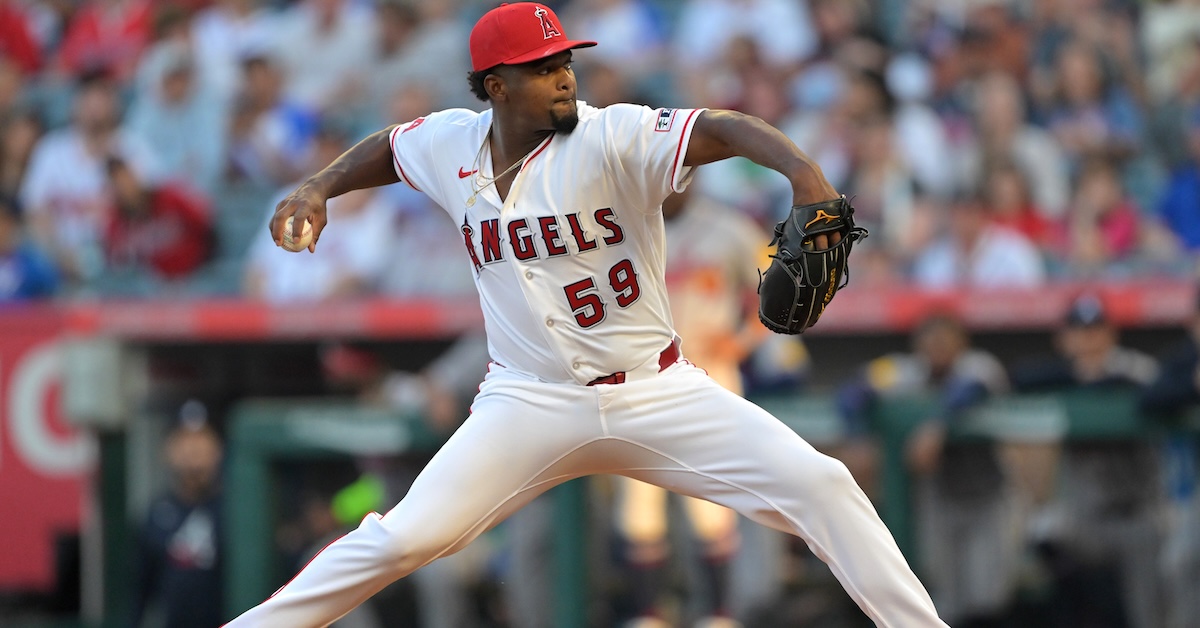
Well, you can take your pity and shove it, because as I write this the Angels are in first place in the division. Tied for first place, at one game over .500, but it still counts. Much as Jo Adell’s three-robbery night on Saturday won fawning headlines, and much as Zach Neto’s four home runs are leading the offense, there is one man driving this train: José Soriano.
Soriano is a good pitcher, but more than anything he’s a weird pitcher. He’s among the hardest-throwing starters in the league, but his sinker-heavy repertoire has traditionally not missed many bats. In 2025, Soriano was second among qualified starters in four-seamer velocity, trailing only Paul Skenes. But he was only 46th out of 52 in K-BB%.
Last year, I wrote about Soriano as one of the avatars of something that’s beginning to look like a systemic problem for the Angels: They love velocity, but their hard throwers don’t strike anyone out. I say “beginning to look like a systemic problem” like I didn’t spend the mid-2010s telling everyone who’d listen that, no, I’m serious, this is going to be the year Garrett Richards stays healthy and wins the Cy Young Award.
In July, Jake Mailhot followed up with a detailed look into why Soriano struggled to strike batters out — a question made all the more puzzling by the fact that his individual pitches did generate a lot of whiffs, even if they didn’t lead to many strikeouts.
Soriano throws five pitches: Sinker, four-seamer, curveball, splitter, and slider. The first three he throws to everyone, with the splitter mostly reserved for opposite-handed batters and the slider for same-handed batters. Last year, he was mostly sinker-curveball, and the splitter and slider came out more later in counts.
When I say Soriano’s a weird pitcher, it’s not because of the pitch types he uses, or how he uses them. His five-pitch mix is now and has been highly orthodox. It’s weird because he throws hard enough to make the pitch labels deceiving. Soriano’s curveball, for instance, averaged 85.2 mph last year, making it one of the hardest hooks in the league. Some of the guys ahead of him, like Jhoan Duran and Jacob Misiorowski, only throw a curveball because we don’t know what else to call that insane breaking pitch.
His curve is also strange in its movement profile: A Kirkland Signature curveball will dip with relatively little horizontal movement. Soriano’s curve has average vertical movement but six inches more horizontal movement than normal. It’s one of the side-to-side-iest curveballs in the league, adjusted for velocity, to the point where if you called it a sweeper I don’t think anyone would notice. Framing it that way, the Soriano of 2025 makes more sense: This is Eduard Bazardo plus five miles per hour and a couple show-me pitches.
I’ve been damning Soriano with faint praise for about 400 words now, so I feel obligated to mention that his splitter is truly gross. I’ve mentioned Duran and Skenes already, and while his splitter isn’t on that level, it’s not too far off. Soriano is either a throwback or a victim of outdated advice, in that he likes to pitch to contact so he can work faster. Regardless, his sinker generates a bucketload of grounders.
Last season, there were 844 individual pitches (e.g., Tanner Scott’s slider) that generated 50 or more batted balls. Soriano’s sinker had the seventh-highest groundball rate among those pitches, at 74.0%. And because he threw the sinker in massive volume (1,368 times, or 49.1% of his total pitches), that made his sinker the leading producer of major league grounders by an enormous margin: Opponents hit 242 grounders off Soriano’s sinker last year, 51 more than Framber Valdez’s sinker. Only 23 pitches even produced 100 groundballs in 2025.
I just want you to take a moment to visualize a pitch that’s more than a quarter more bowling ball-y than Valdez’s sinker, which is itself one of the leading soil disturbers in the sport. This is reflected in Soriano’s groundball rate: 65.3% last year, the highest among starting pitchers (minimum 100 innings) by 6.2 percentage points.
That’s how a pitcher with relatively poor strikeout and walk figures ends up with an impressive 3.73 FIP: Soriano basically never gives up home runs.
In 2024 and 2025, that’s what Soriano was: a groundball machine who threw a lot of innings. Like, what if Aaron Cook wore out the radar gun? That’s a good pitcher — Cook had a couple 3-WAR seasons and made an All-Star team — but it’s not an ace.
Let’s look at how things have unfolded in 2026: Soriano has taken the decision in three of the Angels’ six wins so far this year, and while I’m usually loath to derive meaning from that stat, you have to say he earned the W each time: Six scoreless innings and two hits against the Astros on Opening Day, and then the same five days later against the Cubs.
On Monday, Soriano left a fastball up to Drake Baldwin, who tomahawked it into the right field seats for a solo homer, but that was the only damage. Soriano allowed just two more hits, and this time he struck out 10 over eight innings.
Our WAR has Soriano at 0.6 through three starts, which is great — multiply that over 33 starts and you end up around where Tarik Skubal did last year. And that’s using FIP; Soriano has walked six and (irony of ironies) allowed a home run. One run over 20 innings comes to an ERA of 0.45. Our RA9-WAR has him at 1.4 wins above replacement through just three starts.
Impressive as that is, I’m extremely reluctant to declare anything based on a week and a half of games. (You can tell it’s too early to draw conclusions because of what I said before: The Angels are in first place as I write this.) A week into April, there might only be one meaningful big-picture question that can be answered analytically: Is a given pitcher throwing something different compared to last year?
And in Soriano’s case, yes, he is. It’s the same five pitches, with more or less the same velocities, coming from the same arm angle. But he’s throwing his four-seamer more: 22% of the time, up from 9% in 2025. He’s also getting more drop on his sinker and splitter compared to last year.
In his article from this past July, Jake mentioned that Soriano didn’t get very much two-strike chase on his splitter because he didn’t command it well enough. He hasn’t thrown any pitch enough times for us to learn much from the results, but every pitch he throws is getting chased more, including the splitter. The chase rate on Soriano’s splitter has doubled from last year.
Again, that’s probably a small-sample thing, but if Soriano is finally throwing his four-seamer enough that hitters have to worry about it, it stands to reason that they’d get confused and offer at a misidentified sinker fairly often. That’s the whole point of throwing a sinker, I thought.
On the whole, Soriano’s chase rate is up by almost half year-on-year, from 26.7% in 2025 to 39.2% so far this season. And even though opponents are making more contact in the zone (and hitting the odd home run on a pitch outside the zone), his overall contact rate is down 5.4% from last year.
Pitching trends — especially fastball usage trends — are cyclical. One year, cutters are in, then four-seamers up, then sinkers down, then sinkers up, skinny jeans, baggy jeans, punk, post-punk, pop-punk, post-punk revival… it’s hard to keep track. But this is the second post I’ve written this week about a pitcher finding success after he supplemented his sinker with increased four-seamer usage. Great pitchers can always succeed in their chosen style, but guys like Soriano have to adapt.
If Soriano has truly found a new edge, and can get more whiff and chase without sacrificing that elite groundball production, this could be a fun year for him.
Michael is a writer at FanGraphs. Previously, he was a staff writer at The Ringer and D1Baseball, and his work has appeared at Grantland, Baseball Prospectus, The Atlantic, ESPN.com, and various ill-remembered Phillies blogs. Follow him on Twitter, if you must, @MichaelBaumann.
Watching this start against the Braves, I had forgotten how hard he threw and was surprised at an early 98. He’s fun to watch pitch.