
Groundballs and Home Run Rates
Yesterday, I looked at balls hit on the ground versus balls hit in the air and their relative weights of offensive levels. The conclusion that arose from that was that ground balls are far less harmful to pitchers than fly balls. I do not think that should come as a shock to anyone, though the magnitude of difference might have been surprising.
Of course, pitching is not isolated. In order to get more strikeouts, pitchers generally have to pitch more out of the zone and thus risk more walks as well. Pitchers that seek ground balls tend to pitch lower in the strike zone, and one theory that has been prevalent is that ground-ball pitchers allow home runs more often on their fly balls since their “mistake pitches” are elevated into the hitting sweet spot. In other words, when they aim low and miss high, watch out. It makes some sense, but does the data bear this out? I went looking at figures from both leagues over the 2007 through 2009 seasons.
Looking only at batted balls classified as fly balls (no line drives or pop ups), as a pitcher’s ground ball rate increases does a pitcher’s home runs allowed via fly ball per fly ball increase?
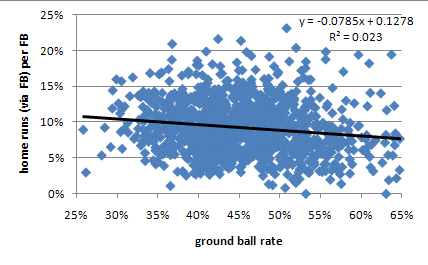
No. In fact, it goes down a little. This might be surprising to some, but I expected something close to this result as it is something I have looked at a couple different times over the past few years and continually end up with the same answer. This look was slightly different as I restricted the home runs in question to only those coming off fly balls. I usually find a trend line that is close to horizontal if I include all types of home runs. Either way, nothing close to a positive trend.
What about line drives? Looking only at batted balls classified as line drives, as a pitcher’s ground-ball rate increases does a pitcher’s home runs allowed via line drive per line drive increase?
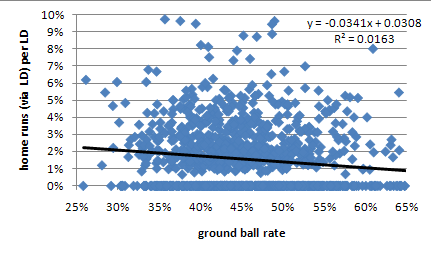
Also no. I was genuinely surprised by this. Even if you restrict the data to pitchers that allowed a line-drive home run (to get rid of the influence of all those zero values) the slope is still negative. Line drives are the squarest form of contact by the hitter and I did buy into the theory of more damagingly placed mistake pitches from ground-ball pitchers at least a little.
It turns out that while ground-ball pitchers are expected to allow more line drives, on a rate basis, than fly ball pitchers, the line drives themselves are less likely to leave the yard. My guess is that this would be due to some fuzziness in the distinction between hard hit ground balls and line drives and that ground-ball pitchers see a greater share of line drives credited against them that have no chance of clearing the fence.
Combining the previous two questions, as a pitcher’s ground-ball rate increases does a pitcher’s home runs allowed per non-ground ball increase? No. Less surprising now given the answer to the two previous looks, but worth mentioning for completeness. Also worth noting is that on all of these the R^2 values are incredibly low and the slopes are not dramatic. The best rule of thumb I can state from this look is that a pitcher’s ground ball rate has no impact on his various rates of yielding home runs and what impact there is might actually be negative.
Matthew Carruth is a software engineer who has been fascinated with baseball statistics since age five. When not dissecting baseball, he is watching hockey or playing soccer.
BP ran a nice article about this last year, but without the nice looking charts. GB pitchers rule!
Not so fast. It would be more accurate to say “good pitchers rule”.
If you read Matthew’s earlier post, he specifically mentions that he’s not addressing whether it’s better to be a groundball pitcher or flyball pitcher. He’s just looking at one certain aspect.
What was the sample used for the regression? Did you include all pitchers, or only those who met a minimum threshold, and what years did you use?
Very interesting article
“Also worth noting is that on all of these the R^2 values are incredibly low and the slopes are not dramatic.”. Indeed. That’s the first thing I came to. Thanks for the data, once and for all proving there’s no correlation between groundballiness as a pitcher and mistake pitches getting creamed for homers. Next step: average run expectancy per homer: groundball pitchers vs flyball pitchers. I’ve heard homers hurt groundball pitchers more. Now I’d like to see the data supporting it.
What would suggest this? If a ground ball produces less hits and more runs than a fly ball, on average, why would home runs hurt ground ball pitchers more? What am I missing if I assume that a ground baller is less likely, on average, to allow baserunners?
A groundball pitcher is more likely, on average, to allow baserunners, though. Ground balls produce more hits than fly balls.
So basically, your assumption is entirely inaccurate.
Ah. Thanks.
Those are really low correlations… I would conclude that the x and y axis are basically independent.
Yes, that would be conclusion too. It’s basically stating that the data is about a 2% fit to the regression line, i.e. there’s no real fit at all, and any “actual” fit is just noise, most likely.
To state the obvious a pitcher is really dependent onthe defense behind him. If a defense can not get to ground balls there is nothing wrong with playing station to station baseball. I would think a measure of a good ground ball inducing pitcher would be to study the ratio of sharply hit ground balls vs “routine” ground balls.
Would we expect to have certain groundball pitchers that could control how easy to field their groundballs are? And how exactly would you define the difference between sharply hit groundballs and routine groundballs? Sometimes a sharply hit groundball is easier to field than a weakly hit one.
I recall reading a study at Hardball Times a couple of years ago, which concluded that a 2 seam FB (versus 4 seam FB) produced grounders whether it was high or low in the strike zone. In other words, the 2 seam pitch’s effectiveness in inducing grounders isn’t because of its sink into the bottom of the strike zone, but rather the inherent movement/spin of the pitch. (That’s not to say that a mistake location for the 2 seam FB won’t produce more line drives or hard hit balls). Your results seem consistent with that study.
There seem to be a ton of data points for only 3 years of data (2007-2009), which makes me wonder if you didn’t restrict the sample to a greater than a certain number of fly balls allowed. I’m not sure what the appropriate number of fly balls would be, but we should first decide how many fly balls we need to have so that HR per fly ball is relatively stable.
Worth noting, is that the HR/FB rates posted on fangraphs WILL increase for ground ball pitchers. This is because HR/FB rates are calculated based on all fly balls (including popups), and fly ball pitchers give up a significantly higher percentage of their fly balls as popups, while ground ball pitchers post a lower percent. So ultimately if you’re looking at the numbers, it depends on what HR/FB rate you’re looking at…a HR/FB rate where the fly balls include popups (the HR/FB rate being used I believe) will yield different results.
So in Summary:
Fly ball pitchers:
-more popup outs
-generally lower BABIP’s (depending on how high their LD% gets)
-more extra base hits (their hits are more damaging)
-less double plays
-more total home runs
-lower HR/FB rates (as posted on fangraphs)
-higher HR/OFFB rate (outfield fly ball)
Ground ball Pitchers:
-less popup outs
-generally higher BABIP’s (depending on just how low they can get their LD%)
-fewer extra base hits
-more double plays
-fewer total home runs
-higher HR/FB rates (as posted on fangraphs)
-lower HR/OFFB rate (outfield fly ball)
Ted Lilly is an interesting case for flyball pitchers, he has been very effective employing the traits of fly ball pitchers, mixed with a very good K and BB rates, showing that extreme fly ball pitchers can be effective too. That’s really beyond the scope of this article though.
It’s been shown (in the article linked above by studes) that there is no inherent advantage to being a ground ball pitcher.
Add to the flyball list:
More strikeouts
Add to the groundball list:
More fielding errors and unearned runs
Slightly fewer walks and HBP
What I think would be interesting is to compare advancement opportunities between the two classes. GB pitchers get more double plays, but there are advancement opportunities for runners to advance on non-DP ground balls (including errors). Fly balls result in fewer double plays, and quite often result in no runner movement, but there are still advancement opportunities on long fly outs and errors.
Somebody that loves GB pitchers as much as I do. The results bear out in baseball sim games, as well. In that environment, I’ve also found GB pitchers are great in reliever roles, as their DP-inducing ways can get you out of a jam when you’ve got a runner or two on base and starter is flagging.
QUESTION: is it true that GB starters go deeper into games than the flyball/power pitchers? Anecdotally, I’ve always believed this to be true, as pitching to contact seems a lot more pitch-efficient than going for strikeouts.
Folks might be interested in this too:
http://www.hardballtimes.com/main/article/the-truth-about-the-grounder/
Matt, could you run it HR/BIP? I think that shows the “advantage” of being a GB pitcher rather than a FB pitcher. Also, I ran a few queries with GB vs various ERA estimators and didn’t really find an advantage, fwiw.
Would using estimators give you reliable results? Depending on how it’s constructed, it could be showing bias because of the different batted ball events. Also, looking at this issue using some form of ERA is probably not going to be particularly accurate, as ground ball pitchers give up more unearned runs. You wouldn’t be capturing everything they’re responsible for.