
Harrison Bader’s Defense Is Generationally Good

I’m going to say this bluntly because it’s something that most should agree with: Harrison Bader’s defense in center field is special. Unfortunately for Bader and baseball fans, he has never totaled above 430 plate appearances in a single season, so we’ve never had the privilege to see him run around the outfield for a traditional full season and rack up defensive value. But even with this limitation, he’s still at or near the top of just about every aggregated defensive metric leaderboard for the last few seasons. If you watch him roam the outfield — and I mean really watch him — you realize that this is a player who does everything correctly out there and has an unflappable baseball IQ. If you could write a script on how to be the perfect outfielder, all you would need to say is “be Bader.”
Let’s start by addressing where Bader ranks next to his peers this season in terms of defensive metrics. I’m only going to focus on Outs Above Average (OAA) for this piece. Defensive metrics are a great starting point to a conversation like this, but they are a complement to video analysis that will show us the details of a player’s fundamentals and decision making.
Here are the leading outfielders in terms of OAA this season:
| Name | Games Played | OAA | Success Rate | Success Rate Added |
|---|---|---|---|---|
| Luis Robert Jr. | 50 | 6 | 92% | 4% |
| Harrison Bader | 22 | 5 | 95% | 8% |
| Jackie Bradley Jr. | 38 | 5 | 95% | 7% |
| Kevin Kiermaier | 41 | 5 | 95% | 5% |
| Joey Wiemer | 48 | 5 | 91% | 3% |
One of these is not like the others! Given that OAA is a counting stat, a player with at least 16 fewer games played (usually more) should not be on this list, but Bader only trails Robert this season in OAA, and that is mainly due to his Success Rate Added. That gives some more insight into how valuable he has been in his limited sample this year.
Typically, I’d say it’s a little too early to rely on this number, as Bader has only played in 22 games, but it’s not like this is out of the ordinary for him. He has been a clear cut 80-grade fielder for the last few seasons and is always one of the most valuable defensive players on a rate basis. Last year, he accumulated 7 OAA despite dealing with plantar fasciitis that either kept him out or kept him limited to 86 games. Being an elite defender with lower body ailments is very impressive.
But now it’s time to address some of the incredible plays Bader has made this season:
May 2
May 17
Any volleyball players out there know how important it is to protect your body when you dive. Depending on the angle at which you’re making your dive, you need to contort your body to make sure you’re not folding over a wrist or buckling a knee in a weird direction that can compromise your health. I’m not sure I’ve ever seen anybody do this better than Bader. In the first play, he comes zooming in head-on. This is probably the most dangerous play for an outfielder to dive on, but as he approaches the ball, he scoots his right leg under him so he can smoothly slide and protect his upper body. In the second play, since he took a lateral angle to the ball as he sprinted in from right center, he instead uses his shoulder as a buffer.
When you can dive like this without compromising your body, you can make the nail-biting plays that other outfielders might pull up on. The Expected Batting Average (xBA) on the liner from Josh Bell was .860; on Whit Merrifield’s liner, it was .700. These are not plays anybody should make, but Bader does.
Now let’s move to plays where Bader is running toward the fences:
May 14
May 23
Randy Arozarena’s specialty is driving the ball to the opposite field. As a center fielder in Yankee Stadium, you have to weigh that knowledge with left-center being the biggest part of the park. This fly ball had an xBA of .430 and was a crucial play for Bader to keep the Yankees in the game; if it drops, it clears the bases and puts a runner on second base (at least) with less than two outs. The catch is incredible; that hardly needs to be said. Where my admiration comes from is Bader getting up and throwing the ball to second base. On a long fly ball like this, the runner on second can see that Bader has a good shot at catching the ball, trails back to second base, then tags up. The runner on first waits right before second base to make sure it’s caught; if it drops, you better get your tail home. Bader knows this, and so he immediately fires the ball into second rather than hitting Anthony Volpe for the cutoff. It helps that he has 97th-percentile arm strength.
The catch on Ryan Mountcastle’s .500 xBA fly ball is slightly different. Here’s the route taken:
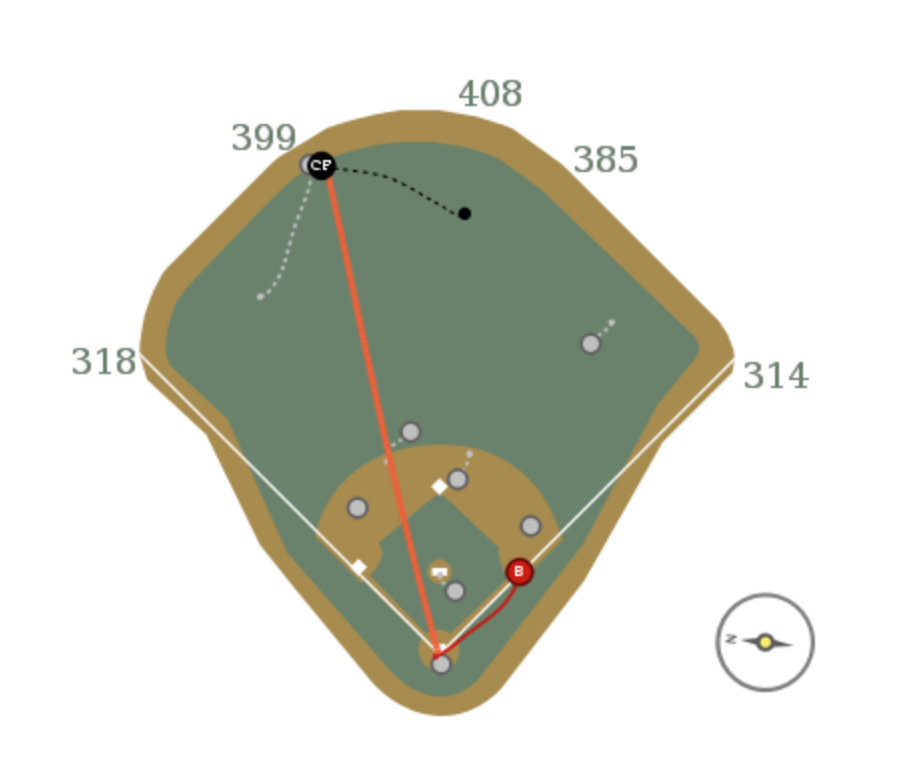
Bader was shaded toward right-center field and took a rounded route to the ball. When you take this route as opposed to a straight diagonal line, you move your momentum away from the wall and instead along the warning track. This takes spatial awareness, a great read, and fantastic body control. Running full speed into a wall is dangerous, but running full speed along the warning track gives you the chance to make a perfect slide and avoid Oswaldo Cabrera. Once again, Bader’s slide direction is perfect. This time around, he uses his right side to pirouette while on the ground as he keeps his glove pointed toward the air. By sticking his glove straight up, he makes sure it never hits the ground; that contact is what can force some outfielders to drop the ball on plays like this.
Each of those plays shows the exceptional skills that allow Bader to make improbable catches and boost his OAA even in a small sample. The difference between making these plays is often whether you can put your body in a position to lay out, and Bader proves time and time again that he can do this while protecting himself. Add that to his arm strength, 83rd-percentile jumps, and 99th-percentile bursts, and you have yourself a player who can go get anything in the air. If you get a chance to watch Bader anytime soon, you should do it. It will be an absolute delight.
Esteban is a contributing writer at FanGraphs. One of his main hobbies is taking dry hacks every time he sees a bat.
He’s phenomenal to watch defensively. I loved getting to see him every day he played with the Cardinals.
On top of the eye dropping plays he does all the little fundamental things like circling a fly ball to be in throwing position perfectly.
I think the thing that’s impressed me the most about Bader is the way that he swivels to get into throwing position before catching the ball *and* without taking his eye off of the ball.
It reminds me a lot of a safety in football, except in reverse (safety is generally facing the QB, but the best can swivel and run with a receiver while still watching the QB).
Thanks for the article! I’ve bee appreciating Bader’s defense, but hadn’t focused much on how he’s positioning his body when sliding and diving to preserve his body and protect the ball.
Harrison Bader is an incredible defensive CF – worth the price of a ticket. But a generational season? Check out Byron Buxton in 2017 – 131 GS and 27 OAA. Bader might end up with a similar stat line at the end of 2023. That would be spectacular but not generational.
So, wait. Buxton’s season is generational, but if Bader matches it, it’s only spectacular?
No, it would change Buxton’s season from generational to merely spectacular (I guess).
Considering the article never mentions Buxton and Bader hasn’t even finished half of this season… BTW, I never said Buxton’s season was generational.
“ But a generational season? Check out Byron Buxton in 2017 – 131 GS and 27 OAA. ”
First sentence could mean “Is it really a generational season? Check out this similar season” rather than “For a generational season, check out Buxton”
But we’re talking about Bader’s career as a whole, not individual seasons. Buxton has never come anywhere near that mark in any other year. While that’s partly because Buxton has never stayed healthy enough to play more than 100 games in any other season to date, he’s still not a match to Bader’s defensive level in general.
Buxton has played 4436 OF innings with an OAA of 69.
Bader has played 4119 OF innings with an OAA of 63.
They’re pretty much identical careers, so I don’t see how one is generational.
Barry Bonds and Albert Pujols were both generational players whose careers overlapped. Ditto Pujols and Trout, or Trout and Ohtani. “Generational” doesn’t mean once in a generation, it means defining of that generation. Wade Boggs and George Brett are two of the top five 3B to ever play the game and played at substantially the same time.
I’ve watched basically every defensive inning of Bader and he’s as advertised. He’s probably just a RHH Kevin Kiermaier. He makes difficult plays look easy because of hisI feel the Yankees should re-sign him if the price is right. I think 13-15M ish a year for 4-5 years is solid. Anything more and I’d let him walk.
Kiermaier wishes he was as good as Bader. They’ve tied in OAA since 2017, but Kiermaier has played 600 more innings by my math.
I do think health should be factored in, though. Kiermaier might not be Bader’s equal inning for inning, but he’s on the field more. I think teams would always take the slightly lesser defense if it means they don’t need to play backup center fielders for 60+ games a season.
While Bader did have a significant injury last year and had an IL stint earlier this year, that’s not always why he doesn’t get a full season of playing time.
In his first full season of 2018, he didn’t become a starter until partway through the season. In 2019, he lost playing time at times due to his poor hitting that year. 2020 was then of course the pandemic year.
OAA depends on hitters hitting the ball to them.
According to statcast Outfielder Jump (factoring reaction time, burst speed, and route efficiency), Kiermaier had a better average jump than Bader in 5 of Bader’s 7 seasons.
Kiermaier consistently has the stronger arm.
Kiermaier is currently faster than Bader according to statcast (even though he’s 33 and 5 years older).
To be clear, when we’re discussing Buxton, Bader and Kiermaier, we’re splitting hairs about the awesomeness of three incredibly talented fielders.
As far as having the ball hit to them, Statcast registers 1295 attempts for Bader in his career. From 2017 forward, Kiermaier has 1432 attempts.
I think the sprint speed data shifted in the last three days, because Bader is reading as faster as of this morning (which means it’s pretty dang close). But Kiermaier has had the better of Bader in jump and arm.
Yeah, I was definitely a bit hyperbolic there — I’ll admit that I was wrong there.
The fact that he didn’t go full-scorpion on that 5/14 play is incredible.
In certain circles, outfield defensive “highlights” are sometimes (often?) Joe Shlabotnik plays – “spectacular catches of routine fly balls” where fielders got fooled or take a bad route and have to compensate at the last second. Bader makes most plays appear routine and when they look spectacular, it’s because they truly are.
Edmonds always got that thrown at him but it was because he generally played 30 feet further in than most CF knowing he could go back on anything. He probably took away 200 shallow hits over the years and still got to everything deep.
I suppose it depends what you mean by “generational.” I think it works as long as you consider Ender Inciarte and Kevin Kiermaier part of an earlier generation. Those guys were insanely good out there.
Yankees need to extend this guy for another 3 years.
If they want just 3 years, they’ll probably have to up the AAV significantly. Like 3/60 instead of 5/75 or something.
Yeah that’s not going to happen, even if there are Yankee fans on Reddit who think it’s better to have fewer years for the same amount of money “just so Cashman isn’t tempted to keep them on the roster after they become deadwood.”
The author makes two points, 1) Bader is an exceptionally good outfielder, and 2) Bader has yet to play a full year without spending some time on the IL. I don’t question these arguments. But what I do question is the metric the author chose to evaluate the performance of Bader – Outs Above Average. OAA is a counting statistic. Shouldn’t the metric be a proportional statistic such as Success Rated Added (SRA)? (Assuming a minimal number of attempts.)
Using SRA would better support the author’s thesis. In 2023, Bader is nearly at the top at 6%. (Jackie Bradley Jr. is a tad better at 7%.) However, if we evaluate all years, Bader was actually more successful on average in 2018 at 7%, just behind Kevin Kiermaier’s 7% in 2019. If we evaluate over his career (really since 2016), Bader has been excellent on average. Essentially the same as KK’s.
Finally, I agree with one poster. If we do use the metric OAA, Buxton’s 27 in 2017 is the generational value. Nobody has had a season close to that one.
He also used xBA when catch probability is clearly the metric to use here
Actually, he played entire seasons from 2018-20 without any IL stints. He didn’t have more than 430 PA any of those years for alternative reasons that I pointed out above
Bader’s MLB career didn’t begin until 2017, and his first full season in the Majors wasn’t until 2018.
While he was in StL it wasn’t injury keeping him off the field, it was being platooned because the Cards seem to always have 5 outfielders who could start on most teams.
Why use xBA…? As I’m sure most people here know that’s not catch probability, and that’s not how OAA is calculated. That’s like Baseball Savant 101. It’s a bit harder to find catch probability but you can find it on Bader’s page on baseball savant, which I would expect a FanGraphs article to do. Otherwise this is a pretty misleading article.
I certainly agree xBA is irrelevant. A line drive into the gap can have a very high xBA. But if the fielder is placed at the perfect location before the ball is struck, nearly every fielder can make the play.
However, I disagree the metric catch probability is the one to be used. Again, suppose the fielder is always positioned where the ball falls. In that case, the catch probability is higher compared to the situation where the player is positioned at a location where the defender must move with maximum speed in precisely the proper direction to make the catch. Some fielders have a higher than average catch probability but have had to make little effort to make the catches.
I believe that is why the SRA metric was created. It measures the fielder’s response regardless of where they were told to stand per opportunity. The question we are trying to answer is: given two fielders, placed at the same location, on average which one is more likely to catch the ball.
I would also add that in reading the values of SRA, error bars, a key component of statistics that Fangraphs writers universally fail to include, are large with a small sample size of 1/3rd of a season. Hence we will have a difficult time determining the meaning of a difference between two defenders. Is it luck that has determined the difference in SRAs, or is it not?
TL;DR. I support the thesis – Bader is a superb outfielder, whom I can respect even if he hurts my team. However, please use an appropriate metric given that fielders will not experience the same number of opportunities and degree of difficulty in each opportunity. SRA should be the most appropriate metric.
I think success rate added is good as a cumulative stat, but catch probability is the best for an individual play since it factors in starting position like you said
Agreed. I understand now we were addressing different questions. Sorry for the mix-up.
Cashman traded away Jordan Montgomery so he could have some good CF defense on the rare occasions Bader is not too injured to play? He must be a lot smarter than me.
Bader filled a need and at the time, Monty was the odd man out of the rotation in a playoff series. The deal worked for both sides.
Any time you can turn a 3 WAR starter into a defensive specialist OF with plantar fasciitis, you have to jump at that opportunity.
Bader is not just a defensive specialist, and the deal was also made with 2023 in mind. So far, I’d say Bader is outplaying Montgomery this year even with the IL stint.
As I’ve pointed out, Bader is not as injury prone as you might think.
Meanwhile, an elite defensive CF who hits a little above average and also steals bases is a very valuable player.
Even if you’re right, that’s not as valuable as a starter who reliably gives you 175 innings & 3+ WAR. It was probably the worst trade of the last 10 years and Cashman will have to wear it forever. I welcome all downvotes from Yankees fans.
as a White Sox fan, I am obliged to bring up Fernando Tatis Jr for the collected broken pieces of James Shields in 2016
That trade doesn’t even make the worst 20 trades of the last 10 years.
Bader’s skills are indeed worth over 3 WAR minimum per season. He’s done it 3 times (including prorating for 2020) and is on pace to do it again this season.
Meanwhile, even though Montgomery played well after the trade last year, the way things are going he isn’t going to get anywhere near 3 WAR (fWAR or bWAR) this season.
He is surely the Master. Has a great attitude too – fun to watch.
Along with his decent hitting, this is why the Yankees were willing to give up a solid SP in Montgomery for a guy on the IL at last year’s trade deadline.
It also highlights just how desperate the Cardinals were to pick up a second SP at the trade deadline, as well as how well Carlson’s CF defense has developed.
That’s a well researched and written article. In that short sample, Bader looks insanely good. In another short sample, Mr. “unflappable baseball IQ” has recently sailed a couple of throws over the cutoff man and over the catcher at home plate. So, as always, we have to see how analysis holds up over a larger sample. Also, any sample for an outfielder should figure in throws and baserunners held from advances.
This guy likes Bader’s offense slightly more than I do, but gets it. I hate the Montgomery trade based on other peoples’ valuations. By my own valuation of Bader (a nice 4th OF), it was just a giveaway of a #2 starter with a track record.
If your fourth OF is 3-4 WAR quality, you must have one hell of an outfield.
Track record or not, and while he may technically be the #2 starter (or #3 depending on how you feel about Flaherty) on the Cardinals right now, you don’t generally want a guy with a 4.48 ERA and 1.442 WHIP near the front of your rotation.
I’ve also heard he’s hella good at catching Pokemon
Love the defensive appreciation. Bader is an exciting player to watch. It’s unfortunate he can’t just put full seasons together, because his defense would be good enough to put him in the HoF. Don’t think he’ll play enough for it though.
St. Louis misses him. Glad to see him thriving!