
Has Ceddanne Rafaela Made the Leap?
Ceddanne Rafaela’s breakout 2025 season has truly been a surprise. It wasn’t just that he ran a wRC+ of 80 in his first full big league campaign in 2024. It was how he got there. He ran the worst chase and strikeout rates of all qualified players. His contact rate and exit velocity ranked right near the bottom as well. He still looked like he could be a very good player by way of excellent defense in center field, but even though he was just 23, it raised real concerns about his potential at the plate. Beyond the fact that players haven’t historically improved their chase rates much after their rookie seasons, Rafaela’s chase rate was so extreme that it was hard to find someone to compare him to. A young player would be expected to refine his plate discipline some, but even if he had literally knocked an unheard of 10 percentage points off his chase rate, he still would’ve had the 12th-highest chase rate among all qualified players. And yet here he is now.
Rafaela has a 115 wRC+ and is on pace for 5.6 WAR this season. He has been the most valuable position player on the Red Sox. It’s probably helped that Rafaela has a year of experience under his belt and has been allowed to stick in center field all season, but this is a huge turnaround nonetheless. How did it happen? Let’s start at the beginning.
Through May 27, Rafaela was batting .221 with a wRC+ of 64. It was ugly, and because it wasn’t that far from what he did last season, it was easy to overlook some genuinely encouraging underlying numbers. (Credit to reader rickdugo3000 who set me straight in the comments when I overlooked those gains back in May.) Even during that terrible stretch, Rafaela’s walk rate was up a bit from last year and his strikeout rate was down significantly. His average exit velocity had taken an enormous jump from 86.6 mph in 2024 – 12th lowest among all qualified players – all the way up to 90.5, which put him around the 70th percentile. His xwOBA had climbed from .273 all the way to .335. He looked a whole lot better, but the ball just wasn’t finding grass.
Since May 28, Rafaela has hit 12 home runs and put up a 178 wRC+. His 2.7 WAR over that 40-game stretch have made him the third-best player in the entire game, sitting between Aaron Judge and Byron Buxton. According to our overall fielding metric (which includes a positional adjustment), he’s been the sixth-best defender in baseball across that same span, just ahead of Pete Crow-Armstrong. As you might expect, Rafaela has experienced some batted ball luck over this period, too. When you combine the ice-cold start and the red-hot recent stretch, his luck has just about balanced out. His wOBA and xwOBA are within a few points of each other, as are his DRC+ and wRC+. He’s making David Laurila’s bold prediction of 4.0 WAR and a Gold Glove look very smart indeed.
So Rafaela really has been better this season. Let’s talk about how he got there, and we’ll start by recapping our three main concerns. First, Rafaela was chasing way, way too much. Next, he wasn’t making enough contact on pitches in the zone. Last, he wasn’t hitting the ball hard. Put that all together and you’ve got a player who never walks, strikes out too much, and won’t get on base when he does put the ball in play. That’s not a recipe for success, so let’s see what’s changed.
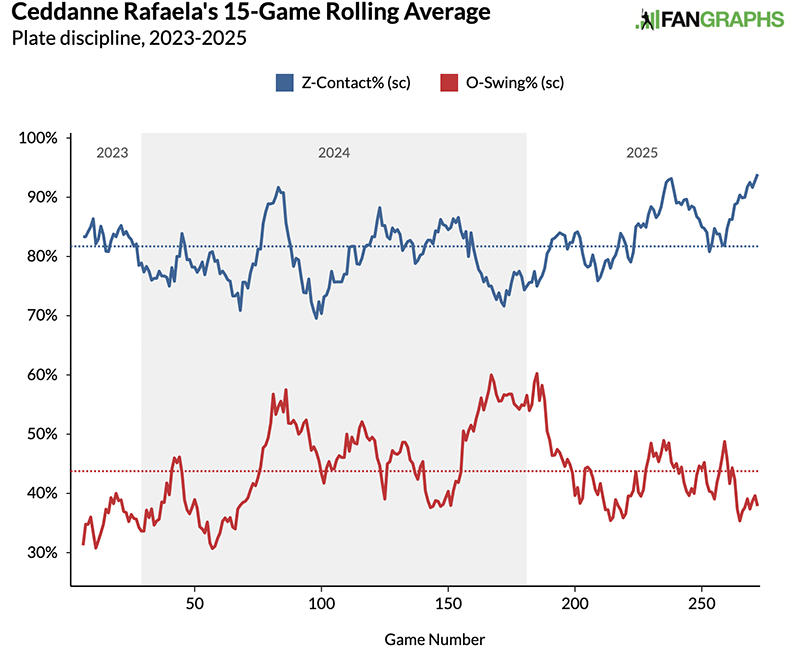
Statcast credited Rafaela with a 46.4% chase rate in 2024. That’s the sixth-highest single-season mark among all qualified players since 2008, the beginning of the pitch tracking era. If we use data from Sports Info Solutions, which has chase rates going back to 2002, Rafaela just ran the highest full-season chase rate of any qualified player ever. We are talking about arguably the worst plate discipline campaign in recorded history. This season, he has dropped his chase rate to 42.1%. That’s a significant improvement, but it still leaves him with the fourth-highest mark among all qualified players, and it’s awfully hard to be a good hitter while you’re chasing that much. Rafaela has cut his chase rate against breaking balls and fastballs, but he’s chasing offspeed stuff more than ever. It’s great that he has improved some in this respect, but this is still a very, very troubling part of his game.
On the other hand, Rafaela’s contact rate on pitches inside the zone rose from 75% in 2024 to 82.8% this season. Not only is that a huge gain – the fifth highest among qualified players this season – but it also pulls Rafaela back from a scary precipice. As Ben Zeidman wrote in an eye-opening article for Baseball Prospectus last year, zone contact is a shelf statistic. That is, it’s important to reach a certain minimum threshold, but as long as you do, it’s not all that important. “The difference between 71% and 79% might mean the world for a big leaguer’s viability,” Zeidman wrote, “but the same eight-point differential between 80% and 88% sees a stark reduction in significance.” Rafaela is still running a below-average zone contact rate, but he’s close enough to that average that it’s not going to hold him back all that much. He has specifically stopped whiffing against offspeed stuff in the zone, improving his contact rate on those pitches from 74% all the way to 94%.
Last comes contact quality, and it provides another really encouraging sign. We probably should’ve expected that Rafaela could hit the ball harder than he showed last season. He hit more than 20 homers in the minors in both 2022 and 2023, and he ran a 45.4% hard-hit rate in Triple-A in 2023. But even knowing that, this season represents quite a jump.
| Season | EV | EV90 | maxEV | Barrel% | HardHit% |
|---|---|---|---|---|---|
| 2024 | 86.6 | 102.2 | 108.2 | 7.5% | 36.7% |
| 2025 | 90.9 | 105.0 | 112.1 | 12.9% | 47.5% |
In every measure of contact quality we’ve got, Rafaela has gone from significantly below average to above average. To be sure, part of this comes from the fact that he’s making better swing decisions. In 2024, 70% of his balls in play came on pitches inside the zone. This season he’s at 79%. If we look at the heart of the plate, those numbers are 44% and 51%. It’s a lot easier to hit the ball harder when you’re swinging at a decent pitch. But that’s not the sole explanation for his improved quality of contact, because even when we look only at pitches in the zone (and again within the heart of the zone), he’s hitting the ball harder than he did last year. His bat speed has increased a bit. His hard-hit rate has improved against fastballs, breaking balls, and offspeed pitches – that is, against all pitches.
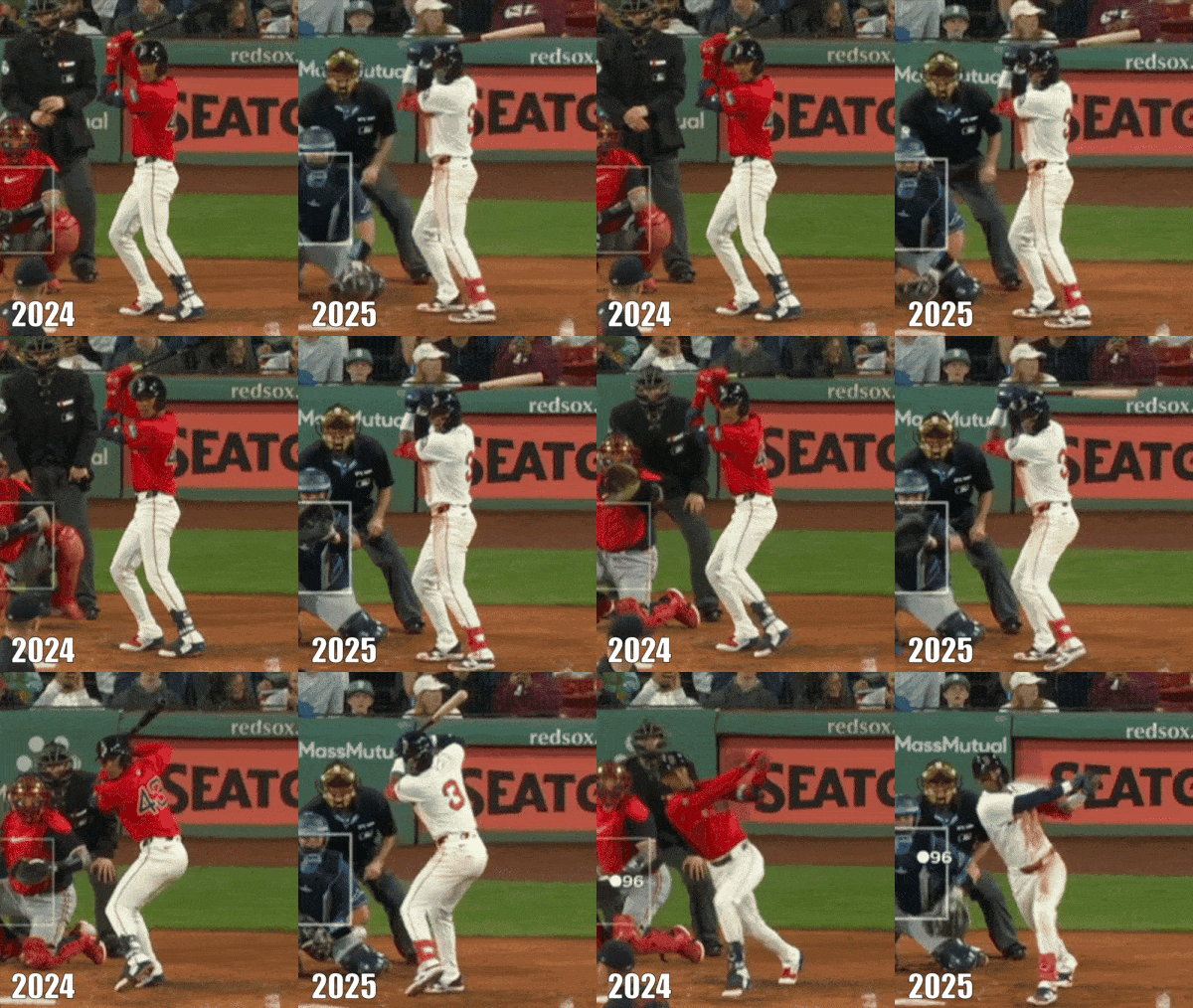
Rafaela also looks a bit different at the plate. He added muscle in the offseason and came into spring training with a plan to improve against lefties. He has adjusted his stance to be a little less open, and his leg kick is much more dramatic this season. At the suggestion of new teammate Alex Bregman, he has pretty much eliminated all pre-pitch hand movement.
So that’s where we are. Rafaela is still chasing disconcertingly often, but his contact rate on pitches inside the strike zone has jumped toward the bottom of the acceptable range and he’s hitting the ball much harder. He no longer looks like a liability at the plate. Rather, he looks like a player whose high strikeout rate and low walk rate will cause him to be very dependent on batted ball luck – setting him up to be very streaky, as we’ve seen so far this season – but one who really could be an above-average hitter overall despite those flaws. Of course, all of that depends on Rafaela holding onto these gains. It’s easier to trust the gain in exit velocity. That’s hard to fake, and it alone raises Rafaela’s floor in a significant way. But his contact rate will be the one to watch. Going forward, plate discipline will still decide how Rafaela’s story turns out.
Davy Andrews is a Brooklyn-based musician and a writer at FanGraphs. He can be found on Bluesky @davyandrewsdavy.bsky.social.
Absolutely made my day to see the shout-out. I am sorry that my comment on the June 10 article in retrospect looks unnecessarily mean, but I just felt the righteousness coursing through my veins. And, since that day, he’s batting .323/.343/.677.
Another thing worth noting is that his xDAWG and AURA+ are completely off the charts. See last week’s walk off home run.
Mea culpa – you were right in your comment and I (one of the downvoters then!) was wrong. I’m a Red Sox fan but was just way too cynical about the changes you were pointing out, and I dismissed them as small sample size data that wouldn’t likely last. I am so glad I was wrong and you were right! Cedanne has been a joy to watch.
Yeah, yeah, enjoy your victory lap! I was a June downvoter.
I still don’t understand how someone can chase as much as Rafaela and still put up good hitting numbers. I’m skeptical it will continue, but it’s been a fun ride.
Why would you downvote somebody for just having an authentic difference of honest opinion? Shouldn’t downvotes be reserved strictly for those posting in obvious bad-faith?
We’re all wondering
I downvoted because the comment ended with this line: ‘This was really lazy and bad analysis.’
I also had a difference of opinion as to whether Rafaela had suddenly become a league average bat, but the downvote was for that final comment.
It is so frustrating to see people who should know better, namely those with appropriate mathematical education, talking about batted ball ‘luck’. There is no such thing as batted ball luck. Regression should be expected, certainly, but luck and variance are not the same thing.
Bro what
If you’re suggesting that luck and variance aren’t the same thing all you are really saying is that luck doesn’t exist.
Obviously, the insinuation is that when a player has variance that negatively affects their performance they are “unlucky”.
People who win the lottery aren’t lucky either, variance just played into their hands. Almost like luck is a psychological concept of something.
Was not expecting to read an argument for determinism and against stochastic models in the comment section today, but here we are.
If John Calvin was a baseball fan.
I clicked through the top link, to Mr Andrews’ article from last year which basically says its really hard/rare to lower one’s chase rate a lot. Super interesting. Does FG or statcast allow us to see players’ outcomes on Chased pitches? Meaning, does all this contemporary stathead stuff take us back to the pre-Excel concept of a “good badball hitter”, and how can we see those?
Yes! You can find all of this and way, way more through statcast’s search function. Here are the results for chases by batters this year, minimum 50: https://baseballsavant.mlb.com/statcast_search?hfPT=&hfAB=&hfGT=R%7C&hfPR=&hfZ=11%7C12%7C13%7C14%7C&hfStadium=&hfBBL=&hfNewZones=&hfPull=&hfC=&hfSea=2025%7C&hfSit=&player_type=batter&hfOuts=&hfOpponent=&pitcher_throws=&batter_stands=&hfSA=&game_date_gt=&game_date_lt=&hfMo=&hfTeam=&home_road=&hfRO=&position=&hfInfield=&hfOutfield=&hfInn=&hfBBT=&hfFlag=is%5C.%5C.swing%7Cis%5C.%5C.bunt%5C.%5C.not%7C&metric_1=&group_by=name&min_pitches=0&min_results=50&min_pas=0&sort_col=pitches&player_event_sort=api_p_release_speed&sort_order=desc&chk_stats_pa=on&chk_stats_abs=on&chk_stats_hrs=on&chk_stats_xba=on&chk_stats_xobp=on&chk_stats_xslg=on&chk_stats_woba=on&chk_stats_xwoba=on&chk_stats_swing_miss_percent=on&chk_stats_delev_run_exp=on&chk_stats_launch_speed=on&chk_stats_launch_angle=on&chk_stats_hardhit_percent=on&chk_stats_barrels_per_bbe_percent=on&chk_stats_sweetspot_speed_mph=on#results
I commented on Rafaela in response to Ben’s article which mentioned his upcoming trade value series. If Rafaela’s present offensive numbers, including both pre 5/27 and 5/27 to the present represent his new level of offensive production is combined with his exceptional CF defense it is easy to see him as a 6+WAR player, but what if he puts out a wRC+ of 130, or more. If this hot streak, so unexpected and astonishing in its magnitude, is a sign of things to come then he could jump to WAR values not seen often. I watch every game and, all of a sudden, without a noticeable change, he started hammering everything. Why? What happened? Did his fairy Godmother touch him with a magic wand? Will he turn into a pumpkin if a game goes past midnight? Anyone’s guess is reasonable. As it stands now, if this is something close to his future performance his present contract, which runs through 2031 with a team option for 2032, and is for the mere pittance of $50 million dollars would give him the most trade value of any player under contract at this time.
About sums it up. Also the Red Sox exercise more patience than most teams with young players and it’s not new. Look back at Xander Bogaerts and Rafael Devers it took a while for things to click with them. It doesn’t always work out but on average it’s been a boon. I have my fingers crossed for Rafaela my instinct though is that most teams would want to see him put up similar results for one additional season. He has a really rough time going from the minors to the bigs, not helped at all by the mismatched roster and injuries playing in the dirt rather than the grass.
I was pretty excited when they called him up because of his glove and how loud his minor league stats were. I really started to loose hobe that the bat would translate and was lowering my expectations. I’m stoked he’s breaking out like this. That said Jackie Bradley Jr had similar hot streaks where he would be on fire and almost look like Mookie, followed by artic winters.
Try the trade value crowd source tool if you are looking for time to kill.
In Spring Training, watching Rafaela, he looked like a different player than last year. Looked radically better. First couple weeks of March he was chasing way less, walking more, hardly striking out at all, but was hard to tell if it was just a Spring mirage or actual improvement. Then he seemed to go back to his chase-happy self once the regular season got underway, and the Spring performance felt more mirage-ish
Then in June-July he was awesome. Maybe it took a while for him to find a rhythm and day-to-day consistency with his new approach? I’m not sure, but I watch every Sox game and Rafaela has looked like a truly special talent over the past month+. In Spring T, it was discussed about how adopting a new leg kick helped his timing and unlocked better plate patience. Took some time but now that seems dialed in. Batted ball luck notwithstanding, I’m a believer in his gains being real
In general you shouldn’t compare anyone to Javier Baez because nobody makes that approach work except Javier Baez. But I do think that Baez gives us some sense that guys like Pete Crow-Armstrong and Ceddanne Rafaela are going to be super streaky.
Walks give you stability, so these guys are going to be very dependent on batted ball outcomes. There are some stretches where they are going to look amazing and others where they are going to look mediocre.
I think that there’s going to be a number of stretches where Rafaela’s bat is going to look much worse than this, but the real cause for optimism is that he’s hitting the ball way harder and making more contact in the zone. Before, it didn’t even seem possible for him to become a league average bat because guys who strike out and walk like Javier Baez and have power like Andres Gimenez don’t have the ingredients to succeed. Now he does.
The floor the glove gives players like Rafaela and PCA is fantastic. Over time they’ll learn how to not let the valleys go so deep and extend the peaks by an extra few games.
Baseball is fun.