
Houston, We Have an Injury Problem
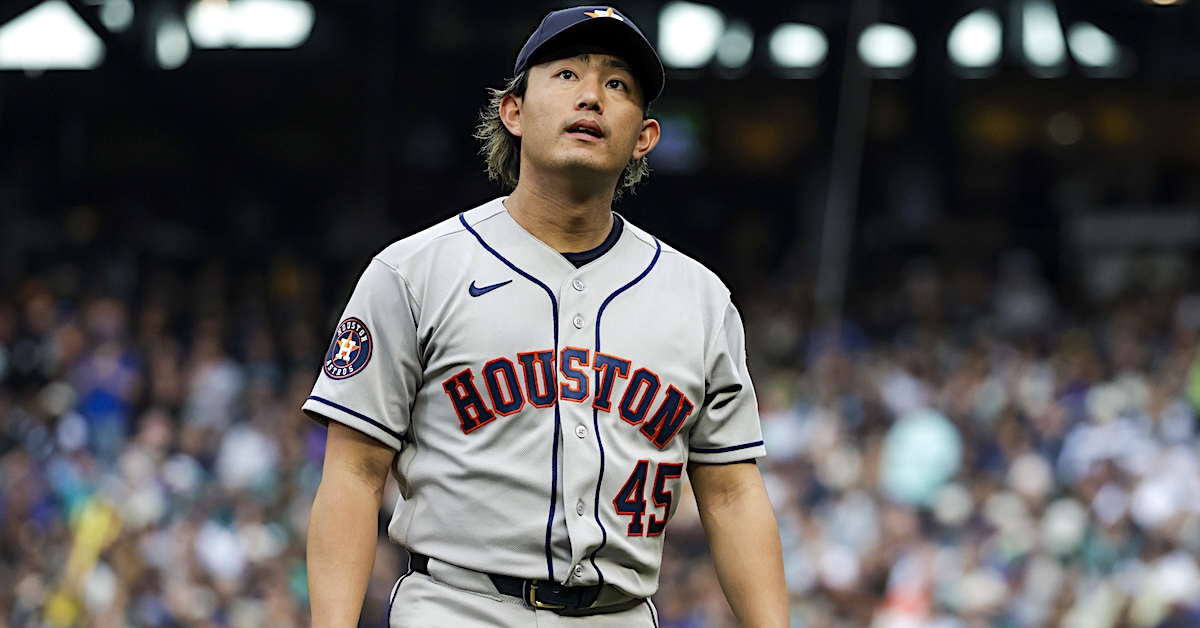
The normal flow of a baseball season inevitably includes injuries. The dog days of summer usually come with a star or two on the shelf. It’s a long year, and roster depth matters more and more as the months advance. But sometimes, injuries don’t occur at predictable intervals. Sometimes it’s April 14 and half your roster is on the IL. Just ask the Astros.
On Monday, Houston placed Tatsuya Imai and Jeremy Peña on the IL. That followed two moves from last Friday, when Cristian Javier and Jake Meyers both hit the IL. Five days before that, staff ace Hunter Brown landed on the IL himself with a shoulder strain that will keep him from throwing for at least two weeks, and likely prevent him from appearing for far longer than that. And that’s just the in-season injuries. Josh Hader, Zach Dezenzo, Bennett Sousa, and Nate Pearson all started the year on the IL. Brandon Walter, Ronel Blanco, and Hayden Wesneski are still working their way back from elbow injuries sustained in 2025. That’s 12 players on the IL if you’re counting at home, and a number of stars among them.
It’s not like every injury matters the same. Pearson has never appeared for the Astros and has a negative career WAR. Dezenzo is a fifth outfielder. The core missing names for Houston are Brown, Imai, Peña, Hader, Javier, and, to a lesser extent, Meyers. If the Astros can’t replace the production from those five, all of whom are key parts of their roster, 2026 will be a long year. So let’s consider how each affects Houston’s prognosis in isolation, and then consider them all in concert.
Peña’s injury is the one the Astros are best-equipped to deal with. Thanks to last season’s Carlos Correa trade and a quiet offseason, Houston came into this year with an infield logjam. Peña, Correa, Isaac Paredes, and Jose Altuve gave the team four good players for only three spots. None could reliably flex to DH because of the presence of Yordan Alvarez. Altuve spent some time in the outfield last year, even before Correa arrived.
So far this season, Houston has found playing time for all four, but it hasn’t always been easy. Peña missed a bit of time with an unrelated thumb injury to start the year, which let Correa play short. Other days, Alvarez rotated to left field to allow Altuve to DH, with Paredes filling in at second. Between roster permutations and rest days, everyone got their fair share of playing time, but there were plenty of awkward defensive configurations involved in doing so.
Until Peña returns, I expect a much more straightforward depth chart. Altuve can now play second every day. Correa can play shortstop or third, and I expect him to keep performing double duty. When the Astros are looking for infield defense, backup infielder Nick Allen is a far superior option, one of the best defensive shortstops in baseball. That shifts Correa to third, Paredes to DH, and Alvarez to left. If they’re looking instead for outfield defense, Alvarez should DH. But that alignment is pretty easy, too: Paredes at third, Correa at short, Altuve at second.
Meyers’ injury hasn’t produced the same kind of lineup-altering reshuffle. Instead, Houston made a simple swap, calling up journeyman Taylor Trammell and plugging him directly into the starting lineup in center. He’s played every day since then – a pinch-hit opportunity the day he arrived, followed by three straight starts. This suggests to me that the Astros prefer his defense to that of Joey Loperfido, the team’s other option in center (and currently the starting left fielder). Brice Matthews and Shay Whitcomb are listed as infielder/outfielders, but both are converted infielders, so I don’t think they’re headed for center anytime soon.
It’s certainly not ideal to replace Meyers with Trammell, because Trammell is the definition of a replacement-level player; 0.1 WAR in 507 plate appearances across six seasons of major league experience. But, on the other hand, Meyers is no Peña; Peña accrued about as much WAR in 2025 as Meyers has racked up in his entire big league career. The real problem comes down to depth. Loperfido is Trammell’s backup, but he’s also starting in left. If Houston were to slide him over to center, Alvarez would have to play the field every day, something the team clearly isn’t comfortable with. And that’s before getting into rest days, or a backup for right fielder Cam Smith. As is so often the case, the first injury isn’t the one that gets you; it’s the injury to an injury replacement. If I were the Astros, I’d be looking to trade for depth outfielders, because the current squad has few options.
The big short-term issue for Houston isn’t the offense, which has been one of the best in baseball so far this year. The pitching, on the other hand, has gotten torched; the Astros are surrendering more than six runs a game. And that was with Brown, Imai, and Javier combining for eight of the team’s 17 starts. That’s not great!
Brown’s injury is a huge unknown. If he’s on the shelf for an extended period of time, the Astros rotation is going to be bad; they just don’t have enough good options to make up for missing their best pitcher. But losing Imai hurts, too. He’s been uneven to start the year, to put it mildly; a 7.27 ERA and a 25% walk rate are about as bad as it gets, but he’s missing bats and keeping the ball on the ground, two things that tend to stabilize quickly. Command has long been Imai’s weak point, and that’s something to keep an eye on this year when he returns, but despite his struggles, his absence is going to be a challenge for Houston.
The Astros’ RosterResource page currently lists four starters in the rotation: Lance McCullers Jr., Mike Burrows, Cody Bolton, and Colton Gordon. McCullers threw a total of 103 innings between 2022 and 2025, so it’s fair to say he’s not fully stretched out. Burrows, an offseason trade addition, looks like a mid-rotation starter at best, though he’s off to a slow start. Bolton is a Quad-A type in his fourth organization, and he’s also day-to-day with a back injury. Gordon, who made 14 replacement-level starts for the Astros in 2025, is getting called up to start Tuesday night’s game. This is not what you’d call an elite group.
Obviously, you need more than four members in a rotation, though because Houston’s starters have delivered so few innings this year – an average of just over four innings per game – the team has plenty of relievers stretched out. Ryan Weiss and J.P. France are starters by trade who are currently pitching in relief; either could slide into the rotation, and both are likely to cover starts in the coming weeks. Steven Okert and Christian Roa have also pitched bulk innings in the early going, but I don’t think either is likely to move to the rotation; they’re more likely to work as long relievers behind some of the fringier starters.
Houston’s minor league system also provides several options. Spencer Arrighetti, Miguel Ullola, and Jason Alexander are all pitching well this year in Triple-A – or at least, pitching passably well and remaining healthy. I expect to see several of them up over the next few weeks, though it’s anyone’s guess as to who gets the first shot and who gets the longest rope.
If I were the Astros, I’d be running my rotation by playing the hot hand. I don’t think that’s generally a good practice, but the truth is that it’s incredibly difficult to have certainty about which of their bevy of replacement-level options is best. All six of the most likely replacement candidates have similar ERA projections. For that matter, Bolton and Burrows do too, and even McCullers isn’t projected to be much better than that group. Even more confusing, two pitchers with the same true talent level aren’t guaranteed to pitch the same in a brief stint. Guys get hot and cold. Talent isn’t stationary. Noise is loud, but skill really does change.
Most of the time, that isn’t a huge deal. You have your top starters – they’re not getting demoted because of a bad game or three. You have your end-of-rotation arms and swingmen – they pitch out of necessity rather than with a set schedule, and if someone does well enough at the role over a period of weeks or months, he might get promoted into the circle of trust. But when you’re building the entire rotation out of swingmen, quickly determining who has it and who doesn’t is quite important.
To my eyes, Arrighetti has been in the best form in the early going. He’s a candidate for Wednesday’s start; the Astros haven’t announced starters for Wednesday or Thursday yet. The first player to get a chance isn’t necessarily going to be the one who keeps the job, though; it’s going to come down to who runs with it. For at least two weeks, and probably longer given the severity of Brown’s and Javier’s shoulder injuries, the Astros have a massive supply of available innings, and a desperate need not to sink further into the basement of the AL West.
Even when Imai returns, this is going to be a weak pitching staff. We had Houston down as a bottom-third group, and that was including Brown, who entered the season as a Cy Young contender. But the immediate future is the bleakest. Tread water for a few weeks, and the picture will brighten meaningfully. Lose two thirds of the games over that stretch, and the chances of playing in October will look quite remote indeed. Dan Szymborski’s look into the importance of early-season performance underscores the importance of avoiding dreadful starts. Even with unchanged team strength, Dan calculated that the Astros would see their playoff odds decline by 22 percentage points with a rough month. And to put it mildly, “unchanged team strength” doesn’t feel like a strong assumption at the moment.
Oh, yeah: The bullpen also needs some help. Hader is on track to face hitters sometime this week, but he’s been out since last August and the ‘pen has not performed well in his absence. Replacement closer Bryan Abreu has a double-digit ERA, and a double-digit FIP to match thanks to some home run problems. As a whole, the group has been worth -1.3 WAR so far. The Astros desperately need more arms, and also for their existing ones to perform better.
Taking this all in concert, I think it’s fair to say that the balance of this month is extremely important for the Astros. That’s not usually true. It’s still April. It’s too early to believe that we’ve learned much about player performance, even. But starting with the worst record in baseball and then losing most of your starting rotation is a special circumstance. The Astros are in danger of leaving themselves too tall a hill to climb if they continue to stumble through this month. I rarely sound the alarm so early, but rarely isn’t never, and this looks like a pretty severe test.
Ben is a writer at FanGraphs. He can be found on Bluesky @benclemens.
Wise move to wait until Artemis was back safe before using this headline 🙂
And the injury bug has now made the trip to Sugar Land. This time, it was Miguel Ullola, who sprained his left ankle when he was backing up home plate a few days ago. So, yeah, that depth chart looking mightily lean at the moment…
Bolton also left his last start with some back issues (I didn’t see that in the article, maybe I missed it).
There are going to be some battlefield promotions to AAA once they empty out the current AAA rotation for the MLB staff.
Might’ve been interesting to touch on the why and how, especially for the pitchers. I know Brown had 102 pitches on opening day, more than any other opening day starter, then pitched again on four days rest! Are they overworking their staff, in spring training and otherwise? Are they being coached in a certain way mechanically that is causing this? Some good questions if I do say so myself.
Four days rest is regular rest? Not sure why that is relevant.
I am pretty sure that the Astros did not count on having a rotation consisting entirely of Lance McCullers, Mike Burrows, Colton Gordon, Spencer Arrighetti, and Jason Alexander but that’s what they are going to have.
Maybe Ethan Pecko will be ready soon?
If Jason Alexander is already fifth in the pecking order, Kenny Banya, Lloyd Braun, and Jean-Paul Jean-Paul can’t be far behind.
Wouldn’t Jean-Paul Jean-Paul not realize there is a separate volume knob for the alarm on his alarm clock & sleep thru his start?
Better have David Puddy as a backup plan.
And that’s a wrap on the Astro’s run. And thankfully so. Still, say what you want about Crane as an owner, leading a cheating franchise with a front office that’s had harassment allegations, but he’s opened up the pocketbook to keep this team winning. After hoisting that piece of metal in 2017, they made sure to get Cole. After losing in 2018, they got Greinke. They resigned Verlander and he won a Cy Young. They got Yordan and Altuve to sign on the dotted line. He reacquired Correa and his contract. But it’s clear that after seven (!) straight ALCS appearances, Crane was willing to go with half measures and let this team wither. Just cash the checks instead of reinvesting them. They parted ways with Tucker, Framber, and Bregman and only to have clear downgrades take their place. And because player acquisition is a zero sum game, I’m glad other teams are taking these guys while a clear villain gets worse each year.
It remains to be seen if the front office gets overhauled and they do a teardown again. It’s a crassness that’s certainly possible for this guy, even in an AL West that lacks the firepower the East has.
Dude, the whole sign stealing thing happened like 10 years ago. *So much* has happened in the world since then. You gots to chill.
I praised the Astros organization for maintaining integrity through actively trying to improve their club… Something the Red Sox, Cubs, and a coterie of small market teams refused to do.
But yeah, everyone in the Astros organization should, at the very least, be shamed for stealing a championship from the more deserving team. Millions of fans were robbed of the joy they were rightfully owed and those players suffered no other material consequence. The least any decent person could do is never let that statute of limitations go.
There’s no statute of limitations on this. They cheated and showed zero remorse. It should be brought up forever as far as I’m concerned.
Who are you mad at though? Jim Crane but he is a pretty vile person even outside of his Astros tenure. Carlos Correa is back. But most of the rest of the team wasn’t around for the Luhnow era, including the front office and the coaches.
Most of the rest of the guys are out of the game. Of the ones who are still around, Altuve didn’t participate. Yordan Alvarez didn’t get called up until 2019 and while maybe he participated that year he missed the part we know about. Cora manages the Red Sox, Bregman plays for the Cubs, and Beltran has been largely kept away from the game (except for being elected to the Hall of Fame which I still think is super sketchy because I am not over it either).
I am fine with holding a grudge forever and I will probably root against the Astros until Crane sells the team or dies, the latter of which could be next week or a couple decades from now. But I am not so sure that the current Astros team deserves this level of loathing for this very specific reason. I think Beltran and Cora are much more appropriate targets.
Who is “they” in this case? 99% of the people involved are gone. Move on with life
This is a bad pitching staff and outfield when everyone is healthy. It’s a weak farm system and the top prospects are still teenagers. Peña and Paredes are free agents after next year, Brown and Alvarez have two more years after this, Altuve is about to turn 36. The playoff odds sit at 20%.
They’ve kept the window open longer than anyone thought they would but if this is a lost season, does it make sense to tear down?
I have no idea what Jim Crane’s position on this is. He’s a meddler, insisting that costs be kept down right up until he decides he wants a player and then he suddenly opens up the checkbook.
This means that I don’t think it’s out of the question that they decide to trade for pitching help and try to make another run at it this year.
As for selling, there’s only so much they can do when Cam Smith is the future, Altuve / Hader / Correa have no-trade clauses, Lance McCullers has 10-5 rights, etc.
Here are their trade chips who are performing at a functional level and not hurt:
-Jeremy Pena–a huge return is possible here even though he’s not hitting for power right now
-Yordan Alvarez—awesome but huge contract and frequently injured
-Isaac Paredes–really only valuable to 3-5 teams, one of them is the Astros
-Christian Walker–raking now but had huge negative value last year
When I look at this, I wonder if it isn’t worth it to just play things out this year, reset the tax penalty (wherever they are on that) and go in for one or two final pushes in 2027 and maybe also 2028. They have Pena and Paredes for two more years and Alvarez, Hader, and Brown under team control for 3.
Yep, nearly the whole team is under control for multiple years. Pena and Paredes are the only two with any trade value that I’d consider trading. Abreu was another before the season but not at the moment.
The other players are either under control for at least two years after this season or have very little trade value. I don’t think they’re trading Yordan or Hunter Brown.
A lot can change in a few months, but the problem is McCullers is the only money coming off the books next season. It’s hard to imagine them having the resources for a #2 starter while patching their lineup.
I also think Yordan could bring back a huge haul if he stays healthy. It’s 2 years/$54 million after this season ending at age 30, he’s still projected for 4 WAR both years, and he was easily a top 5 hitter from 2022-2024. Not everyone can use a DH but he’s looked like he’s right back to being a top 5 bat in the league. It might look like the same situation as Soto on the Nats in 2022 in July
I have a very hard time imagining this team going all in on a free agent pitcher even with more payroll space. They seem more likely to try and trade for Joe Ryan or Sandy Alcantara or Drew Rasmussen. Or more than one of those.
Maybe they could unload Walker if he is still hitting like this at the deadline to free up payroll space for next year. But otherwise it’s hard to see how they could get more value coming back than going out. Is there a team out there who is excited to trade away prospects for a DH only with health problems making $25M a year? Even one as great as Yordan Alvarez? The Padres are basically out of prospects.
I’m not sure if the long-term course of the team will be decided over the next 3 months. As you mentioned things are likely to start changing drastically after 2027 in one way or another, but if 2026 is disappointing, I would expect them to try to reload for one last ride in 2027. If there’s a massive teardown due to underperformance, I would expect 2027 to be the year for that.
Thus, I wouldn’t expect major moves to be made this year (although wouldn’t be shocked if Paredes was on the move yet again, he’s an odd fit when everyone is healthy). Any selling I’d expect to be things more on the margins, like moving on from impending FAs like Bryan Abreu.
Waiting for the Crochet announcement
I am hoping he was tipping pitches, even if he was using big flashing signs and inadvertently mouthing the words “fastball” and “inside”. Anything but the dreaded you know what…
Brice Matthews can play CF
Ullola is hurt.
Okert hasn’t provided bulk innings.
But yeah if Houston doesn’t go 7-3 over their next 10 games they should probably be deadline sellers. Pena, Brown, and Paredes would be their significant trade chips and should bring back a haul good enough to give Houston a top 10 farm (assuming Pena and Brown come back healthy and productive before the deadline). Meyers, Okert, Abreu, and possibly Imai would also be available if healthy. Houston’s in a tough spot but a rebuild shouldn’t be nearly as painful as it was in 2010-2014.
Brown is under team control through 2028. If you think you might compete (which they should with this lineup), I don’t think you can trade him just yet.
It will still be April 10 days from now. Giving up if they don’t go 7-3 seems like a slight overreaction.
What a trash outcome for the ‘Stros. Hope they’re able to can it soon.
Duran and Masa for Paredes and Loperfido. Who says no?
Boston
Who else thinks that teams are using IL as basically a place to store pitchers so that they’re ready for the second half of the season?
There should be a way to acquire pitchers in bulk using Paredes or Peña. Someone like Bello and a couple others.
They need to win in 2026-27. The team is old.
Why they didn’t sign Tailom yday is beyond me
At this point why not take a flyer on Giolito?