
How Much Free Food Can a Player Consume Under the CBA?
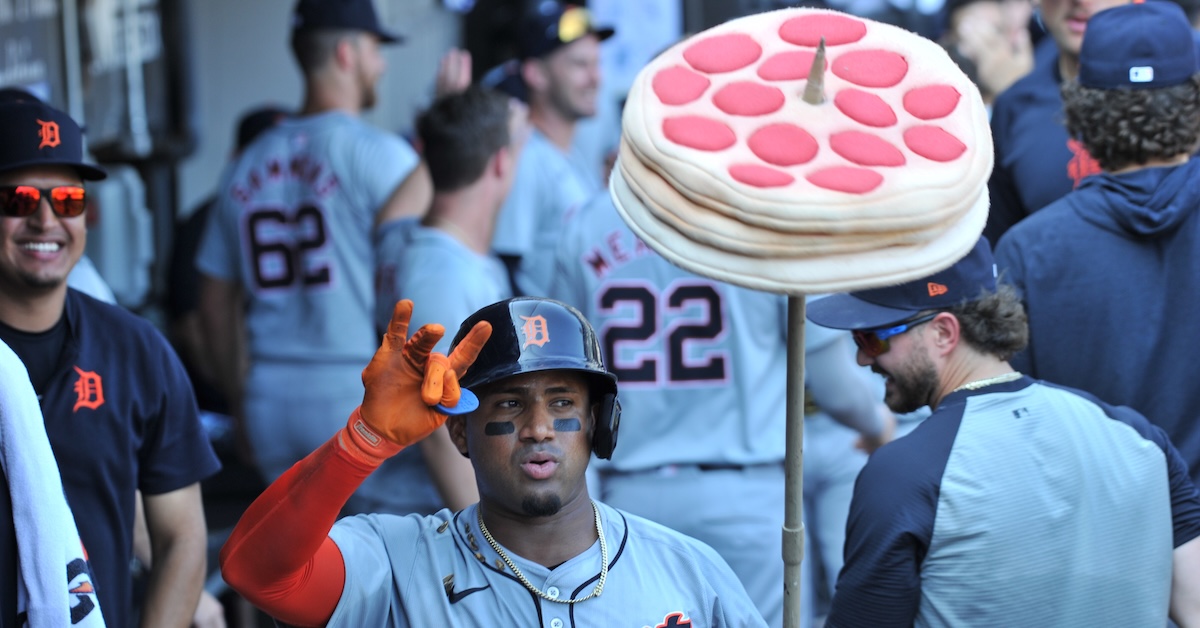
A lot of people think this job is about immersing oneself in the glorious, vibrant culture of baseball. Feeling the sun on your face, schmoozing with athletes, learning the finest intricacies of a children’s game. And it is, to some extent. Some people think this job is about the craft of writing, and ingesting and disseminating knowledge. It is, to some extent. Some people think this job —at least how we do it here at FanGraphs — is about math, the unforgiving exactitude of numbers. And again, it is, but only to an extent.
The more time I spend doing this job, the more I’ve come to believe it’s about the rules. Sometimes literally — once a week I answer a question for our Members Only mailbag, and it usually has something to do with “Why hasn’t anyone thought to do X?” The answer, more often than not: Because they’re not allowed.
So I’ve found myself spending lots of time with two documents: The major league rulebook and the collective bargaining agreement. The latter document is of interest to most fans because of the ways in which it governs transactions. This is where the minimum salary is established, along with the competitive balance tax and rules about arbitration — the minutiae of which made headline news just last week.
Those are the headline details — the big-money sections, literally — that will likely capture the public’s imagination over the next several months. But the CBA is first and foremost a covenant between labor and capital to govern workplace conditions, and it is herein that you’ll find all manner of fascinating tidbits that fans would never notice or care about, but are important to the everyday lives of the players.
For example: Article XV, Section B requires clubs to furnish free parking to the players at the ballpark. In that same article, Section F(2)(a) requires each club to provide classes in English and Spanish as a second language, if one or more players ask for them. Players are allowed to use tobacco products on the field, but not during televised interviews, or in ballparks where tobacco use is banned by local ordinance, and only if the player in question made his major league debut in 2016 or earlier. Why? Because Attachment 28 says so.
I never would’ve noticed the effects of Attachment 28 if I hadn’t spent a lot of time when I was younger watching baseball with people who dipped, and would always point out when a player had a can of tobacco in his back pocket. (Which is now prohibited regardless of debut date.)
But these are the little things that shape a major league ballplayer’s life, or the league’s relationship with the viewing public, and they get argued and horse-traded across the bargaining table, whether the fans notice their effects or not.
Which brings me to the issue of the day: Attachment 47. I first came across this attachment to the CBA in 2024 when I was writing about the Athletics’ imminent move to Sacramento and trying to find out exactly what was required in a major league clubhouse.
The list includes a recovery room; a dietician; a full-time chef for home games; bathrooms that get cleaned and disinfected every day, with soap, shampoo, shaving products, toiletries, towels, and washcloths; and “a safe or lockbox for valuables.” That’s an extensive list, but a reasonable one. It’s what you’d expect from a professional locker room in terms of comfort and hygiene.
But I want to focus on section 3(b), which concerns how many meals are provided in the clubhouse each day. Here’s the section in question:
(b) Meals
(i) On days when Clubs are scheduled to play games beginning at 1 P.M. and 7 P.M., Clubs shall be required to provide three meals for Players (i.e., lunch or breakfast, pregame, and postgame).
(ii) On days when Clubs are scheduled to play games beginning at 4 P.M., Clubs shall be required to provide three meals for Players; provided, however, that a fourth meal (i.e., breakfast, lunch, pregame, and postgame) shall be provided in the event a request is submitted at least seven (7) days in advance by a Club’s Player Advisory Council.
First of all, this section illustrates why, if someone tells you ballplayers only work two and a half hours a day, 162 days a year, you should hit them in the face with your shoe. Ballplayers usually report to the park at least three or four hours early, and spend that time working out or taking in scouting reports or meeting with coaches. Sometimes more. If a game is at 1 p.m., it’s not unreasonable to think that a player might be at work long enough to have breakfast, lunch, and dinner there.
I had to ask around a little on background about Attachment 47, and the question of how many meals a player’s entitled to turned out to be confusing more than anything else. The idea that any team would limit its players to the bare minimum they’re entitled to eat under the CBA seems to be unthinkable.
In practice, when there are players present in the clubhouse, the kitchen is open. Nobody’s scanning a meal card like in a college dining hall, and nobody’s going to get in a player’s business about taking an extra helping of potato salad from the buffet line. Nobody wants to be known as the club that nickel-and-dimes its players over food, even if the combination of hungry young men and unlimited free food leads to the occasional cheesesteak-eating contest.
That’s as it should be, and I’m encouraged that even as tensions and temperatures rise in the final year of the CBA, players can eat their fill no matter the start time. It’s a sign of a healthy workplace.
But unlike professional ballplayers, I’m constitutionally unable to be blasé about free meals. I grew up with two brothers, and spent my 20s as a graduate student and freelance writer; food that’s here today is gone later today, and may not be available tomorrow. To this day, I buy ramen in bulk on the internet, and live by the Iron Law of Euclidean Pizza Geometry: Ordering the largest pizza available will give you the most value for your money.
All of this is to say that if I were entitled to three square meals a day under the CBA, I’d make sure to get my money’s worth. More importantly, if my union negotiated Fourthmeal for me in the case of a 4 p.m. start time, then I’d be a fool not to take advantage. Marvin Miller would turn over in his grave if he knew you were passing up an extra helping of chicken parm on the bossman’s dime. Eat up, kid, there are hungry players in the Pecos League.
Let’s assume, then, a cruel and harsh counterfactual in which MLB clubs provided only the bare minimum of food required by the CBA. Would each team be entitled to the same number of meals?
Of course not.
The MLB schedule as currently constituted is not set in stone. We’re going to have dozens and dozens of games rescheduled due to weather, or flexed to a new time slot for TV, or shifted up a few hours to relieve traffic on the day of a World Cup game. But as it stands now, we have 2,430 games on the books, each with a start time at least written in pencil.
Attachment 47 offers feeding instructions for three start times: 1 p.m., 4 p.m., and 7 p.m. Out of those 2,430 games, would you like to know how many start at exactly 1 p.m., 4 p.m., or 7 p.m. local time?
Three. On July 5, Reds-Orioles and Pirates-Nats are scheduled for 1 p.m.; the Mets and Dodgers are slated for a 7 p.m. first pitch on April 15, presumably for Jackie Robinson Day-related reasons. So clearly there would be some allowance for the traditional staggered start time. How much, exactly, I had to guess. The free provision of food at all hours in major league clubhouses has rendered that question moot in the real world.
I decided to go about an hour in each direction — an hour and 10 minutes into the future, actually, to account for 5:05 start times that are, for all practical purposes, 5 p.m. games. Under these criteria, games fall into one of three buckets: breakfast games, which start before 3 p.m. local time; Fourthmeal games, which start between 3 p.m. and 5:10 p.m.; and dinner games, which start after 5:10 p.m.
| American League | National League | ||||||
|---|---|---|---|---|---|---|---|
| Team | Breakfast | Fourthmeal | Dinner | Team | Breakfast | Fourthmeal | Dinner |
| TOR | 44 | 25 | 93 | MIA | 44 | 22 | 96 |
| BOS | 35 | 24 | 103 | WSN | 47 | 22 | 93 |
| TBR | 47 | 17 | 98 | NYM | 42 | 20 | 100 |
| BAL | 43 | 15 | 104 | SDP | 44 | 16 | 102 |
| TEX | 40 | 13 | 109 | ATL | 34 | 15 | 113 |
| CLE | 48 | 10 | 104 | PIT | 53 | 14 | 95 |
| MIN | 57 | 10 | 95 | ARI | 48 | 12 | 102 |
| SEA | 48 | 10 | 104 | CIN | 50 | 12 | 100 |
| CHW | 54 | 9 | 99 | PHI | 40 | 12 | 110 |
| KCR | 45 | 9 | 108 | MIL | 46 | 11 | 105 |
| HOU | 41 | 8 | 113 | SFG | 56 | 10 | 96 |
| NYY | 47 | 8 | 107 | LAD | 31 | 9 | 122 |
| DET | 57 | 7 | 98 | CHC | 59 | 6 | 97 |
| LAA | 40 | 7 | 115 | STL | 55 | 6 | 101 |
| ATH | 45 | 6 | 111 | COL | 51 | 4 | 107 |
The practical implications of this scheduling discrepancy are limited. By my math, the Blue Jays are entitled to 21 more meals this year than the Rockies (and the National League to 13 more overall than the AL), but in practice they’ll eat the same amount.
But there are 14 teams with home cities in the Eastern time zone; they comprise 11 of the top 13 teams in these late-afternoon starts. Presumably they’d have more afternoon home games against teams from out west, to accommodate a TV audience in another time zone.
And after having compiled this list of every game on the 2026 schedule, I’m able to show disparities in travel — at least by time zone — as well.
| Team | Eastern | Central | Mountain | Pacific | In Time Zone | Outside Time Zone |
|---|---|---|---|---|---|---|
| COL | 31 | 18 | 81 | 32 | 81 | 81 |
| SEA | 31 | 29 | 3 | 99 | 99 | 63 |
| HOU | 34 | 100 | 3 | 25 | 100 | 62 |
| KCR | 45 | 102 | 3 | 12 | 102 | 60 |
| TEX | 31 | 102 | 3 | 26 | 102 | 60 |
| ARI | 33 | 21 | 6 | 102 | 102 | 60 |
| CHC | 41 | 103 | 3 | 15 | 103 | 59 |
| MIL | 37 | 103 | 3 | 19 | 103 | 59 |
| STL | 37 | 103 | 3 | 19 | 103 | 59 |
| LAA | 34 | 25 | 0 | 103 | 103 | 59 |
| ATH | 33 | 25 | 0 | 104 | 104 | 58 |
| SDP | 34 | 17 | 7 | 104 | 104 | 58 |
| MIN | 37 | 106 | 0 | 19 | 106 | 56 |
| LAD | 31 | 18 | 7 | 106 | 106 | 56 |
| SFG | 33 | 16 | 6 | 107 | 107 | 55 |
| CHW | 34 | 110 | 0 | 18 | 110 | 52 |
| CLE | 115 | 31 | 3 | 13 | 115 | 47 |
| CIN | 115 | 29 | 3 | 15 | 115 | 47 |
| DET | 115 | 29 | 0 | 18 | 115 | 47 |
| PIT | 116 | 28 | 3 | 15 | 116 | 46 |
| TOR | 122 | 22 | 0 | 18 | 122 | 40 |
| NYY | 122 | 22 | 0 | 18 | 122 | 40 |
| ATL | 123 | 17 | 3 | 19 | 123 | 39 |
| TBR | 125 | 22 | 3 | 12 | 125 | 37 |
| MIA | 125 | 18 | 4 | 15 | 125 | 37 |
| PHI | 125 | 16 | 3 | 18 | 125 | 37 |
| NYM | 125 | 15 | 3 | 19 | 125 | 37 |
| BOS | 128 | 18 | 3 | 13 | 128 | 34 |
| BAL | 129 | 18 | 3 | 12 | 129 | 33 |
| WSN | 129 | 15 | 3 | 15 | 129 | 33 |
Blue: Central
Purple: Mountain
Green: Pacific (including Arizona)
Not only are the Marlins and Nationals getting more Fourthmeal games than anyone else in the NL, they’re also among the teams that have to travel outside their own time zone the least. The Nationals and Orioles will play a league-high 129 games in their own time zone, followed by the Red Sox at 128. Contrast that to the Rockies, who are the only team in their time zone and will therefore have to adjust their watches for all 81 road games. The Mariners (99 games in Pacific time) are the only other team with fewer than 100 games in their own time zone.
That’s a lot of travel. Good thing food is so freely available.
Michael is a writer at FanGraphs. Previously, he was a staff writer at The Ringer and D1Baseball, and his work has appeared at Grantland, Baseball Prospectus, The Atlantic, ESPN.com, and various ill-remembered Phillies blogs. Follow him on Twitter, if you must, @MichaelBaumann.
Eating 4th meal in the cellar well into their late twenties: the Nationals and Marlins really are just like me!
Your comment had me imagining a food court lineup where the chubbiest guy is usually ‘eating cleanup’.