
How (Not) to Build For Depth
I’ve become increasingly fascinated by major league teams’ depth recently. The reasons for my fascination are all over the map. I’m always interested in looking for blind spots in our playoff odds, and a conversation with the big boss (hi David!) at the Winter Meetings got me thinking about how teams allocate playing time between starters and backups. I was already independently digging into how team strength changes throughout the year as their roster changes. The plight of various injured pitching staffs – and the triumph of the always-adding Rangers – was yet another angle on the problem.
To that end, I started looking at how much of each team’s playing time and WAR comes from their Opening Day rosters every year. I was looking for interesting trends, though I wasn’t exactly sure where to find them, so my plan was to keep an open mind and see what jumped out at me. But, uh, I didn’t expect this.
See, my first check was what percentage of each team’s total WAR in a given season came from their initial roster. In a given year, you might have a very healthy roster like the Blue Jays’ (88.6% of their total plate appearances plus total batters faced came from players who were in uniform for the first game), and thus end up with 91.5% of your WAR coming from that group. You might make a series of call-ups throughout the seasons like the Reds (58.9% of playing time on the Opening Day roster) and end up with only 63.9% of your WAR coming from that group. I thought that by taking averages of these, I might be able to learn something.
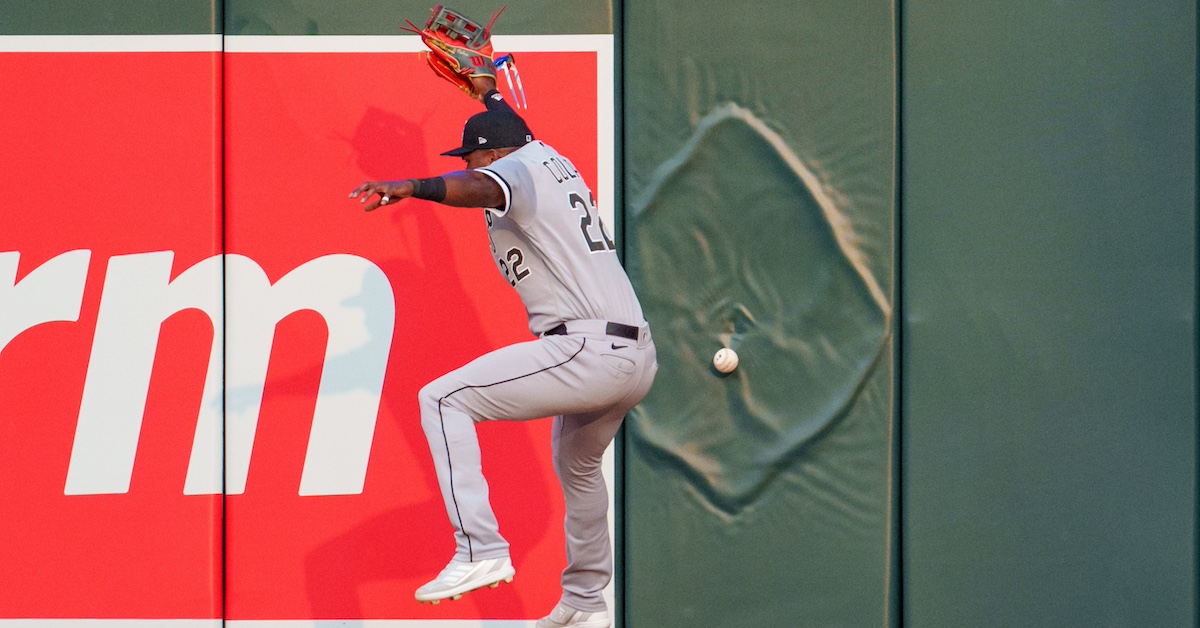
Instead, I just ended up gawking at the White Sox. As you no doubt know, the White Sox were not good this year. They went 61-101 with a -200 run differential. In other words, they got the pants beaten off of them night in and night out. They also traded fairly heavily from their roster at midseason; they made deadline deals with the Angels, Astros, Dodgers, Marlins, and Yankees. But they were remarkably healthy – the second-healthiest team in the game, by some accounts – and so they ended up with a normal amount of playing time allocated to players on the initial roster despite all the fill-ins needed for the players who got traded.
In 2023, the average team gave 72% of its playing time to its initial 26 players, and those 26 produced 82% of the team’s WAR. The White Sox gave 74% of their playing time to their initial 26 players – and those 26 produced 102% of the team’s total WAR. That’s right – the players they called up throughout the season, in aggregate, were below replacement level. Those call-ups accounted for 3,030 plate appearances plus batters faced… and -0.3 WAR. Holy moly, that’s bad. In fact, it’s off the charts:
| Team | OD Roster Playing Time% | OD Roster WAR% |
|---|---|---|
| ARI | 74.1% | 96.5% |
| ATL | 79.5% | 96.1% |
| BAL | 76.8% | 80.1% |
| BOS | 68.2% | 74.7% |
| CHC | 72.2% | 77.5% |
| CHW | 74.1% | 102.1% |
| CIN | 58.9% | 63.9% |
| CLE | 71.7% | 71.1% |
| COL | 65.6% | 66.7% |
| DET | 64.8% | 50.2% |
| HOU | 82.6% | 85.1% |
| KCR | 64.5% | 58.3% |
| LAA | 64.6% | 98.2% |
| LAD | 72.8% | 87.1% |
| MIA | 77.3% | 86.8% |
| MIL | 64.4% | 72.5% |
| MIN | 70.7% | 71.1% |
| NYM | 67.6% | 82.9% |
| NYY | 75.4% | 89.6% |
| OAK | 61.2% | 82.9% |
| PHI | 77.6% | 75.9% |
| PIT | 66.5% | 93.3% |
| SDP | 73.8% | 79.0% |
| SEA | 71.3% | 79.9% |
| SFG | 75.4% | 90.7% |
| STL | 75.7% | 97.4% |
| TBR | 70.9% | 83.8% |
| TEX | 80.6% | 84.7% |
| TOR | 88.6% | 91.5% |
| WSN | 76.7% | 90.8% |
How did the White Sox end up there? Well, it helps to come into the year with an atrocious farm system. We ranked Chicago’s farm 27th in baseball before the year, and that actually oversells how much of the org’s depth was ready to help the big club. That’s because more than half of the value in a bad-as-it-is farm system came from two players, Colson Montgomery and Bryan Ramos, who came into the season somewhat far from the majors. They’re both great, but they were never likely to help the big league club this year. That farm system ranking also included Oscar Colás, who made the big club to start the year and thus didn’t count as additional depth. That said, he was worth -1.3 WAR this year, so their statistics might have looked even more ludicrous if he’d started in the minors.
Okay, so that’s a start: a thin farm system whose best players are too far away to contribute today. But that description applies to plenty of teams; the Braves, Royals, Blue Jays, Tigers, Mariners, and Angels all mostly fit this bill. The A’s, Astros, Phillies, and Nationals, the other teams at the bottom of the farm team rankings headed into 2023, are similar. But those 10 teams got an average of 19.1% of their WAR from replacements, and that doesn’t change much if you exclude the playoff teams.
Bringing up your own prospects isn’t the only way to inject new blood into your roster to fill in missing playing time. You could also trade for players, though obviously Chicago’s swaps were mostly geared toward the future of the roster rather than its present. But you could trade for young players or veterans looking for a new shot. The Sox did just that, adding Trayce Thompson, Korey Lee, and Luis Patiño in trade throughout the year. One problem: Those three accounted for -1.0 WAR in Chicago.
When you’re a team with absolutely no depth, the waiver wire can be a fruitful avenue for supplementing your roster. Every year, relievers and utility infielders pass through waivers and end up helping a new team. The White Sox claimed five players off of waivers in 2023: Nick Solak, Touki Toussaint, Brent Honeywell, Deivi García, and Yohan Ramirez. Solak never played for them; he got claimed away by the Braves four days later. The other four combined for 0.2 WAR in a White Sox jersey. Toussaint looked like a reasonable fifth starter, but none of the rest of the group did much with their opportunity.
What about minor league journeymen, Quad-A types or older guys having resurgent seasons? Amazingly, the White Sox just didn’t have those guys. There were 252 players who batted at least 100 times in Triple-A last year and posted a wRC+ of 100 or better. The White Sox had just five of those – and that counts Colás, who was only in the minors because he got demoted for his early-season work. They didn’t even take advantage of the other four players, who combined for 78 plate appearances, with 76 of those coming from Clint Frazier. Colás is the only one of those five players who’s even still in the White Sox organization.
The team had more room on the pitching side for reinforcements, because they dealt away most of their bullpen and two starters at the deadline. But, well, stop me if you’ve heard this before, but they didn’t really have anyone available to call up. Only four White Sox pitchers threw 30-plus innings at Triple-A with an xFIP below 5.00. The team called up all four of those players – but they needed far more than that, so they also called up pitchers who didn’t clear my arbitrary bar for major league-worthiness.
I don’t have a lengthy database of rosters to run this check on, but I’m fairly sure that no one has managed such an impressive assemblage of below-replacement options in recent memory. Between promising minor leaguers and waiver wire churn, teams consistently manage to find someone to supplement their initial rosters, even if they don’t have a spectacular farm system. The ability to assign playing time helps, too: even if you whiff on five out of six dart throws, you can just play the sixth guy far more. Think Cole Ragans turning it on with the Royals and turning into their ace down the stretch, or Matt Wallner carving out a role in Minnesota.
The point is, it really isn’t easy to do what the White Sox did this year. So if you’re looking for a blueprint for how to get as little as possible to supplement the guys you start with, you’ll have to follow their plan quite closely. Start with no minor league depth. Don’t hit on any waiver claims. Keep your in-season trades focused on guys who aren’t ready yet – and for bonus points, play them anyway to rack up a bit of negative WAR. Don’t do too much churning of upper-minors options, either, lest you hit on a guy who really clicks.
I’m being a little tongue-in-cheek with this, because obviously no one plans to get so vanishingly little out of their depth. But we can answer a different question this way. Why did the White Sox fall apart so completely this year, from a preseason expectation of 80 wins to a 100-loss stinker? It’s because their team was uniquely vulnerable to a need to replace production during the season. Everyone has to do it – it’s a long season and roster moves are inevitable. How you handle those situations, and even how you build your organization with them in mind, can be the difference between a season where adversity helps you find new contributors and one where everything collapses.
Ben is a writer at FanGraphs. He can be found on Bluesky @benclemens.
It’s fun to laugh at the White Sox, but from the chart the Dbacks and Braves don’t look so different. They got “vanishingly little” out of their depth and did just fine.
You can at least explain the Braves by saying their opening day roster was very healthy and had very high WAR totals. That’s less of a depth problem and more of a math problem. The denominator for their team WAR is high because Acuna is putting up an 8 WAR season with normal playing time, and the supporting cast was doing really well too, so depth guys just don’t contribute much to the overall percentage of their WAR. The white sox problem is that they’re just terrible.
Hitters, sure, but in starting pitching especially the Braves both (1) needed a lot of depth and (2) that depth was rough. The top 4 starters contributed 11.9 WAR. The other 11(!) pitchers who started at least 1 game (incl. openers) combined for -0.2 WAR as SP. Essentially any SP inning that was not Fried/Strider/Morton/Elder was replacement.
I think the Braves used more starters last season than any other team. Some of those guys really needed all those runs the hitters scored…
Let’s put it this way. If you “reallocated” half of Acuna’s WAR to a starter, he’s still a 4 WAR OF raising his team’s WAR ceiling. But it’s still a good point.
Frankly, I think the Braves are entering a sneaky period of pitching vulnerability and are about a year behind the 2024 Dodgers in this regard. They haven’t played in the free agent market, partly because they haven’t needed to but partly by design, and that frugality could be a 2025 and beyond issue. Fried is likely gone next year, Morton will retire at some point and has been declining, and Elder had a 17% K rate. You really have to buy Smith-Shawver to think this will be ok without a legitimate FA signing soon.
No question about that, and I don’t think it’s sneaky at all to realistic Braves fans. And a pessimistic Braves fan (me) will even tell you it’ll be a miracle if Strider does not lose 1+ season to TJ surgery at some point in his contract.
I think this is a lesson in how similar numbers can mean different things. With these numbers, a mostly healthy superroster of All-Stars and potential Hall of Famers (ATL) can look kinda like a mostly healthy roster that’s supplemented by weasels and gerbils (CHW).
“vanishingly little” is okay. The problem is getting below replacement level from basically everyone not on OD roster.
Didn’t you throw a no hitter on Sept 3, 2001?
This is awesome. Going a step further:
If you took OD Roster War % minus ODRoster Playing Time % as sort of a proxy for “depth”, 3 teams really stand out:
The White Sox at 28%. Pittsburgh is at 26.8%..but, the grand winner is LAA (of course) at 33.6%
I think if you asked most knowledgeable baseball fans who were the teams with top-line players, but, nothing behind them going into 2023, you’d have gotten LAA & The White Sox as the top 2 answers. Not sure how/why Pittsburgh ends up here,esp with O’Neill Cruz getting hurt, but, I do know their top minor league call ups didn’t play well
Going the other way, only 3 teams has a higher % of PT from their Opening Day roster than they got in Opening Day WAR- Detroit, KC..& Philadelphia. I’d guess Detroit & KC is due to minor league call ups, KC hitting on Ragans & Skubal coming back from injury for Detroit. Philly is prob a combo of trades & Bryce Harper, I’d guess.
Just saw you got to this before me
DET is the most interesting to me. The performance per PA by non-OD roster players is nearly twice as productive as the performance of their OD-roster players. No other team is close.
PHI is the “plug-and-play” team.
Their top two position players by bWAR were Andy Ibanez and Kerry Carpenter, neither of whom was on the OD roster (as far as I can tell).
Of note on the opposite end of the spectrum, the Tigers OD roster contributed only about half of the teams’ WAR. However, that’s probably more of an indictment on the quality of the OD roster than it is a statement of depth.
This and Skubal starting the year hurt
And I think it’s fair to say GM Scott Harris conspicuously didn’t much *try* to field a solid opening day roster by avoiding the free agent market. He was pretty open about this being a “let’s see what we have” season for the org.
This is a pathetic team. Jerry Reinsdorf has been on local news stumping for taxpayer dollars to subsidize a new stadium, otherwise he’s fleeing to Nashville. I say good riddance to bad rubbish.
Hey, we’d love a team but not THAT bad!
Cordially,
Nashville
The Angels may be worse by this measure — they got a lot less playing time from the OD roster, but functionally, that roster was their entire WAR output.
Sort of shocked that the Yankees managed to get 75% of their playing time from their OD roster. Volpe and Torres account for a lot of that, and Cole/Schmidt taking just about every turn in the rotation helped too.
It’s not much of a surprise when Adam Haseley, Clint Frazier, and Trayce Thompson are below average. The real story is the young, relatively unproven guys who seemed like might have some upside. They were miserable! Michael Kopech, Gavin Sheets, Lenyn Sosa, and Oscar Colas looked like they weren’t even backup material. Korey Lee put up -0.7 fWAR in 70 PAs which seems almost impossible. Andrew Vaughn was replacement level. The performance doesn’t lie–the White Sox have done an abysmal job with this wave of prospects. But I don’t think anyone saw how bad it was going to get, or even come close.
The mis-management of their entry franchise in general is bizarre. 2 years ago I was annoyed with how good their roster and depth appeared on paper compared to the Tigers
The Trayce Thompson trade was the worst one I have seen from Hahn.
In slight defense of Sosa, he had a bit of a tale of two seasons. In April-May his wRC+ was -4, but from his August callup through the end of the year it was a nearly respectable 88. He needs some work but I think there’s a potential role player in there.
This was a great read. I don’t think those who follow the game truly appreciate the importance of depth. Part of the reasons the Brewers and Rays are competitive year-in and year-out is their ability to add on the margins. You need 50+ players to get through a season, not 26.
I don’t know that I’d call the Brewers a deep team.
One pleasant surprise is that Yoan Moncada ended the year as a functional player, even though his walk to strikeout ratio is as bad as it’s ever been. If you had any hope that he would have the BABIP of 2023 and the the walk to strikeout numbers of 2022 you’d have a solid, above-average third baseman. Maybe a team decides that the dysfunctional environment of the White Sox led to his regression in swing decisions and thinks they can fix him. Of course there are all kinds of stories that maybe he is part of that dysfunctional culture…
I get combining hitters and pitchers in the table for simplicity, but I’m curious for some of these teams how much the lack of pitching depth, for example dragged them down, as the hitting performances may be masking weaknesses for some teams.
Looking at this aren’t the Angels even worse? The spread between playing time and WAR seems to me to be a reasonable proxy for quality of depth and the Angels spread is the biggest I see on the board. 32% of time allocated to reserves and they put up only 1.8% of their WAR. Perhaps since the angels have more WAR to start with, this isn’t as bad but still looks terrible
OK, OK, we can laugh at the Angels too…
Good thing they fired the guy whose job it was to turn minor leaguers into depth pieces and didn’t do something stupid like promote him to GM.
Over the last year, I’ve backed away from my contacts in the game. But I used to have a contact with at least half of teams plus the usual assortment of national prospect outlets like here, BA, HQ, etc.
For the last several years, nearly all of these contacts were eager to play a good round of Bash the White Sox. If it was time for me to talk to someone, and I didn’t have a natural way to open the conversation, I’d poke fun at the latest Sox fiasco and see where it took us.
All of this is to say, the White Sox 2023 disasterpiece was not some sort of fluke or runaway train of bad luck. This is what you get when your franchise more closely resembles a 1980s org than a Statcast-era club. They can’t dev. They don’t know how to identify talent. It’s up to their players to discover themselves.
Lucas Giolito transitioned from touted scrub to ace with outside help. When he slipped again, nobody could help. Robert, Eloy, Vaughn, Crochet, Abreu all came to them as finished products. Moncada and Colas too, except without the success. Tim Anderson never figured out plate discipline – and he was never some kind of Javier Baez who could punish anything his bat reached. Most of the apparent development successes have performed below expectations. Cease has had the one good year. Kopech and Reynaldo have existed without helping much. Montgomery reportedly does his own thing. This is all just off the top of my head.
They can’t dev is mostly correct (I’d give them credit for Anderson), but they’ve had a lot of guys who finished in both the Top 30 prospects and Top 50 Trade Values like Anderson, Eloy, Moncada, and Giolito who just flopped after a couple good seasons. They’ve also had Vaughn, Kopech, and Madrigal essentially bust and because they can’t dev, they can’t replace fading veterans like Lance Lynn and Yas Grandal, let alone a departing FA like Rodon.
So I’d say they’ve had extraordinarily bad luck, but since they can’t dev and can’t sign any one out of the Dominican Republic, they haven’t been able to mitigate their bad luck like better-run teams can.
While I agree with you, at least in hindsight, there’s another thing you didn’t mention: Their international scouting and development is nonexistent. They signed Robert before the new rules came into place but that’s it. And people forget this but a tremendous proportion of MLB position players come from Latin America and not from the draft. Guys like Christopher Morel and Maikel Garcia aren’t what I would call stars, but if you aren’t churning out a few of those guys regularly your depth is going to collapse.
It is crazy to think that some of these guys like Madrigal, or Kopech, or Vaughn who were “top prospects” might be out of baseball when their rookie contract expires. I’d imagine someone gives them a shot, but doubt anyone will guarantee much money, if any.
Some smart team is gonna sign Kopech & get something out of him. Make him a stud reliever or something.
Kopech will get a long look as a reliever before he has to go to the far east or unaffiliated ball, assuming he doesn’t completely blow his arm out.
I could see it happening to Madrigal, but he probably has a reasonable tail as a utility infielder. He’s probably better than Gordon Beckham with a “skillset” that shouldn’t be hampered much by age and Beckham played in 11 seasons.
Madrigal potentially, although as long as he can take defense at both 2B and 3B he will get some opportunities. The other two will probably get non tendered if they don’t improve and someone will take a chance on them and see if they can develop them where the White Sox can’t.
Madrigal’s been disappointing, but he’s some better health and a little bit of BABIP luck away from being pretty much exactly who we thought he’d be. He had the BABIP luck (but not the health) in 2021 and it’s not crazy to think he could have a few more years like that in him before all’s said and done.
Anderson had an bad year but I believe he is still better than Baez.
“ I’m fairly sure that no one has managed such an impressive assemblage of below-replacement options in recent memory. ”
The 2021 Pittsburgh Pirates would like to have a word. That team managed to give 92 ABs to Ka’ai Tom and it felt like 1,000. I don’t think I’ve ever seen as many averages below the Mendoza line in one baseball-reference tab before. Although they may not do as well by this metric because a lot of their lousy players were on the Opening Day roster (I’m looking at you, Erik Gonzalez).
Scoresheet owners will tell you, below replacement value players are a killer! Love this data on the WhiteSox season considering the 2023 26 man roster did look pretty competitive on paper by Central division standards. I am optimistic the Tigers are sneakily compiling competent pitching depth in a war of mediocre attrition in the Central.
Would be interesting to look at this year over year as a health metric. See who is good at keeping that OD roster on the field.
I watched the manager keep playing Seby Zavala over Grandall all season and was scratching my head. Also they had a player in the minors that was a better hitter than half their roster, Nate Mondou, but he was never used. Carlos Perez is a good hitter, and is worthy to start every game, let’s see what happens in 2024. If we would have used the right players in 2023 the war would have been better, but we chose to go with at least on the batting side, poor hitters.
Hitting well at Charlotte is easy. He had a similar OPS as Lenyn Sosa and Oscar Colas and they both were negative WAR players.
Mondou obp was consistently over .370 in the minors and his k to walk was good. Sosa and Colas weren’t close in either of those categories. Maybe Colas shown a little promise in the minors but not consistent. Both Sosa and Colas have terrible k to bb.
The Angels could write a manifesto on how not to build depth.
Why the hell is the chart in the article organized by alphabetical order instead of by OD Roster WAR which the article is about?
As others have already pointed out, the Angels did an impressive job of getting zero out of their in-season additions.
Just about every move backfired: Giolito, Escobar, Moustakas, Cron, Grichuk.
Nothing worked.
Ouch.