
Yadier Molina’s Career in Four Graphs
Stolen bases aren’t a priority in today’s game. Catchers and pitchers have taken to strategies that slow runners down as teams and players have stressed the value of baserunners and emphasized the risk and downside of making outs. When everybody is hitting home runs, getting from first to second matters a little bit less. But even accounting for that strategic shift, what the Cardinals are doing in preventing steals is impressive.
With 11 games to go, the Cardinals have given up 32 stolen bases. In the last 50 years, the lowest team stolen base total allowed was 31 by the Cincinnati Reds in 1971. Since the advent of the designated hitter in 1973, the 2005 Cardinals have the fewest stolen bases surrendered in a single season with 32.
This is not a new phenomenon for St. Louis. Since 2005, the Cardinals have boasted the lowest stolen base total six times; they’ve finished with the second-lowest seven times, fifth-lowest in 2006, and 17th-lowest in 2016.
As one might expect, the Cardinals have the fewest steals against them since 2005 when Yadier Molina took over full-time catching duties. Before getting to those numbers, though, here’s a graph showing team wild pitches plus passed balls since 2005.
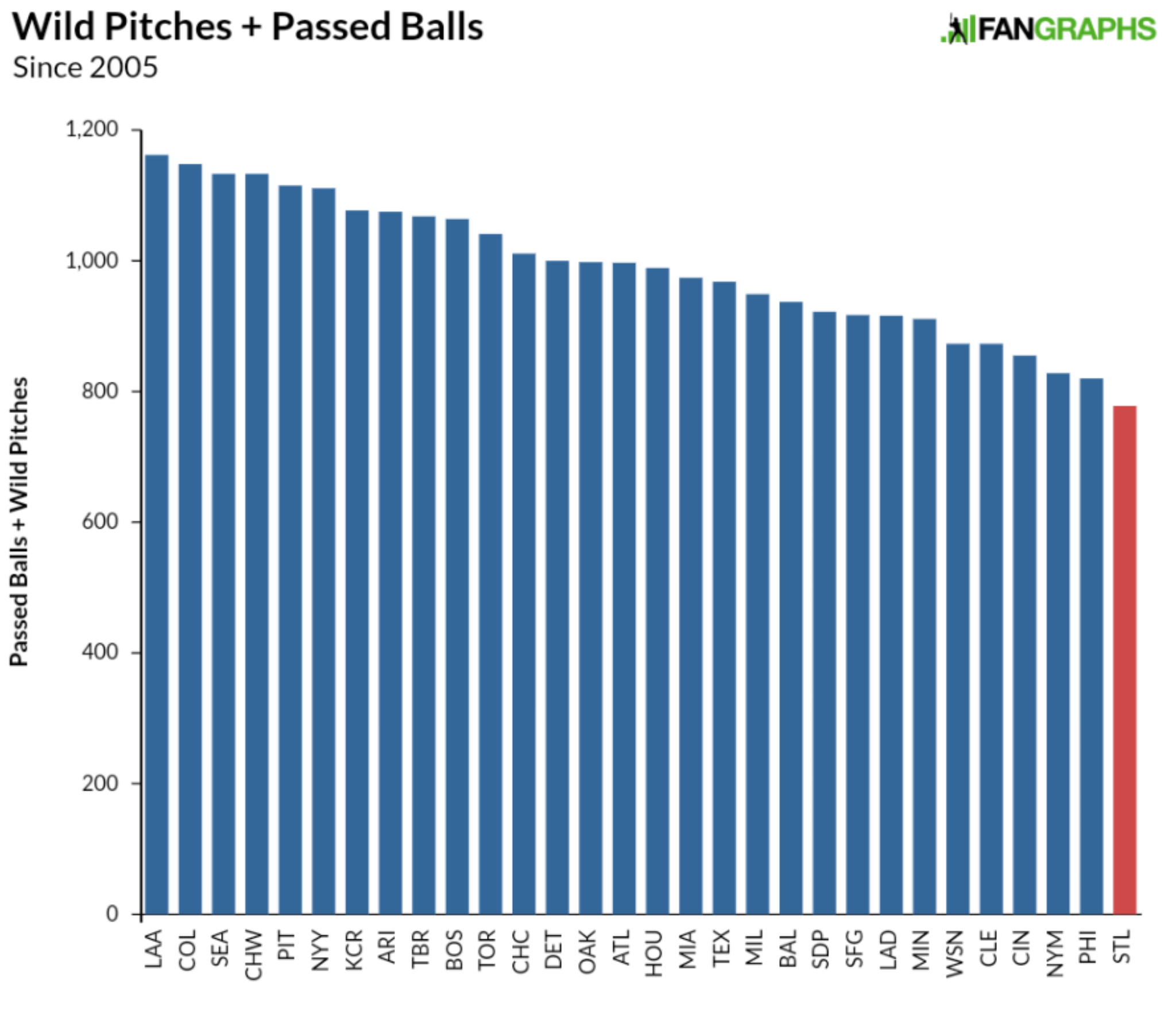
The Cardinals are in first place, and about 200 wild pitches plus passed balls below average. Onto the stolen base numbers. First, stolen base percentage:
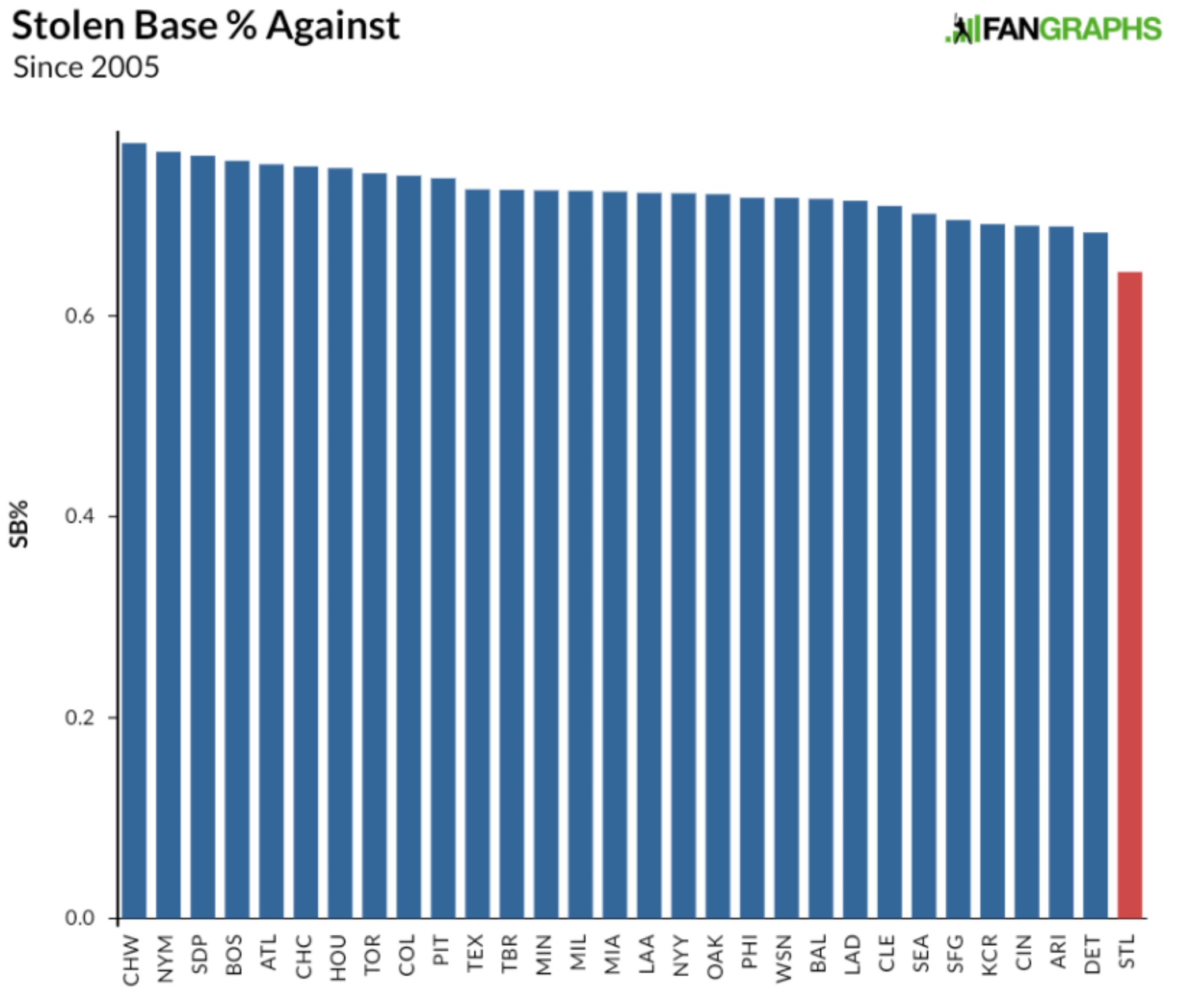
Maybe it’s not a surprise that Molina’s Cardinals have thrown out a higher percentage of base runners. He’s kind of known for that. Now, here are the attempts:
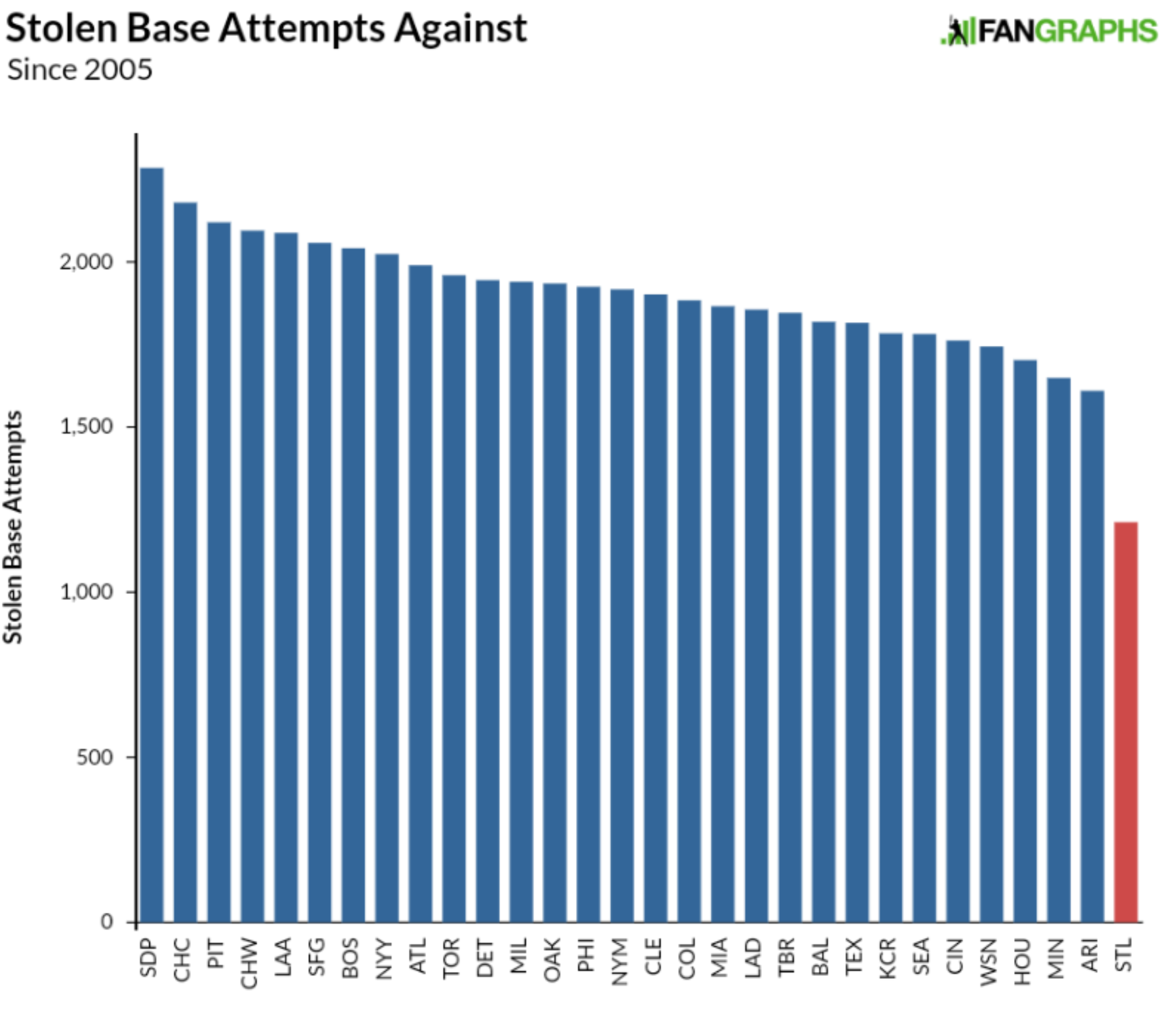
The Cardinals have the lowest total by about 400 attempts and are nearly 700 attempts below average. As to the number allowed:
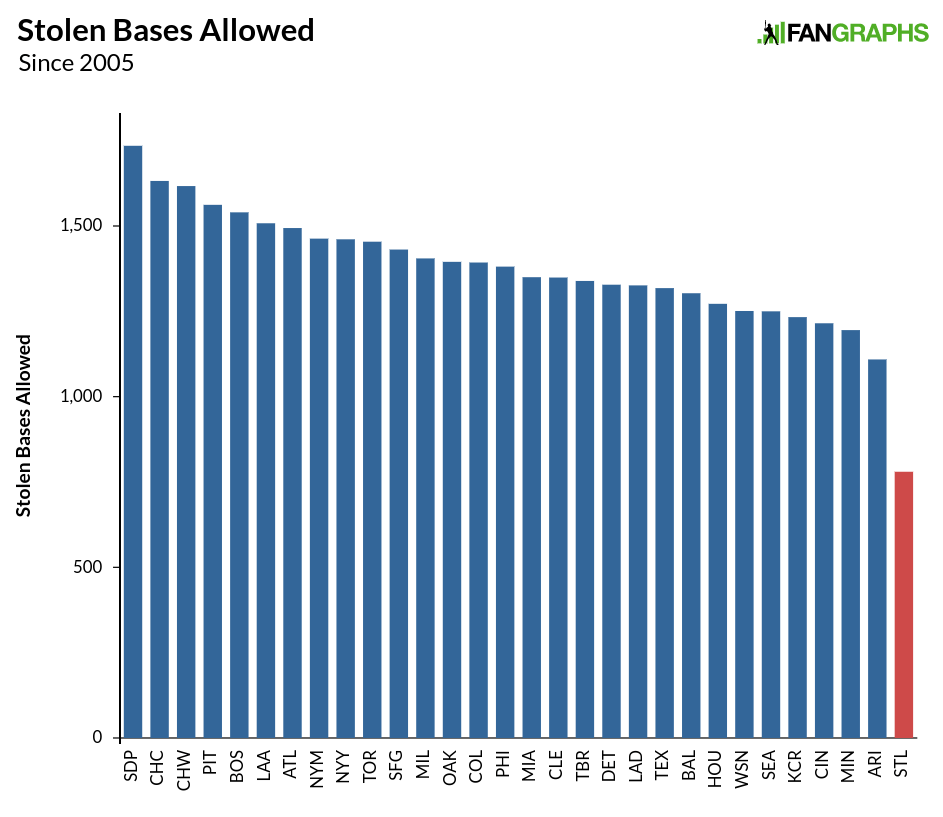
Here, the Cardinals are more than 300 steals below the second-best team and are nearly 600 steals below average. I’m not sure quite what to make of that ridiculously low total compared to the rest of baseball. They are more than three standard deviations away from the average. Most teams are going to have good and bad catchers over the course of 15 seasons; the Cardinals have had just one great one.
How many extra runs are we talking about? 25? 50? 100? Has Molina been worth another 10 wins over the course of his career that he’s not getting credit for? Due to the chances of getting caught and the potential runs taken off the board, a stolen base attempt is barely a positive offensively. Even preventing 700 attempts might only be worth 25 runs or so compared to average. But it’s hard to square that with the 600 fewer steals, which might be worth four times the amount of the prevented attempts.
A lot is made of Molina’s intangibles when it comes to assessing his career. Here, we have something very tangible, yet not fully accounted for by his WAR. Catching is hard. Putting everything a catcher does into WAR is incredibly hard. What Yadier Molina has done to the run game over these two decades has been of great value to the Cardinals. The graphs above should help put his career in perspective.
Craig Edwards can be found on twitter @craigjedwards.
last night a classic Molina play. Nats had guys 1st/2nd and a very wild pitch. Carums off the backstop and Molina catches it and throws out Kendrick at 3rd. Doesn’t get credit(I think for a CS) but wow.
Is was scored as an out on a fielder’s choice. But…the Nats had four steals that game.
2 of them were on a double steal where the pitcher was up and they weren’t holding the runners on at all…
The adage that’s made the rounds in recent years is you don’t steal off the catcher, you steal off the pitcher. Obviously some catchers are better than others, and Molina’s defensive reputation is stellar for a reason. But it could also be something in the pitchers the Cardinals target in free agency/trades and in how they train young pitchers.
It’d be interesting to see one more line on those graphs: teams other than the Cardinals when their pitcher was someone who did or would eventually play for the Cardinals.
Yeah, kind of wish we had Pop Times for Molina’s prime. Having them now tells me that Realmuto is a big-time steal killer for a very good reason. Would love to know if Molina was in that tier as a thrower.
Pop times weren’t around then?! While I’m far from well-versed, I feel (note that: “feel”) certain there were pop times even back in Pudge Rodriguez’s hey-day.
Pop times have been around since the 70s.
well one interesting point this year…..
vs Molina 7 CS in 28 attempts- over 838.2 innings
vs others 11 CS in 22 attempts- over 496.2 innings (prorate the attempts and it’s 37)
I think teams take far more liberties vs other catchers than they do Molina.
Yeah that percentage stat is grossly misleading. Teams only run against Molina at the optimum time, late in games when throws aren’t wise, against hurlers who aren’t good at holding runners, and with only their premier stealers. Thanks so much for the career composites.
It speaks volumes.
According to this admittedly limited sample, the teams do take far more liberties at their own expense vs other catchers but it is at their own expense. Even going by allowed SB, 21 allowed over 838 innings is worse than 11 allowed over 496 innings. A multi year sample might be more instructive.
Let’s not overthink it. Molina is the constant here. The idea that maybe it’s not Molina that’s unique but the set of hundreds of pitchers that’s unique is just silly.
Will FourGraphs.com be a thing?
I can’t tell if I’m surprised or just disappointed that Mike Scoscia’s Angel teams were consistently below average at catching. What else was his allure?
Getting radiation poisoning while working at the Springfield Nuclear Power Plant and therefore gaining “Super Managing Powers”?
Let’s assume 700 fewer attempts vs. average and 600 fewer stolen bases. Using SB% of 40.1% we come up with 419 fewer stolen bases due to reduced attempts. That gives us 1019 fewer stolen bases. Divide that by 4 bases per run and 10 runs per win and we get ~25 additional wins. This is far from comprehensive and I’d like to see a real statistician dig into this, but I think it’s a reasonable hypothesis that Molina’s ability to prevent stolen bases and attempts could account for at least a run per season if not much more.
A better yet still pretty simple way is to compare Molina and an average catcher’s SB/CS per inning.
From 2004 to 2019, Molina caught 16,227 innings and allowed 512 SB and 344 CS.
In the same time span, non-Molina Cardinals catchers caught 6,873 innings and allowed 325 SB and 117 CS.
Also, non-Molina catchers overall caught 675,048 innings and allowed 43.179 SB and 16.413 CS.
In other words, a non-Molina Cards catchers would have allowed 767 SB and 276 CS in Molina’s career. Using rSB of 0.2 and rCS of -0.41 (average between ’04 to ’19), this suggests approximately 79 stolen base runs.
Doing the same exercise for all other catchers, they would have allowed 1038 SB and 395 CS and compared to them, Molina would have been worth an extra 84 runs for controlling the running game.
Now, we must of course compare this to the actual stolen base runs that Molina is credited with which is 53 rSB.
Overall, it looks like there is an extra ~3 WAR that Molina is not getting credit for which is not a huge deal, but also not nothing.
Yadi’s a Hall of Famer .
I have been preaching this for about a decade. Great to see some stats to back up my opinions. If this post doesn’t solidify Molina’s worthiness for the Hall nothing does. Now put deserving Simmons in the Hall and the Red Birds’ catcher’s will finally get their due.
No doubt the Card’ pitchers have done a terrific job of holding runners on base. And no doubt the running game has been curtailed. That said check out the Red Bird stolen base percentage. Still Molina’s stats are off the chart. One more stat that might also add some knowledge, is how many runners did Yadi face compared to others. Should be a pretty easy stat to quantify.
“ I’m not sure quite what to make of that ridiculously low total compared to the rest of baseball. They are more than three standard deviations away from the average. ”
I’m quite sure what to make of it… it’s the Yadi effect. His reputation for excellence behind the plate directly influences how opposing teams approach the Cardinals on the base paths.
Wow. That is amazing. Absolute dominance behind the plate for 15 years.
That’s pretty extra-ordinary. You don’t see someone dominating specific stat lines like that. In its little niche it’s like Ruth hitting 50+ homers while the rest of the league was barely breaking double digits.
I’d argue that Yadi is even better than the graphs indicate, since he only averages ~125 games/season.
I’m not sure why this is an important caveat. It’s true for just about every other starting catcher. It’s a rare exception when a catcher averages more than 130-135 games per season (4/5 – 5/6 of the team’s games).
And a quick check of his profile shows the assertion to be shallow. While it is correct that his career average GP/ season is 123, throughout the 16 years he’s seen any amount of MLB time, he’s gotten less than 125 games only 6 times (including a 124-and 123-GP season. Take out his break-in partial season of only 51 games and the average goes to 128. The still incomplete 2019 season and it’s now 130 — a number still weighed down by the fact that the absolute max will top at 162 while the absolute minimum would be 0.
Rather, I wouldn’t be surprised if his 15-year(!) career average of 123 GP/ season (including the incomplete 2019 is well above not only average for catcher, but probably more than many — if not most — other HOF catchers.
Molinas skills are very hard to quantify.
Catching remains the hardest position to rate.
You really need to see,over time the value someone like Yadi brings to a team.
Bill Freehan is another catcher,folks at the HOF seem to neglect.
Molina is the finest defensive catcher of his era.
That alone should help his HOF chances.
Hopefully Freehan,the best of his era will get likewise recognition.
He’s basically a horse whisperer for rookie pitchers. How do you value that?
Go look at Bench’s CS, Wp and PB totals..
What about pickoffs? I don’t think those are included in the caught stealing numbers. I do not know where to find pickoff numbers, but Molina is notoriously good at it.
A Bill James article says between 2003 and 2009 Molina picked off 33 runners compared to 19 for the next catcher. It values pickoffs at 0.46 runs each. Molina’s might be worth even more, as 21 of his first 24 pickoffs were the 3rd out. From my own recollection, Molina’s pickoffs frequently seemed to be saved for key moments in games. Late innings, starting pitcher struggling, runners in scoring position, and two outs. Boom, inning over.