
Is Baseball Bad at Bunting?
During the fifth inning of Game Two, as Alcides Escobar attempted to bunt against Jacob deGrom, Harold Reynolds decried the current state of bunting in professional baseball. Even after he admitted that hard throwers are hard to bunt on, he went on a mini tirade: “I know it’s hard to get one down against a guy that throws this hard, but I’ve never seen this bad of bunting. Ever. Ever! In baseball, just across the board. I know Escobar can handle the bat, but we see this every night. They have to move the runner. Not just the Royals, but across the board.”
The moment was probably lost for a couple reasons. For one, Escobar decided to swing-away after two failed bunt attempts, and promptly tied the game with a single to center. There was too much excitement to think too deeply about the state of bunting in our game. Now we have a second to breathe, though.
Oh, and a few of us probably missed it because Reynolds has a history of comments that seem to come from another era. Here are a few that demonstrate some of his viewpoints, stolen from an Awful Announcing piece.
I’m being straight up honest. I have no idea what run differential is. – Harold Reynolds
— Heard on MLB Tonight (@HeardOnMLBT) May 23, 2013
“You can talk about on-base percentage all you want, but I didn’t give [Votto] $225 million to put him on base.” – Harold Reynolds
You Aren't a FanGraphs Member
It looks like you aren't yet a FanGraphs Member (or aren't logged in). We aren't mad, just disappointed.
We get it. You want to read this article. But before we let you get back to it, we'd like to point out a few of the good reasons why you should become a Member.
1. Ad Free viewing! We won't bug you with this ad, or any other.
2. Unlimited articles! Non-Members only get to read 10 free articles a month. Members never get cut off.
3. Dark mode and Classic mode!
4. Custom player page dashboards! Choose the player cards you want, in the order you want them.
5. One-click data exports! Export our projections and leaderboards for your personal projects.
6. Remove the photos on the home page! (Honestly, this doesn't sound so great to us, but some people wanted it, and we like to give our Members what they want.)
7. Even more Steamer projections! We have handedness, percentile, and context neutral projections available for Members only.
8. Get FanGraphs Walk-Off, a customized year end review! Find out exactly how you used FanGraphs this year, and how that compares to other Members. Don't be a victim of FOMO.
9. A weekly mailbag column, exclusively for Members.
10. Help support FanGraphs and our entire staff! Our Members provide us with critical resources to improve the site and deliver new features!
We hope you'll consider a Membership today, for yourself or as a gift! And we realize this has been an awfully long sales pitch, so we've also removed all the other ads in this article. We didn't want to overdo it.
— Heard on MLB Tonight (@HeardOnMLBT) August 17, 2013
“Not bunting is like telling a NFL team they can’t throw deep. The bunt is an offensive weapon.” – Harold Reynolds (h/t @maxdank420)
— Heard on MLB Tonight (@HeardOnMLBT) September 20, 2013
Hey. Look at that. Another quote about bunting. Must have been important to Reynolds when he played. Ah, right, he was 11th in sacrifice hits from 1986 to 1993. He must have really appreciated the heck out of Jay Bell and Felix Fermin.
Anyway, is baseball bad at bunting? We don’t have data on bunting for hits going back very far. For the time period we do have, though, it looks like baseball has actually gotten better at bunting. Here, success is a hit, divided by all bunts put into play.

The past four years have been baseball’s best years for bunting for a hit! Well, the sample is small if you’re talking about a fundamental skill across baseball. Especially since baseball has changed a bit recently.
Consider the shift: It opens up an entire half of the infield, should a batter want to bunt. Once again, we are limited to a small sample, since we have numbers on shifts going back four years. But as the number of shifts has nearly doubled since 2012 (from 8,365 to 15,539 last year), bunts into the shift have only increased from about 60 a year 109 this past year. That might be enough to explain away a slight increase in bunt hit percentage, depending on how those extra 40 bunts are distributed.
If you thought the number of bunts into shifts would be higher over the full season, maybe teams are actually only shifting people who won’t bunt. That would make sense. It’s something we’ve heard before, from Charlie Blackmon.
How about velocity and bunts? Joe Sheehan points out that velocity has changed since Reynolds played, and that this is part of the picture.
Ex-hitter analysts who retired bef. 2007 or so played a completely different game. Velocity has changed everything. https://t.co/C9KP2pVLsj
— Joe Sheehan (@joe_sheehan) October 29, 2015
Reynolds even admitted that it was hard to bunt off of a hard thrower like deGrom. And since velocity is up 2 mph in the past decade, it’s fair to assume that it’s up some since 1984, when Reynolds was a rookie.
Let’s define a successful bunt as one that is in play and is not a fly ball. That’s the point, normally, to get the ball on the ground. Even if you’re trying to bunt for a hit. Now let’s bucket success% by velocity.
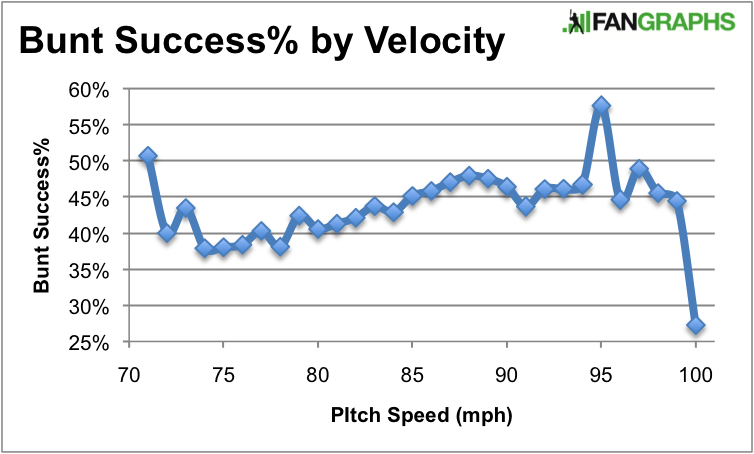
It looks like velocity doesn’t have a great effect on bunt outcomes. (In fact, maybe pitchers should be throwing breaking balls when the bunt is on?) Of course, there’s a weird spike at 95, where the sample starts to degrade, and the scale of the chart makes it hard to see what’s going on in the 90s. Here’s a table of the 90s alone.

| Velocity | Success% |
| 90 | 46.4% |
| 91 | 43.7% |
| 92 | 46.1% |
| 93 | 46.1% |
| 94 | 46.7% |
| 95 | 57.6% |
| 96 | 44.6% |
| 97 | 48.9% |
| 98 | 45.5% |
| 99 | 44.4% |
| 100 | 27.3% |
If hitting 95 and 96 makes it harder to bunt the ball, it does so on the order of one percentage point. Since 2002, we’ve had 11 bunt attempts on 100 mph pitches according to Baseball Info Solutions, so let’s not lean too heavily on that data point. At least until we get to 98 mph, we have 100 bunt attempts in our sample.
Maybe the shift is making it easier to bunt for a hit, and maybe velocity is making it harder. Either way, it’s definitely true that we are bunting less. In Reynolds’ heyday, there were as many as 300 to 400 more bunts a year than there have been in each of the past three years.
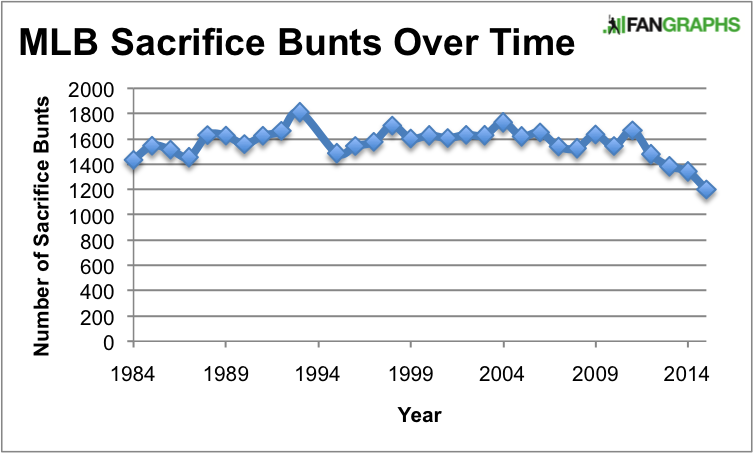
So we know baseball values the bunt less, and that probably means players are a little bit worse at the skill. The sport is not selecting for the bunt, the sport is not demanding the bunt from its players at the same rate, and so players are probably not as good at bunting.
On the other hand, there’s no great evidence this selection has already happened. Players are bunting for hits at a better rate, and despite higher velocity, they’re managing to put the ball in play on the ground about 45% of the time usually. Maybe that’s terrible, but it’s not any more terrible than it was 13 years ago, and we don’t have the data to test it backwards any further. Maybe it’s just a case of the bad bunts standing out a little more, since the sample is 400 bunts smaller in modern seasons than it was when Reynolds was playing the game.
Addendum: another chart, which is inconclusive about the success of bunting. In this chart, success is either a sacrifice, sacrifice with error, or a bunt hit. Divide it by attempts, and we’ve been steady for a decade:

With a phone full of pictures of pitchers' fingers, strange beers, and his two toddler sons, Eno Sarris can be found at the ballpark or a brewery most days. Read him here, writing about the A's or Giants at The Athletic, or about beer at October. Follow him on Twitter @enosarris if you can handle the sandwiches and inanity.
I know the CW is bunting is a terrible idea. Can anyone recommend any articles that support this? Not saying it isn’t true. I just haven’t seen anything directly address the issue.
The current wisdom is that outs are valuable and you shouldn’t be throwing them away. Bunting has its time and place, but some managers are horrible at knowing when that is.
You just need to look at a run-expectancy table. You’ll see that teams lose 10-30% of their expected runs by moving up the baserunners and using up an out. Unless it’s 1st and 2nd with no outs, you need a really bad hitter up to have a bunt make sense consistently.
Also, let’s not forget what should be the one of the largest factors in the decision, which is where you are in the batting order. Mike Trout should never bunt, Yusmeiro Petit should only bunt.
Exactly. People that only look at win expectancy tables forget this major detail.
I’m not sure I understand what you mean here, as this seems more like talent level than spot in order. The more quality hitters you have behind a bunt, the more chance it will work out. If you only have one good hitter after the bunter, they can pitch around or IBB that guy, which makes the bunt less effective. But if you have the middle of your order up after a bunt, there should be plenty of hitters to do the job. Sorry if I’m missing your point…
Bunting is not in general a bad idea especially when it is against the shift.
But instructing Escobar to bunt in that situation did not make any sense.
The Royals got lucky that he could not lay down the bunt, and therefore (to some degree) was forced to swing away after you had two strikes on him.
I would, however, agree with the premises that major leaguers should practice bunting and be able to lay a bunt down when needed / appropriate.
Similar to pitchers not spending much of any time on swinging away, I would agree with Reynolds that bunting is a weapon that is largely unexploited by major leaguers.
Oh. my. goodness. I just agreed with something Harold Reynolds said. Next thing you know I’ll be doing impersonations of Willie Mays.
Have to agree too, shockingly. Guys like Polanco could have 10-15 more hits by learning how to bunt. As it stands now he looks like a baby giraffe trying to do it, not unlike his RF play at times.
I only have one strong feeling after this postseason. Can Harold Reynolds please go away? He is the worst.
No, Tim McCarver was the worst, but HR is a close second. And I hope if he does go he takes Joe Buck with him.
I thought McCarver was only to be referred to in past tense, too….but I ran into him half a dozen times this year on the Cardinals feed and he’s as bombastic as ever. How can we miss him if he won’t go away?
I’ll be the “Unpopular Opinion Puffin” here: I enjoy Harold Reynolds. I wouldn’t want to listen to him for 162 games, but I’ve enjoyed my postseason with him. I suspect part of that is that he sounds like Chris Rock, and I like Chris Rock, so subconsciously I’m predisposed to like him. But I enjoy how he motors on, enthusiastically ejaculating whatever fool thing comes into his head, and sometimes (when he’s commenting on something he actually knows about, typically middle-infielder play or baserunning) he’ll say something interesting or at least relevant. But the rest of the time he’s just a yapping puppy dancing around the dull tree-trunk of Joe Buck’s droning boredom with baseball and life in general.
Jessica Mendoza was great doing Sunday night baseball. It’s high time more women do sports’ broadcasts, and she’s fantastic. I’d vote for her to do the games over Reynolds (and, basically anybody else) any day.
Wouldn’t mind Jon Miller in the booth for these games. But I guess MLB is determined to put a jock there. Reynolds complete lack of effort to even consider sabemetrics is maddening. Or maybe he was told his lifetime OPS of .668 sucked, especially for a leadoff hitter, and that’s why he’s so dismissive?
John Smoltz is on the “B” team, and I think he’s doing international broadcasts. He’s not exactly anti-Reynolds in that he’s not super insightful, but he’s actually pretty entertaining. He likes puns and lame jokes and there’s some charm in that. He also has ten times the playoff-cred that HR does.
“It’s high time more women do sports’ broadcasts”
We should discriminate against male broadcasters on the basis of sex?That’s sexist.
How often do hitters actually practice bunting against live pitching? Anyone can get 80%+ of their bunts down against BP throwing, but do they ever practice against 95 MPH sinkers or 88 MPH sliders? Catchers would hate it, but you could have hitters stand in to bunt against pitchers who aren’t really trying to nail down something specific in a bullpen session. I do think bunting is worse, but as said in the article, it’s as much about teams not caring as hitters not caring.
What do players actually practice, in general? Would love to read an article about that and how it varies by team.
Actually, this is still what I see in batting practice in the majors — you have to take a few practice bunts and get them down before you can swing away. That’s the only bunt practice I’ve seen.
I remember in college having to catch live bullpen’s in a cage inside. Our coach had a rule where you couldn’t swing until you got a bunt down. I can’t tell you how many times I got a foul tip off places nobody should be hit. Not to mention those were 5 a.m. practices, so talk about a wake up call.
Does this increase in bunting account for the “bunt down the third baseline to beat the shift” type of bunts?? In 2002 teams didn’t shift as much as teams do now.
That’s in the piece! There’s a decrease in bunting despite an increase in bunts into the shift. (Almost double)
Escobar and Cain’s bunt attempts were both bad decisions.
But.
Here’s the problem with the conventional anti-bunting wisdom: it is based purely on mean value game state win probability estimates. Many, many, many people confuse those mean value estimates as a statement of universal probability for that game state, when they are not. If either the batting situation or the pitching situation diverges significantly from normal (not statistically normal, just normal) then using the mean estimates is not called for.
Example: Tie game, bottom of the seventh inning, no one out, runner on first. AVERAGE win expectancy is 0.645 (might be slightly different now, that’s 2002 Tango). Bunting, on average, reduces that somewhat, to 0.627.
Always stupid, right?
Well, who is the batter? Who is the pitcher?
Let’s say the batter is peak Jeff Kent with peak Barry Bonds behind him and the shell of Joe Nathan lobbing puffballs at them. Still feel confident in that average win expectancy? What does your intuition tell you?
Flip it around. You now have Yuni Betancorp and peak Ichiro on deck. What do you think the actual win expectancy is now?
More importantly–how confident are you that bunting is still a stupid thing to do?
Average values are interesting. But it is a gross analytical error to confuse the average value estimate with a statement of true probability–it is not, for example, the same as a 50 percent chance flipping a fair coin.
I think in either example above, if the hitter gets the bunt down, the next guy gets walked regardless. Therefore, it’s first and second for Benito Santiago or ??
What do you define as “successful bunt”. What do you call a bunt attempt fouled twice, then the hitters has 2 strikes and hits a weak grounder or strikes out. Or do you consider each individual bunt attempt as a separate event (i.e a bunt fouled is a failed attempt). This is my biggest pet peeve about bunting, is not just about the Win Expectancy, is that managers seem to forget that “bunting the runner over” only works like 70% of the time, there is still a 30% risk which is HIGHER than the possibility of grounding into a double play.
In the article, I define a successful bunt attempt as one that is put in play on the ground. I count a foul attempt or a miss as a fail.
What I get from this article and the info conveniently left out by the author is:
a) Bunting is good because 25% of the time you can get a hit, which compares favorably to swinging the bat, thus: Harold Reynolds is right. Add to it succesful sacrifices (advances the runner) plus hits and you get a whopping 72% of success at either advancing a runner or getting a hit.
b) Modern baseball players are worse at laying down sacrifice bunts but not by much as far as Fangraphs database goes (only has info since 2002) but way worse compared to baseball reference’s databases. Which means Harold Reynolds was right again.
c) Players have been getting better at bunting for a hit in recent seasons (since 2002) and specially in the last 4 seasons, which might be due to more shifts, which again arises the question of “why not train to learn how to bunt properly and exploit that oppening rival defenses give you?”.
http://i.imgur.com/0NyC5Hw.jpg
Where’d you get that data? We don’t have ‘bunt attempt” in PFx, had to go to BIS and call the site’s founder in for that data. Man, I could have made that graph though. Shoot. The data that created the velocity graph might have been able to make that graph. That’s pretty damning.
I did not get the same results as your graph. I used BIS data and defined success as ‘sacrifice’ or ‘sacrifice with error’ or ‘bunt hit.’ Then divided by attempts. My result posted above.
That 25% includes bases empty, and Harold was really talking about sac bunts. Using men on base, you only get a hit about 15% of the time, much worse than most hitters. You are also not controlling for the increased velocity in the game. Eno’s graph shows little difference, but it intuitively makes sense that faster pitches are harder to bunt. Determining the magnitude of the effect of velocity is tough, but I’m sure it’s there.
I’m not saying that bunting hasn’t declined, but there are plenty of external factors that are helping that change. Teams care less about bunting, so hitters will too. Unless you change the culture of the organization, it’s not going to get better, because why will a player work hard on something they might do a handful of times a year?
Even a .250 BABIP is worse than a .300 BABIP. Bunting is not a good idea really.
MLB is poor at bunting. The true measure of good bunting is a sac bunt. Getting it down when you have to is what matters. It is clear that few players are even decent at it.
Bunts for hits are largely a reflection of defensive alignment – shift or not. Even against a straight-up defense, bunting for a hit involves luck. We have all seen the pop-up bunt that splits the defense, or more often than not the 3B making a less than spectacular throw or just sitting back on his heels. Some of the worst bunts end up being hits. This is not a measure of skill.
Last point, nothing is easier than bunting a fastball. I don’t care if it is 85 or 105. You should have your bat out and in position before the ball even leaves the pitcher’s hand.
Regarding the last point, getting your body in position early and out in front of the plate helps, but you still have to get the barrel to the ball. The ball doesn’t magically find the barrel, so the faster the pitch, the less time to get the barrel in position. Hitters need to practice bunting versus live pitching, which I doubt ever happens during the year. Bunts during BP aren’t helping much…
Baseball’s just bad at baseball, period.
Hay donny, can you hang that Picasso a little further to the right? Don’t want it obstructing my view of my, ahem, the new Marlins stadium?
Baseball isn’t bad at bunting. But Harold Reynolds is bad at providing commentary for baseball.
Two better questions than the one posed here:
1) Why are we listening to Harold Reynolds?
2) Is bunting really the super-genius secret weapon that everyone wants to think it is?
One thing Eno misses in this article is the game theory advantage gained by bunting. Players who are adept with the bat and known to bunt for hits can gain an advantage by making the defense think that there might be a bunt coming, drawing them into a shallower fielding position, reducing their effective range on ground balls. Ichiro comes to mind, here, as his bunting ability and speed forced third basemen to play in a shallower position to guard against the bunt or slow grounder; he would then sometimes hit the ball towards third, but so long as it wasn’t hit right at the third baseman, the ball would find its way into shallow left field.
I wonder if this is the point that the terrible Harold Reynolds was trying to make with his football analogy: in football the defense has to guard against the deep pass, which can open things up for shorter plays. If there is no fear that a team can complete a long pass, the defense can set itself up to prevent the run or short pass. Similarly, by choosing to never bunt, defenses are permitted to play in a more ideal fielding position, which (I assume) would drive down BABIP.
Bunting is just awful. I wouldn’t think twice about it if MLB stopped bunting completely.
you should put error bars on those graphs. The binomial statistical error is pretty easy to compute. For probabilities close to 50%, like here, it is very very close to 0.5/\sqrt{N}. That would allow us to see how significant the spike at 95 is.
I’ve countered Buck and Reynolds by turning down the sound and listening to the Royals broadcast on TuneIn, synching up that with the TV picture. I’m not a Royals fan but whoever their announcer is, he is fantastic.
I have the international feed which is delightful after hearing Buck and Reynolds for the LDS and LCS. Reynolds is in the Hall of Shame after Joe Morgan , Tim McCarver, and Rick Sutcliffe as the worst color guys I have heard in the booth during the post season. Kruk would be in there too if he was in the post season
I think what bothered me most about Escobar’s bunt attempts was the first pitch. It was up around his eyes but he still tried to bunt it. That’s not just poor execution, it’s dumb. Have an idea out there!
I used to be a great sacrifice bunter. The key is squaring your upper body around early and keeping your legs in the same position you hit in. You also have to bunt only on your pitch. Anything too high, or where you have to reach out prevents you from keeping your bat horizontal, so you have to pass on those or you will just foul them or pop them up. The pitcher of course will try and throw up in the zone since he knows you are bunting but if you take a couple of pitches then he will have no choice but to throw a buntable strike. Too often batters attempt to bunt on bad pitches and find themselves in a hole 0-2 which is not a good count for bunting or hitting
If I had to ask living player’s their opinion about whether average increased velocity precludes players with speed from excelling like they did in previous eras via bunting and infield hits I’d want to talk to two, maybe three guys.
First, Ichiro because he played pre and post 2007 arguably proving the point already through his numbers.
Second, Brett Butler because in an era where speed was overvalued he ironically was undervalued as a player (1allstar game?–but homeruns) compared to a player that could produce those numbers today.
Third, would possibly be Rickey Henderson, if he would promise not to refer to himself in the third person. He’s unique in that he had the power gave him an additional edge in the mini-game of adjustments.
Players like Harold Reynolds in the old era and Juan Pierre in the increased velocity era shows speed still gets overvalued by front offices despite analytics.
Brett Butler also shows not really the undervaluing of speed, but of obp in the older era. Despite stats that would make him the analytics poster boy for leadoff hitter, he had a lower career profile and valuation in his time compared even to *gulp* Willie Wilson, a worse player (higher steals&sb% than Butler) . 1 all star game? Home runs definitely has something to do with that.
Harold Reynolds career in the previous era and Juan Pierre in the current are examples that speed is still overvalued. In their prime with luck from babip and their speed can post an ops+>100 a few times, but not consistently. Obviously speed merchants without power greatly affects this.
Leadoff hitters with speed can post consistently above average ops+ with power (Henderson) or without(Butler). Speed players without a hit tool post a few ops+<100 seasons playing full time in their prime as the exception to average to slightly below average offensive seasons (reducing role to part time can attenuate this). Once the speed is gone the hitting is markedly below average for good.
I think player valuation has figured that out now. Ichiro productive. Juan Pierre, not as useful.
Now if a domestic Ichiro, another Brett Butler, or better yet a Cobb-gifted/skilled player would come along and reprove bunting could be alive and well if done by players with the skillsets to use it effectively it would be a privilege to all of us fans, not some new dark age of boring baseball. Unless you think Rickey, Butler and Ichiro are boring types of players. Pierre and Willie Wilson, of course not. They were unqualified and the managers doing that were trying to force square pegs into round holes to force a type of game that requires a certain type of player, of which speed is only one part.
Harold Reynolds is and has always been a huge meatball and dumb as a rock.
Fox announcers are worse yet than most all the espn blowhards. Jack BSuck, and the rest should drill a hole in their sides and let the sap pour out.
It’s incredible the number of people that have complained about Joe Buck and Harold Reynolds (others on FOX as well) yet FOX just sticks with them. I don’t usually keep up with this, but is FOX and/or the broadcasters themselves aware of how bad of a job they’re doing as perceived by a large majority of their audience? It’s beyond awful, their broadcasting. It’s not even annoying to me; they absolutely suck.