
It’s Too Early to Panic About Joey Votto
Joey Votto was on my mind even before I read The Athletic’s latest dive into the Reds first baseman’s singular personality. Chess devotee? Aldous Huxley reader? Mop enthusiast? Add it all to the Hall of Fame plaque alongside the MVP award, six All-Star appearances, and seven on-base percentage leads.
It wasn’t Votto’s quirks that were on my mind, however, so much as it was his lagging production. When he spoke of a changed approach to The Athletic’s C. Trent Rosecrans and Eno Sarris back in February, my ears perked up, and I made a mental note to track his progress.
Which, yikes. Through Monday, the 37-year-old first baseman was hitting .171/.209/.244 for a 24 wRC+, with a lone homer in 43 plate appearances representing his only extra-base hit. Keep hitting like that and he might wind up tending to a @JoeyMoppo Instagram account (please give us a @JoeyMoppo Instagram account) while somebody else plays first base. I kid, of course, but even in the season’s first two weeks, before any individual statistics have begun to stabilize, a 24 wRC+ isn’t where anyone want to be.
Votto is coming off a season in which he hit just .226/.354/.446, setting career lows in both batting average and on-base percentage but posting his highest slugging percentage and isolated power since 2017, his last big season. The extra thump helped him to a 114 wRC+, which was at least an improvement upon the previous year’s 101, but still down from the 130 he posted in 2018, when he led the NL with a .417 OBP. Even getting to last year’s decidedly un-Votto-like line required an adjustment in approach after a slow start and a brief benching amid an 0-for-18 skid. He hit .191/.321/.326 (77 wRC+) with three homers through August 25, but .258/.385/.557 (148 wRC+) with eight homers thereafter, trading some control of the strike zone for some power, as he explained to Rosecrans and Sarris in February:
“I just got so dead-set on commanding the strike zone and assuming that I was going to help the team that way… I lost some of the things, some of my strengths that I first came to the league with — hitting the ball, specifically, hitting the ball all over the field with power, being difficult to defend, and I did that in exchange for command of the strike zone, putting the ball in play, being a tough at-bat,” Votto said of those choices. “It sapped my power.”
He also described an adjustment in philosophy:
“The adjustments I made last year after the benching were very, very natural,” he said. “I’ve always hit the ball like that, stood up taller. I’m back to kind of a more comfortable place, in terms of hitting. It’s going to come with some more swings and misses and more strikeouts but as long as I’m productive and as long as I’m dangerous at the plate, it will pay itself off.”
One look at Votto’s stat line through Monday would suggest that his newer approach wasn’t paying off, but there’s more to the story — including what he did on Tuesday night, after the bulk of this was written — and it begins with a look at his Statcast metrics.
| Year | GB/FB | GB% | FB% | EV | LA | Barrel% | HardHit% | xBA | SLG | xSLG | wOBA | xwOBA |
|---|---|---|---|---|---|---|---|---|---|---|---|---|
| 2017 | 1.03 | 39.0% | 38.0% | 87.5 | 14.1 | 8.7% | 32.8% | .298 | .578 | .553 | .428 | .415 |
| 2018 | 1.21 | 37.5% | 31.1% | 88.1 | 13.4 | 6.7% | 34.8% | .286 | .419 | .476 | .370 | .392 |
| 2019 | 0.98 | 37.0% | 37.8% | 88.9 | 15.2 | 6.4% | 37.3% | .254 | .411 | .437 | .332 | .341 |
| 2020 | 0.98 | 38.5% | 39.2% | 87.4 | 15.4 | 9.1% | 35.7% | .253 | .446 | .478 | .347 | .369 |
| 2021 | 1.89 | 47.2% | 25.0% | 92.9 | 12.2 | 8.3% | 44.4% | .320 | .244 | .577 | .204 | .384 |
While his slash numbers are anemic, Votto has been hitting the ball very hard; by both average exit velocity and hard-hit rate, his current numbers top anything he’s done during the Statcast era (though for the display above, I only went back to 2017, his last big season). The thing about Votto is that he’s not exactly known as an exit velo king: He hasn’t ranked in the 50th percentile or better in that category or in hard-hit rate since 2016. He has been back in the good graces of barrel rate in each of the past two seasons after dipping in 2018–19, but only in Statcast’s first season did he have a figure of 10% or better.
Beyond that, there’s some good news and bad news here. The bad news is that within the small sample of this year’s data, Votto is hitting the ball on the ground with a higher frequency than any of his full-season rates, which for a slow-footed 37-year-old — his sprint speed is in the ninth percentile — isn’t a winning strategy. The good news, beyond the fact that we really shouldn’t be reading much into a 36-batted ball event sample (50 to 60 is about where rates start to stabilize), is that even with that slew of groundballs, Votto’s batted ball profile includes a .318 xBA (expected batting average) and a .564 xSLG (expected slugging percentage).
Within Votto’s batted ball splits — and here I’m sticking with the traditional numbers for a moment — two things stand out. On those grounders, he’s 1-for-17 (.059/.059/.059), which is well below his pre-2021 career mark (.226/.226/.244; remember, there aren’t many extra-base hits to be had via this route) and even his 2018–20 mark (.199/.199/.218). Note that I’m going to keep lumping those three seasons together for this exercise because they consolidate his decline years and because I want to avoid getting too wrapped up in his short 2020 season numbers, even given the aforementioned point of inflection. Anyway, that 2018–20 slash line on grounders is good for a 60 wRC+, whereas he’s at -75 through Monday, which is to say, incomprehensibly bad. Some positive regression in that department should improve his batting line.
Meanwhile on his fly balls, Votto entered Tuesday 1-for-9 with his lone homer (.111 AVG/.444 SLG, and from here on, I’m going to dispense with the on-base percentages for these splits, since aside from the odd sacrifice fly, they’re basically identical to the averages) for a 41 wRC+. By comparison, he hit .335/.990 for a 239 wRC+ on fly balls from 2007 to ’20, and .231/.665 for a 121 wRC+ from ’18 to ’20. As with the grounders, some positive regression on those fly balls is in order, though there’s a bit more at work here.
The grim truth is that Votto’s 2018–20 line on fly balls is nothing to write home about, given that the major league average on such balls over that span is .242/.742 (143 wRC+). Some portion of Votto’s comparative lack of power owes to the diminished returns yielded by his hitting to the opposite field in recent years:
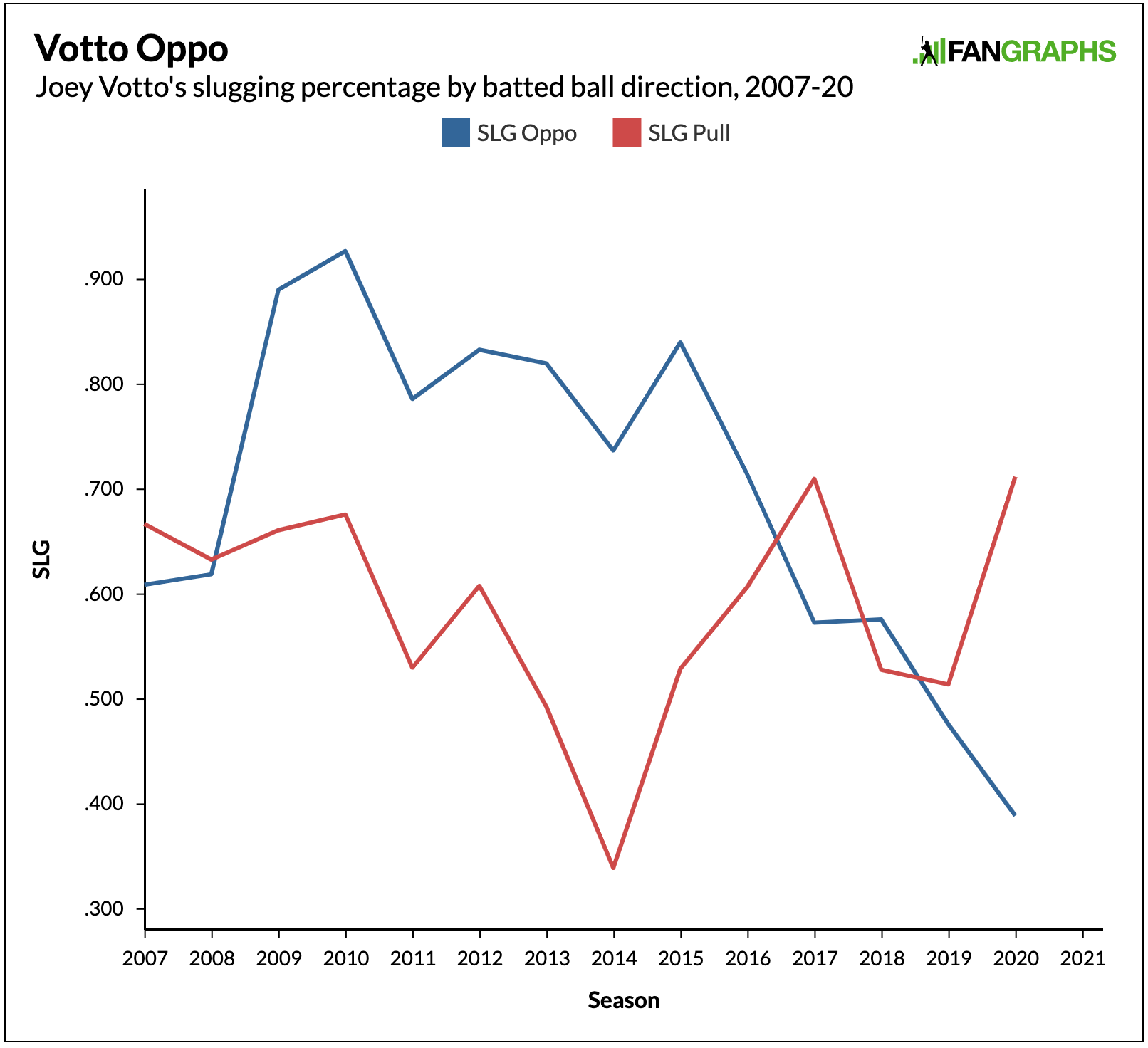
From 2018 to ’20, on balls hit to the opposite field, Votto batted .346/.511, well below the .409/.768 he hit while doing so from ’07 to ’17. By comparison, all of MLB hit .299/.432 going oppo in that 11-year span, and .320/.492 from ’18 to ’20, meaning that Votto was no longer much more productive than the average hitter via that route.
Hence his adjustment towards pulling more balls. Not only was last year’s 46.2% pull rate the highest of Votto’s career, but so was his 19.6% rate of pulled fly balls, as Rosecrans and Sarris pointed out. Pulled fly balls are where the big hits are at for most batters: The league hit .435/1.550 on such balls from 2018 to ’20, and Votto outdid that, at .479/1.646. Through Monday’s small sample, he’s at .500/2.000 while pulling 22.2% of his fly balls, so you can understand why he’d want to do that more often.
Getting back to Statcast and expected stats, Votto entered Tuesday with the largest gap of any batter between his wOBA and xwOBA, which is to say between his actual results and his expected results based upon his batted ball profile:
| Name | Team | PA | BBE | wOBA | xwOBA | wOBA-xwOBA |
|---|---|---|---|---|---|---|
| Joey Votto | CIN | 43 | 36 | .204 | .384 | -.180 |
| Cesar Hernandez | CLE | 39 | 26 | .275 | .450 | -.175 |
| Freddie Freeman | ATL | 41 | 30 | .305 | .471 | -.166 |
| Tommy Pham | SDP | 44 | 32 | .196 | .362 | -.166 |
| Brandon Crawford | SFG | 34 | 26 | .262 | .425 | -.163 |
| Ozzie Albies | ATL | 42 | 35 | .168 | .327 | -.159 |
| Bryce Harper | PHI | 38 | 21 | .416 | .567 | -.151 |
| Avisaíl García | MIL | 36 | 24 | .321 | .470 | -.149 |
| Jake Cave | MIN | 31 | 18 | .195 | .322 | -.127 |
| Paul Goldschmidt | STL | 42 | 31 | .258 | .381 | -.123 |
| Charlie Blackmon | COL | 37 | 29 | .270 | .392 | -.122 |
| Michael A. Taylor | KCR | 32 | 24 | .406 | .525 | -.119 |
| Lourdes Gurriel Jr. | TOR | 30 | 21 | .171 | .282 | -.111 |
| Enrique Hernández | BOS | 42 | 30 | .286 | .395 | -.109 |
| Josh Rojas | ARI | 32 | 20 | .142 | .245 | -.103 |
| Manny Machado | SDP | 48 | 30 | .351 | .451 | -.100 |
| Trevor Story | COL | 45 | 36 | .315 | .415 | -.100 |
| Jorge Polanco | MIN | 43 | 31 | .169 | .267 | -.098 |
| Travis d’Arnaud | ATL | 32 | 22 | .325 | .423 | -.098 |
| Elvis Andrus | OAK | 41 | 34 | .147 | .243 | -.096 |
Not all of these gaps are due to bad luck. A player’s speed often has something to do with the difference between wOBA and xwOBA (a player who can take the extra base in a given situation versus one who can’t) as does his ballpark (a ball that might have been out in one venue might be a routine out in another). Nonetheless, this is a good place to look when a player is performing to one extreme degree or another, for it often serves as a reality check, and here the reality is that Votto hasn’t been as bad as that anemic slashline would lead you to believe. He’s hardly the only player in this boat, but a guy with a career .399 wOBA — second only to Mike Trout’s .420 among active players with at least 1,500 career PA — sticks out in this context, even given his career downturn. Votto’s xwOBA is in the 72nd percentile, but his actual wOBA is in the ninth percentile.
Since both wOBA and xwOBA include walks and strikeouts, it’s also worth noting that through Monday, Votto — who has walked at a 16.0% clip for his career — had walked just twice (4.7%) and struck out in just 11.6% of his plate appearances; both of those would be career lows if they held up. He’s been swinging at more pitches outside the strike zone (24.7%, about three points above his career norm), making contact earlier in counts (3.81 pitches per plate appearances, 0.27 below his career norm), and rarely getting to 3–2 (7.0% of his plate appearances, just over one-third of his career norm of 19.1%). It’s a very un-Votto-like pattern.
Even so, it’s early in the season, and for Votto as with any other player, many of the struggles and anomalies will come out in the wash with larger samples. As if on cue, Votto began Tuesday night’s game with a two-run homer off the Giants’ Kevin Gausman:
The opposite field shot doesn’t quite fit the pattern I’ve outlined above, but hey, Oppo Moppo! Votto did also strike out twice in his four plate appearances and chased a couple of pitches outside the zone. None of that is included in the numbers above, but his work from the previous night — a splash hit into McCovey Cove off Aaron Sanchez, as well as a strikeout — was.
With two homers in two nights, it’s fair to suggest that Votto might be coming around. Let’s not panic just yet.
Brooklyn-based Jay Jaffe is a senior writer for FanGraphs, the author of The Cooperstown Casebook (Thomas Dunne Books, 2017) and the creator of the JAWS (Jaffe WAR Score) metric for Hall of Fame analysis. He founded the Futility Infielder website (2001), was a columnist for Baseball Prospectus (2005-2012) and a contributing writer for Sports Illustrated (2012-2018). He has been a recurring guest on MLB Network and a member of the BBWAA since 2011, and a Hall of Fame voter since 2021. Follow him on BlueSky @jayjaffe.bsky.social.
I love seeing this right next to yesterdays Baez piece.
Votto already has 2 IFFB. He has had more than 2 in a season only twice – 2008 and 2019 – and never more than 5. He only had 20 total for his career before this season.
It’s still early but chase rate up and contact rate down – that’s an ominous combo for a 37 year old.
It doesn’t seem like he’ll get back to the Joey Votto of old, but of course that is the case, he’s 37 years old. It seems like he has come to terms with the fact that he can’t be the elite hitter he used to be, and is instead trying to pull the ball so he can be at least a “good” hitter and maybe a “very good” hitter. Seems totally reasonable to me. The IFFBs are going to come with the new approach, it seems, along with the strikeouts. And he hit both those IFFBs in one game against the Cardinals, iirc- could just be a coincidence
He’s 37 years old. His skills have been eroding for a few years, and perhaps that’s a function of a slightly faster aging curve than some others, but I wonder if we didn’t get spoiled by older players in the steroid era, who retained most their skills longer.
Yeah, when I saw this headline, I thought…who is “panicking” about a guy who has already lost it? “Resigned” is a better word. He keeps on making tweaks to keep himself out of Pujols territory but 2018 is just not a realistic image to have of Votto anymore. He’s busy fighting hard just to maintain what he did in 2020, and it might not work.
Of the top 30 players all-time from age 37 onward, only 3 played through the Steroid Era – Bonds, Moises Alou and Vizquel. On the pitchers side there are quite a few more – Unit, Clemens, David Wells, Moyer, Smoltz, Maddux, Colon, Schilling and Kenny Rogers.
Maybe the pitchers were the ones juicing?
Curious how you defined “all-time”? I’m guessing that it was based on playing time. Otherwise, I have no idea how Vizquel made the list.
The key is “from age 37 onward”. Vizquel played forever, so he’s #17 on a list if you go back to 1950 (probably a little lower if you go back “all-time”).
In any case, there are some cases where a player used steroids to prolong their careers or have weirdly good years in their mid to late 30s, with Clemens and Bonds being the obvious examples, but also guys who weren’t quite as successful at using it to prolong their careers, like Rafael Palmeiro. But even he hit 47 homers at the age of 36. Mark McGwire hit 65 home runs at age 35, but I think 37 was his last season. They were using steroids to extend their careers, they just weren’t quite as successful at it.
From this, it’s hard to say that steroids led players as a group to perform regularly way above their level in that time period, but that’s probably because (contrary to the claims put out by some people) not everyone was using, and the ones who were didn’t have a team like BALCO to help them take full advantage of it. And those individual cases get washed away in the the big picture, because if you take a look at the best players in any defined age range, they will trend towards being evenly distributed.
(The other thing, keep in mind that offensive performance is era-adjusted. Palmeiro smashed 47 homers with a .381 OBP and had a wRC+ of…139. So it would have to be an absolute titanic shift of offensive performance to older players for this to be visible)
But #17 in terms of what?
BTW, I’m sure I’m being way too obtuse. But whatever data Anon pulled doesn’t being to answer the question of skill retention by older players during the steroid era.
Instead, I would point to this article by Ben Lindbergh that shows that Average Hitter Age Weighted by WAR clearly peaked during the steroids era.
https://www.theringer.com/mlb/2018/9/28/17913536/mark-mcgwire-sammy-sosa-steroid-era-home-run-chase
I could be wrong, but isn’t it a characteristic of Votto to start slow?
Votto’s career wRC+ by month:
April: 139
May: 148
June: 153
July: 145
August: 157
September: 152
So slightly slower, but by no means slow
One of the joys the mega-contract era has brought us is former superstars playing long past when they should have retired. Albert Pujols, in a prior era, would have retired after his abyssmal 2017 season; Miggy probably as well. Now we get to see them play years as replacement level players, which is just kind of sad given their former heights.
Votto seems to be about at that point, and probably would have retired after 2019. Hopefully the next few years for him won’t be as ugly as the last few were for Albert and Miggy, but I wouldn’t bet on it.
I think about this every time I hear Cubs fans saying the team should make Anthony Rizzo a “Cub for life,” and I don’t consider him a superstar.
Indeed. There was a ton of MSM hollering back in 2013-14 about how Detroit needed to make Miggy a Tiger for life, he had won the Triple Crown, it would be an insult if they didn’t, etc. We’re all seeing how that turned out.
Turned out owner dies, team stops spending, tanking continues. Miggy milestones are top reasons to pay to watch today’s Tigers baseball!
Haven’t there been studies about which types of players age well and which don’t? It would seem that big first basemen don’t age well – maybe something to do with their size putting wear on their lower bodies. On the other hand, there’s David Ortiz. Maybe there’s no rhyme or reason to it.
As an Angels fan, Trout’s similar body structure to Griffey worries me a bit. But only a bit.
I don’t see how you could say Trout and Griffey have similar body structures at all
Griffey became more Troutian later on, as he built up bulk. Fangraphs has Griffey at 6’2″, 230 lbs – almost exactly the same as Trout (BR has Griffey at 195 lbs, which was more his early years).
Anyhow, the point being that there tends to be some correlation for outfielders who had long careers and slow declines with more svelt body types, while the heavier and bulkier guys tend to decline more quickly. Roids aside, of course.
Physique-wise they’re still quite different though. When I think of Griffey Jr, I think of a pear – not especially wide shoulders but extremely thick through the hips. Trout looks more like a parsnip.
p.s. I always forget about Anthony Rizzo. He reminds me a bit of one of those third basemen who is great in their mid-20s and you think they have another level in them, but they don’t and start declining early. Obviously too early to write him off, but the last two seasons aren’t encouraging and given that he turns 32 in August, he might be in the slippage phase.
There’s a lot that goes into all of this, but if you look at his 11 LD, he has 5 singles on them (BA and SLG of .454). This year, the league has a .643 BA and a .921 SLG on line drives. Five of those 11 line drives are 102EV or higher. He has two singles on those five line drives. The league as a whole has a .767 BA and a 1.298 SLG on line drives hit at 102+.
Line drives have always seemed to me like the biggest “luck” component to hitting, since when they’re not hit in the close vicinity of a fielder, they’re big money, but when they’re hit right at someone, they’re usually nothing.
Also, 10 of his 17 GB were pulled, and the other 7 are classified as straightaway by Statcast. Lefties in the league are hitting .148 on pulled GB and .204 on straightaway GB this year. So he is getting somewhat “unlucky” on the ground, if he hit league average, he would be expected to have about 3 hits instead of 1, but we’re talking about 2 total bases on 17 GB as opposed to the 5ish total bases on 11 LD he’s “missing”.
Matt Carpenter, who barely missed the cutoff of PA, would lead this category handedly. In 28 PA, he’s got an xwOBA of .458 and a wOBA of .250. He’s got a ridiculous average exit velocity of 96.4 mph and the highest Barrel% in the game. I’d love an article about his strange season.
Panicking? Votto has been declining for years.