
Jeremiah Estrada Doesn’t Need To Be Mad at the Cubs Anymore
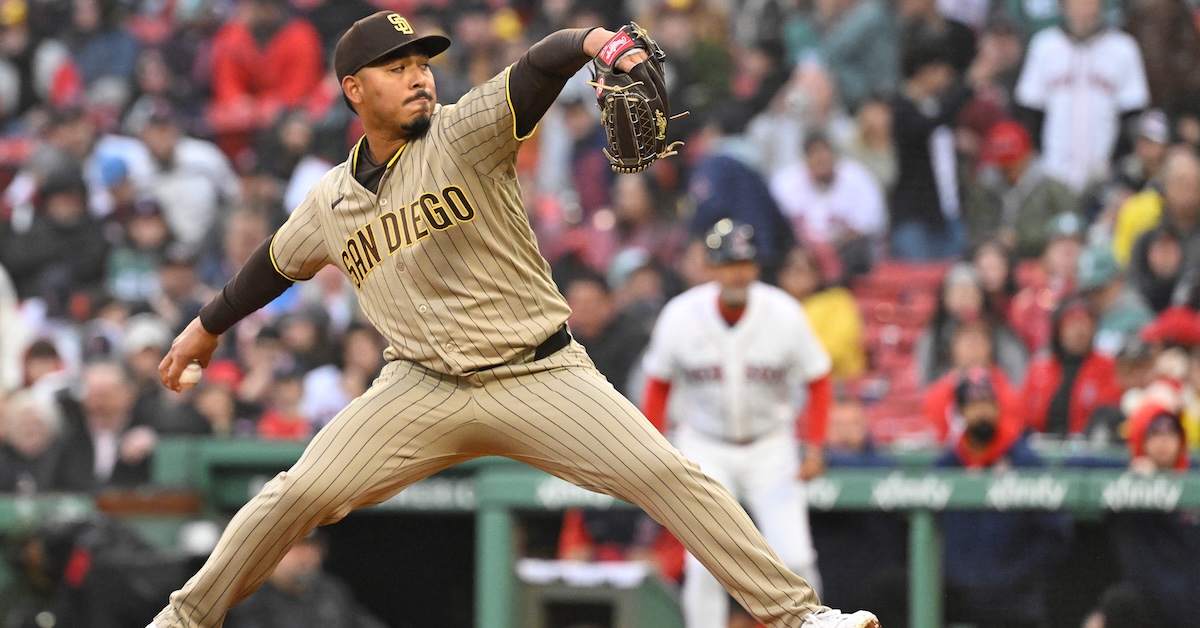
Jeremiah Estrada’s path to big league success was bumpy. Drafted out of Palm Desert High School in California in 2017, the now-27-year-old right-hander battled multiple injuries, including one that required Tommy John surgery in 2019. There was non-health-related adversity as well. Estrada spent his first seven professional seasons in the Chicago Cubs organization, and he didn’t always see eye to eye with the club’s pitching coordinators and coaches. They were occasionally at cross purposes when it came to optimizing his repertoire.
Estrada reached the big leagues with Chicago in 2022, although it wasn’t until two years later that he found much success. Cast aside by the Cubs, with whom he’d thrown just 16 1/3 big league innings over parts of two seasons, he has thrived since being claimed off waivers by the San Diego Padres prior to the 2024 campaign. Over 145 appearances, Estrada has logged a 3.35 ERA, a 2.85 FIP, and a 36.1% strikeout rate over 139 2/3 frames. His Friars ledger also includes four saves and an 11-9 won-lost record.
Estrada discussed his nonlinear, and often frustrating, path to big league success over a pair of conversations. The first came in early March at the Padres’ spring training complex, while the second was conducted at Fenway Park this past weekend.
———
David Laurila: How much have you changed since coming to pro ball?
Jeremiah Estrada: “I’d say a lot, and not just what happens on the field. With the baseball side, you learn what’s important and what’s not important, but that’s pretty much like life. Right? Life starts to kick in. Even though many of our lives are different, we worry about the same things.
“Sometimes I actually get in arguments with people about whether this should be considered a job or not. A lot of people don’t understand what goes into it. This is a job — a blessing, but also a job. That’s something I’d like kids to understand, even adults to understand. You have to put in the work.”
Laurila: What about purely from a pitching standpoint? There have been some changes along the way…
Estrada: “Yes, as a pitcher, I have changed a lot. In my crazy mind, back then — back when I first got [to pro ball] — I thought that I was able to just do what I do. I was kind of… not really a know-it-all, but I felt that what I was doing was good enough. Just throw it by people. But I hopped right in, and they were already talking to me about making adjustments. It was, ‘Hey, we’re going to get rid of this pitch or that pitch.’ I was like, ‘Damn, okay.’ Any kid who wants to be in the big leagues is going to be like, ‘Yes sir, no sir.’
“I had to learn how to trust myself more. I went all those years paying attention to the guidance I’m supposed to be listening to, the organizations and the ideas. I thought that whatever advice I was given was going to take me to the big leagues. Over time, I got to the point where… I started to do much better when I was paying attention to myself and leaving it all in God’s hands instead of putting it in other people’s hands. I made so much progress by doing that. Of course, I’ve accepted some guidance — I’ve accepted some words, some wisdom — but it’s mainly been trusting in myself.”
Laurila: I want to hear about your split-change, but first we should talk about your fastball. Have you always gotten a lot of vertical ride with it?
Estrada: “In high school, my fastball used to cut. I also had a normal changeup back then. My arm slot was about the same, but maybe a degree towards… it was slightly lower. Once it got a little higher, and I got heavier — whatever it was — it started to carry more. Carry and cut. But the carry was kind of always there. Even some of the colleges I talked to were like, ‘That fastball’s got life.’ That’s what they said. I didn’t know anything about it. To this day, I don’t even know how to read some of the numbers on TrackMan.”
Laurila: I was aware of the carry, but not the cut.
Estrada: “At times, I get cut. What’s funny is that when it cuts, it’s not bad… but it’s also kind of bad. I’m losing a little bit of velo, a little bit of vert. It can be effective at times, though. It can work for me. I’ll be leaving a fastball down the middle to a lefty and it ends up being a cutter by accident.”
Laurila: What causes that to happen?
Estrada: “Mechanically, I’m getting on my toes instead of staying back on my hip and pushing off the mound. It’s a balance situation because of mechanics. On the way down from my leg kick, trying to be aggressive, trying to throw hard, trying to place the ball, I’ll kind of leap into it instead of staying on my right hip — kind of like you’re sitting on a chair — and working toward the plate. When I have proper mechanics, I’m keeping my whole foot flat.
“You can throw a baseball as hard as you can, or as soft as you can — as anything as you can — but doing things right mechanically is the most important thing. You have to find for yourself what works mechanically. You have to understand yourself. People worry so much about what they hear, yet if you hear some of the wrong things… you have to listen to yourself, hear your body. At the end of the day, it’s not their arm, it’s your arm. If your arm breaks, it’s not their career that ends. It’s your career.”
Laurila: Your career took off after you started throwing the split-change. Did you learn it after coming to the Padres?
Estrada: “No, I was still with the Cubs. But I learned it on my own. They had tried to teach me a forkball, or a normal splitter, and I told them no. I had a good changeup. It was a circle changeup, kind of like Pedro Martinez’s. I kind of copied his, and along with my fastball, it was the pitch that got me drafted. I don’t need to be mad about it anymore, but in their own world, they thought they should mess with something that wasn’t a problem.
“I mean, right from the start… after my first two days [in the organization] they were telling me, ‘Hey, we’re going to get rid of your curveball.’ They jumped the gate on me, trying to turn me into something they wanted, instead of letting me be the way I need to be, or that I want to be.”
Laurila: I recall reading that you had a good changeup. Why did they want you learn a splitter?
Estrada: “You would have to ask them. For awhile they wanted me to just throw fastballs and sliders — that’s what I was mostly throwing when I got to the majors — but then they wanted me to… I mean, as soon as they started teaching me a forkball, things just went [in the wrong direction]. I stuck with it for months, until I was completely tired of it. This was in 2023. They were trying to send me to Double-A, because I wasn’t figuring it out in Triple-A, and I told them, ‘I’m not going.’ I told them that I’d rather go to Arizona [to the team’s complex] and get blasted on social media, saying that I fell apart. I wanted to go there and figure things out, rather than let something else take over my life. You have to find the darkest moments to find the light.”
Laurila: You then learned the split-change on your own?
Estrada: “Yes. I was in my hotel room, just tossing up a ball. I was trying to figure out the Vulcan, trying to figure out any other kind of… I even tried [Kevin] Gausman’s. It wasn’t working. Like I was saying, you have to understand yourself. I’m more over the top, and trying to get down [action] on it, I would press more on top [of the baseball]. Every time I would try throwing a Vulcan or a splitter, I was getting that fastball carry. I came to the realization that what I needed to do was get my index and middle fingers out of the way, because those were the fingers for my power, for my fastball. That’s what I did. I grabbed a baseball that way, and with that mindset, and it felt good. I stuck a baseball in my hand that way for the entire next day. I told them, ‘This might look goofy, but I want to throw it this way.’”
“When I got traded over here, I showed it to [Padres pitching coach] Ruben [Niebla]. He saw me throw, and said, ‘That looks good. I like it. Whatever it is, whatever you call it, it’s working.’ He was fine with me being who I am.”
Laurila: What did you call it?
Estrada: “The only reason I called it ‘the chitter’ is because it sounded funny. Split change, change splitter. When a Mexican says the bad word — I don’t like to swear — that’s what it sounds like. I was just having fun. It’s important to have fun.”
David Laurila grew up in Michigan's Upper Peninsula and now writes about baseball from his home in Cambridge, Mass. He authored the Prospectus Q&A series at Baseball Prospectus from December 2006-May 2011 before being claimed off waivers by FanGraphs. He can be followed on Twitter @DavidLaurilaQA.
Cubs were stuck in the moneyball 2.0 era. Everything outgrew that era quickly.
Glad he found what works himself.