
John Lackey Versus Lefties in 2016
The 2015 season represented the worst of John Lackey’s career in terms of facing left-handed batters. He rectified that split this year, which is probably just because the balls bounced differently. But it’s also notable that the Cubs’ Game 4 starter changed his approach against lefties this season. He’s mimicking a strategy he last used in 2011, the worst year of his career. Strangely, it’s working.
This lefty problem has always been a thing for Lackey — he’s just better against righties (.309 wOBA career) than lefties (.325) because of platoon splits and also because his best secondary weapon is his slider — but last year, the problem was worse than usual. He recorded a 4.84 FIP against lefties and a 2.69 FIP against righties in 2015. It was also the year he threw the most fastballs, the fewest curves and changeups.
This year saw better numbers against lefties, finally. Lackey had a virtually platoon-free 3.83 FIP vs righties and 3.79 vs lefties, which is meaningless in a global way, but interesting because it came with a change in arsenal. Look at his pitch-type selection against lefties over time:
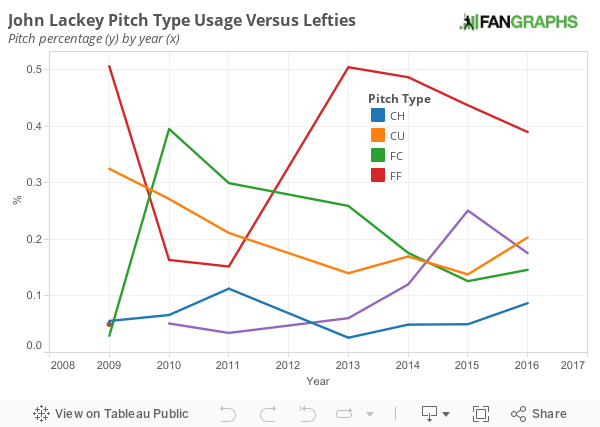
This past season, Lackey used his changeup more than he has in any other year other, save 2011. After a few years of laying off the curveball against lefties, he also upped his curveball usage back to his 2011 levels. He didn’t forgo the cutter/slider at 2011 levels, but he did step off of the pitch a bit. In a lot of ways, 2016’s approach versus lefties was most similar to 2011’s.
But 2011 didn’t work out very well for Lackey, so he must have added some wrinkles.
One such wrinkle comes from the changeup itself. He’s throwing the pitch harder than he’s ever thrown it, but it’s also showing some of the best drop it’s ever seen — and by far the best whiff rates he’s ever gotten. At 13% this year, it was almost average for a changeup. When we see numbers like this, the easy assumption is that he’s improved his arm speed on the change and hitters aren’t picking it up as early. Let’s see if we can see any of that if we compare 2015 (83.0 mph average) to 2016 (84.2 mph average). We’ll push it on either side of the average to see if it’s more obvious on the extremes.
2015, an 80-mph changeup:
2016, an 87-mph changeup:
It’s hard to tell if the arm speed is different, but the movement sure is better on the harder changeup. And you can tell the batter had a harder time identifying it, as Brandon Moss (below) swung while Chris Coghlan (above) chose not to. At 87, it could be a sinker, but his sinker averaged 91 and this pitch featured four inches more fade and an inch more drop than his average sinker, too. It’s just two pitches, but each is more representative of the average change in 2015 and 2016, and the 2016 version is better.
He’s also changed his approach on the curve some. Instead of going for called strikes in the zone with back-door curveballs (left, 2015), he’s burying the curve this year below the zone, more middle-middle (right, 2016). That may be part of why his curve added 50% more whiffs against lefties between 2015 and 2016. It looks like a slider, which Lackey throws to the back foot against lefties, but then it’s bigger and out of the zone.

In many ways, the 37-year-old’s approach hasn’t changed. He back foots his slider to lefties, and supplements that with some curves and changeups to keep batters from hanging out over his sinker or timing his four-seamer. But in other ways, it has changed. His change is better, perhaps benefiting from better arm speed, and his curve usage and location is more set up for whiffs than called strikes.
It’s that combo of changes that helped the ageless Lackey smooth out his platoon issues from 2015, while also putting up the best swinging-strike and strikeout rates of his career. And in some ways, it’s great that a return to the curve is at the center: when he came into the league 14 years ago, he was known for his curve, and barely threw a slider.
With a phone full of pictures of pitchers' fingers, strange beers, and his two toddler sons, Eno Sarris can be found at the ballpark or a brewery most days. Read him here, writing about the A's or Giants at The Athletic, or about beer at October. Follow him on Twitter @enosarris if you can handle the sandwiches and inanity.