
Kevin McGonigle’s Time Isn’t Soon — It’s Now
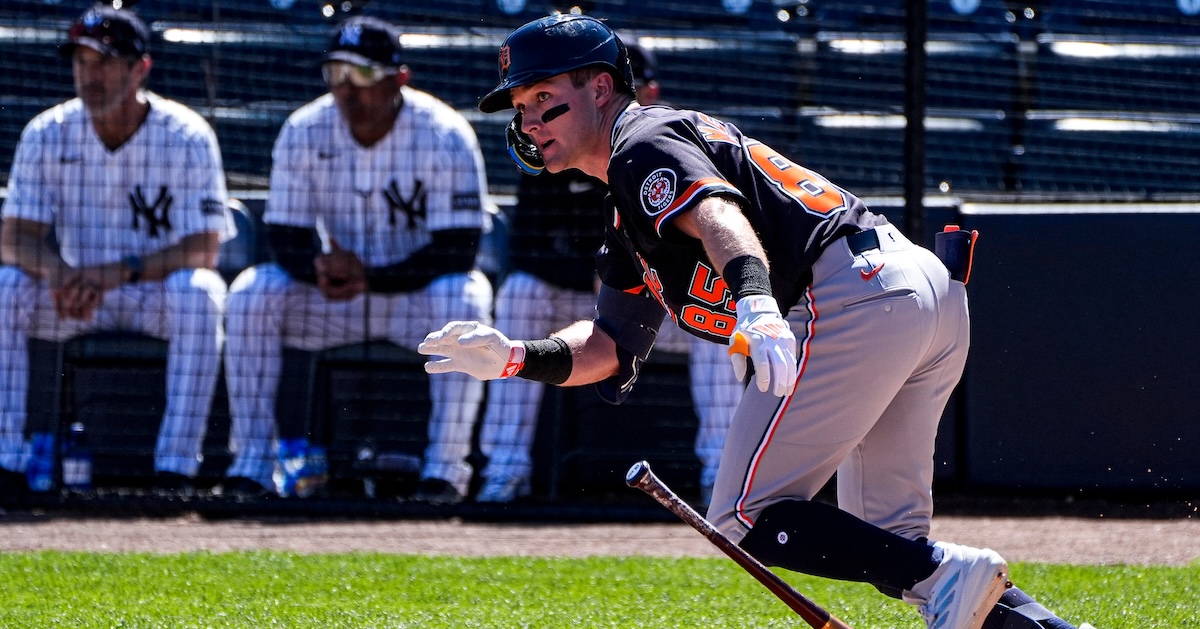
After the signing of Framber Valdez served as an exclamation point on what had been a fairly quiet offseason, the Detroit Tigers have established themselves as the preseason favorites in the AL Central. With a generally deep lineup and a solid rotation further buttressed by what is likely Justin Verlander’s swan song, you have to like Detroit’s chances, even if you think that the Royals or Guardians could prove to be a bigger threat than Vegas currently does.
But as someone who has now spent decades feeding data into a cold, impersonal machine and watching it spit out projections, I know about as well as anyone that the future is horribly uncertain. Predictions are not destiny, and a team with a 75% chance of making the playoffs still has a one-in-four shot of watching them on TV. Over the next few weeks, the Tigers need to answer as many questions about their team as possible, and one of the biggest is whether their top prospect, Kevin McGonigle, will start the season in Detroit or Toledo. And if the Tigers are truly in win-now mode, McGonigle being in the Opening Day lineup is the absolutely correct move to make.
That the Tigers have made “now” into their most important timeframe isn’t an assertion that I’m just pulling out of nothingness. With the negotiating gap between Tarik Skubal and Detroit on an extension reportedly in the range of $250 million, retaining Skubal’s services for 2026 only makes sense if you’re going for it. If their goal is simply to try to quietly cruise into the playoffs with 86 wins, then they might as well have traded Skubal to a team that is willing to go all-in, and hoped that they’ll do fine with the impressive players they’re likely to get in return.
And yet, Skubal remains, which means that McGonigle ought to join him in the majors.
On a fundamental level, the primary purpose of the minor leagues is to develop players who can help the parent club win. And McGonigle didn’t just excel in the minors last season, he absolutely dominated multiple levels, posting a 182 wRC+ (162 at Double-A) with 19 homers in 88 games as a 20-year-old. Those are video game numbers, ones that suggest that you probably need to raise the difficulty level of the game you’re playing.
And there aren’t really any hidden concerns lurking, no wacky BABIP distorting things (he posted a .303 on the season) or disturbing contact rate (83% overall). McGonigle didn’t just torch minor league pitchers; he destroyed them with a very advanced approach at the plate. After the season, he continued his reign of terror in the Arizona Fall League, hitting .362/.500/.710 with a 19-to-12 walk-to-strikeout ratio. His spring training has gotten off to a solid start as well, going 6-for-15 with two doubles and a triple. And that’s not counting the exhibition game against the Dominican Republic’s WBC squad, which he led off with a home run against Luis Severino.
Kevin McGonigle is responsible for
*checks notes*
all of our runs so far ? pic.twitter.com/N9wnoNwT28
— Detroit Tigers (@tigers) March 3, 2026
Giving McGonigle a fair shot doesn’t involve the Tigers having to reduce the playing time of, say, prime Cal Ripken Jr. or Alan Trammell. Javier Báez had a much better 2025 than most predicted going into the season — myself included — but it wasn’t like he had a resurgence into stardom. A .275/.310/.442 first half got him into the All-Star Game, but he hit .223/.230/.318 in the second half, and finished with just 1.4 WAR on the year. Even giving him a lot of leeway for a nagging shoulder issue in June and a September injury stemming from hitting a foul ball that womped him in the forehead, a 1-to-46 walk-to-strikeout ratio during that second half is truly abysmal — and no, I didn’t leave out a digit in the first number. Let’s not forget that Báez even having a roster spot last year had a lot to do with there being about $75 million remaining on his contract going into the season.
Likely sharing time with Báez at shortstop is Zach McKinstry, especially if Báez’s back continues to be a problem. McKinstry has been surprisingly adequate at short when he’s played there, but he’s also an incredibly flexible defensive player who will likely get a ton of plate appearances whether or not McGonigle is in the majors, as he’s basically the team’s best Plan B at several positions. Plus, I don’t think anybody would dispute the notion that McGonigle has greater upside than McKinstry.
ZiPS isn’t expecting McGonigle to instantly challenge Bobby Witt Jr. and Gunnar Henderson for shortstop supremacy in the American League, but it does project him to be in near-All-Star territory if given a full season of plate appearances. It’s rare for ZiPS to project a rookie to be that good, especially a player who hasn’t yet played at Triple-A, and of this year’s prospects, only McGonigle and Konnor Griffin project to be anywhere near that level of performance. Here are McGonigle’s ZiPS percentiles, assuming 600 projected plate appearances:
| Percentile | 2B | HR | BA | OBP | SLG | OPS+ | WAR |
|---|---|---|---|---|---|---|---|
| 95% | 53 | 36 | .308 | .391 | .587 | 162 | 7.1 |
| 90% | 47 | 30 | .300 | .378 | .546 | 151 | 6.3 |
| 80% | 42 | 26 | .285 | .362 | .519 | 141 | 5.5 |
| 70% | 39 | 24 | .272 | .352 | .493 | 129 | 4.7 |
| 60% | 37 | 22 | .265 | .340 | .467 | 122 | 4.2 |
| 50% | 35 | 20 | .257 | .332 | .452 | 116 | 3.6 |
| 40% | 33 | 18 | .249 | .325 | .435 | 109 | 3.2 |
| 30% | 31 | 17 | .240 | .317 | .419 | 102 | 2.6 |
| 20% | 27 | 15 | .230 | .307 | .392 | 94 | 2.0 |
| 10% | 24 | 13 | .214 | .294 | .362 | 82 | 1.3 |
| 5% | 22 | 11 | .205 | .285 | .343 | 75 | 0.8 |
Per the projections, that’s an 86% chance of him accruing more WAR than Báez did in 2025, and a 92% chance of him putting up more WAR than the latter is projected to generate if he’s given 600 plate appearances this year. One of the unknowns, of course, is just how good McGonigle will be defensively at shortstop. ZiPS, which has a probability-based metric based on ball coordinates, thinks he is about average at short, but its method is a far more limited than the Statcast defensive data in the majors. Our prospect team, which ranked McGonigle fifth overall on February’s Top 100 as a 60-FV prospect, isn’t quite as positive, though they don’t think he’s likely to be a butcher or anything:
Shortstop defense is the only blemish here. McGonigle has soft hands and can transfer the ball quickly, but he often doesn’t, and his arm and range look light; he also doesn’t have the kind of frame or build you’d project to get any more nimble with maturity. The Tigers have mostly had him run out to short thus far, but he played third base a dozen times in the Fall League, where he was spotted doing infield work with Alan Trammell. He looked comfortable making throws at third with his body moving toward first. He position may be dictated more by Detroit’s needs than McGonigle’s best fit in a vacuum. Regardless of where he plays, McGonigle offers a great blend of a high floor with star upside.
The Tigers are well-insulated from the risk in the event that McGonigle proves that he does need time at Triple-A for additional polish. They’re not choosing between McGonigle and signing a free agent, but between McGonigle and a player who will already be on the roster. Báez, McKinstry, and Trey Sweeney (depending on the shoulder) remain the fallback options. If McGonigle puts up a .550 OPS in April or has a surprisingly leaden glove, they still have the guy they were going to use anyway. And let’s not forget that risk tends to have multiple sides; advancing a player too slowly can have deleterious effects because if they aren’t being challenged, they aren’t learning new skills or dealing with adversity. There’s a good chance that McGonigle won’t learn anything facing Triple-A pitchers except how much a cheeseburger costs at the Fifth Third Field concession stands.
The ZiPS season simulations attempt to take the interaction between performance and playing time into account when estimating team standings. In his higher percentile outcomes, McGonigle gets more than the 350 plate appearances he’s projected to get on average; when he struggles, he gets less playing time, with the simulated Tigers using their other shortstop options more. As of this morning, ZiPS projects the Tigers with a 61% chance of winning the division and a 5.8% chance of winning the World Series. When McGonigle hits his 80th-percentile OPS+, those numbers climb to 71% and 6.8%. A true breakout season from him would boost the Tigers to being on the level of any other team in baseball in a one-on-one matchup, with the possible exception of the Dodgers.
With three weeks of spring training remaining, the Tigers don’t have to decide who their starting shortstop is right now. But unless something changes drastically, the bold move would be to show faith in Kevin McGonigle, and give the team the strongest chance of ending the year soaked in beer and champagne. Sometimes you just have to push all your chips into the center of the table behind your best hand.
Dan Szymborski is a senior writer for FanGraphs and the developer of the ZiPS projection system. He was a writer for ESPN.com from 2010-2018, a regular guest on a number of radio shows and podcasts, and a voting BBWAA member. He also maintains a terrible Twitter account at @DSzymborski.
Is it possible to see these zips projection by percentiles for other players?
Szymborski releases 80/20 percentile projections on a team-by-by-team basis every winter https://blogs.fangraphs.com/2026-zips-projections-chicago-cubs/
Thanks