
Let’s Hear About, and From, a Quartet of Red Sox Southpaws
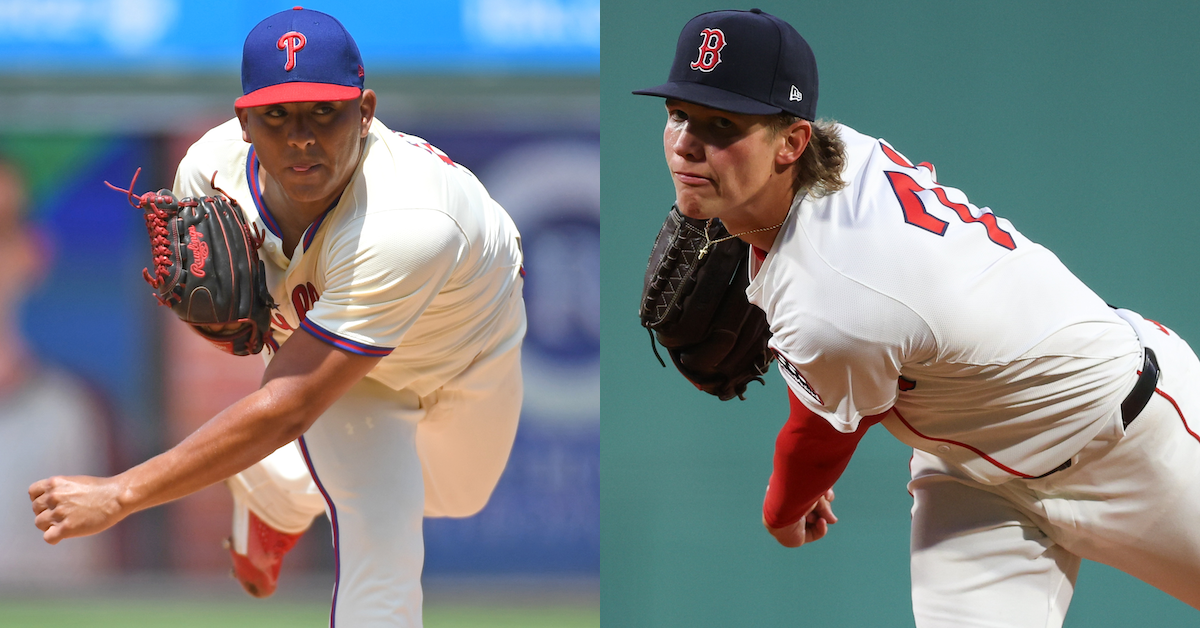
When Eric Longenhagen put together our 2018 Philadelphia Phillies top prospects list, he described southpaw Ranger Suárez as “small but athletic and mechanically efficient, unfurling a sinker/slider combination that has a chance to play at the back of a rotation.” Having yet to pitch above High-A, the 22-year-old Suárez was assigned a 40 FV and a 2020 ETA.
He has gone on to exceed expectations. Not only did Suárez reach the majors earlier than anticipated — July of that same season — he has evolved into a frontline starter. After first establishing himself as a reliever, the Pie de Cuesta, Venezuela native moved into the Phillies rotation in August 2021, and since then, he boasts a 3.39 ERA and a 3.45 FIP over 654 frames. Moreover, he has gone 4-1 with a 1.48 ERA in the postseason, a contributing factor to his desirability in the free agent market. As chronicled by my colleague Davy Andrews, the Red Sox inked Suárez to a five-year, $130-million deal earlier this month.
When Sonny Gray met with the Boston media after being acquired via trade from the St. Louis Cardinals in late November, I asked the veteran right-hander if he feels settled in to who he’ll be going forward, or if he foresees making any changes to his repertoire or pitch usage. I haven’t had an opportunity to ask that question to Suárez, but I did present a version of it to Red Sox chief baseball officer Craig Breslow. Does the organization’s pitching brain trust anticipate suggesting any tweaks, or do they view the 30-year-old lefty as someone who already optimizes his talents?
“He’s good at optimizing usage, locations, and shapes,” replied Breslow, who played parts of a dozen big league seasons and helped develop the Chicago Cubs’ pitching program before coming to Boston. “That’s not to say we can’t continue to help provide the most information we possibly can. He’s clearly a guy who has got the ability to execute and pitch to a scouting report in a game plan, so we want to make sure that we are giving him the best information… He’s been very successful with what he’s done, so we’re not here to reinvent his success. But we will make sure to supplement that as much as possible.”
Suárez and Gray both possess deep repertoires that allow them to succeed without throwing very hard. (Suárez ranked in the seventh percentile for fastball velo last year, Gray in the 16th percentile). Handedness aside, are they much the same pitcher?
“They’re similar in terms of managing contact, Sonny with a little more strikeout potential,” said Breslow. “Sonny’s secondaries also rely more on spin, whereas Ranger’s changeup has been a very good pitch for him. So, kind of raw spin, total spin, the edge goes to Sonny. The ability to execute — both guys have been really successful — maybe a small edge goes to Ranger.”
The newest addition to Boston’s rotation weighed in on his success, as well as his 90.5-mph heater, when he was introduced to the media at Fenway Park.
“If you have really good command of your pitches, and are able to mix them well, you don’t really need 100 [mph],” Suárez said through interpreter Daveson Perez. “That’s kind of what I do.”
———
What Payton Tolle does differs markedly from what Suárez and Gray bring to the table. The 23-year-old southpaw — Boston’s top pitching prospect along with Connelly Early — attacks hitters with a plus-plus fastball. Along with sitting high-90s and touching triple digits, Tolle’s heater gets explosive ride-run and is delivered with 7 1/2 feet of extension. A second-round pick in 2022 out of TCU, he debuted with the Red Sox in late August and went on to log a 6.06 ERA and a 25.7% strikeout rate over 16 1/3 innings in his first taste of the majors.
Whether the 6-foot-6, 250-pound hurler ends up a rotation regular or a power arm out of the bullpen is largely a matter of how well his other pitches develop. His cutter has made the biggest strides thus far, while his repertoire also includes a slider, a curveball, and a kick change.
Tolle recently told reporters, including yours truly, that he wants to get more swing-and-miss on the last of those offerings. I asked him about those efforts. More specifically, is he chasing a certain movement profile, or he is more looking for a greater velocity difference?
“A little bit of both,” he replied. “It’s more the vertical break on it, trying to have more separation from my fastball… I think we’re pretty close to [the zero line] right now. Originally, the goal was positive three vert. That would be anywhere from 15 to 20 [inches] off of my regular heater.
“I also need to throw it for more strikes,” continued Tolle. “People have only had to hunt fastball, because they don’t have to respect anything else. I go back to that Arizona start [three innings, five runs allowed, on September 5] a lot. The offspeed… nothing landed for a strike. I couldn’t find anything other than the fastball and they teed off on it. So, trying to find it in the zone as much as I can, and then, yeah, the vertical break. It’s awesome that they are are going to have to figure that out, how to write that in a paper of me.”
Tolle proceeded to make a whooshing sound, adding that he is going to come in someday and just speak in onomatopoeias. “You guys will have a great time with that” he said with a broad smile.
———
Early isn’t nearly the quipster that Tolle is, but he is every bit as promising. When our 2026 Red Sox top prospects list comes out in the not-too-distant future, the 23-year-old product of the University of Virginia — and before that the United States Military Academy — may well be ranked ahead of his more gregarious teammate. Pitchability is one of the reasons why. Whereas Tolle arguably profiles better out of the pen because of his reliance on the heater, Early is similar to Suárez in that he possesses a six-pitch arsenal that he mixes with aplomb. Breslow used the word “guile” when addressing Suárez, and that word befits the 23-year-old Early as well.
What’s the young southpaw’s focus going into spring training?
“I’ve talked to [pitching coach Andrew Bailey] and [assistant pitching coach Chris Holt] about certain things we might want to work on versus righties, versus lefties,” said Early, whose 93.7-mph fastball ranked in the 39th percentile for velocity in his 19 1/3 big league innings. “I’m always trying to improve every step of the way. I’ve got some stuff to work on in Fort Myers, seeing if certain sequences work.”
Is any one pitch is a priority for improvement heading into the season?
“Not necessarily,” he told me. “I think my pitches are in a pretty good spot right now. Obviously, we can tinker with them a little bit, but the biggest thing is just competing in the zone with each and every pitch. That and being able to sequence well.”
———
Suárez is a lock for Boston’s starting rotation in 2026, while Tolle and Early will be in spring training trying to earn a spot. If they don’t break camp with the Red Sox, they’ll begin the season with Worcester. Jake Bennett is another left-hander who is almost certain to be taking the mound with the Triple-A affiliate. Acquired by Boston from the Washington Nationals last month in exchange for fellow prospect Luis Perales, Bennett is an up-and-coming hurler who pitched at three levels last year, topping out in Double-A. Drafted 45th overall in 2022, the University of Oklahoma product had a 2.27 ERA and a 2.96 ERA over 75 1/3 innings.
Bennett’s repertoire comprises four- and two-seam fastballs, a changeup, a cutter, a sweeper, and a work-in-progress curveball. In December, Longenhagen described him as “a strapping 6-foot-6 southpaw who throws quality strikes with a 92-95 mph fastball that plays up a bit due to its other traits.”
Given the diverse pitch mix and low-to-mid-90s heater, I asked Red Sox farm director Brian Abraham how Bennett compares to Early.
“Jake has a unique fastball and some real strong extension,” replied Abraham. “He’s also a little bigger than Connelly. But I think he does do some things, pitching-wise, that are really hard to teach. One is his ability to get his fastball into the zone and provide some deception. There are some velo gains that he hasn’t especially had yet, but in terms of the overall profile — a left-hander who has the ability to develop and get stronger — yeah, I would say they’re similar.”
When I caught up with Bennett at Boston’s annual rookie development camp earlier this month, he told me that his fastball/changeup combination is “definitely my bread and butter,” and that his changeup is “probably my best pitch.”
Asked about his two fastballs, which he delivers with good extension, the 23-year-old said he doesn’t consider either to be notably better than the other. He described his four-seamer as having ride-run, and his two-seamer as having more horizontal than vertical movement. His changeup was more interesting to hear about.
“I have a lot of confidence in it and can throw it in any count,” Bennett said. “The grip is kind of different. It’s kind of like a circle, but also a little bit weird. I have big hands, and kind of hold it like a claw. I don’t know how my grip got to that, but it feels natural to me. I’ve had it from a young age.”
David Laurila grew up in Michigan's Upper Peninsula and now writes about baseball from his home in Cambridge, Mass. He authored the Prospectus Q&A series at Baseball Prospectus from December 2006-May 2011 before being claimed off waivers by FanGraphs. He can be followed on Twitter @DavidLaurilaQA.
Why no mention, David, of the fifth southpaw, Kyle Harrison?
or #6, Patrick Sandoval.
How could you possibly ignore Shane Drohan?
and with all these promising lefties, tho Bennett is fine, seems odd to have traded Perales