

Luis Severino Sets the Tone

There’s paint on the field, bunting on the steel, and hoopla in our feels. It’s Opening Day no doubt. Well, the third one, at least.
The most iconic trapping of Opening Day is the fleet of excellent starting pitchers who take the mound. Each team sends their best, or at least, their healthiest. For some, it’s the reigning Cy Young winner. For others, it’s a precocious prospect. These starters, true to their name, carry the burden of the new season in their shoulder.
Few carry a burden greater than Luis Severino’s.
The Athletics are on the cusp. They rank 20th in FanGraphs Depth Charts projected WAR and enter Opening Day with about a 16% chance of making the postseason, per our playoff odds. It seems unlikely that this is their year, but they are indeed young and talented and rising. It wouldn’t be too surprising if they stayed in the playoff picture well into September.
If they do, it’ll be because of their lineup. It’s good. They finished 10th by wRC+ last year and have returned mostly the same group. In his rookie season, Nick Kurtz made a case for being the game’s next great slugger. Shea Langeliers finished with the second-highest wRC+ by a catcher at 131. Brent Rooker notched his third straight 30-plus home run season. Jacob Wilson and Tyler Soderstrom each played well enough to earn early-career extensions, and Lawrence Butler got one the year before.
Our Depth Charts project the A’s batters 14th overall by WAR, but they’re less than a win from breaching the top 10, right in that next tier behind the Dodgers and the handful of truly great lineups throughout baseball. It’s a playoff-worthy group.
The issue? The A’s are lopsided:
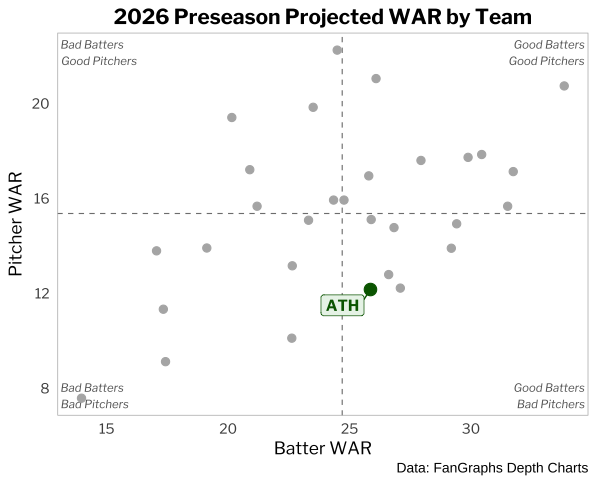
Their pitching is bad. They finished last year in the bottom five by WAR, and we project them no better in 2026: Their starters ranked 24th in our positional power rankings, while their bullpen ranked 26th. I don’t know that I’d call them terrible — they’re still a clear rung or two above the Rockies — but there’s not much there to distinguish them.
To be fair, it’s difficult to project groups of pitchers over a season, as injuries and small samples spur attrition. The bottom of the A’s staff doesn’t look much different than the bottom of many staffs in the mushy middle of our projections. I could totally buy Luis Morales having a breakout season, just like I could buy Jeffrey Springs and Aaron Civale being decent backend guys. And, you know, bullpens are weird, sometimes in ways that works in your favor! Still, there isn’t someone who’s an obvious candidate to post above-average value and carry this group to that next, bare-minimum level.
Except maybe Severino. He’s done it before.
Severino was once a big deal, albeit nearly a decade ago. He was a highly touted prospect, and a top-five pitcher by WAR in 2017 and 2018. He had the simple, classic arsenal of a guy with big time stuff: a 98-mph four-seam fastball, a wipeout slider, and a changeup just to keep you honest. Nobody threw harder, and few struck out more batters. In 2018, he was only 24.
Then, as these things go, he got hurt. Severino missed almost all of 2019 with a shoulder injury. Then he missed all of 2020 and most of 2021 with Tommy John surgery. He pitched pretty well for half a season in 2022 before being sidelined with a lat strain, then pitched pretty poorly for a half a season the following year while dealing with the lat strain and an oblique strain. He threw just 209.1 innings over five years.
Severino signed a prove-it deal with the Mets before the 2024 season, and he proved to be… well, good enough to sign a three-year deal with the A’s that December. It was a surprising move because the A’s are notoriously stingy. But it was also kind of a perfect move because the A’s needed someone who could potentially be a frontline starter to lead the staff. And there just aren’t many pitchers available in the A’s price range who have proven capable of posting five-win seasons, especially ones willing to play in a minor league ballpark.
That minor league ballpark, of course, was a big part of Severino’s first season in Sacramento. He really didn’t like pitching there, and he told The Athletic as much in June.
“It’s not the same atmosphere. We don’t have a lot of fans. Our clubhouse is in left field. So, when we play day games, we have to just be in the sun. There’s no air conditioning there, too. It’s really tough.”
Now, I’m not going to call Severino a liar. I’m sure he truly didn’t like pitching in Sacramento. When he offered that quote, he had a 6.79 ERA in 10 starts at home and a 3.04 ERA in eight starts on the road. That’s a big split! But Severino also had a 4.36 FIP at home and a 4.34 FIP on the road over the same stretch — his fundamental ability wasn’t much different. As the season progressed, so did he; he posted a 4.26 ERA and 4.28 FIP in five starts at home from July onward, compared to a 3.00 ERA and 3.20 FIP on the road. I’m willing to chalk up much of Severino’s early-season home performance to poor luck: His .342 BABIP and 58.2% LOB rate were bottom five among starters through June. That seemed to self-correct as the season wore on.
In other words, yes, Severino was generally worse at home, and we might expect him and the rest of the Athletics’ staff to be worse while working against what ended up being the fifth-highest park factor in the majors last year. It’s a minor league park, it’s very warm, and the wind blows out — it isn’t easy to pitch there. But there’s maybe a tendency to exaggerate the extremity of Sutter Health Park. What we saw in 2025 was nowhere close to Coors Field, and I think I’d classify it as being more of a nuisance, rather than a barrier to a season of quality pitching.
No, Severino’s merely decent performance in 2025 was his own doing. He posted the lowest strikeout (17.6%) and whiff (18.3%) rates of his career. It’s part of a years-long downward trend in either category.
Why?
A great pitcher who declines after injury is typically dealing with some sort of velocity dip. That’s sort of the case with Severino, but also not really. Again, he was once the hardest-throwing starting pitcher in the game, averaging 97.6 mph on his four-seam fastball in 2018. He was down to 96.1 mph on his four-seamer in 2025. That’s a meaningful difference, but he still boasted one of the 15 fastest four-seamers in baseball last year. In fact, Severino’s whiff rate on the pitch jumped from 20.2% in 2018 to 21.9% in 2025 (though still shy of his 24.0% mark from 2017).
But he isn’t just throwing four-seamers anymore:
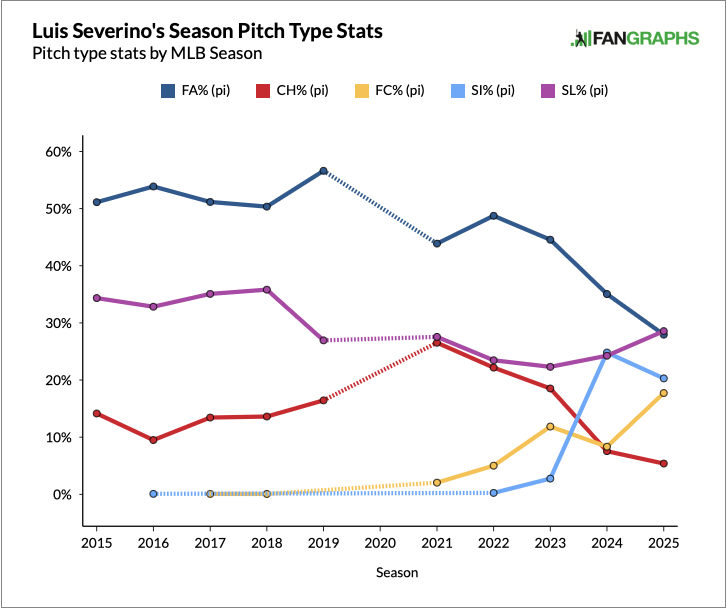
Severino now has a contemporary arsenal. He still throws a lot of fastballs, but some of them are now sinkers to righties and cutters to lefties. These tend to be a bit slower. If we look at his average velocity on all fastballs, he was actually down to 95.4 mph, or 2.4 mph lower than 2018; his total fastball whiff rate last year was just 16.7%. Severino also ditched his sharp, biting slider in favor of a slower, looping sweeper. The pitch produced a mere 22.8% whiff rate in 2025. It’s still a good pitch overall, and it does seem to produce poor contact (namely popups and weak fly balls). But it’s just not “2018 Luis Severino 37.6% whiff rate” good.
Now, maybe these tradeoffs are worth it. It’s not entirely fair to compare Severino in 2025 to himself from seven years ago. It’s possible that continuing to throw the same three-pitch mix wouldn’t have the same effect today as it did when he had that extra, tip-top gear. But the sum total of these changes is a slower, more contact-oriented approach. Severino last year struggled to get ahead in counts and finish off batters.
If this is who he is going forward, that’s fine. He remains an average-ish pitcher worth giving 30 starts a season to in just about any rotation. Still, I can’t help but feel there’s room for something more. He throws hard, he has good command, and he’s still Luis Severino. He looked electric for the Dominican Republic at the World Baseball Classic, pumping upper-90s fastballs and dominating the fearsome Team USA lineup.
What will we get in 2026? Well, we’re about to find out. Severino will begin his 11th season in the majors Friday at age 32. The odds of him posting another ace-level season are growing longer, but he wouldn’t be the first or even the most unlikely pitcher to have a late-career resurgence. If he can find that next level again, the A’s are sure to follow. Such is the beauty — and burden — of Opening Day.
Ryan Blake is a contributor for FanGraphs and Lookout Landing.