
Luis Severino Signed the Latest Contract Extension
As far as FanGraphs is concerned, we’re just wrapping up Prospects Week. But as far as Major League Baseball is concerned, it’s just wrapping up Extensions Week. Aaron Nola signed an extension with the Phillies. Both Max Kepler and Jorge Polanco signed extensions with the Twins. And now, as of Friday, Luis Severino has signed an extension with the Yankees. You’ll remember that Whit Merrifield had already signed an extension with the Royals. Other players are surely going to sign extensions with other teams. That’s what happens this time of year.
Severino is a Super Two player who was looking at a 2019 salary of at least $4.4 million in his first of four arbitration years. That’s all wiped out now, with the Yankees having bought out all four arb years for $40 million. There’s also a fifth-year club option, that would have this contract max out at $52.25 million. The terms are similar to what Nola got from the Phillies, although Nola signed away two would-be free-agent years, while Severino signed away one. This shouldn’t be his last opportunity to make a splash.
The explanations tend to mirror one another. Teams like these contracts because they provide cost certainty. Teams also like these contracts because they usually end up looking club-friendly. Players like these contracts because they’re opportunities to become financially stable and secure for the rest of one’s life. How could Luis Severino possibly turn down a chance to make forty million dollars? Especially as a pitcher in the age of Tommy John. Severino’s set. His family is set. You know how all this goes.
This still looks club-friendly. So many players just don’t want to chance it.
Given a thousand opportunities to repeat the same future, Severino would frequently make more than $40 million through arbitration. And then he’d hit free agency a year sooner. Given a thousand opportunities, then, most of the time, Severino would come out looking good. But of course, some of the time, Severino would get hurt, or otherwise sidetracked. Pitching, and pitching hard, is a dangerous business, so you can’t get too mad at anyone for just taking the money. Just like that, Severino’s career is a success story. He’s achieved the stuff of his wildest childhood dreams. It’s just also relevant to understand how good Severino already is.
I know that he struggled in his sophomore campaign, and I know that 2018 was something of a roller-coaster. But, over the past two years, 197 starting pitchers have thrown at least 100 innings. Here are some of Luis Severino’s ranks among them:
- Innings: 10th
- WAR: 5th
- K-BB%: 9th
- ERA-: 16th
- FIP-: 6th
- xFIP-: 5th
Severino has pitched like an ace. Not all of the time, but enough of the time. It’s reflected in his statistics. Because of inconsistencies, because of a challenging second half, and because of the nature of the Yankees’ media market, Severino feels like he’s still an unfinished product, but he’s incredible. He’s a top-five or top-ten starting pitcher in the game today. He has some things he wants to work on, but even peak Clayton Kershaw went to camp every spring trying to learn to throw a changeup.
You wonder what might’ve happened had Severino’s 2018 season been flipped. Had his second half been better than his first. Maybe he wouldn’t have been so willing to sign an extension. Maybe he would’ve been looking for more. Or maybe it all would’ve been exactly the same. We’ve already talked about this, but the conversation is spreading: More and more people believe young players are going to jump for extensions. In particular, extensions that buy out some years of free agency. The free-agent market has been devalued, and players have unified in complaining about the conditions. The idea of becoming a free agent now doesn’t seem so appealing. So, in theory, players will be more willing to sign away free-agent years in advance. I can get behind the idea. I believe we are likely to see a trend.
I also think it’s worth examining the history. So, to gather some numbers, I turned to the MLB Trade Rumors Extension Tracker. I narrowed to extensions given to players with less than six years of service time. I further narrowed to extensions that bought out at least one year of would-be free agency. I then split every year between October and November. I’ve prepared two plots. This first one shows the number of qualifying extensions per season:
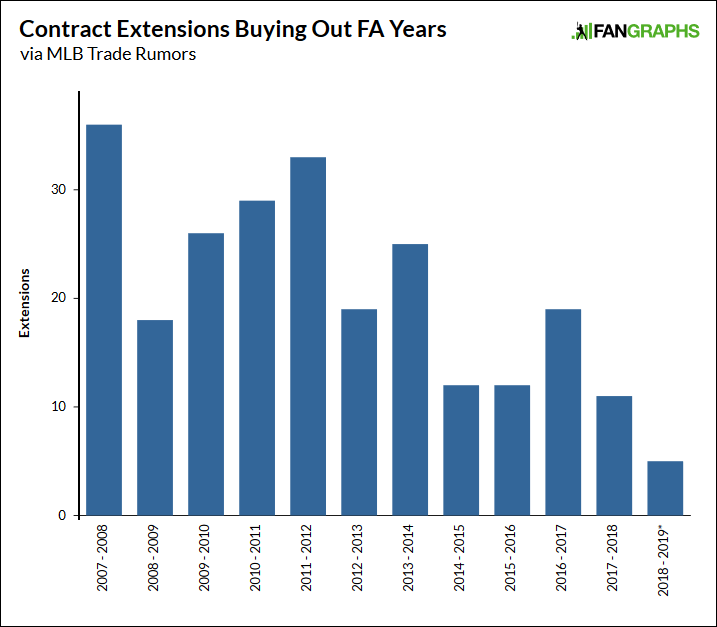
The last bar doesn’t matter that much yet, because of course the time period is incomplete. For the previous November-to-October 12-month period, there were 11 qualifying extensions. From 2007 through 2018, each year, there was an average of 22 qualifying extensions. We’ll see where this current period goes, and in just a few days we’ve seen the Nola, Kepler, Polanco, and Severino deals. But, for a comparison, flash back to 2013-2014, before anyone thought there was a major problem developing. There were 25 extensions. In just over a one-week period, there were extensions given to Starling Marte, Jose Quintana, Mike Trout, Yan Gomes, and Chris Archer. Each bought out at least two years of free agency.
That takes us to the second plot. This is based on the same information, except instead of counting up the number of extensions, I’ve counted up the number of free-agent years bought out (including option years, which are virtually always club options):
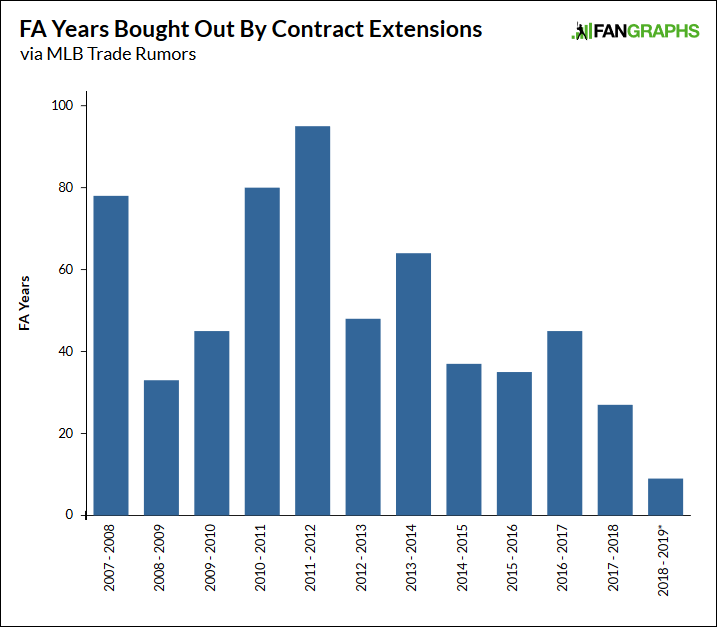
So far, five players have signed away a total of nine free-agent years. This doesn’t count Carlos Carrasco’s extension, since he has more than six years of service. I didn’t have to use the six-year cutoff — older players have to think about giving up free-agent years, too — but I wanted to keep the focus on the younger guys, who haven’t had a real chance to cash in. In the previous 12-month period, players signed away a total of 27 free-agent years. The overall annual average from 2007 to 2018 was 53. For whatever it’s worth, the average qualifying extension has bought out 2.4 free-agent years. This current, early period is sitting at 1.8. Only Polanco has signed away three seasons.
It’s possible, if not probable, that we’re going to see a run of extensions. You could say we already have, and it’s only the middle of February. There are still several weeks to go until the opening-day soft deadline. The free-agent market lately hasn’t made itself very appealing. But we’ll have to see where the numbers end up, because if anything, these kinds of extensions were recently in a down cycle, relative to five or ten years ago. And so, if they come, it’ll be more like they’re coming back. Between 2007 and 2014, there was an annual average of about 27 qualifying extensions. So far this period, we have five. It could just be that what’s old is new again. It’ll take a lot of contracts in the next few weeks for this current period to make history.
Which doesn’t mean free agency doesn’t seem worse than it used to. Players hear about it and talk about it every day. It’s why Severino got extra money up front, instead of taking something backloaded — he’s trying to protect himself in the event of a work stoppage. We all have an understanding of the market conditions. Just, remember that contract extensions have always been somewhat common. We see them every spring. There were a lot of them, and then there were fewer. It could be we’ll see a return to an old norm. I’m not yet sure we’ll see baseball blow past it.
Jeff made Lookout Landing a thing, but he does not still write there about the Mariners. He does write here, sometimes about the Mariners, but usually not.
Mets should offer Syndergaard a contract extension on the level of Nola and Severino’s contract extension as he’s a comparable pitcher, but the Mets aren’t exactly known for buying out arb years and a couple free agent years beyond with Wright and Reyes thirteen years ago or Niese and Lagares
Syndergaard would be an idiot to sign one
Really?
With his injury history?
A guy who had his arm cut open to fix it with one big season under his belt just landed nearly 3 times what Nola and Severino took. So yeah, he like those other two, would be an idiot. Hell, it’s even worse in his case since he’s such a freakish physical talent. At least the other two can argue that they’re mid-peak right now, whereas Syndergaard has basically stumbled into multiple 4+ WAR seasons on piss and vinegar as he still finds his way
Boras might have to start having his guys sign extensions
Elvis Andrus is the best-know Boras client to take a contract extension. That deal was the result of an front office valuing Andrus’s skill set much more than the typical arbitrator would have, making it possible for the Rangers to give Boras an offer he couldn’t refuse. He also took one for Steven Strasburg, but I have to imagine he had nightmares of Strasburg blowing out his elbow before the end of his walk year.
Agree,had to take it in both situations
So I agree with Jeff that the “simulation” is the right way to think about this. Run this simulation a thousand times, Severino earns more in arbitration than $40M in about 80% of them. Sometimes much more. In that last 20%, though, have some scenarios where he earns a lot less. Extrapolating this to the team, if a team signs ten players to extensions like this, the team wins about 80% of the time, and is more than capable of taking the loss on those two players that don’t pan out. On the other hand, the player only gets one career, and is poorly equipped to handle that 20% outcome. This is why it makes sense for teams to extend guys already under team control, and it makes sense for the players to take them. The model I use for this as the ideal “win-win” was the extension Eugenio Suarez signed with the Reds.
I do not necessarily agree that this one was a win-win, though. The Nola and Severino deals are so cheap compared to what is being handed out in free agency that it’s staggering that players are accepting them. I know that from an actuarial perspective, pitchers are a much scarier risk than position players, but because there are so few of them out there the demand is also far higher. Had he not signed this extension, he would have hit the free agent market at the same age as Patrick Corbin. Can you imagine what Severino would get in free agency if Patrick Corbin got $140M? One more year means that not only is he giving up his single most valuable year of free agency, he’s also giving himself one more year to get injured before he hits free agency (and because it’s a team option, it doesn’t protect him against devastating injury in his age-28 season).
Random pitchers, earnings through arbitration years:
David Price: $52M
Jordan Zimmermann: $32M
Jake Arrieta: $30M
Max Scherzer: $26M
Mike Leake: $19M
Patrick Corbin: $19M
Jeff Samardzjia: $19M
Matt Harvey: $15M
Nathan Eovaldi: $13M
David Price is the 99th-percentile, the absolute best case scenario, a super-2 went through all four arbitration years without ever getting hurt, 4-time All-Star, won the Cy Young with three arb years to go and finished 2nd two years before. A 20% discount off the best case scenario is hardly disproportionate to the risk offset.
Among the other pitchers, Scherzer and Arrieta would have passed $40M if they had 4 arb years, and even they would have been short of $50M. Punks like Zimmermann don’t even sniff 40M.
Basically, you’re whipping numbers from out of your arse. It’s more likely that making more than $40M is the top 20% scenario.
Comparing arbitration buyout to free agency contracts is just stupid. Why not compare it to Chris Sale’s 32.5M/5 yr contract with the White Sox, or Cueto’s 27M/4 yr contractwith the Reds, or Lester’s 30M/5 yr contract with the Red Sox.
In fact, most of the star pitchers who made it to free agency DID sign multi-year arbitration buyouts that sometimes include FA buyouts. Signing these contracts make the pitcher MORE likely to hit free agency, not less, because now they have less incentive to sign long-term extensions for less money.
“Why not compare it to Chris Sale’s 32.5M/5 yr contract with the White Sox, or Cueto’s 27M/4 yr contractwith the Reds, or Lester’s 30M/5 yr contract with the Red Sox.”
Maybe bc MLB payrolls from that time period were 20% lower than they are today? And they will likely rise another 5%-10% during the next four years.
More importantly, why look at a group of “random” pitchers and assume that Severino’s career path will have a similar distribution of outcomes? How does a young Mike Leake or Patrick Corbin resemble Severino’s profile?
You are free to try to find pitchers who earned more than 40M in arbitration on your own.
Also, 30 + 20% < 40.
Re-read my comment and actually answer the question as to why one would ever choose random pitchers’ historical earnings as comps when projecting an elite pitcher’s projected earnings.
If you genuinely think that Severino would have had a less than 20% chance to make $40m in arbitration, you have quite a bit to learn.
I found you a David Price, which is one more example of a pitcher who made more than 40m than you bothered to find for yourself.
You want to make a point, moron, do something to prove it rather than have the other side do it for you, and stop talking out of your ass.
Yep – he traded one year of control in order to lock in the 80% outcome of his arb years.
Makes a ton of sense, especially for a six-figure bonus kid.
Those were years ago! Of course they are lower! The most relevant comparison here is probably Trevor Bauer, another Super Two guy, who is on track to hit about $40-45M, except that Severino actually made 30% more in his first trip through arbitration (this is not as much as it sounds…about $1M more, but it gives you a sense of how much more he could get).
If Severino stayed healthy and kept on producing similar seasons, we are probably talking about something north of Trevor Bauer. But that’s not the part that’s the problem, because it totally makes sense to lock in $40M, or even something like $35M, to guard against injury. Those free agent years in the late 20s for elite starting pitchers are valued a *lot* more than $15M. The comparison is mostly for the FA years. If Severino had signed a deal that bought his arbitration years for even something as low as $33M, I think that would have made more sense than what he’s doing here.
I also don’t know you can attribute cause to the idea that signing these short-term extensions prevents them from signing long-term extensions. But that’s another story.
Salaries have not changed that much, nor should they be expected to. All of the arbitration years mentioned above occurred after 2010.
20% isn’t “much”? LOL
If you ever attended grade school, add 20% to the numbers above and tell me how many of them exceed 40M during arb years.
Not that you actually have the guts to look at real numbers.
Of course, a team isn’t likely to guarantee money without buying out at least one year of free agency and/or attractive team options. The fact that Severino only gave up one year of free agency (the team option at the end) is a decent outcome for him given the upper hand owners have with players under team control. And though he has the additional risk of losing his possible FA jackpot in that extra year, the risk of his arm going south in the next four years has got to outweigh that from a utility standpoint (he is now comfortably set for life).
On a related note, in his chat yesterday Jeff threw out the idea of making pitchers FA eligible one year earlier. This would improve the length and AAV of the contracts pitchers could get in free agency, which would also give them more incentive to bet on themselves during their control years. I really think that’s a great idea that the MLBPA should put on their wish list.
…it’s one FA year.
It doesn’t make sense for the Yankees to lock him in at $33m for the next 4 years, if they get no control in return.
In a perfect world for Severino, he’s sacrificing $15m in 4 years’ time to guarantee himself $40m now.
LHPSU, really good points and I appreciate actual numbers instead of assumptions. I view these deals as income performance, health, and life insurance. There is tremendous value in that for an arb eligible player- $4.3m to $40m is most life changing contract they’ll sign. I’d also like to see better numbers before I sign on to the 80% number. From the team perspective, their risk is “substandard” performance, their benefit is providing protection for their player, cost certainty (value in a cap management era) AND discounted performance value if the player outperforms. I do believe enlightened teams realize providing protection for their players has incremental value and they can manage the risk they incur in the reinsurance market.
Except his “actual” numbers were from scrubs like Eovaldi and Leake, which have no bearing on what Severino’s range would be.
Why don’t you bring up some numbers for a change instead for talking out of your ass, little twerp.
The deal works for both sides. Just like Nola, it’s a lot of guaranteed money, and he’s still going to get a chance for one more big score. Yankees will know what they have/.have to spend.
In a case like Severino’s, do teams and/or players usually have insurance policies for major injury? How about players insuring themselves against poor performance? No one ever seems to talk about this aspect.
Teams likely do, see Fielder, Prince.
And the Mets with Wright and Cespedes
They do.
But the premiums are high, they don’t cover the full salary, and they come with restrictions.
Thinking more about it, it’s prob not even worth it for the Yanks to insure a $40M contract extension. For the player, though, insurance could be very important. I just saw this re: Harvey:
https://www.cbssports.com/mlb/news/inside-baseball-mets-harvey-bought-arm-insurance-plus-more-mlb-notes/
It’s not exactly insurance but there are products on the market that give players a few million up-front in exchange for a percent of their future earnings:
Take a look at Fantex, Inc. – a few big leaguers have signed with them over the past few years.
The two main effects of having so many contract extensions 5 to 10 years ago are:
– More surplus value available to teams (because the extensions are team-friendly compared to market value), and
– A smaller supply of top free agents to spend that surplus on (because guys like Trout, Longoria, and Sale gave up some years of their free agency)
Those are the necessary ingredients for salary inflation on the free-agent market. This inflation made it reasonable to offer $20M+ AAV for a Jordan Zimmerman, or $25M+ for a Cespedes, because the money was available.
In the last 5 years, young stars under team control have been more willing to bet on themselves because of this bubble of salary inflation, leading to fewer of them accepting contract extensions. And if you extrapolate the previous salary inflation blindly, you can talk yourself into expecting $40-50M AAV if you’re a Harper or Machado, especially because you’re better and younger than those guys who just got $20-30M. But fewer guys on contract extensions means a larger supply of free agents to spend money on, both this offseason and in the next few (Betts, Lindor, etc.), which has now caused the salary inflation bubble to pop. Though it doesn’t help that baseball has fewer teams near the hump of the win curve, the change in the supply of free agents is the biggest reason why salaries have failed to keep skyrocketing.
And now, with the possibility that Harper and Machado may have to settle for $35-40M AAV, players don’t have as big of a windfall upside to make them bet on themselves when offered a contract extension. So the trend will swing back for more contract extensions to be taken, until the supply of free agents shrinks enough to trigger another fresh round of salary inflation.
I’ve seen suggestions that the Stanton contract is what “broke” free agency.
He got a massive nominal contract from Florida of all teams, because everybody assumed salary inflation would continue indefinitely so he would opt-out to get a bigger deal. Then the launch angle/rabbit ball thing happened and suddenly sluggers aren’t quite a rare commodity anymore and teams have internalized the lessons of the post-PEDs era. There may not be another such deal for a while.
Odds are that as the younger players adapt there will be more extensions accepted and less FAs in five years leading to a new balance. The Severino front-loading may be a sign of things to come with outyear salaries being restrained by the rising risk factor.
The seniority-based compensation model might give way to a salary model more closely resembling actual aging curves: Salaries might rise for the first few years of young stars’ careers, level off in the early thirties, and give way to short deals afterwards.
Excellent point about the Stanton contract. The Marlins set it up as 6 years for $107M before the opt-out after 2010, which would work out to less than $18M/year (basically Wei-Yin Chen money). After the opt-out, Stanton would be guaranteed $218M for the following 7 years (his age 31-37 seasons), not crazy for the market at the time but certainly more than the Marlins would ever want to commit. But then Stanton missed over 100 games in the first two years of the extension, raising the possibility that by 2020 he might be an injury-riddled slugger in decline with no incentive to opt out.
I think the Jake Arrieta deal last year is proof of the market’s reaction to the Stanton dilemma. This deal was front-loaded in the guaranteed portion, with a smaller amount in the later years, and gave the Phillies the right to “refuse” Arrieta’s second-year opt-out by giving him a guaranteed extension for two more years. Overall, the Arrieta deal’s salary structure fits closer to the expected aging curve, and also gives the team some upside if Arrieta returns to ace form.
With the amount of young pitching talent at a long-term low (besides Whitley, no one under 25 (college/minors/MLB) is considered terribly exciting), it seems like most pitchers should postpone long term deals and watch supply diminish over the next couple years.
LOL. Please list all the pitchers under 25 who have ace potential.
You did say no one aside from Whitley…
I think Walker Buehler is exciting, below 25, and just pitched like an ace (2.31 ERA/ 2.92FIP in 136.1 IP as a starter – yes, I am ignoring his one inning as a relief pitcher)
Amen to Buehler. I love Whitley, but Buehler has the Clemens/Verlander starter kit (great command of a plus-plus fastball, with good breaking stuff). Heck, the Dodgers have another exciting potential ace in Urias – if he stays healthy he’s Mark Buehrle plus about 5 MPH.
There are others too, but I haven’t finished my first coffee of the morning yet. 😉
I don’t know, when I see Buehler pitch, I think Lincecum.
There are several who are already in the MLB and are arguably already aces. Severino, Marquez, Buehler, Berrios, Flaherty. Plus Kopech, McKay, Sixto, Gore, Honeywell, Mize.
Besides Severino, who turns 25 tomorrow, that’s the sorriest list of top under-25 pitching talent I have ever seen. Which is my point. Unless some studs pop out of the woodwork, we’ll looking at a historic shortage of high-end pitchers very soon.
How are agents typically compensated for a contract deal vs. arbitration?
MLB owners and executives did not want to risk SEVERINO winning at $5.25m and establishing a new SP ARB1 target COMP for future guys like FREELAND. Right now there i huge void between S MILLER $4.35m and KEUCHEL $7.25m. The gap of $4.5m ( PHI filing on NOLA) and $7.25m makes it very challenging for future SPs to demand, say $6m , because there are NO RELEVANT COMPS.
MLB wants to MAINTAIN that gap!
Is this a ransom note?
Seems like it, luckily Liam Neeson is on the way
I don’t think Severino would be reassured by that, after the last week…
Owners of the League and BASEBALL leaders do not want a chance to win, SEVEN 5,55 m, as well as the establishment of a new target SP ARB1 for future types such as Freeland. Now I will have a great distance between Miller and 4 dollars. 35 million and Keuchel $ 7. 25 m. distance of $ 4.5m (PHI-Fill Nola) and $ 7. 25 million makes the future of the SPS a difficult issue, say 6 million dollars, because there is no corresponding agency.
MLB wants to keep this distance!
which of us would advise one of our 25 year old kids NOT to take a guaranteed $50M for five years work?
I can think of a few names but they’re all in politics or millionaires to start with.
Somebody else might be able to come up with something.
Maybe.
Someday.
Shouldn’t Sonny Gray be included in extended players?