
Max Muncy Might Be the Best Version of Himself
To the surprise of no one, the Dodgers are good. They lead all of major league baseball with a 10-2 record. They’ve outscored their opponents by 32 runs. Barring catastrophic injuries or a long run of bad luck, they seem poised to end the season as one of the league’s winningest teams.
You may be wondering where I’m going with this. It’s to introduce the idea that good teams are good by design. In a game whose goal is to maximize runs scored and minimize runs allowed, their hitters launch dingers, their pitchers compile strikeouts, and numerous depth players allow them to deal with injuries. But today, I want to focus on a single characteristic: plate discipline. As of writing, the Dodgers have the lowest in O-Swing% in the league. They’re also second in Z-Contact%, behind only the Astros. Laying off bad pitches, making contact with hittable ones – that seems like a recipe for success. And currently, no Dodger hitter is more emblematic of this approach than Max Muncy.
We haven’t written much about the first baseman here at FanGraphs. One reason might be that he isn’t the flashiest athlete – like Trout, he achieves greatness through consistent production at the plate. Theatrics are kept to a minimum, save for when he feuded with Madison Bumgarner. But another, more relevant reason might be that Muncy had remained true to himself since 2018, his breakout year. Sure, his wRC+ plummeted in 2020, but he sported an uncharacteristically low BABIP in one of baseball’s weirdest seasons. Besides that quirk, nothing much had changed. He drew his share of walks; he hit for power.
That is, until now. Somehow, someway, Muncy has become an even more extreme version of his patient, slugging self. His O-Swing rate of 12.5% is the lowest among all hitters, which is also the lowest of his career. But wait, that’s based on 12 games! How do you know this isn’t some small-sample blip? I wondered about that too, but looking at his rolling O-Swing% tells a different story, one which began in 2019:
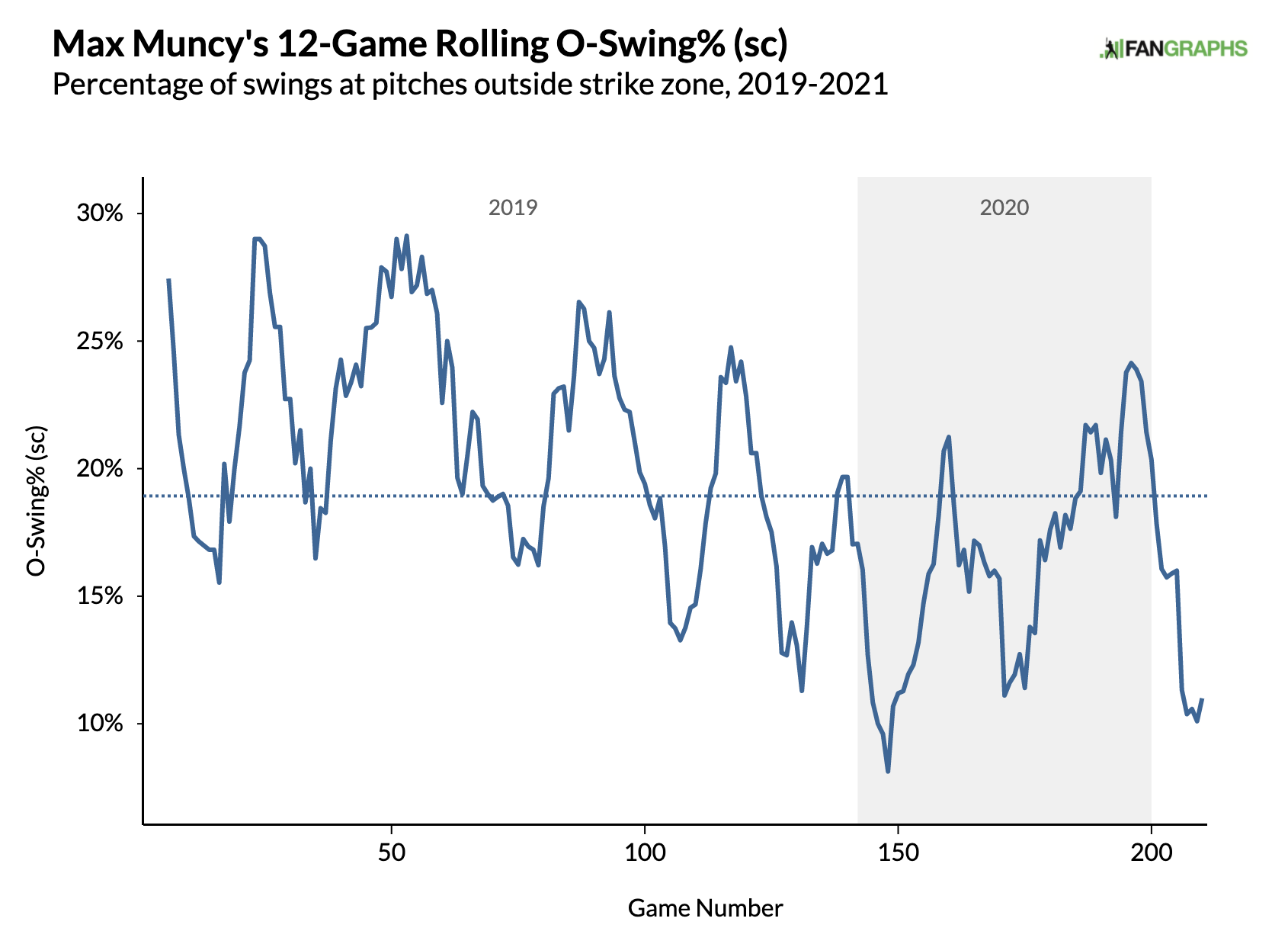
There are fluctuations, of course, but consider the overall trend. Starting in 2019, Muncy has gradually chipped away at his O-Swing%. It reached a minimum in July of 2020, then climbed back up towards the end of September, but he seems to be back on track. It also provides strong evidence that his career-best O-Swing% (so far) isn’t merely a fluke. While the rate is arguably unsustainable, there’s clearly been a conscious effort on Muncy’s part to show more discipline.
Chasing less is great, but pitches in the strike zone matter, too. If you can’t capitalize on your efforts by doing damage to those, the benefit of ignoring balls is limited to drawing walks (see: Carlos Santana). Fortunately, Muncy got the memo. A Z-Contact rate of 87.3% represents the second-highest in his career, and when he makes contact, he’s demolishing the baseball: Of 131 hitters with at least 25 batted ball events, his wOBAcon of .541 is the 11th highest.
The lethal combination of a minuscule O-Swing% and a well-above-average Z-Contact% made me wonder – how does Muncy compare to other hitters in these regards? To find out, I plotted the O-Swing and Z-Contact rates of qualified hitters on the x- and y-axis, respectively. Muncy is the point in yellow:
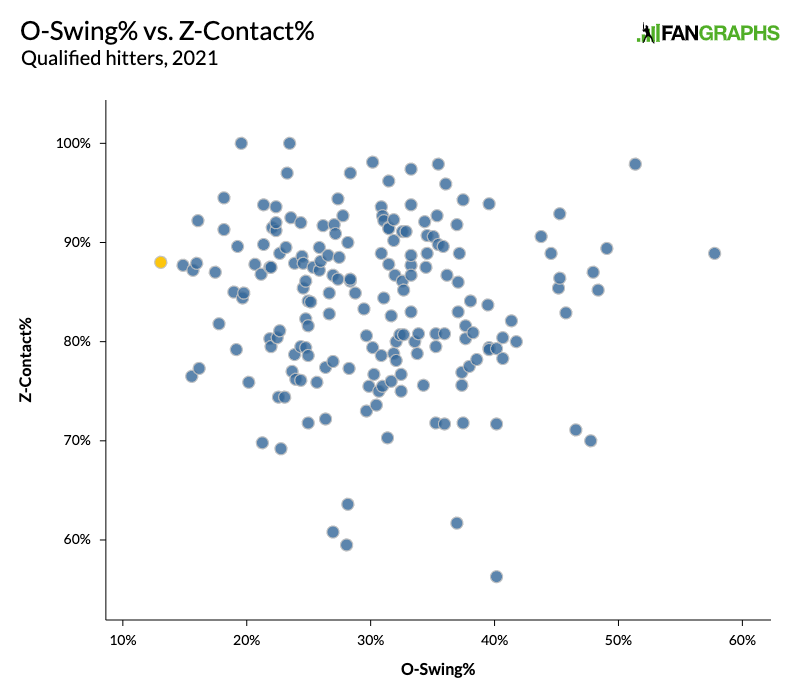
He’s not quite on an island by himself, but where he is on a scatterplot doesn’t matter too much. This is for fun! For something more substantial, I have an at-bat that captures Muncy’s meticulous approach at the plate. It’s bottom of the third, one out, with a man on second against Rockies pitcher Antonio Senzatela. The Dodgers have a 3-0 lead. Here’s the first pitch:
A four-seam fastball straight down the pipe to Max Muncy – that could have been dangerous. You could argue that Muncy should have swung at it, but letting a few hittable pitches pass by is the small sacrifice required to maximize one’s on-base potential. It’s fine. Onto the next pitch:
Good take! The fastball wiggled within the strike zone before veering up, but Muncy knew better than to swing. The next two pitches aren’t that notable. Senzatela threw a fastball at the knees for another called strike, then he went back upstairs, which Muncy ignored. The count is now 2-and-2. Muncy’s overall swing rate is 33.5% so far this season, but on two-strike counts, he’s dialed it up to 49.5%. Like most accomplished hitters, he knows when and when not to exude patience:
Fouling off a well-located slider? Just another day in the office. This next pitch, though, is the highlight of this at-bat:
Forget about Senzatela’s performance this season – that’s a perfect two-strike curveball. From his perspective, it must have been irritating to watch our protagonist not even complete a quarter of his swing before letting the pitch hit the dirt. Now, it’s a full count. Will Senzatela challenge him, or will he induce Muncy to chase? Here’s the awaited finale:
The PA result: “Max Muncy flies out to center fielder Garret Hampson.” It’s an anticlimactic ending against a hittable changeup; Muncy even slammed his bat on the ground in frustration. Despite the out, however, the preceding events showcased many of his qualities. For one, he didn’t swing and miss at a single pitch. He also ignored everything outside of the zone, and when he did swing, it was in a reaction to a clear strike. Outside of maybe missing a first-pitch meatball, Muncy didn’t make a single mistake, discipline-wise. Sometimes, you just get under the ball.
Besides, he can do without the extra hit. The Dodgers’ first baseman has been slashing .368/.520/.632 so far, good for a 211 wRC+. After becoming a BABIP victim in 2020, his batted balls have more or less been finding spots to land as hits. Venturing outside the theme of plate discipline for a moment, Muncy seems to be benefiting from pulling the ball less. Below is data on his batted ball directions from 2018 to now. The changes are crystal clear:
| Year | Pull% | Cent% | Oppo% | Non-Pull% |
|---|---|---|---|---|
| 2018 | 44.7% | 31.2% | 24.1% | 55.3% |
| 2019 | 44.2% | 33.2% | 23.7% | 56.9% |
| 2020 | 45.5% | 32.4% | 22.1% | 54.5% |
| 2021 | 37.5% | 34.4% | 28.1% | 62.5% |
Why avoid pulled balls? Teams love to shift against left-handed sluggers in the mold of Max Muncy, and last year, he faced one in 88.6% of his plate appearances. That, in tandem with general bad luck with batted balls, is most likely why Muncy’s batting average sat below the Mendoza line. What’s crucial to monitor, though, is whether he can replicate his offensive output of previous years with more up-the-middle and opposite-field balls. Sure, the shift gobbles up a few hits here and there, but the fact remains that pulled air balls provide the most bang for a hitter’s buck.
Then again, none of this might end up mattering. We’re still in small sample territory, where data for a player consists of less than 100 batted balls. It’s possible that with time, Muncy returns to his pull-happy ways.
But… what if he continues to mix up his batted ball tendencies? And continues to lay off bad pitches and attack hittable ones? When we write about small samples, those are the speculative questions we’re asking. If he does, it would represent the next step for Max Muncy. I once assumed that his breakout 2018 represented a new status quo. He’d stay there for a bit, then decline with age. As it turns out, he’s more than capable of sharpening his already stellar plate discipline and addressing the shift, a new adversary. The Muncy of now is perhaps the best version yet.
Justin is an undergraduate student at Washington University in St. Louis studying statistics and writing.
I love Max Muncy. Cinderella kid, comes out of nowhere. But I don’t how he could have laid of the proverbial 1st pitch meatball. Sometimes mashers just need to mash. No?
We can’t all be Corey Seager 😉
In an at bat later that game he took another first pitch fastball down the middle from Robert Stephenson. On his next pitch Stephenson threw a fastball in the same spot that ended up in the seats
Maybe he’s becoming the next Donnie Baseball albeit late-blooming…
He’s such a fun player to watch, like Justin Turner–someone who had to figure out how to be good at the things he could do just to get another shot, and therefore never stops working at it or being grateful for the opportunity. Appreciated the distinction between him and Santana, as well! I can’t tell if it’s my bias playing, but I also feel he’s unfairly disparaged for his defense at first (which has gotten better each year).
Who are those hitters up in the high 90s for Z Contact %?
Alex Verdugo and Jose Ramirez
Gee, man, you’re an awfully good addition, Choi.
I just love watching guys like Muncy grind every AB and the Dodgers as a whole are so freakin good at running up the pitch count of the opposing pitchers
Same guy who was struggling to get a job for the Oakland Athletics (A team now devoid of 1B depth) is now one of- if not THE- most disciplined and controlled lefty hitter in baseball
I can only dream of having had him make this metamorphosis while still on the Oakland roster though by now they would have traded him.
As much as that’s probably true, the Dodgers did extend Muncy at a rate that even the Athletics could pay (through 2023 w/ club options at just under 9m per year). That Muncy’s debut was delayed and his service time didn’t really advance until he landed with the Dodgers means that covers him through his age 33 seasons (and it was just 2 years of free agency bought out). Honestly, the Taylor/Muncy profile is probably the only sort of emergent talent that the A’s could realistically afford to retain.
The fluctuations on that O swing graph are oddly regular, like a sine wave. Is Muncy a robot?
alternate title: “Max Muncy Might Be Maximum Muncy”
One thing that just about all FG mentions of Muncy’s subpar 2020 results seem to overlook has been the injuries that probably substantially impacted him, particularly the fractured finger he sustained before the shortened season began and then some other possibly less significant injury a month or so in.
Those injuries didn’t completely stop him from playing most everyday, but they probably did make a rather substantial impact on his BABIP… probably until he eventually healed enough to start mashing during postseason play…
I have seen in various places that there seems to be a tendency for guys returning from finger/wrist injuries to show reduced power performance for a month or two after return
With that said, Muncy was -also- unlucky. His batted ball stats were great! It wasn’t a case of him not getting his full power or making weaker contact due to a weakened grip or anything like that. If he’d just had normal luck, he’d have had a 110-120ish wRC+.
Like we saw in the playoffs or see in this piece, because Muncy is one of the most patient hitters in MLB, his ‘lows’ have a much higher floor than most players, because he’ll pretty much always get on base at a league-average rate (which is the single most important thing a hitter can do).
If it was just that Muncy had a low BABIP in 2020 because he was not hitting the ball the way he usually does, the finger explanation would make a lot of sense. But he made great contact, he was just super unlucky when he did so. He wasn’t really much different than the player we saw in the playoffs, other than that he didn’t hit his line drives right at people all the damn time.
Muncy’s 2020 demonstrates how difficult it is to be a bad MLB player if you walk in 15% of your PAs.
We acknowledge that you cannot be a good MLB player if selectivity is your only skill, but that isn’t because you don’t produce if you just walk like Muncy did in 2020. Rather, the issue is what you’d see if I magically gained Muncy’s 2021 plate discipline as a real skill: I wouldn’t walk 22% of the time because MLB pitchers would quickly recognize I couldn’t hurt them if they just threw strikes all the time. If you have enough capability of dealing damage to keep pitchers from changing their approach, a 15%++ walk rate is enough to get almost anyone to league average production.