
Maybe the Pirates Can Unlock Gregory Soto
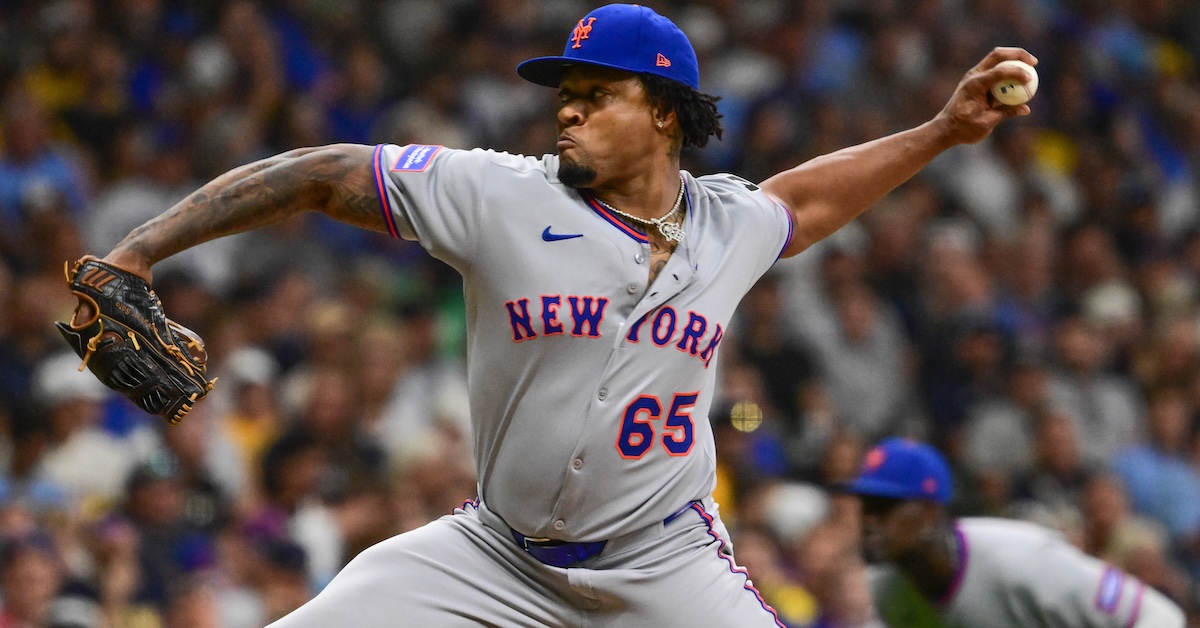
The Pittsburgh Pirates, rebuffed in their totally-serious, no, we-mean-it courtship of Kyle Schwarber, have found another way to spend in the free agent market. Gregory Soto is the lucky recipient of a one-year, $7.75 million contract.
Soto missed the cut for our Top 50 free agent list, which included 14 relief pitchers, including lefty specialist Hoby Milner. But before you go and say, “Yikes,” and run away, give me an opportunity to explain.
I’ve actually given Soto the once-over quite recently, as he moved from the Orioles to the Mets at the deadline. What I wrote about him then still fits:
Why Soto in particular? Well, the Mets are not the first team to be ensorcelled by his velocity. He is fourth among left-handed pitchers in four-seamer velocity this season. His primary fastball, however, is a sinker, which ranks fifth in velo among lefties. Soto is also pretty durable; the 30-year-old is on track for his fifth consecutive season of 60 or more relief appearances. He’s not especially homer-prone, and he’s having a good season. This year, Soto has his lowest ERA since 2022 and his lowest FIP ever.
That said, Soto has had trouble converting that velocity into reliable outs. His strikeout rate is 27.6%, 41st out of 169 qualified relievers, and one spot ahead of Tanner Scott. That’s the same Tanner Scott who went on the IL while he was in the process of being run out of Los Angeles on the rail. Soto’s walk rate, 11.0%, is almost twice Scott’s.
Soto had a bit of a bumpy time in New York. (It went under the radar, because the last two months of the 2025 season were bumpy for just about everyone on the Mets.) But he held those positive statistical markers: Career low in FIP, lowest ERA since 2022, and he actually got all the way up to 70 appearances on the season, which also established a new career high.
And some of those struggles might’ve been bad luck. Soto’s opponent HardHit% was 15% lower after the trade than before; nonetheless, his opponent BABIP ballooned by nearly 100 points, to .392.
The simple truth is that even in this golden age of fastball velocity and wicked arm-side run, sinkers like Soto’s don’t grow on trees. Even though his velocity has dropped by about 1.5 mph in the past three seasons, he’s still one of the hardest-throwing lefties out there. Only six left-handed pitchers with 30 or more innings put in a higher average sinker velocity in 2025, and you’ll recognize most of those names: Aroldis Chapman, Jose A. Ferrer, Tarik Skubal, Aaron Ashby. And finding a guy who throws that hard with Soto’s Toyota pickup-like reliability is not easy.
Believe it or not, the Pirates are going to need to worry about their medium-leverage relief arms in 2026, in a way they haven’t for almost a decade. Because, even after trading Johan Oviedo a week ago, this looks like a pretty good pitching staff. Not just good for a team that hasn’t had a winning season since 2018, or good for a team that makes Carl Weathers in Arrested Development look like Jay Gatsby. Good, full stop.
Paul Skenes is so good he counts for two aces. Bubba Chandler was the no. 1 pitching prospect in all of baseball when he got called up, and will throw as many innings in the majors as his arm can handle. Mitch Keller? He’s good. Braxton Ashcraft had a terrific rookie season, thanks to some home run-suppressing trends that may or may not carry over. In the bullpen, Dennis Santana is great, and Justin Lawrence looked like he’d figured it out before he got hurt.
These Pirates might lose 90 games again, such is the state of the offense. But if they do, they’re going to take a lot of those losses by scores like 3-2 and 2-1. Even an average bullpen arm can make a difference in a medium-leverage, high-usage role.
Even so, $7.75 million is probably more than you’d ideally want to pay for a pitcher who has a career 100 ERA- and a career 93 FIP-. That might be an artifact of the market; of the relief pitchers for whom our readers put in a crowdsource contract estimate, seven have signed so far. Of those, everyone except Edwin Díaz has outkicked his estimated contract. Substantially, in most cases.
| Crowdsource Results | Actual Contract | |||||||
|---|---|---|---|---|---|---|---|---|
| Name | Prev Team | Med Years | Med Total | Med AAV | Team | Years | Total Salary | AAV |
| Edwin Díaz | NYM | 4 | $84.0M | $21.0M | LAD | 3 | $69.0M | $21.1M |
| Devin Williams | NYY | 3 | $42.0M | $14.0M | NYM | 3 | $51.0M | $15.0M |
| Ryan Helsley | NYM | 2 | $21.6M | $10.8M | BAL | 2 | $28.0M | $14.0M |
| Emilio Pagán | CIN | 1 | $7.5M | $7.5M | CIN | 2 | $20.0M | $10.0M |
| Kyle Finnegan | DET | 1 | $7.0M | $7.0M | DET | 2 | $19.0M | $9.5M |
| Raisel Iglesias | ATL | 1 | $12.0M | $12.0M | ATL | 1 | $16.0M | $16.0M |
| Phil Maton | TEX | 1 | $5.0M | $5.0M | CHC | 2 | $14.5M | $7.25M |
So maybe $7.75 million is just what a league-average reliever costs in this market. And to be fair, Soto gets to average in a fun way. He wrecked lefties in 2025, holding same-handed batters to a .253 wOBA. That’s useful to the Pirates, because before Soto came along, the only left-handed pitchers they had on the 40-man roster were Evan Sisk and minor league starter Hunter Barco.
Let’s explore a hypothetical in which the Pirates overachieve and stay in the NL Central race in the second half of the season. If Don Kelly came out after a loss and explained that “have Chase Shugart throw a lot of changeups” was the best option against Christian Yelich or Pete Crow-Armstrong in the late innings, Pittsburgh fans would riot. At the very least, Soto solves that problem.
But the thing about Soto is that while he’s been an OK reliever for four teams over the past four seasons, those teams didn’t acquire him with “OK reliever” in mind. They saw the sinker velo and thought, “I can fix him.”
You know how this is Soto’s fifth major league team since 2022? That’s because everyone thinks they can fix him. Here’s how that’s gone so far.
| Team | G | IP | K% | BB% | K-BB% | Sinker Velo | HardHit% | ERA | FIP | xERA |
|---|---|---|---|---|---|---|---|---|---|---|
| DET | 64 | 60 1/3 | 22.8% | 12.9% | 9.9% | 98.2 | 43.2% | 3.28 | 3.59 | 4.10 |
| PHI | 112 | 95 2/3 | 26.3% | 10.1% | 16.1% | 97.9 | 38.3% | 4.42 | 3.60 | 3.43 |
| BAL | 68 | 54 | 27.2% | 10.5% | 16.7% | 96.9 | 41.5% | 4.33 | 3.48 | 3.65 |
| NYM | 25 | 24 | 21.8% | 5.0% | 16.8% | 97.0 | 34.6% | 4.50 | 3.55 | 4.56 |
The Phillies gave up multiple useful bench players because they saw a hard-throwing lefty and thought they could turn him into a second José Alvarado. Within a year and a half, it was clear that this wasn’t happening, so Soto went to Baltimore as the Phillies reshuffled their bullpen to make room for Carlos Estévez. The Orioles thought they’d found their high-leverage power lefty… and a year later traded him to the Mets. Same as it ever was.
Soto is getting older and his fastball has been slowly leaking velocity, but the Pirates have been pretty good at developing pitching recently. Maybe not as good as the Phillies, but definitely better than the Orioles and Mets at the major league level. Maybe the fifth time will be different.
If not, the Pirates know beyond a shadow of a doubt that someone will be interested at the deadline. Someone always wants Gregory Soto.
Michael is a writer at FanGraphs. Previously, he was a staff writer at The Ringer and D1Baseball, and his work has appeared at Grantland, Baseball Prospectus, The Atlantic, ESPN.com, and various ill-remembered Phillies blogs. Follow him on Twitter, if you must, @MichaelBaumann.
I mean no, I do not believe it. They have a lot of other things to worry about first. Even with the understanding that he is obviously going to be moved at the trade deadline, this seems like a bizarre allocation of resources for a team that badly needs to focus on hitting.
If Cherington doesn’t win this year he will lose his job, so yeah he is worried about his 7th and 8th inning guys. The Skenes window is down to 2-3 more seasons so now or never.
A bat is undoubtedly a greater need. Signing quality lefty relief is worthwhile, and I like this signing, but the offseason will be a failure if they don’t spend real money to sign a FA with offensive talent. Jorge Polanco? Okamoto?
Like all Pirates fans, I’ll believe Nutting willing to spend such money when the ink on the contract is dry.
Soto is interesting in a way that he is not the typical LHP that PNC Park fixes. He isn’t a flyball HR prone lefty. He clearly is an upgrade over the nothing that they have so hard not to see the rationale.
Greg Soto is a legend in the pantheon of the late 2010s to early 2020s Tigers rebuild (aka the All Star Reliever roulette years), in that he earned two All Star appearances to Shane Greene, Michael Fulmer, and Joe Jimenez’s one each
Initially, I thought that the $7.75M figure was a bit high. The Pirates have to overpay to get someone to come to Pittsburgh. If the Phillies and Pirates are each offering $5M, the player will take the Phillies offer every time.
I mean, the Pirates just did acquire the Password, so if anyone could unlock him…?