
Mets Snag Luis Robert Jr. From White Sox
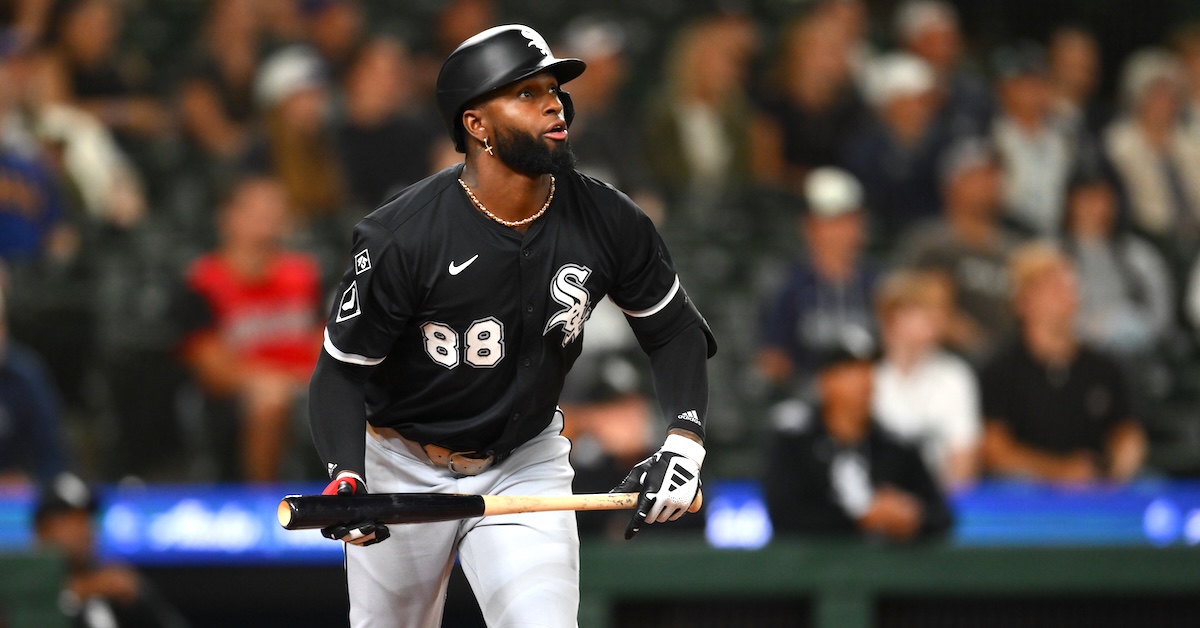
With most of the top free agents having found new homes – 12 of our top 15 have signed – the baseball transaction news figured to be light this week. Maybe the Yankees and Cody Bellinger would keep making lovey-dovey eyes at each other across the negotiating table to give us some headlines, but that felt like the only game in town for at least a few days. But just because no one is left to sign doesn’t mean nothing can happen. Out in Queens, the Mets weren’t content to sit pat after signing Bo Bichette. They continued their offseason splurge by acquiring Luis Robert Jr. from the White Sox in exchange for Luisangel Acuña and pitching prospect Truman Pauley, as ESPN’s Jeff Passan first reported.
I’ve grappled with evaluating Robert innumerable times over the past few years. For a while, he was a yearly feature in our Trade Value series, an electric talent in his early 20s. Then he became an interesting litmus test when talking to team evaluators, as his production dipped but his prodigious tools remained as loud as ever. Finally, as his contract hit the expensive team option phase, I considered him for a list of top free agents, as I have to predict what option decisions teams will make. At every turn, I came away equally impressed and frustrated by Robert’s ludicrous ceiling and subbasement-level floor.
You want a tooled-up center fielder? Robert is your guy. If you click on the “Prospects Report” tab on his player page, you’ll see this short blurb by Eric Longenhagen: “Graduation TLDR: The Vitruvian Outfield Prospect in all facets save for his approach, Robert graduated from prospectdom as one of baseball’s most exciting players.” That Vitruvian Outfield Prospect phrase has stuck with me.
If you made an outfielder in a lab, he’d look a lot like this. Power? Robert has 90th-percentile bat speed and clobbered 38 home runs in his last full season of playing time. He gets the ball in the air, too, all the better to maximize his best contact. Speed? You guessed it, 90th-percentile sprint speed. He’s also among the best defensive outfielders in the game when he’s healthy. He even has a strong throwing arm, though it’s inaccurate at times. If you’re looking for a Gold Glove defender who can hit 40 homers at the hardest outfield spot and swipe 30 bags, he’s one of maybe three players in the entire majors who fits the bill.
I just described an MVP candidate to you. Indeed, he finished 12th in MVP voting in his incandescent 2023 season, even while the White Sox went 61-101. But that’s his aforementioned ceiling – 4.9 WAR in 145 games on the back of a 129 wRC+. His floor? Across his next 210 games and two seasons, he’s produced 1.9 WAR and an 84 wRC+. Forget an MVP candidate; that’s a fourth outfielder or a defensive specialist.
Therein lies the rub with Robert. There’s only one clear hole in his offensive game. The problem is that it’s the most important thing there is: plate discipline. Robert has rarely seen a pitch he doesn’t like. In 2025, he chased more often than 80% of major leaguers. That was the best mark of his career. His enormous, looping swing also brings a ton of swing-and-miss. He whiffed more often than 91% of major leaguers, roughly in line with his career rate. Robert wants to put the ball in the stands, but it ends up in the catcher’s mitt quite a lot when he’s not right.
Fine, fine, it ends up in the catcher’s mitt a lot even when he is right. But the trade-off can work – that transcendent 2023 season came with a 29% strikeout rate and a mere 5% walk rate. And there’s room for optimism on that front, too. Pitchers quite reasonably have no interest in coming near the strike zone when Robert is at the plate. Merely by reducing his chase rate from obscene to bad, he posted a career-high 9.3% walk rate in 2025. We might be projecting him as a roughly average bat, but it’s one of those cases where a bunch of 30s and a bunch of 70s average out to 50. It’s not hard to imagine Robert returning to elite form, and likewise not that hard to imagine him continuing his descent into poor hitting.
If there’s one thing the Mets need to fix, it’s that Robert’s best contact hasn’t been elevated of late. He still hits the ball plenty hard; in fact, he’s posted better average exit velocities than his superlative ‘23 campaign in each of the last two years. But that’s not translating to homers like it did in the past. In a picture, here’s why:
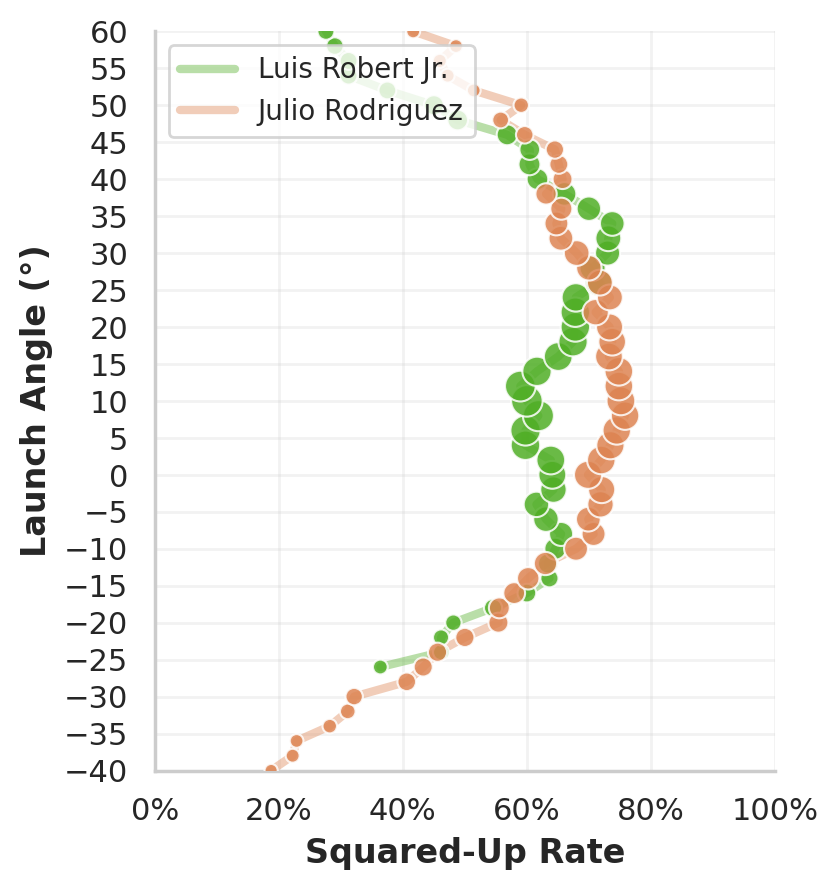
This little tool I’ve been working on isn’t ready for primetime yet, but I think it’s a great way of explaining what’s happening here. The x-axis is the percentage of batted balls at a given launch angle that are squared up – hit right on the nose, at 80% or more of their theoretical maximum speed given how fast the bat and the ball are traveling. The size of the circles represents how often the hitter hits a ball at that particular launch angle. Like his fellow powerful center fielder Julio Rodríguez, Robert squares the ball up somewhere between 60% and 80% of the time when he’s not hitting it straight into the ground or straight into the air. But he hits a ton of balls at unthreatening angles, from -5 to 15 degrees, and he’s not even squaring those up all that well. His purest contact is in a great home run band, 30 to 35 degrees, but he very rarely reaches those heights. In fact, he squares up fly balls less frequently than Rodríguez does despite hitting them more often. In other words, his swing isn’t doing the thing you’d want it to do — hit the ball hard in the air — even though he often hits the ball hard, and also often hits the ball in the air. It’s mismatched.
Can the Mets turn Robert’s offensive game around? Much as I like to stay away from this assessment, I think a lot of it depends on Robert’s mindset. It’s not hard to imagine getting into the occasional bad habit on the woeful White Sox, particularly with trade rumors swirling around you nonstop. A swing-first approach makes bad habits sting more; when you swing a lot, you’re engaging the pitcher on their terms instead of yours, which means that if you have a weakness, they can go after it. Combine that with a string of injuries, and you get the last two years of Robert.
It’s equally possible that he just needs a fresh start, a new voice as a hitting coach, different teammates to bounce ideas off of in the dugout. Or, maybe it’s not a mindset or approach thing; maybe he just can’t adjust, try as he might. That happens, too. Sometimes guys hit a peak and then decline away from it through no fault of their own. Baseball’s tough. The other guy also lives in a big house. It’s not a failing of character to have two down seasons. But it’s inarguably the case that something needed to change with Robert, and this trade certainly qualifies as something.
At a $22 million salary, that’s a bit of a gamble for the Mets. But the high-end outcomes Robert offers are more or less inaccessible to add in trade, or even in free agency most years. He even has a team option for 2027 ($20 million, but $2 million of that is a buyout that I’ve counted in 2026 salary), so if he bounces back to a facsimile of his 2023 form, it isn’t out of the question that he could stick around for a second campaign, a contract extension, or both. He fits New York’s roster so well that even a so-so season would be acceptable. The Mets have no other center fielders who are anywhere near Robert’s caliber, and his fielding prowess should help compensate some for the expected defensive problems from their corner outfielders. Sure, the money might be more than you’d expect to pay someone with Robert’s recent performance, but if you ignore that, he’s a great match for the Mets. Steve Cohen is a very good owner to have if you’re looking to ignore someone’s salary.
That salary helps explain Chicago’s return in this deal. Acuña is best known for having a famous brother, and second-best known for being swapped for Max Scherzer in the great Mets pitcher teardown of 2023. He reached the majors in 2024 and then caught on as a utility infielder in ‘25, racking up nearly 200 plate appearances in 95 games. Can he hit? Eh, not really: He’s been a below-average hitter in the minors each of the last two years, and of course a below-average hitter in the majors as well, with a career 83 wRC+.
He does offer blazing speed and defensive versatility, which makes his floor pleasingly high. At 5-foot-8 and with bottom-tier bat speed, he’s never going to post gaudy power numbers, and he’s too aggressive at the plate to be an on-base machine, but he puts the ball in play, adds value on the bases, and can play a ton of positions at least passingly well. He even made a cameo in center field last year, and the Sox will probably give him plenty of run out there to see how he takes to it. Lots of good teams have players like Acuña; most of those clubs do not give up much of note to acquire them. Given that he’s only 23 and still has less than a year of service time to his name, the White Sox will have a long time to see if he can develop into something more, but for all the name recognition, his actual ability is not all that intriguing.
Truman Pauley isn’t exactly your average headliner, either. A 12th-round pick in the 2025 draft, he’s thrown only 4 1/3 innings in professional baseball. Here’s Eric Longenhagen on the second-most-notable Harvard prospect traded in the past week:
Pauley was a draft-eligible sophomore at Harvard who added two ticks to his fastball (sitting 93 now) in 2025 but struggled with walks in his first year as a starter. His stuff has interesting characteristics; his fastball averages 19 inches of induced vertical break, and his slider spins at nearly 2,800 rpm. Pauley added a cutter after the draft and committed to its use. He threw it more than any of his other offerings and had strike-throwing success with it in a small post-draft sample. That pitch has tight, late movement in the 88-92 mph range while Pauley’s slider is more 82-85 mph. It looked like he was experimenting with a splitter late, too. Though Pauley lacks any kind of starter-quality strike-throwing track record, his repertoire improved enough after the draft to justify development as a starter in his first full pro season and beyond. He’ll enter the White Sox list as a 35+ FV prospect, more an “arrow up” flier who has improved quite a bit in the last 12 months.
It’s pretty easy to understand what’s going on here on the White Sox side. Robert’s contract is at least arguably underwater. That’s why I considered him for this year’s free agent list; I wasn’t confident that the White Sox would be willing to pay him north of $20 million, about a quarter of their entire payroll, with absolutely no hope of competing and not much chance of a big trade return. They did pick up his option, but I stand by my evaluation: This deal implies that Robert’s on-field value was not meaningfully more exciting to teams than his salary was onerous.
What’s less clear is how we got here. Robert would have been a prize acquisition at multiple points in the past. The Sox have been open to trading him, and he’s reportedly been on the trade block ahead of a few deadlines and during a few hot stove seasons. But they kept holding out for a premium return, a “this team is desperate and needs Luis” return, as is their prerogative. As his production started to decline, it’s understandable that the Chicago brass was slow to lower its asking price. After all, look at that 2023 season! But while the Sox held out for 110% of X, where X was Robert’s current perceived value, X declined rapidly.
This is an easy concept to understand intuitively. I guarantee that you’ve done something similar in your life before. As a former markets guy, it feels to me like hanging on to a stock too long even as it keeps going down. When it’s at 80, you want 85 for it. When it’s at 60, you want 65. Pretty soon, it’s at 20 and you’re wondering if someone will pay you 18. Some of the rumored returns for Robert would dwarf what the Sox ultimately got for him, but they were playing a game of chicken with their potential trade suitors, and they lost.
That’s a bummer, but look at it this way: 18 is more than zero. The bad decisions of the past don’t affect the optimal strategy in the present. The Sox had to trade Robert, and they weren’t going to get much for him. They did that! Good work. Sure, a utilityman and a lottery ticket pitching prospect isn’t exactly a bounty, but it was that or nothing. I also don’t put a lot of credence into the idea of the Sox paying down Robert’s salary to get a bigger return; he’d still be a rental, and teams just don’t pay much for rental bats these days.
Mets fans will probably look at this trade in the context of their team’s not signing Kyle Tucker. White Sox fans will probably look at this trade in the context of their team’s not trading Robert in the past. Neither fan base is wrong, exactly. But neither is living in the present, either. Nobody’s perfect, and every front office has decisions and past turning points that it regrets. But where we’re standing now, this trade makes a ton of sense for both sides.
Ben is a writer at FanGraphs. He can be found on Bluesky @benclemens.
Robert and Acuna have virtually an identical wRC+ the past two seasons: 84 and 83.
Acuna had a week of at bats in 2024 where he killed it come on dude!
Right, but the only way Acuna would ever put a 129 wRC+ would be if you let his brother take some of his at-bats.
Unfortunately his brother isn’t on the field enough to take his own at bats most nights lol
Peep his wRC+ two days ago in Venezuela:)
One man’s ceiling is another man’s floor, at least if they live in the same apartment building.
Acuna is out of options, and being generous, was maybe like 8th on the Mets 2B/SS/3B depth chart.
Tyrone Taylor in 2024-2025: .235/.289/.361; .302 xwOBA; 84 wRC+; 8 FRV in 1,056 CF innings; 1.8 WAR
Luis Robert Jr. in 2024-2025: .223/.288/.372; .302 xwOBA;
84 wRC+; 7 FRV in 1,693 CF innings; 1.8 WAR
I’ll take Robert’s upside and celebtrate Tyrone Taylor as our (hopefully!) fourth outfielder.
true, but very different ceiling obviously