
Mike Trout Goes for a Walk
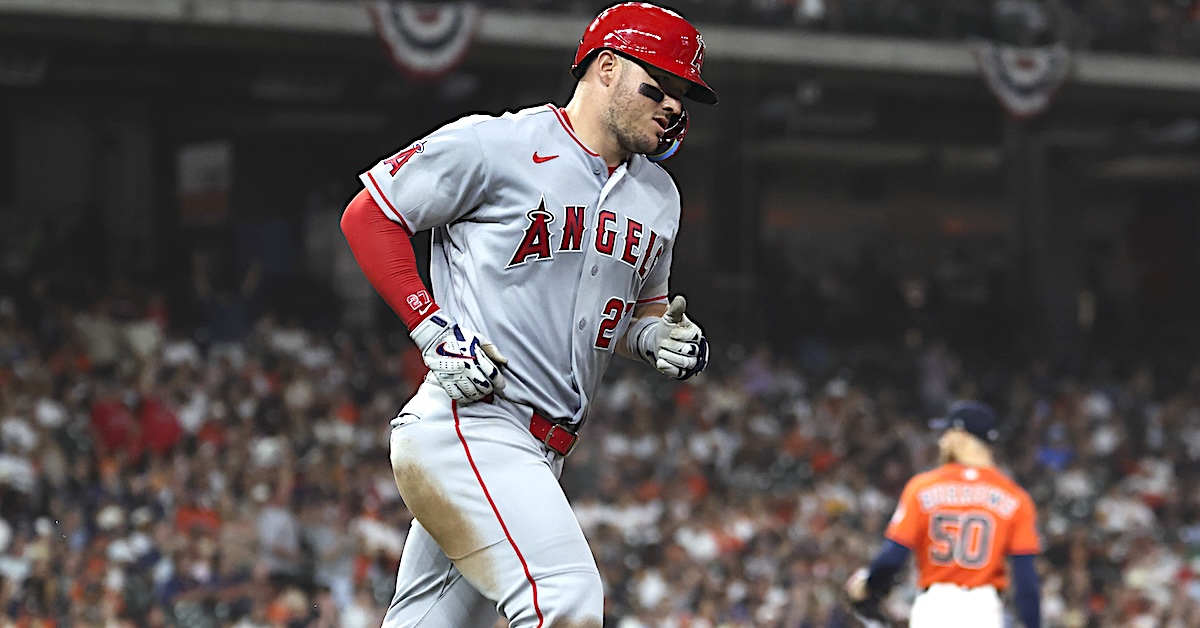
Let me tell you a story about a 34-year-old baseball player. Seven games into the new season, there are some worrying signs about his performance. His swing speed is down half a tick, and two full ticks from 2024. His fast-swing rate has declined precipitously. He’s squaring the ball up less frequently than ever, the opposite of what’s supposed to happen when you rein in your swing. He’s never run a lower hard-hit rate. He’s never run a higher infield fly ball rate. Somebody call an ambulance.
… But not for him. The hitter in question is Mike Trout, and he’s off to a scorching start. He’s slashing an absurd .261/.485/.522, good for a 192 wRC+. Whenever process statistics and result statistics diverge this much, this early in the season, I’m tempted to yell “April” in my best Dan Szymborski voice and move on. But when it’s Trout, one of the best players of all time, I’m willing to be more open-minded. Let’s take a quick peek into what’s changed, what hasn’t, and what’s too early to tell.
The most obvious change in Trout’s statistics this year is that he’s walking 30% of the time. Walks have always been a part of Trout’s game, of course. He has a keen eye at the plate, annually notching one of the lowest chase rates in the game, and he makes enough contact that he can grind his way back into at-bats even after falling behind. But 30% is double his career rate. What gives?
Trout hasn’t changed the way he starts at-bats that much. On the first pitch, he’ll swing if you make him, but he wants to either drive a pitch he’s hunting or take a pitch he wasn’t expecting. It’s a great plan if you have a good eye for balls and strikes, and he does. There’s not much to see here. Pitchers are starting Trout off with strikes half the time, right in line with league average and what they’ve generally done against him, and he’s swinging as often, and with as much malicious intent, as ever.
When he falls behind, Trout has always been an adaptive hitter. He expands the zone, but not recklessly so. I like to explain this by looking at swing rate in the chase zone, the area off the plate by enough that there’s no question of a called strike, but close enough that the pitches that end up there often start out tempting enough to draw a swing. Trout swings around 20% of the time – 18% this year – at chase pitches when down in the count. The league swings at around 30% of them. This means that he gets back into counts quite frequently.
The real bonanza comes when Trout gets even or ahead. When he’s on the defensive, he applies his keen batting eye to work his way back to even. When he’s attacking, though, he adeptly tunes out everything except the pitch he’s looking to drive. If you’re trying to beat Trout when he’s ahead in the count, you’ll pretty much have to do it in the strike zone, because he’s just not going to expand. He hasn’t swung at a single pitch in the chase or waste (even farther outside than chase) zones this year when he’s ahead in the count. He’s only swung at three when he’s even. To him, those pitches might as well not exist.
The takeaway here is: Don’t try to make Trout chase when you don’t have count leverage. But pitchers aren’t taking that lesson so far. More than 30% of the pitches he’s seen when he’s even or ahead have been in the chase or waste zones. That’s an outrageous number, and would be one of the highest rates in the league over a full season. That’s how pitchers deal with super aggressive hitters like Bryce Harper (35% chase rate in 2025), Nick Castellanos (41%), or Jhonkensy Noel (49%). Trout chases 20% of the time! He’s nothing like those guys. The result is a ton of pitches that have been very easy for him to pass on.
Pitchers really don’t want to get into this situation against Trout. One of two things is going to happen. First, they might throw Trout the pitch he’s looking for and watch him clobber it. Sure, he doesn’t swing quite as hard as he did at his best, but he still does a ton of damage. His EV90, the exit velocity of his 90th-percentile batted ball, remains among the best in the league. He’s spectacular at elevating his hard contact; if he hits it flush, it’s often leaving the yard, as evidenced by his 20% barrel rate. He’s Mike Freaking Trout. You know he can slug.
Second, you might walk him. It’s rational to fear throwing Trout a gimme. Half the pitchers he faces grew up seeing him terrorize the pitchers they idolized as kids. The Angels were one of the worst offenses in baseball last year. They project to be one of the worst offenses in baseball again this year. Why not try and strike the guy out with some sliders in the dirt, and then move on to dealing with his less-gifted compatriots if he doesn’t bite?
That’s not actually a good way to think. Free baserunners make everyone batting after Trout better. But he’s walking 44% of the time after getting ahead 1-0 so far this year, 56% after getting ahead 2-0. There’s just no way to successfully pitch to Trout – or anyone, really – if you’re walking him half the time that you fall behind in the count against him.
Believe it or not, Trout hasn’t yet managed to record a hit after getting ahead 1-0. He’s batting .000/.438/.000 after that count, and .000/.556/.000 after getting ahead 2-0. I don’t even really know how to analyze those lines. They don’t look like baseball. But what is he supposed to do, not take these walks? They’ve been presented to him on a silver platter.
The challenge system might actually be helping Trout walk even more. His weakness has long been fastballs at the top of the strike zone. That’s so well-known that Effectively Wild made a t-shirt about it. So what has Trout challenged so far? Four high fastballs. He’s overturned three of them into balls. Now that pitchers can’t get as many called strikes if they aim for Trout’s weakness, the puzzle gets even harder to solve.
Perhaps the funniest part of all of these statistics, to me, is that Trout has done all of his extra-base damage in 0-1 counts. Throw him a mediocre sinker on the inner edge? He’ll pull his hands in and send it into orbit:

Throw him a worse sinker, with more of the plate and not enough elevation? Well, yeah:

The best way to explain Trout’s hot start, at least for now, is that he’s scrambled the minds of the pitchers he’s facing. Those two sinkers? They came in the first two games of the season, in pitcher’s counts, and announced to the league that Trout is still a force. Ever since then, teams have treated him with kid gloves. But they’ve done so to far too great an extent, and now they’re just walking him half the time.
I’m not sure where this equilibrium is going to settle in. Trout’s discipline means that his stats are largely determined by how he’s pitched; if the opposing team doesn’t challenge him in the zone, he’ll continue to take pitches and walk. If they decide that attacking the zone is the order of the day, he’ll strike out more – he’s striking out a quarter of the time even while teams are avoiding him – but he’ll also hit for a lot of power. Trout’s two greatest skills – waiting for a pitch to hit, and then hitting it – have both been on display this year. They’ve just been on display at different times, because right now, pitchers want no part of him.
Ben is a writer at FanGraphs. He can be found on Bluesky @benclemens.
Mike Trout is good at baseball