
Mike Trout Goes for a Walk
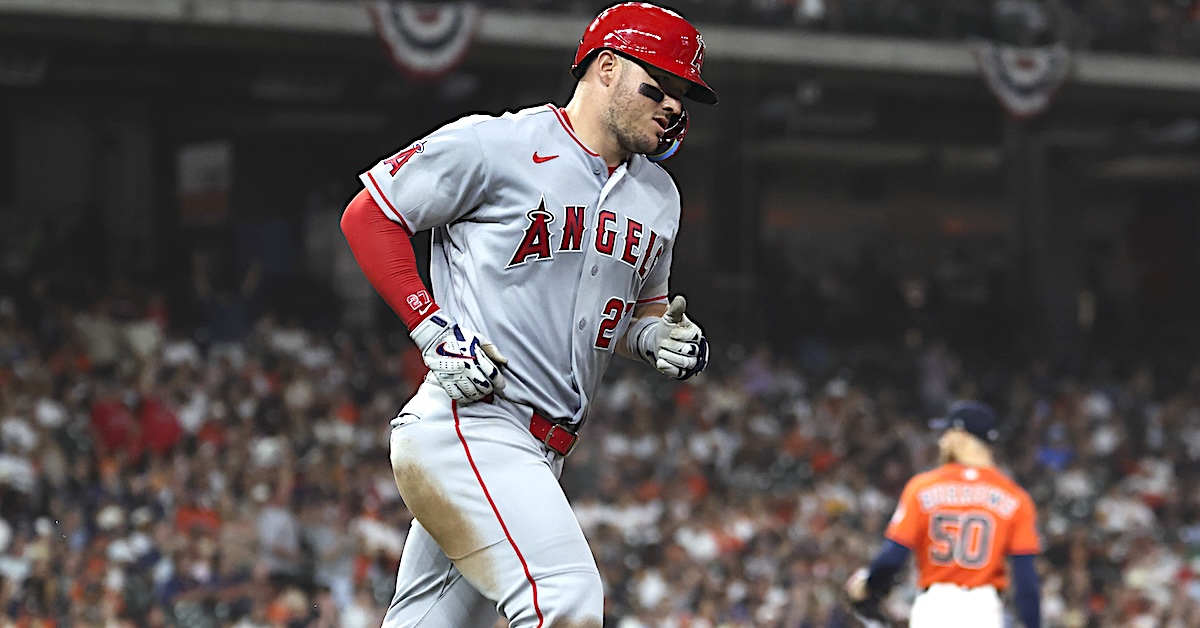
Let me tell you a story about a 34-year-old baseball player. Seven games into the new season, there are some worrying signs about his performance. His swing speed is down half a tick, and two full ticks from 2024. His fast-swing rate has declined precipitously. He’s squaring the ball up less frequently than ever, the opposite of what’s supposed to happen when you rein in your swing. He’s never run a lower hard-hit rate. He’s never run a higher infield fly ball rate. Somebody call an ambulance.
… But not for him. The hitter in question is Mike Trout, and he’s off to a scorching start. He’s slashing an absurd .261/.485/.522, good for a 192 wRC+. Whenever process statistics and result statistics diverge this much, this early in the season, I’m tempted to yell “April” in my best Dan Szymborski voice and move on. But when it’s Trout, one of the best players of all time, I’m willing to be more open-minded. Let’s take a quick peek into what’s changed, what hasn’t, and what’s too early to tell.
The most obvious change in Trout’s statistics this year is that he’s walking 30% of the time. Walks have always been a part of Trout’s game, of course. He has a keen eye at the plate, annually notching one of the lowest chase rates in the game, and he makes enough contact that he can grind his way back into at-bats even after falling behind. But 30% is double his career rate. What gives?
Trout hasn’t changed the way he starts at-bats that much. On the first pitch, he’ll swing if you make him, but he wants to either drive a pitch he’s hunting or take a pitch he wasn’t expecting. It’s a great plan if you have a good eye for balls and strikes, and he does. There’s not much to see here. Pitchers are starting Trout off with strikes half the time, right in line with league average and what they’ve generally done against him, and he’s swinging as often, and with as much malicious intent, as ever.
When he falls behind, Trout has always been an adaptive hitter. He expands the zone, but not recklessly so. I like to explain this by looking at swing rate in the chase zone, the area off the plate by enough that there’s no question of a called strike, but close enough that the pitches that end up there often start out tempting enough to draw a swing. Trout swings around 20% of the time – 18% this year – at chase pitches when down in the count. The league swings at around 30% of them. This means that he gets back into counts quite frequently.
The real bonanza comes when Trout gets even or ahead. When he’s on the defensive, he applies his keen batting eye to work his way back to even. When he’s attacking, though, he adeptly tunes out everything except the pitch he’s looking to drive. If you’re trying to beat Trout when he’s ahead in the count, you’ll pretty much have to do it in the strike zone, because he’s just not going to expand. He hasn’t swung at a single pitch in the chase or waste (even farther outside than chase) zones this year when he’s ahead in the count. He’s only swung at three when he’s even. To him, those pitches might as well not exist.
The takeaway here is: Don’t try to make Trout chase when you don’t have count leverage. But pitchers aren’t taking that lesson so far. More than 30% of the pitches he’s seen when he’s even or ahead have been in the chase or waste zones. That’s an outrageous number, and would be one of the highest rates in the league over a full season. That’s how pitchers deal with super aggressive hitters like Bryce Harper (35% chase rate in 2025), Nick Castellanos (41%), or Jhonkensy Noel (49%). Trout chases 20% of the time! He’s nothing like those guys. The result is a ton of pitches that have been very easy for him to pass on.
Pitchers really don’t want to get into this situation against Trout. One of two things is going to happen. First, they might throw Trout the pitch he’s looking for and watch him clobber it. Sure, he doesn’t swing quite as hard as he did at his best, but he still does a ton of damage. His EV90, the exit velocity of his 90th-percentile batted ball, remains among the best in the league. He’s spectacular at elevating his hard contact; if he hits it flush, it’s often leaving the yard, as evidenced by his 20% barrel rate. He’s Mike Freaking Trout. You know he can slug.
Second, you might walk him. It’s rational to fear throwing Trout a gimme. Half the pitchers he faces grew up seeing him terrorize the pitchers they idolized as kids. The Angels were one of the worst offenses in baseball last year. They project to be one of the worst offenses in baseball again this year. Why not try and strike the guy out with some sliders in the dirt, and then move on to dealing with his less-gifted compatriots if he doesn’t bite?
That’s not actually a good way to think. Free baserunners make everyone batting after Trout better. But he’s walking 44% of the time after getting ahead 1-0 so far this year, 56% after getting ahead 2-0. There’s just no way to successfully pitch to Trout – or anyone, really – if you’re walking him half the time that you fall behind in the count against him.
Believe it or not, Trout hasn’t yet managed to record a hit after getting ahead 1-0. He’s batting .000/.438/.000 after that count, and .000/.556/.000 after getting ahead 2-0. I don’t even really know how to analyze those lines. They don’t look like baseball. But what is he supposed to do, not take these walks? They’ve been presented to him on a silver platter.
The challenge system might actually be helping Trout walk even more. His weakness has long been fastballs at the top of the strike zone. That’s so well-known that Effectively Wild made a t-shirt about it. So what has Trout challenged so far? Four high fastballs. He’s overturned three of them into balls. Now that pitchers can’t get as many called strikes if they aim for Trout’s weakness, the puzzle gets even harder to solve.
Perhaps the funniest part of all of these statistics, to me, is that Trout has done all of his extra-base damage in 0-1 counts. Throw him a mediocre sinker on the inner edge? He’ll pull his hands in and send it into orbit:

Throw him a worse sinker, with more of the plate and not enough elevation? Well, yeah:

The best way to explain Trout’s hot start, at least for now, is that he’s scrambled the minds of the pitchers he’s facing. Those two sinkers? They came in the first two games of the season, in pitcher’s counts, and announced to the league that Trout is still a force. Ever since then, teams have treated him with kid gloves. But they’ve done so to far too great an extent, and now they’re just walking him half the time.
I’m not sure where this equilibrium is going to settle in. Trout’s discipline means that his stats are largely determined by how he’s pitched; if the opposing team doesn’t challenge him in the zone, he’ll continue to take pitches and walk. If they decide that attacking the zone is the order of the day, he’ll strike out more – he’s striking out a quarter of the time even while teams are avoiding him – but he’ll also hit for a lot of power. Trout’s two greatest skills – waiting for a pitch to hit, and then hitting it – have both been on display this year. They’ve just been on display at different times, because right now, pitchers want no part of him.
Ben is a writer at FanGraphs. He can be found on Bluesky @benclemens.
Mike Trout is good at baseball
Eventually pitchers will figure out a way to deal with this, but I kind of hope he sticks with his refusal to expand his target for swinging anyway. We haven’t had this kind of really extreme walk-strikeout levels outside of the steroid era. I’d like to see if we can figure out what the maximum number of combined walks and strikeouts you can get in a season.
The last person to walk anything like this was Bonds, and a lot of that was intentional. That’s kind of different. Going back even further we haven’t had anyone with a walk rate of 25% or higher since Ted Williams in 1954. And he didn’t really strike out.
Do we think that someone could get to 350 combined walks and strikeouts in a year? Obviously something close to half of those would have to be walks, or you would have to hit for an obscene amount of power along with it. Otherwise you just wouldn’t get enough playing time to get there. The highest I could find was 2023 Kyle Schwarber, who combined for 341 walks + strikeouts. And his BB% was only 17.5%. Trout’s at 30%.
Looking at league-adjusted measurements, it looks like a walk rate of about 22% translates to a BB%+ of 260 in 2025, and 25% is about 300.
And it looks like Trout’s strikeout rate is about 10-15% above league average from 2025, but that would go up. About a K%+ of 110-115, let’s say it goes up to being a higher than his walk rate–maybe about 25% walk rate, about a 30% strikeout rate. That’s about a 130 K%+.
There are some examples of this in the not too distant past, especially with the elevated strikeout rate. But we still don’t have any examples of a BB%+ higher anywhere close 300 except Bonds. The closest is Jack Clark, who had a 269 BB%+ and 147 K%+ in 1990, and also had a huge number in 1987. Gene Tenace was at 264 and 125. Joey Votto did this but he didn’t really strike out.
Even Jack Cust–who walked and struck out at an absurd rate–was only at 242 BB%+ (although with 194 K%+).
This is far beyond what we have seen recently. And if he were to do it, Trout would have a combined BB%+K% of 55%. He would need something like 640 PAs in order to get to 350 combined walks and strikeouts at that level.
What this is telling me is that (1) if Trout can sustain this long-term than we’ve come up with a new theoretical maximum of walks + strikeouts, but also (2) he’s never going to get there himself since the last time he had 640 PAs in a year was (takes deep breath) 2016.
That last paragraph made me sad.
the world feels better when trout is good. please baseball gods do whatever you want to the angels, but let trout regain form
When the Angels literally start growing horns and tails and start to resemble devils rather than angels, you’re going to wish you could take that one back
eh. worth it
I do want Judge to pass Trout…AFTER Trout cracks 100 WAR!
Excellent and insightful column. But also – please tell me this doesn’t mean the death of your five things Friday column – it was one of the true joys of my week!
Don’t worry, Five Things just took a while to get stretched out this spring, and so it’s on a slightly delayed start. FanGraphs expects its season debut next Friday (I spent a little too much time this week digging through challenge databases and not enough time watching baseball)
Thanks Ben. Always appreciate your work, and can’t wait! Wahoowa
Lindor becoming a walk machine early in the season is surprising he has one less walk than Trout and as a leadoff hitter and the Mets still can’t score! Back to Trout it is wonderful to see Trout looking like himself as his 30’s hasn’t been kind to him health wise. I’d love to see him have a second straight healthy season as baseball is better when he’s healthy.
I wonder if the challenge system is somewhat changing his approach. With that said, he has always had a smaller zone than other hitters it seems (gets a higher % of strikes called balls at the top of the zone than any other hitter) .
A Fangraphs Mike Trout article. Things are as they should be.
Fingers crossed
Analytics is fun but can they quantify soft factors, like reputation?
Short answer, yes.
It’s terrific that Trout is being so productive, but this high walk rate may prove to be a sign that he is about to enter a precipitous decline. This is Rich Lederer quoting Bill James in Lederer’s Baseball Abstract summaries on Baseball Analyst: Toby Harrah: “I have a theory that when an older player’s walks total suddenly shoots upward, his batting average will decline the next year by at least 20 points–as, for example, Gary Matthews a year ago, or Willie Mays in 1971. One of the reasons that walk totals explode like this is that it is a case of a veteran hitter compensating for slowing reflexes by trying to work the count in his favor. That only works for so long; then the pitchers will start making the hitter hit good pitches. We’ll see what happens.” Lederer Comment: Well, I checked and, sure enough, ol’ Bill hit the nail squarely on the head once again. After hitting .270 and walking a career-high 113 times in 1985, Harrah’s batting average fell to .218 in 1986 with no change in team or home ballpark. He was granted free agency that November and never hooked on with another team again.
A Dead Bat Bounce, if you will.