
My 2025 National League Rookie of the Year Ballot
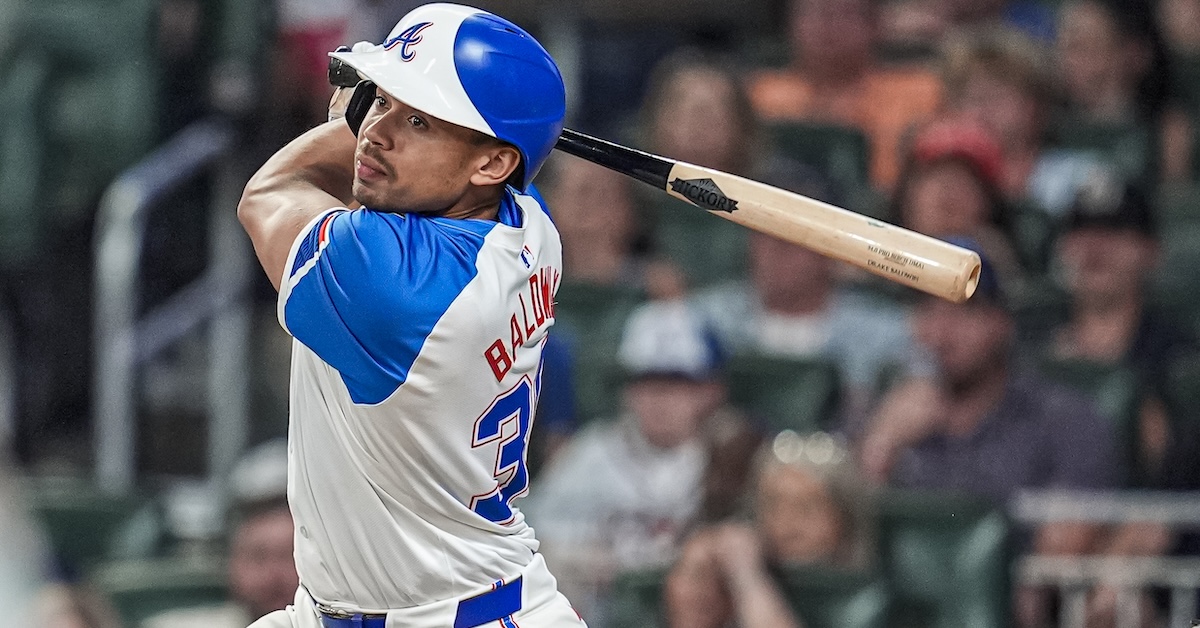
Just in time to push back the withdrawal symptoms from the lack of baseball, it’s awards week! We started, as usual, with the Rookie of the Year awards, and in the National League, Drake Baldwin earned the hardware, finishing with 21 first-place votes to Cade Horton’s total of nine. Baldwin was the only candidate to appear on all 30 ballots. Horton finished second, followed by Caleb Durbin, Isaac Collins, and Daylen Lile.
Did the BBWAA members entrusted with this task make good picks? That’s for you to decide. I’m here for my usual task of explaining/justifying/defending how I voted in my award this year, the NL Rookie of the Year award. I like to think I do a pretty good job, but I personally feel my responsibility for addressing my vote ought to go beyond the confidence I may have in my own competence. This is ostensibly an expert panel, not a federal election, so a vote here isn’t a question of my right to have one but my duty to exercise it thoroughly. People in the baseball community, from the most casual fans to the players themselves, ought to know why I voted for someone and not others. This is especially true when many disagree with me, such as my past first-place votes for Jackson Merrill last year and Trevor Rogers in 2021.
As a reminder, I don’t simply rank players by WAR and then call it a day. There are a lot of subtleties in WAR, with different philosophies involved in some of the thornier questions in different WAR estimates, and significant things that are sometimes not captured perfectly by what is our best estimate of value. There’s a reason that we don’t consider a player with 2.8 WAR to be meaningfully different in terms of value generated from a player with 2.5 WAR. As with any tool, using it well also entails knowing when a tool is not fit for the task at hand. An axe is good at chopping stuff, but it’s not so good for cutting your steak or trimming your toenail (that is not why I only have feeling in 9 1/2 toes).
As usual, I started with the numbers. How could I not? In baseball, a sport that largely consists of individual duels set within a team context, the numbers do a very good job of describing what happened, how it happened, and who should get the credit or blame for it. The WAR framework that we use is highly useful for giving us the basic lay of the land, but the differences between it and other versions of the stat don’t necessarily make a conclusion here obvious.
For first place, the numbers here are in agreement that Baldwin was the best rookie, or at least the most valuable rookie. I’ll get back to that in a bit. At 3.1 WAR, he holds the lead by a half-win over a trio of Brewers rookies; that’s a decent distance, but it’s also not so large a gap that I would automatically vote for Baldwin. So let’s look at some other numbers to see if there’s anything inflating Baldwin’s value here. He pasted the ball pretty well, with a wRC+ of 125, right around the career averages of both Contreras brothers. We have a high level of confidence when it comes to hitter offensive numbers, so I think his WAR is pretty solid here. Baldwin was third in the NL in offensive value (11.9), a run behind Collins (12.8) and three behind Lile (15.1), and that number is before positional adjustments, so the catcher “bonus” isn’t doing an unreasonable amount of work. There are no freaky framing numbers that may be one-year blips powering his defensive WAR either. So Baldwin was my first-place pick, and I’m very comfortable with it.
The rest of the ballot was trickier, in that there weren’t a whole bunch of standout candidates. Of last year’s rookie contenders, I’d confidently put all of Merrill, Paul Skenes, Jackson Chourio, Masyn Winn, and Shota Imanaga at the top of this year’s ballot, and I’d actually have to sit and think about whether Baldwin would come out ahead of all of Joey Ortiz, Yoshinobu Yamamoto, Spencer Schwellenbach, and Jacob Young.
So with a lot of good candidates that weren’t All-Star level, my question for second place was who actually played the best? It’s a bit like a miniature version of the Don Sutton/Sandy Koufax comparison. Sutton certainly had the more valuable career in terms of total wins he created for his team, but if you ask basically anyone which pitcher was better, I believe nearly everyone would say Koufax. Jakob Marsee didn’t play the whole year, but he was excellent when he did play. He ranked fourth in offensive value (11.4) among NL rookies, and he produced at that level despite getting barely half the playing time of Baldwin and Collins. He also played a solid center field for the Marlins. A 133 wRC+ from a center fielder is impressive, even in a partial season, and the stolen bases (14) were a nice bonus. I believe in treating awards more about greatness than value, so like Hall of Fame arguments, I’m more prone to looking at measures relative to average rather than replacement. So Marsee was my number two.
For third place, I went with Horton. He pitched only a partial season in the majors, but he did a very good job at helping to stabilize a Cubs rotation that lost Justin Steele early. His 2.67 ERA was impressive, but ERA is frequently not the whole story. He was merely average at missing bats, and that ERA reflects a lot of help from an extremely skilled Cubs defense. He’s still figuring out how to punch out major leaguers. If he’d finished with a full slate of innings or featured just a bit more dominating a profile, I would’ve put Horton slightly over Marsee, instead of what I ended up doing. I’m pretty confident in who the second- and third-best NL rookies were in 2025, but the order of these two was one of my most difficult ballot decisions.
At this point, Brewers fans might be a little miffed at me, as all of Collins, Durbin, and Chad Patrick lost out on the first three places. Along with Lile, those were my four candidates for the final two spots on my ballot, and I basically saw all of them neck-and-neck in terms of suitability, so it had to come down to tiny things. Collins’ having much less defensive value than Durbin, and simply not hitting as well as Lile did (.299/.347/.498) basically tie-broke him out. Patrick lost out from the simple fact that he struggled a bit during the timeframe the Brewers were making their eventually successful move against the Cubs in the standings, to the extent that he was demoted for a while; when he came back, it was mostly in a swing-ish role. That left Durbin and Lile for the last two slots, but what would the order be? Ultimately, I gave Durbin the nod because he was the more well-rounded player.
Well, that’s my ballot for 2025, at least until my I vote for the Hall of Fame in another month. Am I 100% confident that this was the ideal ballot? Of course not, but I feel after my due diligence, this was the very best ballot I could put together based on my impression of events.
Dan Szymborski is a senior writer for FanGraphs and the developer of the ZiPS projection system. He was a writer for ESPN.com from 2010-2018, a regular guest on a number of radio shows and podcasts, and a voting BBWAA member. He also maintains a terrible Twitter account at @DSzymborski.
Thank you Dan. For what it’s worth, this Brewers fan is not miffed at you, as your reasoning is solid. Having three players even in the conversation is a testament to the pro scouting arm that keeps rolling — Durbin from the Williams trade, Patrick from the A’s, Collins as a Rule 5 (from the Rockies!).
Baldwin is from Wisconsin after all, so we’ll count it as a win.
Collins is the most inexplicable success but people (including maybe the Brewers decision makers themselves) are sleeping on Patrick. He had the same / slightly better xERA as Horton did as a starter in roughly the same number of innings. And Stuff+ likes his fastball and breaking balls.
Next year’s crop of rookie starters will be more exciting with Yesavage, Schlittler, Tolle, Burns, McLean, Tong, Early, maybe also Chandler. But if you asked me who was going to be the best starter out of this year’s group it would be a tough choice between Misiorowski, Patrick, and Horton.
Schlittler crossed 50 IP – he’s no longer rookie-eligible.
Whoops, thanks for the information. He and Misiorowski are the guys with the best stuff but are most likely to blow out their arms, while Patrick and Horton are a bit more stable.
Nice pull, detective
McLean got a downballot vote which made me wonder how many rookies have gotten votes in multiple years.
I doubt it happens all that often outside of 2020/2021 for obvious reasons. McLean hit the trifecta and also benefited from voting change to go from three to five spots for ROY. McLean was (a) spectacular, (b) barely missed the rookie cut-off, and (c) benefited from a lack of stellar rookie performances.
To some extent, (b) might not have been purely luck, though it seems crazy that a team in a playoff chase would worry about manipulated the service time rules in order to simply have a chance at a draft pick two years later. But, I think it’s likely that sort of thing is happening now and might happen more as everyone catches on.
https://www.mlb.com/news/players-to-receive-rookie-of-the-year-votes-in-2-years
Prior to 2021, only Gregg Jefferies had done this