
Observations From No. 1 UCLA’s Trip to New Jersey
I live in Mercer County, New Jersey, which has a lot going for it. If there’s a place on Earth with more great hoagie shops per capita, I’ve yet to encounter it. We’re the world capital of passive-aggressive bridge architecture, and it was here that George Washington gave the United States of America its first great Christmas gift: A big pile of dead Hessian mercenaries.
But a college baseball hotbed it is not. Rider and Penn are nearby, and both schools are frequent pesky no. 4 seeds in the NCAA Tournament. Which is fun, but it’s not too interesting to a national baseball writer who focuses primarily on the major leagues.
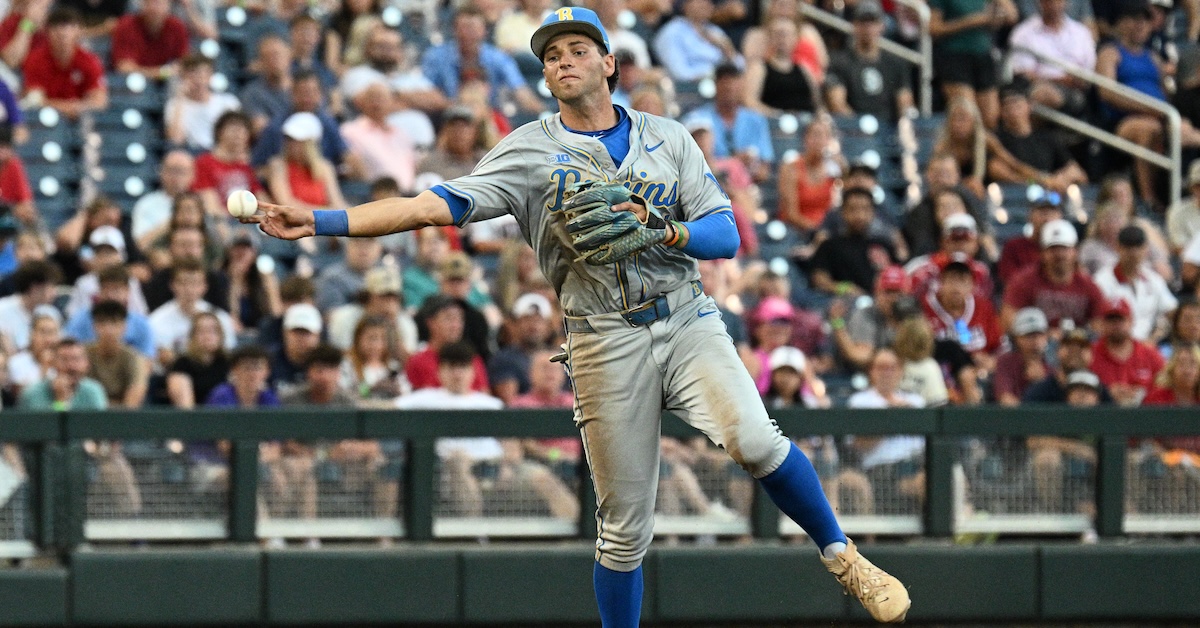
Last weekend was different. Several rounds of Big Ten expansion led to an unusual event: UCLA, the no. 1 team in the country, with presumptive no. 1 overall pick Roch Cholowsky in tow, was obliged to visit Rutgers. I’ve had this series circled on my calendar since last year, and here’s what I learned.
UCLA is in the midst of a monster winning streak. The Bruins swept the Scarlet Knights in Piscataway (apologies to anyone who was hoping to avoid spoilers), to bring their record to 33-2 overall and 18-0 in conference. Back in February, UCLA took a pair of one-run losses to UC-San Diego and San Diego State (which are different schools). They haven’t lost since: 27 games as of this writing, which ties the Big Ten Record set by Illinois in 2015.
The Big Ten is a fairly strong conference; Baseball America has UCLA and USC ranked in the top 10, while D1Baseball also has Oregon ranked and Nebraska just dropping out of the Top 25 after losing two of three in Eugene over the weekend. But the Big Ten is not the week-in, week-out grind of the SEC. UCLA swept its crosstown rivals and picked up midweek wins over Mississippi State and Texas A&M, both ranked. But Oregon doesn’t come to Pasadena until May, and Nebraska not at all. Much of this 27-game win streak has come against teams in the bottom half of the conference, including Rutgers.
Which is not to paint Rutgers as some tomato can; the Scarlet Knights have some good pitchers, as they showed in the Friday night game, an attritional 14-inning epic that I’ll get to in a second. For Cholowsky, this would be far from the hardest test of his season, but he was supposed to be the best player on the field.
In the two games I attended — Friday and Saturday — Cholowsky didn’t do too much. He went 1-for-8 with four walks and was hit by a pitch over those two games, and his lone base hit was an infield single.
When Cholowsky was coming out of high school, he was viewed as a talent worthy of attention in the late first or early second round based mostly on the exceptional promise of his glove. An Arizona native and the son of a big league scout, Cholowsky idolized fellow UCLA shortstop Brandon Crawford growing up, and you can tell. At 6-foot-2, 202 pounds, Cholowsky is more solid than rangy, and an average runner at best. But like Crawford, he has terrific hands and moves around the diamond efficiently. In the majors, he’ll be a very good defensive shortstop or, if he loses a grade of foot speed, perhaps a terrific defensive third baseman.
What vaulted Cholowsky into the conversation for no. 1 overall was a monster sophomore season in which he hit .353/.480/.710 with 23 home runs in 66 games and more walks than strikeouts. He’s an aggressive hitter with good strength and barrel control, and profiles as a good contact hitter with plenty of pull-side power from a wide-open stance, though probably not an elite on-base guy.
Not that he got a chance to show much of that against Rutgers, because the Scarlet Knights gave him absolute bupkis to hit, especially on Friday. You could probably deduce that by his four walks (one intentional) and that first-pitch HBP in two games.
There were a couple of rough moments. In my experience, any game that goes 11 innings or longer veers into “Please God, someone end this so we can all go home” territory, and everyone starts swinging from their heels. Cholowsky felt that, reaching for a 1-0 pitch that popped out tamely behind first in the 11th, and grounding into an inning-ending double play in the 13th.
Saturday was better; in addition to the infield hit in the first, Cholowsky made two outs that caused me to take note. One was a fourth-inning groundout off Rutgers starter Vincent Borghese. Borghese was mostly fastball-curveball (91-92 for the former, 78-80 for the latter), but he mixed in a cutter at 84-86 mph with about 12 inches less induced vertical break than the fastball and six inches more glove-side movement.
Cholowsky turned on the cutter and yanked it to third at 109 mph; a nice reaction by Rutgers third baseman Charlie Meglio turned it into a routine groundout, but it was only a couple feet from being a double down the line. In his last at-bat of the day, Cholowsky came within a few feet of hitting a pitch out to left center, even though it looked like he got jammed.
But even if the bat goes quiet, Cholowsky can still pick it. I was prepared for the first game to be a total bust for the country’s top prospect, as he only had one assist through nine innings for reasons I’ll get into shortly. But in the 13th, he pulled off a beautiful turn for an inning-ending 4-6-3 double play, bounding over a sliding Trey Wells to get the out at second by a hair, then making an acrobatic throw to first to complete the play by an equally thin margin.
So while I wish Cholowsky had given me more to write about offensively, it’s two games. The overall numbers are great and the glove looks terrific. This is one of the more thoroughly scouted prospects you’re ever going to see; I’m sure he’ll be fine.
The real star of the weekend was UCLA’s Friday night starter, Logan Reddemann. Cholowsky didn’t get to do much with his glove, but neither did most of his teammates; over 14 innings, Rutgers hitters struck out 30 times, missing the Division I single-game record by one.
There are two ways to score only one run over 13 innings, and I was lucky enough to witness both in a single game. UCLA produced 23 baserunners: 11 hits, six walks, six hit batters. (Rutgers Friday night starter Zack Konstantinovsky hadn’t plunked a single hitter in 35 1/3 innings before last weekend; he hit four on Friday, including three in one inning.) But 10 of those 11 hits were singles, and UCLA grounded into three double plays and left 17 runners on base.
Rutgers leadoff hitter Tristan Salinas started the home half of the first with a double. He advanced to third on a groundout, and scored on an RBI single by Meglio. No other Rutgers hitter reached second base all night.
Reddemann was mostly responsible. He threw eight innings, allowing no more hits after Meglio’s first-inning single, and struck out 18 of the 27 batters he faced, while walking just one. Of the six outs Reddemann’s fielders recorded, this diving full-extension grab by Payton Brennan bears watching:
SUPER PAYT??
?B1G+#GoBruins pic.twitter.com/LUjSYa87vA
— UCLA Baseball (@UCLABaseball) April 10, 2026
There isn’t any particular scouting value here; I just thought you’d want to see a cool play. Actually, this fifth-inning home run robbery by Rutgers right fielder Chase Krewson is even better:
ROBBED ??@RutgersBaseball’s Chase Krewson denies the homer to keep this game level ?
Subscribe/watch on B1G+ https://t.co/vshkVDWnUN pic.twitter.com/1Qm1z3IwUc
— Big Ten Baseball (@B1Gbaseball) April 10, 2026
Back to Reddemann. UCLA’s Friday night starter, a junior, wasn’t part of last year’s run to Omaha; he just transferred in this past winter from the University of San Diego. (Which is not either of the two San Diego schools that handed UCLA its two losses this year.) With the Bruins, he’s become a tremendously efficient out-getter.
Having an 18-strikeout, one-walk game will do predictable things to a pitcher’s overall stats, but Reddemann is now third in Division I with a K-BB% of 33.6%. He’s 16th in FIP, at 2.64. And both of those numbers need to be considered in a collegiate context; the league-wide ERA in the Big Ten is 5.29, and while there are usually around 50 qualified starters in the majors each year, in Division I there are currently almost 1,100.
Reddemann is not a big guy; UCLA has him listed at 6-foot-2, 200 pounds, and it looks like about 170 of those pounds rest between his waist and his knees. Given those proportions, Reddemann does exactly what you’d want from a pitcher: three-quarters arm angle, powerful leg push from a drop-and-drive delivery. The result is a fastball that sits in the upper 90s with strong two-plane carry. Here’s a representative example:
Redd strikes out the side ?
He matches his career-high with 10 strikeouts!
B1G+#GoBruins pic.twitter.com/WX6w2PX8WB
— UCLA Baseball (@UCLABaseball) April 10, 2026
Reddemann tunnels this pitch with a mid-80s changeup, while also throwing a slider and an occasional curveball. Against Rutgers, he pounded the top of the zone with the four-seamer, and there was simply no response. I counted 32 swings and misses out of 77 total strikes on 104 pitches for Reddemann. He hit 98 with his fastball and held 96-97 through his final inning.
Looking at Reddemann’s overall numbers (namely, his 3.8% walk rate), you can surmise he likes to throw strikes, and Rutgers isn’t really a lineup that’ll punishes that. The Scarlet Knights offense is middle-of-the-road in the Big Ten in terms of runs scored and batting average, but near the bottom in power. Their top hitter is center fielder Peyton Bonds (yes, of the San Francisco outfield Bondses), who’s hitting .358/.433/.547 in 33 games and posted an exit velo of 121 mph last week.
Bonds injured himself in pursuit of UCLA’s only extra-base hit on Friday night and didn’t play the rest of the weekend, but Reddemann got him to ground out three times. That does, however, make Bonds the only Rutgers hitter who didn’t strike out on Friday. And it did seem like Reddemann, and the three hard-throwing UCLA relievers who followed, were just throwing the ball past their opponents.
Saturday starter Michael Barnett also set a season high in strikeouts, using a goofy low-spin changeup to get seven punchouts in five innings. Sunday starter Landon Stump only struck out five in six innings, but he needed just 64 pitches to manage those six innings, and only one Rutgers batter reached.
Reddemann was unquestionably the weekend’s standout player, and he presents something of the inverse of the conundrum posed by Cholowsky’s quiet weekend. Reddemann’s performance on Friday, on the day, was as impressive an outing as I’d ever seen from a starter. After about six innings, I started looking up old box scores, trying to remember the most strikeouts I’d ever seen from one pitcher in one game. Then Reddemann came back out and struck out the last six batters he faced and generated 13 more whiffs. I know beyond a shadow of a doubt I’d never seen an 18-strikeout game in person before, at any level.
The command, velocity, physicality, and ability to work to his secondaries are all there for Reddemann. But to what extent was he dominant, and to what extent was Rutgers just not able to handle a pitcher this good? Can Reddemann get away with four-seamers up in the College World Series? In the minors? If not, does his low approach angle lend itself to a more diverse fastball approach?
Those are the next questions, and the fact that I’m even asking is quite a compliment. For most pitchers, I’d still be wondering if he could strikeout 18 batters in a start. We now know for sure that Reddemann can.
Michael is a writer at FanGraphs. Previously, he was a staff writer at The Ringer and D1Baseball, and his work has appeared at Grantland, Baseball Prospectus, The Atlantic, ESPN.com, and various ill-remembered Phillies blogs. Follow him on Twitter, if you must, @MichaelBaumann.
Roch is RHH, has played weak competition in the Big10 and has struggled with a wood bat. If I was the ChiSox I’d take Emerson. Further away but way higher ceiling.
The wood bat thing is the only thing that gives me pause.
Dude, but the optics of having a dude named ROCH CHOLOWSKY in Chicago are too tempting. Just slap a fake mustache and a bears sweater on him and give him four Kielbasas (Keilbasie? Kielbasii?) right now.
Not a bad South Side potential double play partner with ole Sammy Antonacci either.
Right handed hitter who struggled with a wood bat and who has weak in-conference competition…is this Roch Cholowsky or Kris Bryant you are talking about here?
Let us review the pros and cons for Roch Cholowsky:
Pros
Running a .336 / .464 / .679 slash line*, which is the third best batting line in the Big 10 Conference of players aged 20 or 21
Even better hitting the previous year
Potential gold glove defense at shortstop
Literally is the best player on the #1 team in the country
Cons
He didn’t play in the SEC or ACC
Only slashed .218 / .338 / .327 over 65 PAs when he was 19 years old
Bats right handed (?)
Grady Emerson ran a .333 / .464 / .571 slash line in HS last year.
That sounds pretty good, but it’s basically what Cholowsky did against college pitching, not high school. And his junior year in HS.
And if you want to see fireworks, take a look at what Cholowsky did in HS his senior year with him playing football in the baseball offseason.
Grady Emerson could definitely be better than Roch Cholowsky. because sometimes these HS guys blow up. But Cholowsky was an Emerson-level prospect coming out of HS. It’s not common that guys like this wind up at college, and he has developed about as well as expected.
As a side note, I went to look up every HS player on the draft page of the The Board who had a hit tool equal or greater to 50 but raw power equal to or less than 60. This is roughly in line with Emerson’s tool grades. These are the guys who were Top 10 on The Board and who were in the Top 10 that year between 2015 and 2021:
Brendan Rodgers
Trent Grisham
Mickey Moniak
Delvin Perez
Blake Rutherford
Royce Lewis
Jo Adell
Jarred Kelenic
CJ Abrams
Riley Greene
Corbin Carroll
Marcelo Mayer
Khalil Watson
Jordan Lawlar
That’s one franchise player (Carroll), two fringe all star types (Riley Greene, Trent Grisham), three guys who might be putting it together but also might not (Adell, Royce Lewis, CJ Abrams), two guys whose career looks like it’s going to get wrecked by injury (Mayer, Lawlar), five busts (Rodgers, Grisham, Moniak, Perez, Kelenic, Rutherford), and one guy who is currently striking out more than 30% of the time in AAA (Watson). There’s this idea out there that high school players are higher upside, but that’s really only true if they have big power projection like Kyle Tucker or Bobby Witt.