
Pittsburgh, Houston, Tampa Bay Link on Three-Team Trade
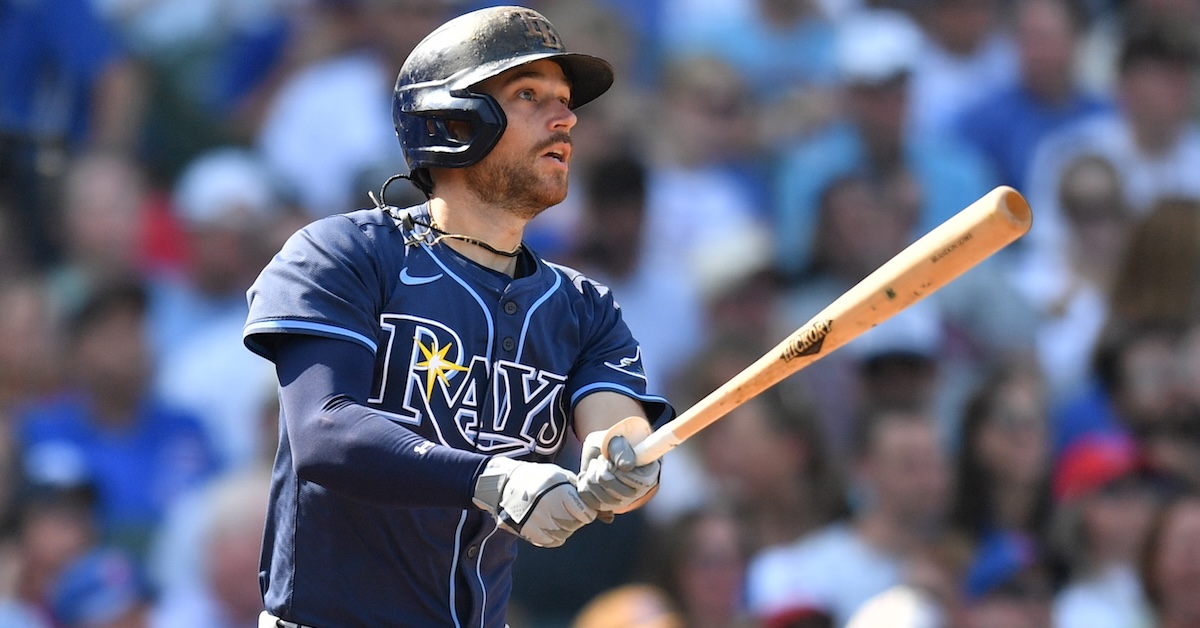
The Pirates, Rays, and Astros came together on a three-team trade on Friday. In the move, Pittsburgh acquired Brandon Lowe, Jake Mangum, and Mason Montgomery from Tampa Bay. The Bucs sent Mike Burrows to Houston, who in turn dealt Jacob Melton and Anderson Brito to the Rays. Multi-teamers are always complicated, and I find it most helpful to break these down team by team.
Pittsburgh Pirates
Acquires: 2B Brandon Lowe, OF Jake Mangum, LHP Mason Montgomery
Loses: RHP Mike Burrows
The motivation for the Pirates here is obvious, as they entered the offseason with a dire need to convert their pitching surplus into a few bats. The Pirates scored 583 runs this past season, the fewest in baseball, and only Colorado saved their collective 82 wRC+ from bringing up the rear in that category, as well. At the same time, the team’s pitching development pipeline is humming. Paul Skenes is the best pitcher in the NL, and Mitch Keller is a solid mid-rotation starter behind him.
From there, the Pirates have plenty of rotation candidates. Burrows, Braxton Ashcraft, Carmen Mlodzinski, Thomas Harrington, and Bubba Chandler all started games this year. Another potential starter, Hunter Barco, clambered ashore from the banks of the Allegheny late this season, and Jared Jones will presumably return from Tommy John surgery in 2026 and be in the mix, too. It’s enviable depth and ripe for a resource exchange. Pittsburgh started that process earlier this winter, flipping Johan Oviedo to the Red Sox for outfielder Jhostynxon Garcia, and really kicked things into gear with this move.
Lowe is the biggest name in the deal. The second baseman is an eight-year veteran who made his second All-Star team in 2025, when he bashed 31 homers and notched a 114 wRC+. Tempting as it is to link that power surge to his diminutive home park — the Rays played at George Steinbrenner Field, where the right field pole is just 314 feet from the plate — Lowe actually hit much better on the road: .275/.337/.500, compared to 240/.279/.456 in Tampa. His pull-side power suits his new digs: Twenty-eight of Lowe’s 31 dingers went to the right side of the field, and PNC Park’s otherwise cavernous dimensions offer a bargain to sluggers looking to drive the ball out to right field.
While Lowe’s exit velocities, hard rates, and launch angles have been stable year-over-year, you can squint and see signs of a slight decline elsewhere. Now 31 years old, Lowe has always been an aggressive, strikeout-heavy hitter reliant on the long ball, and those traits have become a marginally but noticeably bigger part of the equation amid a two-year collapse in his walk rate. Per Baseball Savant, Lowe’s sprint speed has dropped for two years running now, and while he’s rarely graded out as a good defender at the keystone, he was the worst qualified regular there in 2025, according to our metrics.
Between that and his expiring contract — he’s signed through 2026 with an $11.5 million team option for 2027 — Lowe is a short-term proposition in Pittsburgh. He’s instantly a lineup anchor, and one of the two or three best bats on the roster. On a WAR/162 basis, he’s averaged more than three wins per season over the last three years. Injuries have been a constant thorn in his side — his 134 games played in 2025 was the second-highest total of his career — so the safe projection is for less than that, but he should be a productive player when he’s on the field. ZiPS isn’t rosy on injury-prone guys in their 30s, but this isn’t a bad projection by any means:
| Year | BA | OBP | SLG | AB | R | H | 2B | 3B | HR | RBI | BB | SO | SB | OPS+ | WAR |
|---|---|---|---|---|---|---|---|---|---|---|---|---|---|---|---|
| 2026 | .246 | .310 | .433 | 443 | 62 | 109 | 21 | 1 | 20 | 60 | 39 | 127 | 3 | 105 | 1.7 |
One nuanced piece of this deal is that the man Lowe is replacing, Nick Gonzales, wasn’t a zero last year. He didn’t hit a ton, but Gonzales accrued nearly a full win’s worth of value in 96 games, and who knows how much his hitting was affected by the ankle fracture he sustained hitting a home run on Opening Day. He posted a 94 wRC+ in 2024, and even if you split the difference between that and his 82 wRC+ this year, with good defense at second he’s comfortably a second-division regular at the least. You can call Lowe a marginal upgrade if you’d like, but I think there’s value in stacking talent here. Gonzales will presumably have plenty of opportunities to spell the oft-injured Lowe, and perhaps he’ll also work in more at short or third next year. Regardless, moving him from a starting job into a utility role gives Pittsburgh valuable depth and a high-floor Plan B if anything goes wrong.
Mangum spent six years in the minors across three organizations before Tampa Bay cracked the door open on an opportunity for him this spring. He busted that door off its hinges, hitting .296/.330/.368 while playing a good center field and establishing himself as a legitimate major leaguer. He was one of baseball’s best fourth outfielders in 2025, and while his 1.8 WAR might be the high-water mark of his career, even a slightly diminished version of those numbers would earn him a place in Pittsburgh’s lineup.
Mangum is a batting average-dependent hitter with well below-average power and low walk and strikeout totals. That’s a volatile skill set and one often sensitive to father time and advance scouting reports. The park is again a good fit here, though, as Mangum tends to spray the ball, and PNC has one of the largest acreages in the game. His glove is also a welcome addition. The Pirates prefer to have two center field-caliber defenders to handle center and left, and Mangum affords them that kind of player.
Montgomery is an intriguing fit for the bullpen. He has excellent stuff from the left side, a high-90s fastball and a plus slider, both of which miss bats. He endured some home run trouble that fluffed up his ERA, but he posted a sub-4.00 FIP, and the deep left field dimensions at his new home stadium can only help him sand down the damage on contact. Strike-throwing is the key variable here: He was wild last year, so even though he’s got late-inning stuff, it’s hard to trust him in leverage spots. The Rays are usually quite good at getting their high-octane guys to throw strikes. They were unable to in this case, and that perhaps shades the long-term outlook here down a tad.
While exciting, these acquisitions haven’t come cheap. Burrows may not be a household name yet, but the Astros get six years of control of a guy who generated mid-rotation numbers across 19 starts and nearly 100 innings this year. We’ll cover him more in Houston’s section, but from Pittsburgh’s side, of all the pitching depth mentioned above, Burrows was perhaps the most likely of the group to take the ball 30 times next season. In addition to that lost production, there’s also a sentimental piece. The club drafted him out of high school in 2018, and he’s spent his whole career in the organization. Through a pandemic and Tommy John surgery, he’s taken the long path from a talented but flawed high schooler into a promising big leaguer. Don’t hug your prospects too tight; you might be the one who gets hurt.
One final note on the Pirates side: With this move, their 40-man roster is now over capacity, and they’ll need to make two subtractions from their current group. No announcement has been made just yet.
Ultimately though, this is a move that makes a lot of sense for a team, and a front office, that needs to win now. Skenes’ clock is ticking. If the Pirates aren’t able to extend him long-term, and it seems unlikely that they will, they’ve probably got a year, maybe two, left before it might make sense to explore a franchise-altering trade. Mangum and Lowe represent a pretty significant upgrade over what they’ve gotten from second base and their corner/depth outfielders in recent years, and the Bucs have the pieces to backfill Burrows. Lowe’s $11.5 million price tag is manageable, even for Bob Nutting, and they should have the flexibility to make further reinforcements. By itself, this trade doesn’t turn the Pirates into wild card favorites, but they’re working their way into that conversation, and the pattern we’re seeing from them this offseason suggests a mandate to put a winner on the field next season. Expect more action from them in the coming weeks.
Houston Astros
Acquires: RHP Mike Burrows
Loses: OF Jacob Melton, RHP Anderson Brito
With Framber Valdez seemingly out the door and the rotation looking perilously thin, Houston needed to reinforce the starting five this winter, which brings us back to Burrows. In his first sustained major league action, the 26-year-old put up a surprisingly strong season, striking out more than a batter per inning with a 7.7% walk rate and manageable damage surrendered on contact. That translated to a 3.94 ERA, a 4.00 FIP, and a tidy 1.3 WAR in 96 innings across 19 starts.
Whether Burrows can maintain that going forward is the big question. On paper, he has the profile of a mid-rotation arm. He sits in the mid-90s and has four average or better pitches. The changeup is plus, with a caveat. It’s his best bat-misser, but it’s also vulnerable when he hangs it in the zone — the big movement is conducive to the occasional stinker — and he uses it so much that hitters can afford to sit on it and make him pay when he misfires. It’s also worth noting that much of his work came in four- to five-inning stints, outings in which he rarely was afforded the chance to dampen his numbers by turning the lineup over a third time. Part of that stemmed from Pittsburgh’s hybrid-heavy strategy, and there are people within the front office who didn’t really see Burrows as a guy likely to succeed in longer outings anyway. He was also working back from Tommy John surgery, which cost him most of the 2023 and 2024 seasons.
A year further removed from the procedure, might Houston loosen the reins? He’s had few developmental opportunities to learn how to navigate that third time through (him and everybody else these days) and the homer totals suggest growing pains if the Astros let him learn on the job. Still, the long-term forecast here is positive. He’s either a solid twice-through-the-order guy, or he learns how to do enough to justify a traditional starter’s workload. If it’s the second one of those two, Houston has a no. 3 starter on its hands and six years of service time to play with.
To find out, the Astros parted with Melton, their top prospect in our updated 2025 rankings, and Brito, who was likely going to jump into their top 10 had he stayed. This was a thin farm already, and there’s now very little impact talent on the horizon.
It’s shocking how quickly the core of Houston’s World Series teams has scattered to the winds. The Astros remained competitive without Alex Bregman and Kyle Tucker this year, even though they missed the postseason for the first time since 2016, but with Valdez likely gone too, this looks more like a team capable of challenging for a playoff spot than one entering the season with the division on ice. The swap here stabilizes that present somewhat at a modest long-term cost.
Tampa Bay Rays
Acquires: OF Jacob Melton, RHP Anderson Brito
Loses: 2B Brandon Lowe, OF Jake Mangum, LHP Mason Montgomery
It’s a restock-the-farm kind of day for Tampa Bay. In addition to this move, the Rays dealt Shane Baz to the Orioles in exchange for four prospects and a competitive balance pick. In this one, Tampa managed to get Lowe’s $11.5 million off their 2026 books and added two prospects with upside. Losing the pre-arb parts of Mangum and Montgomery’s careers is a calculated blow.
Melton is in theory Mangum’s ready-made replacement. He played 32 forgettable games in Houston this year, where he hit .157/.234/.186 with no home runs and a ton of strikeouts. Ugly numbers to be sure, but I’m not inclined to move off of him over that. He never had a sustained run in the lineup, and it’s hard to expect much of a rookie playing a game here and a game there. He still projects as a solid fourth outfielder, and he’s a playable center fielder. Doubts about his ability to get to his considerable raw power and questions about whether he’ll perform against left-handed pitching make him more of a good prospect than a great one. The Rays have historically had a ton of success getting the most out of players on the line between everyday guy and quality role player, and they’re rolling those particular dice again here.
Brito is the wild card of the whole deal. He’s small, just 5-foot-10 and 160 pounds, but he has a quick, electric arm. Both his mid-upper 90s fastball and hellacious, plus slider missed a ton of bats in High-A, and both generated called-plus-swinging-strike rates above 30%. He’s not a great strike-thrower, and while there’s value in developing him as a starter in case that changes, Eric Longenhagen saw him as a likely reliever when he caught him in the Fall League. Again though, this is the kind of guy with whom the Rays succeed. They’re very good at bringing pitchers into the strike zone, and they tend to find ways to deploy guys with plus pitches in stints as long as their control and health will allow. The safe bet is that they got two quality role players in this trade, but it would come as no shock if one or both exceeds that projection.
I’m not inclined to call this deal a winner or a loser for any team in particular, as each of the squads involved executed on parts of their offseason plan. The Pirates swapped depth for need as they gear up to compete in 2026. The Astros stabilized their rotation in their pursuit of continued playoff relevance. The Rays managed to shed payroll while adding to their already deep collection of young players. There’s something for everyone here, and this trade helped each team consolidate its short-term strategy.
Brendan covers prospects and the minor leagues for FanGraphs. Previously he worked as a Pro Scout for the Pittsburgh Pirates.
It seems like the Rays traded 2 sort of interesting young players and acquired 2 sort of interesting young players. I’m not seeing how they added to the stable
Mangum isn’t young–he’s 29. Seems like, as a 2019 college senior signing, he didn’t really get minor league ABs till age 25, in 2021.
I feel like these senior signs and all but a handful of high school guys were probably most affected by the lost 2020 minor league season