
Pittsburgh Pirates Top 43 Prospects
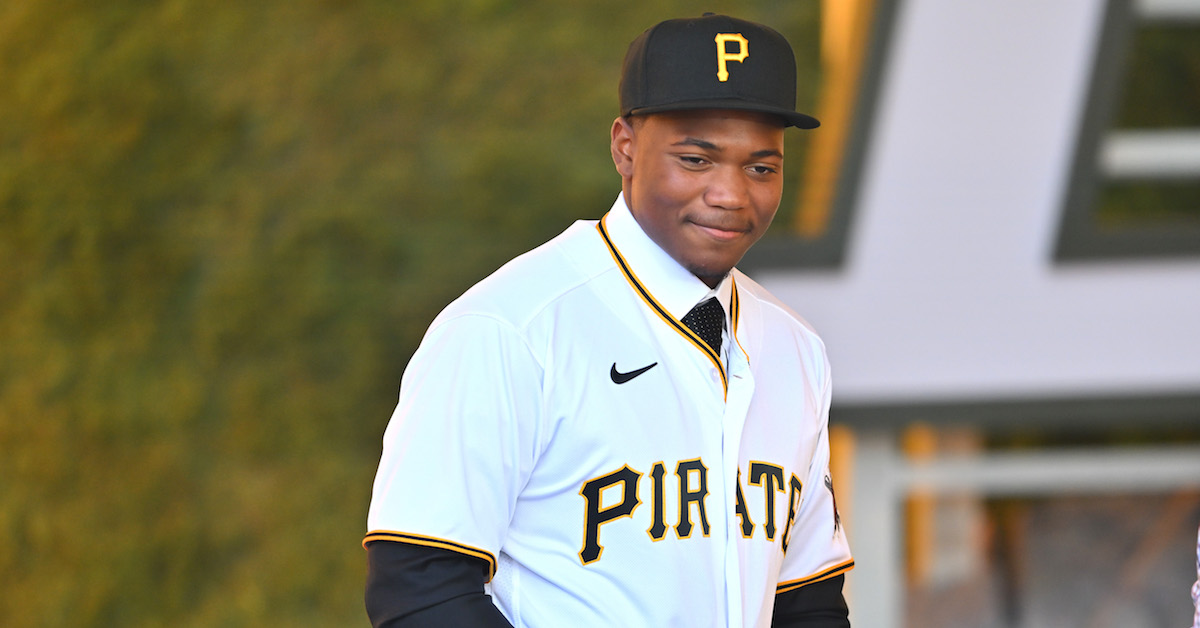
Below is an analysis of the prospects in the farm system of the Pittsburgh Pirates. Scouting reports were compiled with information provided by industry sources as well as our own observations. This is the third year we’re delineating between two anticipated relief roles, the abbreviations for which you’ll see in the “position” column below: MIRP for multi-inning relief pitchers, and SIRP for single-inning relief pitchers. The ETAs listed generally correspond to the year a player has to be added to the 40-man roster to avoid being made eligible for the Rule 5 draft. Manual adjustments are made where they seem appropriate, but we use that as a rule of thumb.
A quick overview of what FV (Future Value) means can be found here. A much deeper overview can be found here.
All of the ranked prospects below also appear on The Board, a resource the site offers featuring sortable scouting information for every organization. It has more details (and updated TrackMan data from various sources) than this article and integrates every team’s list so readers can compare prospects across farm systems. It can be found here.
| Rk | Name | Age | Highest Level | Position | ETA | FV |
|---|---|---|---|---|---|---|
| 1 | Termarr Johnson | 18.7 | A | 2B | 2028 | 55 |
| 2 | Endy Rodriguez | 22.8 | AAA | C | 2023 | 55 |
| 3 | Henry Davis | 23.4 | AA | C | 2024 | 55 |
| 4 | Luis Ortiz | 24.0 | MLB | SP | 2023 | 50 |
| 5 | Quinn Priester | 22.4 | AAA | SP | 2024 | 50 |
| 6 | Liover Peguero | 22.1 | MLB | 2B | 2023 | 45+ |
| 7 | Mike Burrows | 23.3 | AAA | SIRP | 2023 | 45+ |
| 8 | Bubba Chandler | 20.4 | A | SP | 2026 | 45+ |
| 9 | Jared Triolo | 25.0 | AA | 3B | 2023 | 45 |
| 10 | Ji Hwan Bae | 23.5 | MLB | 2B | 2023 | 45 |
| 11 | Jared Jones | 21.5 | A+ | SP | 2025 | 45 |
| 12 | Yordany De Los Santos | 18.0 | R | 3B | 2027 | 45 |
| 13 | Thomas Harrington | 21.6 | R | SP | 2026 | 45 |
| 14 | Kyle Nicolas | 24.0 | AA | SP | 2024 | 40+ |
| 15 | Colin Selby | 25.3 | AAA | SIRP | 2023 | 40+ |
| 16 | Ricky DeVito | 24.5 | A+ | SIRP | 2023 | 40+ |
| 17 | Carlos Jimenez | 20.6 | A | MIRP | 2025 | 40+ |
| 18 | Tony Blanco Jr. | 17.7 | R | RF | 2027 | 40 |
| 19 | Jun-Seok Shim | 18.8 | R | SP | 2029 | 40 |
| 20 | Anthony Solometo | 20.2 | A | SP | 2026 | 40 |
| 21 | Hunter Barco | 22.2 | R | SP | 2026 | 40 |
| 22 | Malcom Nunez | 21.9 | AAA | 1B | 2024 | 40 |
| 23 | Nick Gonzales | 23.7 | AA | 2B | 2023 | 40 |
| 24 | Dariel Lopez | 21.0 | A+ | 3B | 2024 | 40 |
| 25 | Jose Hernandez | 25.1 | AA | SIRP | 2023 | 40 |
| 26 | Po-Yu Chen | 21.4 | A | SP | 2025 | 40 |
| 27 | Michael Kennedy | 18.2 | R | SP | 2027 | 40 |
| 28 | Lonnie White Jr. | 20.1 | R | CF | 2026 | 40 |
| 29 | Carmen Mlodzinski | 24.0 | AAA | MIRP | 2024 | 40 |
| 30 | Tyler Samaniego | 24.0 | AA | SIRP | 2023 | 40 |
| 31 | Travis Swaggerty | 25.5 | MLB | CF | 2023 | 40 |
| 32 | Abrahan Gutierrez | 23.3 | A+ | C | 2023 | 40 |
| 33 | Jack Brannigan | 21.9 | A | 3B/SIRP | 2027 | 35+ |
| 34 | Tsung-Che Cheng | 21.6 | A | SS | 2025 | 35+ |
| 35 | Tahnaj Thomas | 23.6 | AA | SIRP | 2023 | 35+ |
| 36 | Nick Dombkowski | 24.5 | AA | MIRP | 2024 | 35+ |
| 37 | J.C. Flowers | 24.7 | AA | SIRP | 2023 | 35+ |
| 38 | Max Kranick | 25.6 | MLB | SIRP | 2022 | 35+ |
| 39 | Canaan Smith-Njigba | 23.8 | MLB | LF | 2023 | 35+ |
| 40 | Rodolfo Nolasco | 21.4 | A | RF | 2024 | 35+ |
| 41 | Nathan Webb | 25.5 | AAA | SIRP | 2024 | 35+ |
| 42 | Cody Bolton | 24.6 | AAA | MIRP | 2023 | 35+ |
| 43 | Owen Kellington | 20.0 | R | SP | 2026 | 35+ |
- All
- C
- 1B
- 2B
- SS
- 3B
- LF
- CF
- RF
- SP
- SIRP
- MIRP
55 FV Prospects
1. Termarr Johnson, 2B
| Age | 18.7 | Height | 5′ 8″ | Weight | 175 | Bat / Thr | L / R | FV | 55 |
|---|
| Hit | Raw Power | Game Power | Run | Fielding | Throw |
|---|---|---|---|---|---|
| 25/60 | 55/60 | 25/55 | 50/40 | 30/45 | 50 |
Johnson was a well-regarded prospect basically as soon as he reached high school, and there were scouts who were so excited when they first watched him hit that they considered him a future top 5-10 pick when he was only a freshman. He ultimately went fourth overall to Pittsburgh, and because he’s a relatively advanced hitter with a mature build, there’s a good chance the Pirates move Johnson through the minors pretty quickly if he hits the ground running offensively.
Johnson’s swing bears some mechanical resemblance to Bryce Harper’s, especially its lower half usage and finish. Johnson often ends his swing with his torso having made a full 180 degree rotation, sometimes swinging with such ferocious bat speed that he loses his balance and faceplants in the batter’s box. He has a pronounced bat wrap. When an opposing pitcher releases the ball, the scoop in Johnson’s bat head is pointing at the mound with his back elbow hiked way up above his shoulder in a position that seems to defy the rules of normal human physiology. Short but not small, his lack of length and size is actually an advantage for Johnson’s swing, as he can enjoy a bat path geared for power and lift without it being too long. While especially adept at launching pitches on the inner third, Johnson also shows some ability to shorten up and cover the top and outer edge of the strike zone. He showed a tendency to expand the zone and make some sub-optimal contact as an amateur and in his 2022 pro sample, but there are times when Johnson does this and rather than frustrate scouts and analysts, he impresses them with his ability to identify and adjust to breaking balls, his barrel feel, and his hand-eye coordination. Most of his swings and misses over the last few years have been on fastballs running away from him, but in 2022, he displayed a more advanced ability to poke the barrel at balls on the outer edge of the plate, extending his short levers in an effort to slap outside pitches the other way.
Defensively, he has mostly played second base so far in his professional career, with just a handful of starts at short. He’s a good enough defender that he’d probably being playing shortstop had he ended up at Arizona State, but in pro ball the keystone is Johnson’s likeliest defensive home given his maxed-out, stocky build and what projects to be somewhat limited range. There’s an All-Star-caliber hit and power combination here, and while a bigger pro data sample might reveal some approach-related issues, Johnson has been one of the best hitters his age for going on a half decade and feels like a relatively high-probability high school hitting prospect. If he does end up having relevant chase issues, he might track like a left-handed hitting Brendan Rodgers, but Johnson’s makeup and personality are so universally lauded that it’s fair to expect him to make relevant adjustments and become a key cog on Pittsburgh’s next competitive team.
2. Endy Rodriguez, C
| Age | 22.8 | Height | 6′ 0″ | Weight | 170 | Bat / Thr | S / R | FV | 55 |
|---|
| Hit | Raw Power | Game Power | Run | Fielding | Throw |
|---|---|---|---|---|---|
| 55/60 | 40/40 | 30/45 | 55/55 | 45/55 | 60 |
As of list publication, Rodriguez is one of just two catchers on Pittsburgh’s 40-man roster, and while it’s possible he’s beaten out by a veteran non-roster invitee like Tyler Heineman, Rodriguez’s defensive chops and versatility give him a shot to break camp with the big club, split time with Austin Hedges, and moonlight at one or two other positions before eventually seizing the primary catcher job. Endy had an incredible 2022 statline — .323/.407/.590 — most of which was generated at hitter-friendly Greensboro. He’s now a career .303/.394/.533 hitter and has had meaningful statistical success up through Double-A, where he spent about a month toward the end of 2022.
From a heuristics standpoint, you can’t do much better than Rodriguez’s profile. He’s a young, switch-hitting catcher with cartoonish offensive numbers (especially from a bat-to-ball standpoint) and uncommon defensive versatility, as he’s played a bunch of second base and left field as well. Throw in the visual twitch and athleticism, and this is the player Spotify’s algorithm would recommend to FanGraphs if prospects were musical artists.
From the left side of the plate, Rodriguez has an exceptional ability to rip his hands through pitches on the inner edge of the zone. Out over the plate, he has a tendency to stay inside fastballs and lift them toward the opposite field gap. So compact and short to the baseball is Rodriguez that he can wait an extra beat to diagnose pitch types, which enables him to make in-flight adjustments to breaking balls, spoil the well-located ones, and crush the hangers. As a right-handed hitter almost all of Endy’s damage is done on outer-third pitches that he can get fully extended against. His swing is quite uphill from the left side and he can tend to swing underneath fastballs up and away from him, but overall he is very difficult to make whiff inside the strike zone despite his steep-launch style of contact.
On defense, Rodriguez’s size is both a feature and a bug. He’s naturally adept at framing low strikes because he’s already so low to the ground, but it’s also fair to wonder if such a small athlete can withstand the grind of catching 80-100 games every summer. Rodriguez’s arm is comfortably plus. You can really see his athleticism and remarkable hip/shoulder separation on his throws down to second. His pop times are routinely in the 1.85-1.95 range in part because Endy has a strong arm, but also because he’s almost always leaving his crouch before he even receives the pitch on steal attempts, which hastens his exchange. This level of athleticism might be an indication that Rodriguez will find a way to mature into more raw power despite not having a traditionally projectable frame. His swing is already geared for lift, but he doesn’t currently have the raw juice to make the most of it. He’s going to be a star if he ends up with even average raw power, and even if he doesn’t, we’re talking about a switch-hitting catcher who can make an impact on both offense and defense. He might end up becoming the player the industry hoped Francisco Mejía would become.
3. Henry Davis, C
| Age | 23.4 | Height | 6′ 2″ | Weight | 225 | Bat / Thr | R / R | FV | 55 |
|---|
| Hit | Raw Power | Game Power | Run | Fielding | Throw |
|---|---|---|---|---|---|
| 35/45 | 70/70 | 50/60 | 30/30 | 30/40 | 50 |
Davis was on the IL multiple times in 2022 with issues stemming from a small nondisplaced fracture of his left wrist that he suffered when he was hit by a pitch in May. He did not hit well after the injury, but that’s typical of hitters coming off a wrist fracture, and a second IL stint due to the wrist was an indication that it was bothering Davis throughout the year. A core scouting rule of thumb is to take the long view with catchers who have impact offensive potential. M.J. Melendez’s 2019 and Bo Naylor‘s 2020 are recent examples of otherwise good-hitting catchers who had a terrible offensive season in the mid-minors that was followed by an immediate and significant rebound the following year. The bumps and bruises suffered from catching can sometimes level players for whole seasons, and Davis had a lot of them in 2022. He practically straddles the plate and was hit by 20 pitches during an injury-shortened regular season, then was somehow beaned seven more times in just 17 Arizona Fall League games. Across the 2022 calendar, Davis had nearly as many HBPs as he did extra-base hits, to which the wrist fracture likely contributed. Davis’ plate crowding helps enable his pull-heavy approach. He has the strength to do damage the other way, but save for the occasional pitch on the outer edge, he’s geared to pull. Big league sliders might force Davis to make an adjustment, but so far his contact performance has been solidly average. Even if sliders are a chronic issue for Davis, he’ll likely still get to enough power to produce better than the average everyday catcher.
He’s not a great defender right now, and probably won’t ever be better than a 40-grade glove, but Davis frames high strikes well and has plus raw arm strength. His footwork on throws to second is clunky and variable, which often impacts his throw times and accuracy, but the pure arm strength is in there. You can see the power and athleticism in Davis’ lower half throughout other aspects of his game, and it’s an indication that he has the ability to polish this stuff up and control the running game. With Endy Rodriguez around, it may not matter a ton. Even though both Davis and Rodriguez are near-ready catching prospects, they aren’t redundant, and in fact they complement each other well. Both can be in the lineup every night because of Rodriguez’s defensive versatility and the universal DH, and a more liberal timeshare behind the plate might help keep them both healthier and more consistently productive on offense. Davis’ skills and offensive style are tailored like those of Evan Gattis.
50 FV Prospects
4. Luis Ortiz, SP
| Age | 24.0 | Height | 6′ 2″ | Weight | 240 | Bat / Thr | R / R | FV | 50 |
|---|
| Fastball | Slider | Changeup | Command | Sits/Tops |
|---|---|---|---|---|
| 60/60 | 70/70 | 40/45 | 45/50 | 96-99 / 100 |
Ortiz rocketed through the system in 2022, skipping High-A and spending most of the season with Double-A Altoona before making his big league debut across four starts in September and October. While he was already throwing quite hard, Ortiz came into even more velocity in 2022 and averaged 97 mph on his fastball, up two ticks from 2021. The pitch has natural tailing action, but Ortiz can also blow it past hitters at the letters when he wants, and his TrackMan data shows he’s mixing in four- and two-seamers in the locations where they’re most effective. His finishing pitch, though, is his slider, a nasty upper-80s sweeper that generated a 50% whiff rate and 38% chase rate in 2022. He commands it consistently enough to his glove side to project as a starter. In the past, Ortiz’s high-effort delivery and sub-optimal fastball shape put him on the starter/reliever line, but he’s thrown plenty of strikes across multiple seasons while simultaneously developing more velocity and comfortably projects as a starting pitcher now. How impactful a starter may depend on how his changeup, currently a tertiary offering, develops at the big league level. It shows above-average arm-side action on occasion, but he’s only throwing it 12% of the time. Poised to compete for a rotation spot when 2023 camp breaks, Ortiz is one of a few high-upside Pirates youngsters who look like they’d fit in a contender’s rotation.
5. Quinn Priester, SP
| Age | 22.4 | Height | 6′ 3″ | Weight | 210 | Bat / Thr | R / R | FV | 50 |
|---|
| Fastball | Slider | Curveball | Changeup | Command | Sits/Tops |
|---|---|---|---|---|---|
| 45/45 | 50/55 | 70/70 | 40/45 | 50/55 | 92-94 / 96 |
Priester’s four-seamer is divisive. It comes out of his hand from a high arm slot that looks like the kind optimized for data-friendly ride, but the pitch’s downhill angle makes it less of a weapon at the letters and actually makes it very vulnerable within the strike zone. Perhaps as an adjustment to deal with this issue, Priester now mixes in plenty of fastballs for which he pronates on release, giving the pitch screwball-like spin. Its bat-missing capabilities are limited to the bottom arm-side portion of the zone, where this two-seam-ish fastball tends to finish. Many scouts are champing at the bit over Priester’s prototypical frame and four- or five-pitch mix, depending on whether you consider his fastballs two distinct pitches. Quants and front office analyst types are more bearish, citing issues with Priester’s fastball playability. His fastball velocity is down, in the 92-94 mph range, a far cry from Priester’s upper-90s peak. In 2022, it garnered just 8% whiffs and 13% chase during his time at Double-A, where he spent most of the season. However, Priester makes up for it with his preferred secondaries — a huge, arcing curveball that Priester has had forever, and a more recently developed mid-80s slider — both of which have garnered swing-and-miss rates well above the big league average. Neither his slider nor changeup is fully baked quite yet, but if either (or both) become viable, they would bring with them a higher probability that Priester slots in as a mid-rotation starter. Here he’s projected as a no. 4/5 on a contender.
45+ FV Prospects
6. Liover Peguero, 2B
| Age | 22.1 | Height | 6′ 1″ | Weight | 200 | Bat / Thr | R / R | FV | 45+ |
|---|
| Hit | Raw Power | Game Power | Run | Fielding | Throw |
|---|---|---|---|---|---|
| 35/50 | 50/55 | 40/50 | 60/60 | 30/45 | 30 |
Traded from Arizona to Pittsburgh as part of the Starling Marte deal, Peguero had been a top 100 prospect for the last couple of years, tracking like a plus bat middle infielder. Some aspects of that optimistic projection still exist, while others have changed or are currently absent, but the tools package here is still on par with the middle of the everyday second baseman player population, and we’re hoping that young Peguero will polish up his game’s current smudges. For instance, he’s struggled badly on defense, wracking up 46 errors combined the last two seasons. Peguero’s lack of throwing accuracy from shortstop is concerning. He appears tentative on routine throws and still isn’t a sure-handed defender. His range, footwork, ability to bend, and overall athleticism are all plus, and it made sense to try to develop him as a shortstop for as long as possible, but Peguero finally saw time at second base in 2022 and a permanent move there will hopefully help him throw more confidently and accurately. If his defense continues to look like it did in the 2022-23 Dominican Winter League during 2023 spring training, he may quickly be repositioned on this list.
A second base-only defensive fit puts the onus on Peguero’s bat to perform at an everyday level. After coasting through the low and mid-minors, he finally hit a speed bump in 2022, posting his first below-average statline as a 21-year-old at Double-A Altoona. Aspects of the offensive profile that made him exciting in the first place are still here, led by Peguero’s compact but authoritative swing, which is especially good at punishing pitches at the very top of the strike zone. (One weird scouting note: Peguero chokes up with two strikes, but only with his top hand, creating separation between his two hands à la Kevin Youkilis.) His overall pitch recognition, especially against breaking balls, has become a more noticeable issue. Peguero’s pull-heavy style of contact leaves him vulnerable to breaking balls on the outer half, even ones that catch a lot of the plate. His quality of contact is very good when he does make it, and is already on par with the typical starting major league second baseman even though he’s barely 22. His 2022 performance deserves some age-related adjustment, but it’s possible we saw flaws in Peguero’s game exposed by upper-level pitching. He has the talent to be an everyday player, but has to improve in one or two key areas (throwing accuracy, slider recognition) for that to be his outcome.
7. Mike Burrows, SIRP
| Age | 23.3 | Height | 6′ 2″ | Weight | 183 | Bat / Thr | R / R | FV | 45+ |
|---|
| Fastball | Curveball | Changeup | Command | Sits/Tops |
|---|---|---|---|---|
| 55/55 | 55/55 | 60/60 | 45/50 | 94-96 / 97 |
Burrows had success as a starter throughout a 2022 season split between Double- and Triple-A before shoulder inflammation effectively ended his season. He missed basically all of September and was shelled in the only start he made coming off the IL. He had all the markers of a major league-ready Top 100 prospect prior to the injury, largely due to the progression of his changeup and its usage. He threw it 16% of the time (up from 9% the previous season) and induced a 53% whiff rate with this power-action, mid-80s change. The emergence of a consistently above-average third offering reignited Burrows’ projection as a starter (he had been projected as a reliever here in previous seasons, in part due to injuries), and of his 24 outings in 2022, only two came out of the bullpen and just four were shorter than three innings. Across his 94.1 innings, he racked up 111 strikeouts against just 31 walks, with a 1.21 WHIP. Mechanically, Burrows adds additional length to his 6-foot-2 stature with an over-the-top delivery. His arm action looks longer and looser than it was in his injury-shortened 2021, and his upper body appears more closed, which might be helping him hide the ball longer than before. His turn at the 2022 Futures Game gave viewers a glimpse of his heater/curveball combo, showcasing the carry on his mid-90s fastball in contrast to the vertical depth of the high-spin (2,800 rpm) curve. Given their respective shapes, it’s easy to see how those pitches play off of one another, and they were the reason Burrows presented a traditional relief look prior to his changeup’s development. He would slot among Priester and Ortiz on this list had he completed a totally healthy 2022.
8. Bubba Chandler, SP
| Age | 20.4 | Height | 6′ 3″ | Weight | 200 | Bat / Thr | S / R | FV | 45+ |
|---|
| Fastball | Slider | Changeup | Command | Sits/Tops |
|---|---|---|---|---|
| 55/60 | 40/55 | 35/50 | 30/55 | 93-96 / 98 |
Chandler started the 2022 season on the complex, where he showed two-way promise, slashing .231/.444/.654 over 36 plate appearances while annihilating opposing batters, issuing 27 strikeouts and giving up just three hits without allowing a run over 15.1 innings. He was promoted to Bradenton and fell into a rhythm where each pitching appearance was buttressed by an off day before and after it, with the 19-year-old DHing in the intervening days.
Chandler’s pitching performance wasn’t as lights-out as it had been pre-promotion, but it was still a display of the righty’s potential. His fastball velo is up a tick since 2021, now comfortably sitting in the 95-96 mph range and routinely touching 98. His slider has a sweeping horizontal shape, but his inability to locate it has hampered its utility. He also mixes in the occasional changeup or curveball, which accounted for a combined 11% of his offerings at Low-A. In his time at Bradenton, Chandler struck out 33 batters over 26 innings, and while his walk rate was an unacceptably high 15.8%, that’s actually down a notch from what he was allowing over a larger sample on the complex. Still, his strikeouts come primarily on in-zone swing-and-miss, so it’s important for the strike-throwing to improve for him to capitalize on his ability to overpower hitters as he continues to advance. He hit his stride in mid-August with back-to-back scoreless starts in which his four-seamer averaged over 96 across a combined nine innings – a high water mark for the season and a true glimpse of his upside. But at other times, he had difficulty maintaining the velocity as the innings wore on, which was compounded by his ongoing command inconsistency.
Meanwhile, Chandler’s post-promotion production at the plate plummeted to a sub-.200 batting average and an OPS of just .574, thanks largely to a strikeout rate just barely south of 40%; he launched just a single dinger in his 32 Low-A games compared to three in his 14 games on the complex. Climbing the minor league ladder often comes with offensive slumps, many of which are cured as hitters accrue at-bats at the more advanced level. That’s hard enough to do for any batter, let alone one whose schedule also includes the grueling demands of pitching development. That makes it seem all but inevitable that Chandler will eventually ditch the bat to optimize his development on the mound.
45 FV Prospects
9. Jared Triolo, 3B
| Age | 25.0 | Height | 6′ 3″ | Weight | 212 | Bat / Thr | R / R | FV | 45 |
|---|
| Hit | Raw Power | Game Power | Run | Fielding | Throw |
|---|---|---|---|---|---|
| 40/50 | 45/45 | 40/45 | 50/50 | 55/60 | 55 |
Triolo has long been viewed as a glove-first third baseman who’d likely have some big league utility, similar to D-backs third baseman Emmanuel Rivera. But as Triolo’s pro success with the bat continued at a high level, and with Ke’Bryan Hayes manning the hot corner for the Pirates’ foreseeable future, the Pirates began searching for defensive alternatives in order to plug Triolo into their lineup. They’re finding them. During a full season at Double-A in 2022, he saw time at third base, shortstop, and center field, and in 2023 he’ll start seeing more time at second base. Triolo earned industry praise for his defensive aptitude and high marks for his baseball IQ and instincts. His acrobatics and creativity at third base make him a plus defender there. He clearly wasn’t comfortable in center field during his brief time there last season, but he only played there once every couple of weeks and he isn’t a firm “no” at the position, even if he is bad there right now. Given how good he is at third, it seems likely that Triolo will be a good defensive second baseman if given enough time, and he’s a fine emergency option at short (Kyle Farmer has played there a ton and Triolo is about that good).
What’s more, there’s a chance Triolo hits enough to simply be an everyday option at second (or if he turns out to be okay in center). He spent much of the season leading off for Altoona, where he slashed .282/.376/.419 and stole 24 stolen bases. His swing decisions and ability to make contact out front and tap into his latent power improved throughout the season. If you split his season exactly in half, the improvement is obvious. While his walk and strikeout rates were both descent through the first half of 2022, only nine of his 57 hits through mid-June went for extra bases (eight doubles and a home run). From that point on, however, Triolo walked more and struck out less, such that both rates sat in the mid-teens, while flipping the slugging switch on to the tune of 13 doubles, five triples, and eight home runs over the course of the same number of games. This impressive performance inspired his offseason 40-man addition. Triolo’s swing and footwork in the box make him vulnerable in a couple of obvious ways (high heat, sliders away), and we don’t think the 60-grade hit, 45-grade power profile that he has put on paper so far will hold quite that much water against big league arms. If it does, he should be a 50, and that grade was discussed during the Pirates list-making process. If a clearer path at third base existed in this org, that might have been enough for us to do it. Instead, Triolo looks like he’ll be a superutility guy.
10. Ji Hwan Bae, 2B
| Age | 23.5 | Height | 6′ 1″ | Weight | 185 | Bat / Thr | L / R | FV | 45 |
|---|
| Hit | Raw Power | Game Power | Run | Fielding | Throw |
|---|---|---|---|---|---|
| 55/60 | 35/40 | 30/35 | 60/60 | 40/50 | 40 |
After spending most of the year at Triple-A, where he hit .289/.362/.430, Bae spent the last couple weeks of the 2022 season as an everyday member of the big league club, where he seems likely to stick throughout the coming season as a lefty-hitting 2B/OF. He’s still the contact-first, chop-and-spray hitter he’s always been, an approach to hitting enabled and bolstered by his speed, which allows him to beat out infield singles. The type of contact he makes is unlikely to ever lead to home run power commensurate with a true everyday player, but Bae makes enough stinging, all-fields contact that he projects to hit plenty of doubles and triples. His defensive versatility will allow the Pirates to play in-game matchups that take advantage of Bae’s speed and ability to put balls in play. He spent more of his big league time in the outfield than at his native second base. He doesn’t always look comfortable out there, but his speed makes him viable at all three spots, solidifying his role as a heavily-used role player even without the power production.
11. Jared Jones, SP
| Age | 21.5 | Height | 6′ 1″ | Weight | 180 | Bat / Thr | R / R | FV | 45 |
|---|
| Fastball | Slider | Changeup | Command | Sits/Tops |
|---|---|---|---|---|
| 60/60 | 55/60 | 40/50 | 30/40 | 94-98 / 99 |
A two-way high school player, Jones was clearly a superior prospect as a pitcher, as he was one of the most electric on-mound athletes to roll through the high school ranks over the last decade. Jones checked all but two scouting boxes as a high school pitcher. His feel for throwing strikes would come and go, and he’s only 6-feet-1, a little smaller than the prep pitching prototypes who you often see getting $2 million or more in the draft. But Jones’ athleticism and physical strength drove confidence that he could maintain plus fastball velocity across a starter’s workload in pro ball (which so far has been true), and his natural breaking ball bite gave him at least one likely plus pitch to go with it. Jones spent 2022, his second full pro season, at High-A Greensboro, where he sat 94-98 mph across 122.2 innings and posted a 26.7% K% and 9.6% BB%. For the second straight year, he allowed a high rate of home runs, which inflated his ERA. That’s something to watch as Jones continues to progress through the minors. His letter-high, heater-heavy style of pitching, like Gerrit Cole‘s, results in lots of fly balls and he may have long-term vulnerability to the home run. Jones’s velocity and breaking ball quality (a power, mid-80s slider with vertical action) give him the floor of a really good reliever, especially if he can somehow throw harder an inning at a time. His command and changeup are both still works in progress, but his 2022 fastball strike% (68%) is an encouraging sign, and again, Jones has a special level of athleticism that should enable him to hone both over time. He’s on track to debut in 2025 as a starter if those issues improve and as a reliever if they do not.
12. Yordany De Los Santos, 3B
| Age | 18.0 | Height | 6′ 1″ | Weight | 170 | Bat / Thr | R / R | FV | 45 |
|---|
| Hit | Raw Power | Game Power | Run | Fielding | Throw |
|---|---|---|---|---|---|
| 20/45 | 50/60 | 25/60 | 45/45 | 30/45 | 50 |
In some respects, it’s easy to assess DSL players. Because they’re about the same age as high school draft prospects, apples-to-apples projection and tools comparisons are feasible, which then allows you to triangulate where they’d be selected in a draft based on those comparisons and get a sense of how to FV them. But when a potentially significant DSL prospect plays for a rebuilding team, it can be difficult to find other clubs that have pro scouting reports on them. Clubs like the Pirates aren’t making buyers’ trades, so they have little to no incentive to move a potentially great young player, which in turn means teams have little incentive to scout said player. In cases like these, sometimes the things that initially pique your interest, like data and/or available video, are enough to excite on their own even as you acknowledge that the error bars are as wide as can be because of the relative dearth of reinforcing club opinions.
This is the case with De Los Santos. He was ranked 25th on the Pirates list at the end of 2022, but we were blown away after watching him on video and seeing some of his underlying DSL data during the construction of this list. As FanGraphs sourced TrackMan/Hawkeye data from team personnel after the season, De Los Santos’ hard hit rate and peak exit velocities stood apart from most of his peers, especially when limiting the sample to the DSL’s age-appropriate players. Still 17 years old as of initial list publication, De Los Santos’ DSL barrel rate (it’s more a proxy for a barrel rate — the exit velo and launch benchmarks aren’t exactly the same as Statcast’s “Barrels,” but it’s the same idea) is so high that it actually breaks an age-adjusted 20-80 scale, grading out as an “83.” Meanwhile, put on the tape, limited though it may be, and you’ll see an explosive young athlete with a prototypical baseball frame and premium bat speed, sizzling line drives all over the field. If this were a high school draft prospect, you would already know his name based purely on how explosive De Los Santos is in the batter’s box. This FV grade is commensurate with a mid-first round high school infield prospect.
The component parts of a scouting, tools-oriented look — De Los Santos’ frame, bat speed, and infield actions — put him in that range, while the DSL data reinforces it somewhat. DSL data is noisy, in part because pitchers there don’t yet throw enough strikes or with much velocity compared to more advanced levels of the minors. In some ways, this makes aspects of De Los Santos’ data even more impressive, because he’s turning around soft DSL pitching with ridiculous pace. Readers should note that taking an aggressive line with players like this has yielded predictably mixed results in the past (so far, so good: Kevin Alcantara, Marco Luciano, Alexander Canario, Jordy Vargas, etc.), and some of the recent, perhaps overzealous examples (Maikel Escotto, Rodolfo Nolasco) are in this system. De Los Santos’ contact metrics are a hair south of average, and that’s the biggest indicator that there’s real risk here, but boy, there is also real ceiling.
13. Thomas Harrington, SP
| Age | 21.6 | Height | 6′ 2″ | Weight | 185 | Bat / Thr | R / R | FV | 45 |
|---|
| Fastball | Slider | Changeup | Command | Sits/Tops |
|---|---|---|---|---|
| 40/45 | 40/50 | 55/60 | 35/60 | 90-93 / 96 |
A draft-eligible sophomore in 2022, Harrington is an athletic, pitchability righty with a tailing low-90s fastball and a power-sink changeup in the mid-80s. His on-mound athleticism enables plus long-term command projection, though for right now Harrington really only locates his fastball to his arm side. More glove-side fastballs might help him set up his sweeping slider more effectively, as that pitch has good-looking movement but wasn’t a dominant offering in college. Pro teams are more open to east/west fastball operation and the Pirates might be able to coax more sweep out of Harrington’s slider, though Campbell does a pretty good job developing pitchers, so there may be less developmental meat on the bone here than you’d guess considering he’s coming from a smaller program. He projects as a quick-moving no. 4/5 starter. Pathways toward a more impactful role are most likely to be carved by Harrington’s command outperforming this projection.
40+ FV Prospects
14. Kyle Nicolas, SP
| Age | 24.0 | Height | 6′ 4″ | Weight | 223 | Bat / Thr | R / R | FV | 40+ |
|---|
| Fastball | Slider | Curveball | Changeup | Command | Sits/Tops |
|---|---|---|---|---|---|
| 50/50 | 55/60 | 50/55 | 30/30 | 50/55 | 92-95 / 97 |
Nicolas spent most of his college career in the bullpen, but he’s held up well as a starter in pro ball, developing two distinct breaking balls that he’s using much more than he did at Ball State. Traded from Miami during the 2021-22 offseason as part of the three-player package for Jacob Stallings, Nicolas spent 2022 with Altoona, where he worked 90 innings with a FIP and ERA close to 4.00. While he hasn’t continued producing the mid-to-upper-90s velocity he did during college relief outings, Nicolas still sits a respectable 92-95 mph and leans on his two above-average breaking balls, a low-80s curveball and a mid-80s slider. Nicolas has consistent glove-side command of his entire repertoire, and he tends to live on that half of the plate exclusively. Ideally, Nicolas can develop an offering that has some arm-side movement, one better than his current changeup that can prevent hitters from sitting on those glove-side locations. He’s already taken a sizable step in the breaking ball department in just two pros seasons. It’s now fair to expect that the current version of Nicolas will be capable of holding down a spot toward the back of Pittsburgh’s rotation by the middle of 2024.
15. Colin Selby, SIRP
| Age | 25.3 | Height | 6′ 2″ | Weight | 220 | Bat / Thr | R / R | FV | 40+ |
|---|
| Fastball | Slider | Curveball | Command | Sits/Tops |
|---|---|---|---|---|
| 60/60 | 60/60 | 55/55 | 40/40 | 96-98 / 99 |
Amid a couple of short IL stints in 2022, Selby put up impressive numbers split between Double- and Triple-A and then looked great in the Arizona Fall League. Pittsburgh to add him to their 40-man roster after the season, indicating that he’ll be a big league relief option in 2023. Selby’s fastball sits 96-98 mph and he looks to blow it past hitters up in the zone. He pairs it with two above-average secondaries: a high-80s slider with sharp, downward movement that garnered a 48% chase rate against righties, and an 11-5 curveball with a shape that mimics the slider, only slower and looser, which helps keep batters off balance and enables him to pitch backwards. An extreme groundball pitcher in a small sample, he allowed just two home runs in 35.2 innings of work in 2022. He’s poised for a big league bullpen role this season and has a repertoire that’s deep and nasty enough that he should be considered a late-inning option.
16. Ricky DeVito, SIRP
| Age | 24.5 | Height | 6′ 3″ | Weight | 195 | Bat / Thr | S / R | FV | 40+ |
|---|
| Fastball | Slider | Curveball | Splitter | Command | Sits/Tops |
|---|---|---|---|---|---|
| 55/55 | 50/55 | 45/45 | 70/70 | 30/40 | 92-95 / 97 |
DeVito is a bird of a feather that has flocked together in the Pirates system: a promising arm with in-zone swing-and-miss, but one whose unsteady command has prevented him from capitalizing on that whiff rate. DeVito brandishes a five-pitch arsenal headlined by a filthy splitter, but he struggled to locate any of his pitches well enough for them to really complement each other. It should be noted that DeVito’s development has been plagued by stops and starts caused first by the pandemic and then by an ulnar nerve issue that shortened his 2021 season. He stayed healthy throughout 2022, throwing 70.1 innings, and was more effective out of the bullpen than in his late-season starts. Now 24 and neither protected from nor claimed during the 2022 Rule 5 draft, it’s imperative for him to start throwing strikes more consistently in order to find his way to a big league bullpen.
17. Carlos Jimenez, MIRP
| Age | 20.6 | Height | 6′ 2″ | Weight | 180 | Bat / Thr | R / R | FV | 40+ |
|---|
| Fastball | Curveball | Changeup | Command | Sits/Tops |
|---|---|---|---|---|
| 45/50 | 55/55 | 60/60 | 30/40 | 92-95 / 97 |
Jimenez has a very good sweeping, upper-70s curveball and creates plus action on a changeup that he sells with fantastic arm speed. He’ll also show you a 92-96 mph fastball that plays down a bit due to its shape and Jimenez’s lack of command, which caused him to walk 5.8 per 9 IP in 2022. He has the stuff to continue developing as a starter just in case things click, but the bullpen is Jimenez’s more likely future destination. He was passed over in the 2022 Rule 5 Draft despite his stuff quality because he’s so raw as a strike-thrower. If he continues missing bats at High-A in 2023, though, Pittsburgh may be forced to add him. A proactive bullpen move could put him in position to debut in 2024.
40 FV Prospects
18. Tony Blanco Jr., RF
| Age | 17.7 | Height | 6′ 5″ | Weight | 230 | Bat / Thr | R / R | FV | 40 |
|---|
| Hit | Raw Power | Game Power | Run | Fielding | Throw |
|---|---|---|---|---|---|
| 20/40 | 55/70 | 25/60 | 40/30 | 20/40 | 45 |
Blanco is a gigantic corner outfield/1B prospect who had the most present raw power in the January 2022 international signing class. He absolutely towers over his father, who was twice a Baseball America Top 100 prospect but spent most of his pro career in Japan. The recent track record of hitters this size isn’t favorable, with only Franmil Reyes really panning out, but it’s exciting to watch Blanco take BP and see how loose and athletic he is for his size. He signed for $900,000 and barely played in the 2022 DSL. He will be an unmistakable fixture on Pittsburgh’s backfields for the next couple of years and is a power-hitting corner prospect of extreme variance.
19. Jun-Seok Shim, SP
| Age | 18.8 | Height | 6′ 4″ | Weight | 215 | Bat / Thr | R / R | FV | 40 |
|---|
| Fastball | Slider | Curveball | Command | Sits/Tops |
|---|---|---|---|---|
| 55/60 | 20/55 | 45/50 | 20/45 | 94-96 / 100 |
In August of 2022, Jun-Seok announced he would skip the September KBO draft in order to sign with an MLB club right away. A few months later, the Pirates emerged as the word-of-mouth favorite to sign him; he inked a deal for $750,000 in January. Shim is a big, physically mature righty with huge present arm strength, creeping into the upper 90s. His slow, mid-70s curveball is easy to identify out of his hand, but it has lovely shape and depth of break, so perhaps it can be sculpted into a more traditional big league breaking ball. Opinions around Shim vary because he offers less physical projection than is typical in the international talent space, even for an older pitcher. But there’s big arm speed here and big riding life to Shim’s fastball. The effects of a pro strength and conditioning program might kick-start him down the path toward finding a more consistent release and sustaining the big velocity as a pro starter. That’s a very walkable path. Still, the teenage pitcher demo is bust-prone and, anecdotally, this seems especially true when the prospect in question already throws really hard at age 17 or 18. Those risks apply here. Even with that in mind, any team would be happy to sign a teenager with this kind of stuff for just $750,000 of their bonus pool.
20. Anthony Solometo, SP
| Age | 20.2 | Height | 6′ 5″ | Weight | 220 | Bat / Thr | L / L | FV | 40 |
|---|
| Fastball | Slider | Changeup | Command | Sits/Tops |
|---|---|---|---|---|
| 30/35 | 45/50 | 30/50 | 35/70 | 88-92 / 94 |
Solometo was a very high-profile amateur pitcher, drafted in the second round but given a bonus commensurate with the 24th overall pick ($2.8 million) as one of several exciting high schoolers who Pittsburgh landed with the pool space freed up by Henry Davis’ under slot agreement. A successful 2022 pro debut (47.2 IP, 9.63 K/9, 3.59 BB/9, 2.64 ERA) driven by very advanced fastball command contrasts with skepticism about how Solometo’s stuff will play against older and better hitters.
His delivery evokes Madison Bumgarner‘s long, slingin’ lefty arm stroke, and Solometo’s east/west feel for location is Bum-ish, but don’t mistake this for a true comp, as Bumgarner had already made 24 big league starts at Solometo’s age. Solometo’s fastball sits in the 88-92 mph range. He throws precise, high-quality strikes with the heater, and the pitch has enough tailing action to have stayed off of A-ball barrels. His delivery also creates an odd angle on a mid-80s cutter/slider, which Solometo commands to his glove side. That pitch plays up against lefties for reasons that are probably obvious, but it isn’t a nasty pitch in a vacuum. Righties get a nice long look at everything Solometo does, and he could be very platoon-vulnerable against big leaguers. That makes changeup development, or anything that might help him deal with righties, important, and indeed that’s already underway — Solometo has begun to more heavily incorporate a mid-80s changeup into his pitch mix. Like his other stuff, his feel for location is better than the movement he’s creating on the pitch. Might the changeup develop over time into a plus pitch? Could Solometo eventually throw harder? He is a 6-foot-5 20-year-old, after all. Solometo certainly has superficial frame-based projection, but his athleticism and explosiveness are comfortably below what’s typical of someone who finds more and more velocity deep into their 20s. Finding a great changeup (or maybe a split?) feels like the more realistic path to an eventual 45-grade role, or above. While likely of low impact, Solometo’s feel to pitch will almost certainly enable him to be a big leaguer of some kind, either a backend starter or long reliever.
21. Hunter Barco, SP
| Age | 22.2 | Height | 6′ 4″ | Weight | 220 | Bat / Thr | L / L | FV | 40 |
|---|
| Fastball | Slider | Changeup | Command | Sits/Tops |
|---|---|---|---|---|
| 40/45 | 50/55 | 40/50 | 35/60 | 89-93 / 95 |
Barco is a low-slot lefty with advanced command and several underlying pitch traits that give clubs hope of more upside even though he looks like a lower-variance backend starter prospect on the surface. Barco’s long, low arm slot creates a flat approach angle, but he’s not really inclined to climb the ladder and pitch at the top of the zone right now, instead living on the arm-side third of the plate with sink and tail. His slider lacks nasty, biting movement, but his arm slot makes it tough on lefty hitters, and his command of it gives it back-foot utility against righties. As a high schooler, his ultra-low spin splitter seemed like the more promising pitch, but his feel for it has regressed. He entered the 2022 spring as a high-probability 40 FV prospect who some scouts thought belonged in the 40+ tier because of pitching approach changes Barco could make in pro ball that might enable a breakout, but he ended up blowing out his UCL and having Tommy John in May. The timing of his surgery is more detrimental than that of the other college pitchers, as it ups the odds that he won’t (or will barely) pitch in 2023.
22. Malcom Nunez, 1B
| Age | 21.9 | Height | 5′ 11″ | Weight | 205 | Bat / Thr | R / R | FV | 40 |
|---|
| Hit | Raw Power | Game Power | Run | Fielding | Throw |
|---|---|---|---|---|---|
| 40/45 | 60/60 | 50/55 | 20/20 | 40/45 | 55 |
Nunez started 2022 at St. Louis’ Double-A affiliate before being dealt to Pittsburgh as part of the José Quintana deal at the trade deadline. To that point in the season, his mid-teens walk rate had inspired guarded optimism regarding an improved approach, though Nunez also may have become intentionally passive, as his raw swing% was a minuscule 40%. He maintained his patient approach in Altoona, and when the Double-A season ended, he was sent up to Indianapolis for the last five games of the Triple-A season. The husky Nunez swings really hard and generates big peak exit velocities. He’s been able to maintain nearly average contact rates despite a pull-heavy approach to contact. Defensively, Nunez has transitioned from full-time third baseman to mostly first base, with a handful of innings in the other corner of the infield still mixed in. His maxed-out frame is cumbersome on the infield, but his footwork at first base has improved a ton since he started playing there, and we’ve updated our previous DH-only projection. While it may seem like a lot of time has passed since he put his name on the prospect map with his otherworldly 2018 DSL performance, Nunez is still very young; he’ll turn 22 during spring training, where he’s a non-roster invitee. This is one of those prospects fantasy players should value more highly than this because of his potential home run output, whereas defensive limitations cause us to value his real-world roster fit in this range.
23. Nick Gonzales, 2B
| Age | 23.7 | Height | 5′ 10″ | Weight | 195 | Bat / Thr | R / R | FV | 40 |
|---|
| Hit | Raw Power | Game Power | Run | Fielding | Throw |
|---|---|---|---|---|---|
| 30/35 | 55/55 | 45/50 | 60/60 | 40/45 | 45 |
Gonzales has begun to track like Keston Hiura, Carter Kieboom, and Jeter Downs, and his swing shares mechanical similarities with both Hiura and Kieboom. He has now struck out nearly 30% of the time during each of the last two seasons, but he’s still performed comfortably above the league average at each stop because of the quality of the contact he does make. Gonzales’ hands work in a short, explosive loop. He’s different from Kieboom (lever length) and Kiura (simpler footwork) in meaningful ways, but that entire group (and Downs) has had issues with letter-high fastballs, which Gonzales often swings underneath. He seems able to make some mid at-bat adjustments to this type of pitch but then ends up playing a guessing game with breaking balls. Overall, there is a ton of in-zone swing-and-miss happening here. There were only three big league hitters with 100 plate appearances who had sub-70% in-zone contact rates in 2022 (Chris Morel, Brett Phillips, Eli White). Gonzales had a 68% Z-contact% as a 23-year-old at Double-A. Every once in a while he will show you the power, and he’s very good at hitting pitches out away from him to the opposite field with authority, but you can get him out if you can execute location against Gonzales, and big league pitchers often do. The power might be enough to make him a 1-WAR player if given regular at-bats in the big leagues, but as a second base-only defender, it’s hard to find an on-roster role for a player like this if they aren’t hitting enough to play there all the time. That’s the situation we’re projecting here.
24. Dariel Lopez, 3B
| Age | 21.0 | Height | 6′ 1″ | Weight | 183 | Bat / Thr | R / R | FV | 40 |
|---|
| Hit | Raw Power | Game Power | Run | Fielding | Throw |
|---|---|---|---|---|---|
| 30/40 | 50/60 | 30/55 | 45/40 | 20/40 | 60 |
Lopez is a huge-framed infielder who hit .286/.329/.476 and launched 19 homers in just 106 games as a 20-year-old at hitter-friendly Greensboro in 2022. He was Rule 5 eligible after the season, and hitters who have performed that well at High-A tend to be added to their club’s 40-man roster, but Lopez doesn’t have a crystal clear defensive home and his plate discipline needs a lot of seasoning, so he wasn’t a real threat to be taken. Instead, Lopez picked up some reps in the Dominican Winter League, just a few games against the most advanced competition he has yet seen, and is poised to spend 2023 as a 21-year-old at Altoona.
Lopez swings exceptionally hard and makes some mechanical compromises to do so, but not in a way that has impacted his performance yet. Counter to our past reports, his swing is rather stiff and some of Lopez’s length makes him vulnerable to pitches in on his hands. He still has a pretty exciting hit/power combination for a player his age, showing a proclivity for big contact to dead center and the opposite-field gap, the latter in part due to his length, which causes him to be late. The high-waisted Lopez has a wide range of athletic/mobility outcomes that will impact where he ultimately ends up on defense. While he’s played a bunch of shortstop, he is much more likely to wind up on the edge of 3B/1B than he is to see middle infield time at maturity. That puts pressure on his plate discipline to improve, since right now Lopez is a little too proactive at the plate and might be exposed at the upper levels. If he moves to first base, this will become especially scary. For now, he’s lithe enough for third, where he has a shot to be an everyday player based largely on his power projection. The swing length and approach combination is scary enough to keep Lopez out of the 40+ FV tier even though he has this sort of upside.
25. Jose Hernandez, SIRP
| Age | 25.1 | Height | 6′ 3″ | Weight | 205 | Bat / Thr | L / L | FV | 40 |
|---|
| Fastball | Slider | Changeup | Command | Sits/Tops |
|---|---|---|---|---|
| 60/60 | 60/60 | 45/50 | 40/40 | 94-97 / 101 |
Hernandez showed up to 2022 spring training with a harder breaking ball than he had previously shown, and as the season went along, he added to his fastball as well. Hernandez sat 93-96 mph in 2021 and when seen prior to Dodgers list publication last season, then kept throwing harder throughout the summer and ended up averaging 95-97 and touching 101 while with Double-A Tulsa. His breaking ball is now a mid-80s power breaker that’s up to 88-89 at peak and generates plus chase and whiff rates. You’ll occasionally see a low-90s changeup from Hernandez as well, but he’s a relief prospect all the way and likely to stick in Pittsburgh’s bullpen despite below-average command. The Pirates snagged him in December’s Rule 5 draft, making him only the second lefty reliever on their 40-man, so he’ll likely be called upon for consistent use out of the big league ‘pen in 2023.
26. Po-Yu Chen, SP
| Age | 21.4 | Height | 6′ 2″ | Weight | 198 | Bat / Thr | R / R | FV | 40 |
|---|
| Fastball | Slider | Curveball | Splitter | Command | Sits/Tops |
|---|---|---|---|---|---|
| 30/35 | 40/45 | 45/45 | 55/60 | 35/60 | 91-92 / 93 |
Chen was the 22nd-ranked player on the 2019 International Player section of The Board and was generally seen as the best signable high school prospect in Taiwan. After pitching well at the U-18 World Championships and at a Nike showcase in Asia, he signed for about $1.25 million, which is pretty sizable for a late-market signee. Chen began his career with 26 consecutive walk-free innings in the 2021 Florida Complex League, then spent all of 2022 at Bradenton, where he had a solid second pro season, carrying a 3.76 FIP across 98 innings. Chen is a very advanced righty with a deep repertoire led by his plus changeup. None of his other pitches are above average — in fact most of them are currently below average — but Chen has plus command projection and a plus changeup, so he’s pretty likely to pitch at the back of a big league rotation or as an innings-eating spot starter.
27. Michael Kennedy, SP
| Age | 18.2 | Height | 6′ 1″ | Weight | 205 | Bat / Thr | L / L | FV | 40 |
|---|
| Fastball | Slider | Changeup | Command | Sits/Tops |
|---|---|---|---|---|
| 40/45 | 45/50 | 30/50 | 25/55 | 88-92 / 94 |
Pre-draft rumors pegged Kennedy as a tough sign given a strong commitment to LSU. The Pirates got a deal done for a cool million, nearly twice the slot amount in the fourth round. He was one of the younger players available in the 2022 draft and yet at a listed 205 pounds, Kennedy is more physically mature than most of his peers, even some who are a year or two older than he is. Currently, Kennedy’s best attribute is multi-faceted fastball utility. While he has a low three-quarters slot that creates natural tail on his heater, Kennedy can still create riding life at the letters. His slot also helps generate two-plane sweep on his breaking ball. It could stand to have more consistent depth, but the flashes are there, and remember that Kennedy is barely 18. He can already land his breaker in the zone and its angle should help it become a viable back-foot offering to righties. Kennedy’s delivery is simple, compact, repeatable, and easy-looking, and you can project heavily on his changeup because of this, though right now he often gets underneath it and it tends to cut on him. Even though he’s so young, you’re not really projecting on his frame in a positive way so much as it feels possible Kennedy could have impact command at maturity, because his delivery is so effortless and the quality of his fastball strikes so advanced. He and Solometo have the same flavor of stuff wrapped in different packages. Both feel like high-floored backend or long relief types who need to walk an atypical path to an impact role.
28. Lonnie White Jr., CF
| Age | 20.1 | Height | 6′ 3″ | Weight | 212 | Bat / Thr | R / R | FV | 40 |
|---|
| Hit | Raw Power | Game Power | Run | Fielding | Throw |
|---|---|---|---|---|---|
| 20/40 | 45/55 | 20/50 | 70/70 | 45/60 | 50 |
White was a multi-sport star in high school and after initially making a verbal commitment to Clemson solely for baseball, he eventually became a two-sport commit to Penn State to play wide receiver and center field. White was seen early and often as an underclassman since he went to a Philadelphia high school with University of Virginia outfielder Chris Newell, and would frequently match up against the Siani brothers during varsity play. On the showcase circuit, he was less whiff-prone than is typical for a multi-sport guy from the Northeast, though he was a pull-only hitter and struggled to contact fastballs in the upper/outer quadrant of the zone. As you can probably imagine of a Division-I football commit, White is already very physical, buff to the point where he looked a little bit stiff during his pre-draft summer. Those games were taking place amid weight-lifting and practice for the coming football season and then during the season itself, so White’s balance of strength and flexibility might change as he trains just for baseball. He barely played in 2022 due to hamstring, elbow, and hip flexor injuries that cost him all but a couple of games. It’s a pretty big lost year of reps for a multi-sport player looking to get traction with the bat in pro ball.
29. Carmen Mlodzinski, MIRP
| Age | 24.0 | Height | 6′ 2″ | Weight | 232 | Bat / Thr | R / R | FV | 40 |
|---|
| Fastball | Curveball | Changeup | Command | Sits/Tops |
|---|---|---|---|---|
| 55/55 | 55/55 | 45/50 | 40/45 | 93-97 / 98 |
Mlodzinski started for most of his 2022 season at Double-A but was called upon for middle-inning relief on a few occasions, and though it was only a handful of appearances, he was more effective as a reliever than as a starter. He has a wide arsenal, including a changeup and a two-seamer, but tends to rely more heavily on pairing his riding fastball and curveball to keep hitters off balance. His curveball was his only secondary to induce an above-average chase rate. Spotty command and limited fastball utility push Mlodzinski into a multi-inning relief role.
30. Tyler Samaniego, SIRP
| Age | 24.0 | Height | 6′ 4″ | Weight | 206 | Bat / Thr | R / L | FV | 40 |
|---|
| Fastball | Slider | Changeup | Command | Sits/Tops |
|---|---|---|---|---|
| 55/55 | 55/55 | 40/50 | 55/60 | 92-94 / 95 |
Samaniego looks like a typical second lefty out of a bullpen, sitting 92-94 mph with a deceptive, whippy arm action, and locating his fastball with precision on the arm-side part of the plate. His two-plane slider has nasty, late break and his changeup might have late projection because his arm action is so clean and loose. He spent two years at a JUCO before heading to South Alabama in 2020, and he only pitched 21 total innings for the Jaguars due to the timing of his transfer. He finished 2022 at Altoona and has a chance to be in the big leagues at some point this season.
31. Travis Swaggerty, CF
| Age | 25.5 | Height | 5′ 10″ | Weight | 200 | Bat / Thr | L / L | FV | 40 |
|---|
| Hit | Raw Power | Game Power | Run | Fielding | Throw |
|---|---|---|---|---|---|
| 40/40 | 55/55 | 40/40 | 60/60 | 45/50 | 60 |
When we last saw Swaggerty for a full season of play, he was a 21-year-old whose nine home runs in 120 games was far lower than you’d expect from someone with so much raw power playing in a hitter-friendly park. But given his age and the amount of runway still afforded to him, this was seen as a speed bump for his development rather than being of great concern at the time. Unfortunately, he then lost the 2020 season to the pandemic and most of 2021 to a shoulder injury he sustained just 12 games into the season. He re-emerged in 2022 as a 24-year-old at Triple-A, and had an offensive season commensurate with that of an extra outfield prospect, a lefty stick with more raw power than he’d hit for in games, but enough bat to play a bench role provided he’s capable of playing center field. Reports around his once-stellar defense have dimmed, and we’re hoping it’s due more to rust and lost time than to an actual regression in ability. There were some signs of offensive progress in 2022. Swaggerty matched the nine home runs he posted in 2019, but this time, he did so against better pitching, in fewer at-bats, and in a much less hitter-friendly park, and he improved on his walk rate by a couple of ticks. Still, his tendency to roll his wrists over early in his swing, breaking up his attack angle, resulted in a groundball rate above 50%. He’s on the 40-man roster and will likely get a chance to sink or swim on the big league roster in 2023. Whether his ability to go get it in center field bounces back is the X-factor that will determine his ability to play a long-term big league role.
32. Abrahan Gutierrez, C
| Age | 23.3 | Height | 6′ 2″ | Weight | 214 | Bat / Thr | R / R | FV | 40 |
|---|
| Hit | Raw Power | Game Power | Run | Fielding | Throw |
|---|---|---|---|---|---|
| 35/45 | 40/40 | 30/30 | 20/20 | 50/60 | 45 |
Still tracking like a high-probability backup catcher, Gutierrez set a career-high in homers in 2022 amid an uptick in strikeouts that his underlying data (just a 10% swinging strike rate) indicates will bounce back to career norms. His carrying tool is still his defense, especially his receiving, which is crafty and advanced. Gutierrez has soft, quiet hands, he doesn’t tip pitch type or location with runners on base, and he will drop to one knee when he receives some pitches as a means of framing them. It’s unlikely he’ll make enough of an offensive impact to be a primary catcher, but he’s very likely to spend time on big league 40-man rosters as a second or third catcher.
35+ FV Prospects
33. Jack Brannigan, 3B/SIRP
| Age | 21.9 | Height | 6′ 1″ | Weight | 200 | Bat / Thr | R / R | FV | 35+ |
|---|
| Hit | Raw Power | Game Power | Run | Fielding | Throw |
|---|---|---|---|---|---|
| 30/40 | 50/55 | 30/40 | 50/50 | 35/60 | 70 |
| Fastball | Slider | Changeup | Command | Sits/Tops |
|---|---|---|---|---|
| 60/60 | 50/55 | 30/40 | 30/40 | 94-97 / 100 |
It sounds like Brannigan is going to develop as a two-way player. Before he was drafted he was considered, at least at FanGraphs, a more likely reliever due to the quality of his stuff. He’s been up to 100 mph, sits 96, and has solid glove-side command of a mid-80s slider. The Pirates are going to develop him at many different positions with the hope that he can provide a late-game upgrade at a couple different spots (he’s already very good at third base), serve as righty power off the bench, and work in middle relief. It’s going to be fascinating to watch him develop, and if it doesn’t work, he’ll probably still be a viable reliever.
34. Tsung-Che Cheng, SS
| Age | 21.6 | Height | 5′ 7″ | Weight | 154 | Bat / Thr | L / R | FV | 35+ |
|---|
| Hit | Raw Power | Game Power | Run | Fielding | Throw |
|---|---|---|---|---|---|
| 35/55 | 30/40 | 20/35 | 60/60 | 40/50 | 55 |
Cheng entered 2022 coming off an incredible season in which he slashed .311/.449/.492 with twice as many walks as he had strikeouts. He then played for Taiwan’s National Team at the WBSC U23 World Cup and helped los Caimanes de Barranquilla win the Colombian Winter League and later the Caribbean Series. His 2022 was not as remarkable from a walk and strikeout standpoint but it was still good, as he hit .270/.376/.418 with 38 extra-base hits (pretty good for the Florida State League) and 33 steals at Low-A Bradenton. After the season, he again played winter ball, this time in Puerto Rico with Carolina, where Cheng struggled. He has become meaningfully stronger over the last year and has more of a balanced, low-ball swing now, as opposed to the slash-and-dash style of contact in his pro debut. There isn’t suddenly big power here or anything like that, but it’s the start of a physical step that was likely necessary for Cheng to take to play major league ball. He can play a fine shortstop. His range and footwork are great, while his actions and arm are fine. He’s still on a path toward a glove-reliant bench role but is closer to having meaningful pop than he was last year.
35. Tahnaj Thomas, SIRP
| Age | 23.6 | Height | 6′ 4″ | Weight | 190 | Bat / Thr | R / R | FV | 35+ |
|---|
| Fastball | Slider | Changeup | Command | Sits/Tops |
|---|---|---|---|---|
| 50/50 | 55/60 | 35/40 | 45/50 | 93-97 / 99 |
Thomas’ 2022 was a tale of two seasons. In April and May, he posted a strikeout rate of 15.9% and a walk rate of 14.5%; from June to September, he improved those marks to 28.5% and 6.9%, respectively. His fastball remains in the mid-90s but continues to underperform in terms of its bat-missing ability due to its hittable line. His low-80s slider, which has late, two-plane bite, has improved considerably and is now an above-average big league pitch. He also threw a smattering of changeups in 2022, though it amounted to fewer than a dozen across his 50.2 innings of work at Double-A, and the changeup didn’t show up at all when the Bahamian took the mound for Great Britain’s WBC squad. But the improvement on his slider means he could solidify a role as a middle reliever, especially if the converted infielder is able to re-establish the fastball velos he flirted with a few years ago.
36. Nick Dombkowski, MIRP
| Age | 24.5 | Height | 6′ 2″ | Weight | 195 | Bat / Thr | R / L | FV | 35+ |
|---|
| Fastball | Slider | Changeup | Command | Sits/Tops |
|---|---|---|---|---|
| 35/35 | 55/55 | 55/60 | 55/55 | 88-91 / 93 |
Dombkowski is a lefty whose high-80s fastball plays up thanks to his low arm slot and excellent command over his above-average secondaries. His changeup is deceptive against batters in both boxes, but in particular against righties, who have a 40% chase rate on the offering. He fills out the bottom half of the zone with his slider, itself an impressive bat-misser, thanks again to Dombkowski’s command. He’s been a fast-mover thus far and looks likely to continue that pattern, with a chance to show up on the big-league roster later this season, though a 2024 big league debut is more likely.
37. J.C. Flowers, SIRP
| Age | 24.7 | Height | 6′ 3″ | Weight | 190 | Bat / Thr | R / R | FV | 35+ |
|---|
| Fastball | Slider | Changeup | Command | Sits/Tops |
|---|---|---|---|---|
| 40/40 | 60/60 | 50/50 | 50/50 | 92-95 / 97 |
A two-way high school prospect, Flowers was primarily a center fielder at Florida State but transitioned to the mound full-time in pro ball. Flowers has pitched very well in the mid-minors (he carried a 2.88 ERA with Altoona in 2022) and he’s been especially good at avoiding walks for a pure relief prospect. His low, short-armed slot is like a righty version of Reiver Sanmartin’s delivery. It’s a shorter, less natural looking delivery than what Flowers had as an amateur, but he’s been able to throw strikes with it. Flowers’ velocity has never really popped in a big way despite some of the late projection because of his conversion. His multi-tasking fastball plays at the letters due to angle and also gets a groundball when located down, but at just 91-94 mph, it’s still a below-average pitch. It plays nicely with Flowers’ plus slider, and he has enough changeup feel to parachute one in against lefties once in a while. It’s possible Flowers’ strike-throwing consistency will make a big league manager feel secure going to him with consistency in the middle innings, but on stuff he projects more as a near-ready up/down reliever.
38. Max Kranick, SIRP
| Age | 25.6 | Height | 6′ 3″ | Weight | 220 | Bat / Thr | R / R | FV | 35+ |
|---|
| Fastball | Slider | Changeup | Cutter | Command | Sits/Tops |
|---|---|---|---|---|---|
| 50/55 | 55/55 | 45/45 | 45/50 | 45/45 | 92-96 / 98 |
Still right on the cusp of graduating from prospect eligibility, Kranick made four appearances in the minors to start the 2022 season before being called up to the major league bullpen. He pitched five innings of relief over two games in early May for the Pirates without allowing a run. But he was then shut down and had TJ, which ended his season early enough that he could be back in 2023. He used his upper-90s fastball for in-zone whiffs, relying on his above-average slider as a chase pitch. He has a short arm action, which aids in his command, though refining his location will likely be the order of the day upon his return from injury as he continues to work out of the Pirates ‘pen.
39. Canaan Smith-Njigba, LF
| Age | 23.8 | Height | 6′ 0″ | Weight | 215 | Bat / Thr | L / R | FV | 35+ |
|---|
| Hit | Raw Power | Game Power | Run | Fielding | Throw |
|---|---|---|---|---|---|
| 30/45 | 60/60 | 35/45 | 45/45 | 40/45 | 45 |
The older brother of Ohio State wide receiver phenom Jaxson Smith-Njigba, Canaan is another of the many prospects acquired from the Yankees for Jameson Taillon. The barrel-chested Smith-Njigba has huge strength-driven power and a patient approach that borders on passive. He has a career .387 OBP but hasn’t been able to actualize his plus raw power in games, driving the ball into the ground at a whopping 66% clip in 2021 and a 54% rate in 2022. His size creates some stiffness and imbalance during his swing, which can lead to him putting suboptimal contact in play. When Smith-Njigba takes a comfortable, max-effort hack, it’s obvious that he has big power, and his exit velo data reinforces the visual evaluation. In most cases, corner-only outfielders who play consistent big league roles have better actualized their raw power in games. Smith-Njigba’s on-base skills drive an above-replacement forecast here, but it’s tough to project a real big league role, and he may be an interesting candidate for teams in Asia.
40. Rodolfo Nolasco, RF
| Age | 21.4 | Height | 6′ 1″ | Weight | 215 | Bat / Thr | R / R | FV | 35+ |
|---|
| Hit | Raw Power | Game Power | Run | Fielding | Throw |
|---|---|---|---|---|---|
| 20/30 | 55/60 | 35/50 | 50/40 | 30/50 | 55 |
Nolasco had two years of surface-level statistical success in rookie ball and the huge exit velos to match, but now after three pro seasons, his strikeout rates show a troubling upward trend. They’ve tripled since his claim-staking 2019 DSL season and Nolsaco K’d at a whopping 34% rate in the 2022 Florida State League. Some of his early-career success seems to have stemmed from his physical maturity. His Adonis-like physique helps him generate plus pull-side power, and he will show it to you without overswinging — he simply lacks bat control and breaking ball recognition. It felt like the Pirates were slow-playing him a little too much after the pandemic (Nolasco was easily physical enough to go to Low-A in 2021), but perhaps they simply knew he wasn’t ready to parse full-season pitching. There’s still some prospect clout here because of Nolasco’s power and long-haul physicality, but at this stage, he should be considered more of power-driven flier than a likely big leaguer. Be warned that he may hit for huge power at Greensboro in 2023, but the key thing to watch is his strikeout rate.
41. Nathan Webb, SIRP
| Age | 25.5 | Height | 6′ 2″ | Weight | 240 | Bat / Thr | R / R | FV | 35+ |
|---|
| Fastball | Slider | Changeup | Command | Sits/Tops |
|---|---|---|---|---|
| 55/60 | 40/50 | 20/20 | 30/40 | 96-99 / 101 |
Webb’s velocity began to climb in 2019, when he went from sitting 89-92 mph to sitting 90-94 and touching 96. It had exploded even further when he was seen following the pandemic shutdown, as he sat 95-97 mph and was touching 101 during the 2021 regular season. From 2017-21, Webb’s strikeout rate more than doubled as a result of his uptick in arm strength. This was a four-year rookie-level player who had suddenly been added to the Royals 40-man roster after the 2021 season even though he had all of 32 innings above Low-A. Webb dealt with a forearm strain that delayed the start of his 2022 season. He was throwing as hard as ever when he returned but still got shelled, and was quite wild at Double-A before he was sent to Arizona to audition to keep his 40-man spot with Kansas City. He did not pass. Even though he was sitting 96-98 in Arizona, Webb’s fastball doesn’t play like an upper-90s pitch right now, and his mid-80s breaking ball quality is highly variable (lots of 30s, some 50s). The Royals designated Webb for assignment in mid-November and he elected free agency before signing with the Pirates. He’s an arm strength reclamation project with a shot to pitch in Pittsburgh’s bullpen.
42. Cody Bolton, MIRP
| Age | 24.6 | Height | 6′ 3″ | Weight | 185 | Bat / Thr | R / R | FV | 35+ |
|---|
| Fastball | Slider | Changeup | Command | Sits/Tops |
|---|---|---|---|---|
| 50/50 | 55/55 | 45/50 | 40/40 | 92-95 / 97 |
Bolton was able to stay healthy for the entirety of 2022, which was an accomplishment in itself given that his professional career has been plagued by injury since it began. Not counting his time at the alt site in 2020, last season was Bolton’s first time back in competitive action since 2019. Spending all season at Triple-A, he put up decent numbers, striking out roughly a quarter of opposing batters and allowing just four homers all season. He mixed in four pitches, with his four-seamer and slider accounting for 88% of his pitches, and the changeup and two-seamer bringing up the rear. His four-seamer was around the same velo as it had been at the alt site, sitting comfortably at 93 mph and maxing out at 95. He spins the hell out of everything that leaves his hand, in particular his slider, which averaged over 2,700 rpm, but his inability to fine tune his command puts a damper on its utility (his walk rate was an untenable 12.4% across his 75.2 innings of work). Indeed, of his offerings, only his four-seamer had a whiff rate above the big league average, and he struggled to keep that pitch competitive, only throwing it for a strike 57% of the time. His chase rates were at or below league average across the board, further emphasizing the troubling command. His delivery is violent and scary, especially given the injury track record, though not all of his injuries in the past have been to his arm. His arm action is very long, and he bends at his torso as he lunges toward the plate, allowing for more extension during his release, but also creating an uncomfy angle that adds stress to his shoulder. Barring a velo bump or another significant alteration to some of the more concerning elements of his profile, he looks like a single-inning up/down reliever.
43. Owen Kellington, SP
| Age | 20.0 | Height | 6′ 3″ | Weight | 193 | Bat / Thr | R / R | FV | 35+ |
|---|
| Fastball | Curveball | Command | Sits/Tops |
|---|---|---|---|
| 40/50 | 55/60 | 20/50 | 87-90 / 92 |
Fourth-round high school pitcher Owen Kellington was a participant in the 2021 Draft League and Combine, and looked like an interesting, slow-burning developmental prospect prior to a hamstring injury than ended his 2022 season. He has a delivery similar to Ubaldo Jiménez’s, where his front side flies way open and he tilts out, which helps Kellington get to a vertical arm slot. That creates backspin and carry on his fastball and big depth on his curve. He sits in the upper 80s right now but has promising underlying traits and plenty of time to develop.
Other Prospects of Note
Grouped by type and listed in order of preference within each category.
Very Young Prospects to Monitor
Antwone Kelly, RHP
Axiel Plaz, C
Jesus Castillo, SS
Enmanuel Terrero, OF
Isaias Uribe, LHP
Andres Silvera, RHP
The powerfully built Kelly, 19, is a squat but loose righty who sits 93-95 mph and throws quality strikes with his fastball. He also has a promising sweeper slider, but he lacks typical physical projection for a teenage pitcher. Plaz had a cartoonish line in the DSL (he slugged over .700), but he’s very burly and physically mature for a 17-year-old, so we’d like to see him do it stateside. Castillo is a loose rotator without a lot of bat speed, but he seems to find a way to put the bat on the ball and the power might come if he gets stronger. He’s 19 and struggled over the winter in Australia. Terrero is a compact outfielder with a well-rounded skill set and strong rookie-level line. Quick backfield looks at him have his tools in more of an extra outfielder bucket for now. Uribe, 20, is a projectable lefty with a 92-93 mph fastball and high-spin breaking ball. His delivery has a relief-only look to it. Silvera, 18, is a physically mature righty who missed a ton of DSL bats even though he only sits 88-90. He pitched for Panama’s U18 team in September and showed a good changeup and fair slider as well.
Hard-Throwers
Hunter Stratton, RHP
Cy Nielson, LHP
Alessandro Ercolani, RHP
Eddy Yean, RHP
JP Massey, RHP
Cristofer Melendez, RHP
Oliver Mateo, RHP
Roelmy Garcia, RHP
Luigi Hernandez, RHP
Stratton, 26, sat 94-96 mph in 2022 and has a plus-flashing slider that he rarely throws for strikes. He could get a cup of coffee in 2023. A 2022 eighth rounder, Nielsen’s velocity has been up and down depending on when he’s been seen, peaking at 94 in 2022 but at 96 in years prior. His breaking ball is his best pitch and he could be a lefty relief piece. Ercolani, an 18-year-old righty from San Marino, had a velo spike during the winter and has been up to 97 mph in the bullpen recently. His breaking ball has inconsistent length and he has a relief-only mechanical look, but he’s throwing quite hard. Yean, 21, was once a 40+ FV prospect in Washington’s system. He has basically been the same guy since he entered pro ball, sitting 94-95 with ineffectual shape and a pretty good slider. He moved into a minor league relief role in 2022. Massey, going on 23, is a very loose, projectable college prospect from Minnesota. He showed a velo spike (92-96) at the onset of the 2022 college season before his arm strength and command regressed. He has an interesting long-term body projection and breaking ball combination. Melendez (sitting 97) and Mateo (sitting 95) are upper-level relievers with poor control. Garcia is only 19 but is already sitting 96. He walked more than a batter per inning in 2022. Hernandez, also 19, sat 93-96 in 2022 and has a good-looking two-planed slider, but a relief-only delivery and a mature build.
Not Quite Enough Hit Tool
Matt Gorski, OF
Maikol Escotto, 2B
Juan Jerez, 3B
Carter Bins, C
Mason Martin, 1B
Jackson Glenn, 2B
Gorski had a nutty statline at Greensboro and indeed has plus raw power, but it’s tough to project a real role for a 25-year-old who struck out as much as he did at High- and Double-A. Escotto, 20, was a 40+ FV prospect after his huge DSL season and later became part of the Jameson Taillon trade, but he struggled very badly in 2022 and needed to be demoted back to Low-A. His swing may look different in 2023 and prompt a re-evaluation. Jerez has above-average power and a 70 arm. Bins is athletic for a catcher and has a good arm, but his receiving and contact skills are both 30s. Martin has plus-plus raw power and a 30-grade hit tool, not enough for first base but maybe enough for consideration overseas. We considered Glenn a high priority senior sign in the 2021 draft, but he needed to hit all the way up the minor league ladder and didn’t do that in 2022.
Injured Arms
Blake Cederlind, RHP
Brennan Malone, RHP
Cederlind, 27, spent 2022 recovering from Tommy John, and he had renewed soreness during his rehab, which is part of why he missed the whole year. When healthy, he was a hard-throwing 40 FV reliever. Malone, a former first round high schooler who was part of the Starling Marte trade with Arizona, has barely pitched since he was acquired, and dealt with shoulder injuries in 2022.
Once-Loved Outfielders
Ryan Vilade, LF
Hudson Head, CF
Lolo Sanchez, CF
Matt Fraizer, CF
Connor Scott, RF
Sergio Campana, CF
Sammy Siani, LF
Vilade spent some time near the top of the Rockies list due to his feel for contact. Drafted as a shortstop, he fell down the defensive spectrum pretty quickly but without finding a way to lift the ball and hit for power in games. A fresh start with a new org (he was a waiver claim this offseason) might help him find a swing that produces more power. Head, who was part of the Joe Musgrove trade, has K’d at a 33% clip in A-ball and might also be in the midst of a swing change that gets rid of his arm bar. Sanchez runs pretty well. He has above-average bat-to-ball skills and very little power. He’s now 23 but could still be a fifth outfielder. Last year, Fraizer’s 2021 performance at Greensboro (which included 20 homers) convinced us that he had a chance to be a big deal, but his plate discipline was a big problem against Double-A pitching. Scott, Siani, and Campana all have big physical tools and have all struggled badly from a bat-to-ball standpoint. Campana, soon to be 21, is the youngest of this group.
System Overview
Pittsburgh graduated two top-50 prospects in 2022 (Oneil Cruz and Roansy Contreras) and still has a top-five system, or close to it, because of the three potential stars atop the group and the many upper-level, core role-playing hitters who should arrive in the big leagues soon. Aside from the persistent Bryan Reynolds trade rumors, the general industry sentiment is that the team is shifting from prospect collection mode and into a phase where those players start to arrive. The depth-focused style of their rebuild — in which the Pirates often got many mid-tier prospects back in trade rather than just one key piece — has had some profound positive impacts on this system (it’s arguably why they have Cruz, Endy Rodriguez, Contreras, and four of their 40+ FV prospects or better on this year’s list) even as many of the pro department’s targets have started to fizzle out at the upper levels. The club’s hit rate on these trades per prospect isn’t great, but the hit rate per trade has been better than that because of their risk-mitigating approach.
This also may have been part of why the Pirates lost so many players (11!) in the minor league phase of the 2022 Rule 5 Draft. They had a ton of depth and a need to fill their Triple-A roster with external veterans in case of injury, and it’s likely that they mis-evaluated some of their own players who they should have protected, players like Trey McGough, Cristian Charle, Joelvis Del Rosario, Austin Roberts, Wilkin Ramos, Jared Oliva, and Peter Solomon, all of whom have either been on past prospect lists or were flagged for interesting performance or characteristics during this list cycle. It’s not a great look to lose half a minor league roster’s worth of players in the Rule 5, but that whole group might produce one or two big league role players, which is a small price to pay if they’re byprospects of a bigger group from which the Pirates can pick and choose before exposing the rest to that arcane process.
The depth-drive approach has extended to the amateur side of things, where the Pirates tend to spread out their bonus pool to at least a couple of over-slot prospects every year. Obviously the 2021 draft was the big one, and seven players from that class are currently on the list. As the Pirates improve and fall into the middle of the draft order, opportunities to do this might dwindle since they can’t create a big pool space surplus as easily, but their steady stream of competitive balance picks should give them at least some opportunity to explore creativity in the draft room just about every year.
Not exactly on topic, but I’d love to get some thoughts on the recently graduated Jack Suwinski
He’s a fun one cause he had 20 grade defense apparently but scored positive defensively and 30 grade speed but ran nearly 29 feet/second.
To be fair, he was only about average in terms of OAA. The reason why he graded out so positively was due to his arm, gunning down runners like crazy, which was fantastic, and his tool grade for his arm…was a 40.
His player page shows him above average in UZR/150, OAA and RAA (although only 1 in each of the latter two). Either way, he played over half the season in the outfield and was roughly average, which is much better than I would have expected after the reporting on him previously called him a positionless defender. So the question is, was there actual improvement in his ability or is this just noise in the signal?
If Johnson ends up being Jose Ramirez minus some speed, the Pirates could have a sweet core of a lineup with the other top prospects plus Hayes and Cruz.
Without knowing a whole lot about Johnson, a present 25 hit tool seems pretty scary.
every HS draftee with such little pro experience gets either a 20 or 25 as a present hit tool, the 25 indicates he’s rather advanced for his age. it’s not really a knock on Johnson to say that he wouldn’t do well if called up as an 18 year old with 23 pro games under his belt.
That’s fair. It’s just a big grade for someone with almost no pro ball experience, I guess.
My understanding is the present grades are not how Eric actually views them right now but correlate to their current level in proximity to the MLB, at least when it comes to hit and game power. So, he’ll likely get a 5 to 10 grade bump as he graduates to each level. Look at Marcelo Mayer for example. Last year he was given a present grade of 25 on his hit tool and 20 on his game power tool.
Personally, I don’t like it. If a guy whose evaluations I respect puts a number down on paper (or computer screen), Id like to know there was some scouting or evaluation behind it. We all just want to know what you think he will do in the big leagues.
If that’s the case, then you’re probably looking at him coming out with more like 65 hit, 65 game power. I lost my copy of Future Value and just ordered another one so I forget what corresponds to a guy who is #20 in home runs and #30 in OBP.
That’s out of 130 players who qualified for the batting title, so we’re probably looking at someone who is in a very different place than a 60 hit / 55 game power guy. That guy looks a whole lot like Luis Urias, a respectable cog on a contending team but not anything like a star.
Still, I think there’s certainly hope he becomes more than that. That hit tool could very well go all the way up to a 70, and you could imagine him launching 30 homers a year as well. That guy does sound a lot like Ramirez without the baserunning, but the tool grades here as the likely outcome don’t reflect that–and, frankly, neither did his impressive solid cup of coffee in A-ball this past year.
I hope San Marino is the next unlikely baseball hotbed
Lol, a kid from San Marino playing in the majors would be like a kid from St. Pierre et Miquelon playing soccer in the Premier League.
No Shalin Polonco is crazy!! A 20 year old, international big bonus baby(2.35M) that comes with a great scouting report as a power hitting CF. Already stateside in the FCL with decent production. Probably starts out in Bradenton at age 20 season.
Jase Bowen, Javier Rivas, Braylon Bishop, Tres Gonzalez, Jacob Gonzalez, Andres Alverez and Sean Sullivan should’ve atleast gotten a mention in the “other prospects of note”.
Polanco is a miss, as is Alvarez IMO – at least a 35+ given his ability to take a walk and do a little damage on contact.
As for the others, I’m not sure I disagree with leaving each of them off the list. n particular Bowen was completely overmatched at GBO and J Gonzalez was 24 at GBO and did just ok after his first couple weeks there. If Gorski and his monster half-season only got honorable mention, I can see why Gonzalez didn’t even get that.
I’m not advocating for the bottom 7 players I mention to be on the big list. Although I do agree with you on Alverez. Having a 20/20 season in AA is no joke. Along with playing MI and multi positions. A MLB utility infielder is a real possibility.
Braylon Bishop was a top 100 prospects on most lists in the 2021 draft. He’s the only top 100 pre draft ranked prospect drafted that doesn’t make these list. Literally the only one.
Jase Bowen only 100 AB in HighA. He’s playing in his age 22 season and will probably see AA at some point this season.
I’m not big on Jase Bowen either; he’s a hard prospect to figure out. With no real defensive home and a < 30% K rate. But his season in A- atleast deserves a mention.
Jacob Gonzalez looks like one of the best 1B prospect the Pirates have. He’s athletic and good defensively along with a new swing and up tick in production last season. He hit well in Greensboro with 9 of his 13 HR’s there.
And from all reports a great clubhouse guy. He won the Pirates “Manny Sanguillen Teammates of the Year” award for the Pirates minor leagues in 2022. The Pirates sending him to the AFL shows the organization likes him too.
How’d he do in the AFL?
This would be my list:
1.TermarrJohnson
2.HenryDavis
3.QuinnPriester
4.MikeBurrows
5.EndyRodriguez
6.NickGonzales
7.LioverPeguero
8.BubbaChandler
9.AnthonySolometo
10.ThomasHarrington
11.J.Bae
12.LuisOrtiz
13.LonnieWhiteJr
14.HunterBarco
15.JarredJones
16.MattGorski
17.ShalinPolanco
18.TravisSwaggerty
19.KyleNicolas
20.YordanyDeLosSantos
21.CanaanSmith-Njigba
22.Jun-SeokShim
23.R.Nolasco
24.MattFrazier
25.DarielLopez
26.Tsung-CheCheng
27.CarmenMlodzinski
28.MichaelKennedy
29.CarlosJimenez
30.TonyBlancoJr
Next 30
31.JaredTriolo
32.JackBrannigan
33.MalcomNunez
34.HudsonHead
35.RyanVilade
36.CodyBolton
37.MasonMartin
38.MaikolEscotto
39.BraylonBishop
40.BrennanMalone
41.PoYuChen
42.RickyDeVito
43.JulianBosnic
44.SeanSullivan
45.A.Gutierrez
46.ColinSelby
47.JcFlowers
48.JpMassey
49.JaseBowen
50.JavierRivas
51.TresGonzalez
52.JacobGonzalez
53.TylerSamaniego
54.HungLengChang
55.JosiahSightler
56.AlesandroErcolani
57.RaymondMola
58.JuanJerez
59.AxielPlaz
60.AndresAlvarez
Excellent list…but Axiel Plaz is 50-55 spots too low. And where did the Fangraphs staff get the idea that Plaz is “very burly”? Watching some of his DSL performance on video, the kid has an almost ideal catcher’s physique, I’d say. Roughly 5′ 11″ and 195 lbs. or so.
I feel like this system is a bit overrated. The top-3 is strong, but not one of the best top-3’s in the sport. And it drops off sort of quickly. Liover Peguero at #6 is somewhat disappointing. But then, they do have some interesting names lower in the rankings like Nick Gonzales.
They have had recent graduates from their higher FV prospects so I think it is a bit early to say this. Come mid season if we don’t see some + signs in the 45s and some rockets up from below, like Endy and Luis Ortiz did last season, maybe you’ll have a point.
But if you read Eric’s notes all the way to 43 you will see there isn’t much “filler” here as another poster said. There is a lot of young upside which is new for pirates fans used to the previous regime’s conservative “floor centered” approach.
I think there is a good chance we see another couple of risers.
Not sure your concerns about the quality of their top 3 is completely warranted. Of the 8 orgs Eric has reviewed to date, they have the 2nd most 55+ guys behind Baltimore. And his looks already include reviews of what most other reviewers consider among the best systems in the league (Balt, Dodgers, Cleveland, Tampa, Cincy).
And the depth is also up there through the next levels (through 45’s) with other top orgs as well. But the proof is in the pudding and we aren’t to the dessert course just yet here.
Think Eric is getting tougher as a grader. He calls this system a top 5 even though he graded it harsher than last season. He’s fine the same with draft classes
Generally speaking, I’ve seen other sites say that the top 100 is weaker/shallower this year than in past years, which may account for Eric’s seemingly “tougher” grading. Different curve.
Joe Jacques and Domingo Gonzalez were also lost in the MiLB portion on the Rule 5. Nine(9) pitchers; all with atleast one carrying tool that at the least provides MiLB depth. Imo, the ranks of players lost:
1. Joelvis Del Rosario
2. Trey McGough
3.Joe Jacques
4.Cristian Charle
5.Domingo Gonzalez
6.Austin Roberts
7.Peter Solomon
8.Wilkin Ramos
9.Enmanuel Mejia
10.Jared Oliva
11.Yoyner Fajardo
Wei-Chieh Huang and Josh Palacios are ok but neither are close to the upside of the top 6-10 players lost.
They shouldn’t have lost Blake Sabol either. Hopefully he gets returned with SF signing Roberto Perez and the bevy of OF’s on their 40 man.
Love the top 4, but surprised this system is expected to be top 5. Seems like a lot of filler and little impact. But I guess if the top 4 pan out, that’s all that really matters, and then you want the filler.
I agree with this. This is not what I would consider a Top 5 system, not by a long shot. Obviously it’s hard to compare a system like this to one like the D-Backs or Orioles who have multiple impact players who are likely to graduate this year. But I think this group is pretty clearly behind the Guardians and the Cardinals, and I think they are probably in with a bunch of other teams like the Dodgers, Rays, Cubs, Yankees, Rangers, and Reds filling out the 5-11 range.
Per the ratings from last week in the Baltimore section, it’s 4th I believe. Of course Arizona will be higher. I think it will be Baltimore, Arizona, then a big dip to Cleveland/Pgh/LAD and so on.
Cue Matt?
You gotta put Cinci in there. And Washington’s top 5 can rival any systems.
A sleeper system I love is Colorado. From top to bottom a very strong system; but Colorado is gonna Colorado and probably mess it up!!
Brenton Doyle and Hunter Goodman really broke out last year. Along with Veen, Tovar, Amador, Benny Montgomery, Drew Romo, Toglia, and Lavigne.
Plus their 2022 draft class of Gabe Hughes, Sterlin Thompson, Jordan Beck, Carson Palmquist, Conner Staine, Jackson Cox, Michael Prosecky, Ryan Ritter and Brad Cumbest I like a lot!!
If only we could calculate systems based on $/projected future performance…
Well the division isn’t great and almost half the teams make the playoffs so Pirate fans should be optimistic. Relevance is just around the corner
Pirates have been so bad for so long it’s hard to muster up much hope.
Like, I get the Oneil hype, but the early returns on K% and OAA are pointing in the direction of a guy who’s performance might not live up to the loud tools.
Ke’Bryan is looking increasingly like a glove only 3B, which is fine as a complimentary player on a contender, but as a (hot) cornerstone of a rebuild?
Once you get past Reynolds, the second best recent MLB player they’ve produced is who? Felipe Vasquez?
I think the hope is that the new group will be better at player development than the old group. But it’s also sobering to see so many of the guys who were highly ranked on this list last year take a step back.
I have little hope of this honestly. So much of what Cherington feels a lot like NH. If they do end up developing enough talent to contend, I’ll be ecstatic. But I don’t see specific trends or philosophies like Baltimore, Cleveland, LAD, etc. who have churned out talent. At least not yet. If they do it with this group of prospects, it’s starting to feel like it may be an accident.
Who did better from last year? Endy? That’s pretty much it. That 2020 draft already looks like a wash out. Maybe Jared Jones can be something, but I don’t think Nicky Swings is gonna amount to much at all.
If this whole build goes south and Cherington gets sacked, I hope Bobby Nutting expands the job search beyond Amherst drones.
If I can be hopeful as an A’s fan Pirate fans should have no problem
“Pirates have been so bad for so long….” Maybe I’m just showing my age, but I wouldn’t say it’s been *that* long.
For the 4-year period from 2013-2016, the Buccos won 18 more games than the Yankees, 19 more than the Red Sox, 23 more than Frisco, 48 more than Atlanta, 61 more than the Brewers, and 78 more than the Phillies. The Pirates had MLB’s 4th-best record. (Detroit and Kansas City also won more games from ’13-’16 than the Yankees, et. al.)
So keep the faith. It happened before and it can happen again.
Thanks. Younger fans are impatient. Long suffering pirates fans realize it’s not been long AT ALL.
Vazquez was a product of the Nationals farm system.
.. and Reynolds of the Giants haha. Oh well
Hayes should hit better in the future but even without much bat, he was a 3 WAR player last year. He’s clearly second to Reynolds in terms of recent MLB players they’ve developed, but Keller took a big step forward last year and along with Contreras and the SP in the top ten, there is hope for an above average rotation.
I’d be more hopeful, though, if they extend Reynolds. Once you get past Reynolds there are a lot of interesting OF options but none that appear likely to be a star.
Thanks for this. I really am impressed with the depth of analysis even far down the list. You clearly dig deeper than most of the top prospect list makers out there, some of whom I think are too quick to fill in opinions from others when they don’t have enough knowledge themselves to make a judgement.
That said, you mention keeping Triolo at a 45 overall FV with the primary reason stated as being distinct from his skillset. I.e, the existence of Ke’bryan Hayes. I was under the impression that FV was agnostic to such factors as depth charts, and even team development reputation, due to the possibility of a prospect being traded or injury above them or even further advancement of skills such that they overcome the obstacles by becoming better than their senior.
Can you explain? In the meantime I will take that ending paragraph about Mr. Triolo as the equivalent of a + sign after his 45. If you considered 50 that’s good enough for me.
I can see both sides of this point – in a vacuum, it sounds like he’s a 50 FV 3rd baseman. But because of the MLB roster, he’s probably not going to play 3rd base primarily, so if he can’t be a 3rd baseman (his best defensive position), his value goes down. I think you can also make the argument that, because of these circumstances, his development may plausibly be affected enough that his long-term projected value takes a hit. Not sure if that’s the right way to look at it, but that’s my best interpretation.
I was struck by the same comment as luke was, and rationalized it in the same way that you did.
Welp, if we have a top-5 system, MLB is very shallow.
No FV 60, three FV 55s, and two FV 50s including 24 y.o. Ortiz who started the last three weeks last year. It is written in part about Ortiz:
“In the past, Ortiz’s high-effort delivery and sub-optimal fastball shape put him on the starter/reliever line, but he’s thrown plenty of strikes across multiple seasons while simultaneously developing more velocity and comfortably projects as a starting pitcher now. How impactful a starter may depend on how his changeup, currently a tertiary offering, develops at the big league level.”
which all rather smells like #3 starter upside with #4/%/swing as the basecase..
It is. Eight systems in and Gunnar is the only 65. Doesn’t really feel like there will be any others than Eury Perez. It feels like we’ve had so many big grads in recent years, it feels like a dip was due.
Corbin Carroll is in a similar spot as Gunnar for me, IMO. I agree Eury Perez might be up there too.
I thought Espino would be up there. I guess the injuries probably held him back a bit. If he’s healthy as reported I bet he gets there by midseason.
“If [Peguero’s] defense continues to look like it did in the 2022-23 Dominican Winter League during 2023 spring training, he may quickly be repositioned on this list.”
Would this be an upward repositioning or a downward repositioning? I (and, I’m assuming, at least some others reading this list?) have literally no idea how his defense looked in the Dominican Winter League. From context in the write-up, I’m leaning “bad”, but also maybe “good after his move to 2nd”?
I’m assuming bad as well. Im not buying the 50 grade game power or 45+ overall grade either. He’s never shown he can hit for power and regressed even more last year. The projection systems hate him, ZIPs doesn’t have him with higher than a .115 ISO through 2025. Defensively challenged and can’t hit for power doesn’t make for a good combo. I’m guessing he’s a utility infielder at best and more likely just an org guy.
He socked 38 extra base hits in 90 games at high A in 2021. That was good for a .174 ISO.
Major league player with a .170 to .178 IO in 2022
Sean Murphy
Mike Yastremski
Carlos Correa
Starling Marte
MJ Melendez
Luke Voit
JD Martinez
Carlos Santana
Bobby Witt Jr.
Ryan Mountastle
Jeremy Pena
If Peguero irons out his defensive issues, he looks so,somewhat similar to Jermy Pena as far as what he could become. This is a big season for Peguero, obviously. He has hit for substantial power though.
Not that I have any real concerns about the specific players who were picked–like, maaaybe they would miss Austin Roberts–but it is quite validating to see that my prediction about the Pirates and the Rule 5 draft came through. There were just so, so many prospects that came through that were interesting and were way too far away from being ready, and some of them had to be left off because there are only a handful of slots you can spend on pure developmental prospects for your 40 man (simply because of depth requirements at AAA).
A more proactive approach would be to try and sling some of them elsewhere, even if it was just for bonus pool slots or weird fliers that the Pirates liked more than other teams. It’s small stakes on an individual level for each one–most of these guys are not going to pan out, and most of these guys they would get back are not a big deal. But other teams did think it was worth it to spend a 40-man slot on those guys, and even take up a 26-man roster spot, and if you flip enough of those guys eventually you come up with a gem like Curtis Mead (although it might be like 20 fliers before you find someone like that).
I agree they should be more proactive about trying to move guys that are Rule 5 eligible and they can’t protect. But what we’re talking about here are guys that fit neither onto the 40 man or the 38 man AAA roster for protection from the minors phase of the draft. Realistically how valuable / what trade demand is there for such guys?
The Rays do a nice job of moving guys proactively, as do some other orgs. NYY does too but both more so for guys at risk in the majors phase where there is likely some trade demand. We do see some plums picked in the minors phase, but its far from the norm. And here it seems a direct result of Pittsburgh’s approach to “rebuilding” their system – quantity in trades – that hamstrings their ability to protect assets, even lesser ones. Trading down the years of control spectrum seems to be a strategy they should be embracing – guess there are “prospect huggers” even in org offices. But basically if a kid isn’t one of your top 78 assets (40 man + AAA rosters) losing them shouldn’t be a huge blow.
This problem is also related to the IFA signing system – these kids are Rule 5 eligible far before they are ready to contribute. Why there isn’t an added year of control for kids signed at age 16 or 17 is beyond me. Its not like they have a clear choice to go to college or JC’s instead as is the competitive / development case in the domestic draft. It would be a nice development for Carib kids – and their societies – if that were the case. It appears that the majority of those lost 11 prospects – as is true throughout the minors Rule 5 phase – are IFA signs.
I don’t disagree with a lot of your points, except for one thing: There is a lot of “filler” at the back end of the 26-man or in AAA that you cannot replace with prospects. So it’s not exactly that they are “not one of your top 78 assets”; it’s that you need guys lying around who you don’t mind getting rusty by sitting on the bench, waiting for their turn. For the Pirates, that’s a particularly big group, with many of them starting because their major league roster is so bad. Connor Joe and Cal Mitchell are like that, but so are Austin Hedges and Rodolfo Castro.
But it’s not like you can say, “well, we will DFA Rodolfo Castro and just promote and put Nick Gonzales on the 40-man roster.” Nick Gonzales should not be sitting on the bench because there’s a chance he will work through his issues, and getting destroyed by major league pitching by starting him everyday probably doesn’t make sense either. So guys like him are pretty exposed. And if you don’t do one of those two things, then you’re really just down one spot on your 40-man roster, because you still need Rodolfo Castro to play second base.
If I were to summarize this, I would state that 40-man roster spots are not nearly as fluid as we think. Teams typically only have only about 5 spots to spend on pure developmental prospects who aren’t likely to contribute at the major league level.
I hear what you’re saying, but if the discussion began with the losses in the MInors phase of the Rule 5 then there are another 38 spots to consider for those developmental guys for protection from that. Some will be taken by AAA holdovers and early minors FA signings, but quite a number remain. That is where the best exposed guys will be placed offseason after 40 man adds. Pitt obviously felt they had a number to add to their AAA list (for now) that were more important than the 11 taken in the big minors phase loss.. Only Blake Sabol was lost in the majors phase.
As a Yanks fan I saw fear and anguish about guys that could be lost in the Dec majors phase – guys like C Antonio Gomez and SS Alex Vargas that didn’t play above low A, and P Matt Sauer, C Josh Breaux, and OF Brandon Lockridge. Perhaps some residual fear from the selection of Luis Torrens from low A by SD years ago and the emergence of Garrett Whitlock and Trevor Stephan more recently (and they kept Brooks Kriske?). It didn’t work out well for SD or for Torrens. But who actually got picked? AAA relievers Zach Greene and Wilking Rodriguez (???).
I completely agree on the majors phase of the Rule 5. We largely agree here, just are talking about 2 different rosters. NY lost 6 guys in the minors phase this year, SF 8. I doubt more than about 10% of the 67 picked there even reach the majors.
Alright, cool. I must have misunderstood.
Misunderstood that the pirates only lost one player to the rule 5 by leaving him off the 40 man.
55 seem high for Davis considering his only above average projected skill is power. Those numbers say 50 to me. Maybe not even that, if the fielding grade is low enough that he can’t stick at catcher.
I’ve heard Eric say he bumps catchers up a letter grade
I’m surprised Endy is not a 60. I’m probably missing something but:
Is it that he has a lower ceiling than Henry Davis? I saw Keith Law flag that Endy didn’t have elite exit velo’s, but I’m curious what else limits his rating?
Are minor league exit velocities really worth fussing over, though? Do we have any idea at this point how predictive minor league exit velocities are? If there’s been any systematic study, even a rudimentary or anecdotal one, I haven’t seen it. Not just in terms of how well they predict MLB exit velocities, but how well they predict MLB hitting success in general.
I mean, compared to minor league batting averages, isolated sluggings, and walk/strikeout rates. We know very well how predictive those are. Sometimes extremely so.
Prejudgments. ER’s past had him as just a face in the crowd, a defensive specialist. So, for him to acquire even more helium, he’d need to do it again. He’ll be in the Majors at sometime next season, so that won’t happen.
Is Termarr Johnson’s ETA of 2028 correct in the table? Projecting 5 more years in the minors for a 19 year old top prospect seems pretty slow.
ETA here is basically just how long it is before a guy is Rule 5 eligible. I wouldn’t read into it very much (or at all).
Frankly FG should get rid of it because it’s not accurate and only causes confusion. That, or change “ETA” to say “Rule 5 eligible”
I swear we have had questions like this in the comments section of every single one of these articles, and you know why? It’s because the ETA column makes no sense. It makes no sense!
And I must put in my obligatory plug, if you are looking for something to replace it with, the Rule 5 eligibility year / # of options is far more useful.
As I’ve replied to you before here ST(for the benefit of others) that data is available on Roster Resource, but I take your point
Maybe RR has the “internal Trademark” on FG for that data?
I just want them to pipe it into here. But that is a good question; if the agreement for Jason bringing RR over here involved that…?
Eric had mentioned serious concerns from scouts about Davis’ makeup and said “[he] looks bad” a couple months back. I think he was referring to Fall League play at the time. Obviously the right up isn’t glowing and there are flaws but I’m not sure I’m getting “he looks bad” from it either.
I came here to say the same thing: Eric had mentioned scouts were out on Davis during his last chat due to makeup etc., then there is no mention of it here and he retains his 55 FV.
What’s the deal with Davis?
Gotta think his draft slot is doing a lot of work in his grade.
More precisely, what led to his draft slot as evaluators have had few opportunities, due to injuries, to watch him play since being drafted. The bulk of information about what Davis can do when healthy still comes from his college years.
But if he doesn’t perform this year, then we’ll see him drop like Gonzales has dropped since being a high pick.
Eric did provide a video of him facing live pitching for 20 minutes here, though. I can see what he was talking about with the lower-half thing.
At the plate, visually, he kind of reminds me of Pete Alonso a little bit. I could see him packing on 20lbss of muscle, ditching catching, and becoming a BEAST.
It’ll be interesting to see how it goes.
I’d guess he got pushback from that comment and it seemed to have come out of nowhere. FWIW, the Pittsburgh media, mainly Jason Mackey, often cite Davis’s plus makeup.
I’d really like Mozeliak to get hold of Ji Hwan Bae, and sprinkle some Cardinals Devil Magic on him.
I agree. I love the old Cardinal tradition of having a ton of speedy guys, and bae is exciting to watch run.
Looking at this group and who is already up at the pro level, it seems like the Pirates have third base and catcher locked down, and Oneil Cruz will probably play somewhere, whether it’s the corner outfield or shortstop.
They also probably have second base too if we’re feeling good about Termarr Johnson. For what it’s worth, I thought Termarr Johnson was the number two talent in the draft last year behind Druw Jones; I think I was much too light on Jackson Holliday and so probably Johnson is no better than #3, but this sort of “elite hit tool second baseman” thing seems to have a poor track record, with Nick Yorke and Keston Hiura and Nick Gonzales. I think Johnson is the real deal but it could go wrong.
I think that Bae and Triolo are probably good utility guys, and that Triolo might wind up being the everyday shortstop if Cruz can’t hack it there (or, alternately, Hayes could wind up at shortstop and Cruz or Triolo winds up at third). And they have some pitching, but not enough (it is never enough). Suwinski looks like an interesting guy in RF, and may even be a long term solution.
That leaves a couple of weird holes. One is at first base, where Davis could spend some time, or maybe some set of Smith-Njigba or Nunez breaks out. The other place is in center field, because as good as Bryan Reynolds is he had a rough, rough time defensively last year. I don’t think the team necessarily has to trade him, and if they signed him to a long term deal they could probably move him to left field and he’d be fine. I do think that that if they trade him, they’re going to need to either get elite talent or alternately high-majors pitchers and outfielders who are likely to graduate in the next year or so, and those are in increasingly short supply. A team like the Rangers would be a perfect fit with a lot of interesting top pitchers and Evan Carter, but it gets harder and harder to see matches the closer the Pirates’ guys get to the big leagues.
You hit on a major issue, centering on Cruz and Reynolds. There’s a good argument they’re both playing important defensive positions they’re ill suited for. So this organization either thinks these guys can play positions they really can’t OR they don’t wanna move these players off positions because they don’t wanna piss them off. Neither is ideal.
This irritates me because playing guys in their best positions is going to get more significant with the shift ban. I don’t think shift-aided IFs will start to be phased out. Also, the defense side of run prevention is still cheap, so it behooves this frugal organization to take advantage of this. A better deployment is Reynolds in left, Cruz in either center or right, and Triolo/Hayes at third short in either combination.
If they decide to deal Reynolds, I think either Texas (Carter/White) and Cleveland (Valera/Williams) would be good matchups from a high majors pitching/OF perspective. Maybe LAD too. The Yankees have a need for Reynolds, but they need a third team in to help with the pitching prospects.
The Yankees actually would be interesting because Dominguez probably has a very wide range of opinions on him, enough that it’s possible the Pirates like him more than the Yankees. But if it’s the other way around I don’t see any way a deal comes together there.
That’s true. On the other hand, the Yankees and their publicity team (like Heyman) can certainly pump up the next big thing from LA if they made Dominguez the centerpiece of a Reynolds deal. So they’ll be able to replace Dominguez fairly easily!
I wouldn’t call Hiura’s hit tool “elite”. There’s a lot of “swing and miss” in him. An example of an “elite hit tool” 2B might be Luis Arraez or Tommy LaStella, or I guess Rod Carew.
I’m not saying he has an 80 grade hit tool, but there are a lot of guys who fit the mold of “he has a plus hit tool” who turned out to have really bad hit tools. Hiura was consistently graded as a 60 hit tool. Gonzales, when he was drafted, also supposedly had a 60 hit. Nick Yorke got a 60 hit tool last year, and he rewarded that by absolutely not hitting at all at high-A (and in the ways we would expect someone with a bad hit tool to do). There are other guys who turned out to be disappointing because of the power (Brujan, Lux, Madrigal) but there is something very weird about the second base guy with a plus hit tool. It is an archetype that does not seem to do well.
I’d question the 60 grade for someone with massive strikeouts. I also don’t understand why a 2B with legitimate bat to ball skills like La Stella would be a bad bet. They might fail because they have no power nor defensive ability but the hit tool shouldn’t depend on position
I think it’s a little too wild for me to say, paraphrasing, they probably have second base “locked down” too on a 19 y/o, graded a 55, and has less than 60 PAs in Single-A.
Based on these ETAs, which we all know are a very skewed, Johnson and Cruz would only have a season or two together in Pittsburgh anyways.
I’m staying high on Nick Gonzales. He has a tendency to start slow and then break out. He’s got a power compact swing and still hits for average and gets on base despite the K’s. People have been talking about filler but there’s breakout potential all over the place in the system. Neither Endy nor Ortiz were anywhere near where they are now. Jack Suwinski and Rodolfo Castro were outside the top 30 last year and combined for 30 homers in the bigs last year despite both initially coming up from AA. Anthony Solometo, Dariel Lopez, Lonnie White, Michael Kennedy, Jun-Seok Shim, and Braylon Bishop all could be 50 FV prospects by the end of the year. Bubba Chandler, Nick Gonzales, and Michael Burrows have shown up as 50 FV players on other lists. Keith Law and Kiley McDaniel both pointed out how deep this system is on their lists. This is a deep system.
Most others are hanging with Gonzales as well. Eric is either the lead lemming off the cliff here or the kid works out his issues. We’ll see soon enough, but he has a better shot in Pitt than in other more competitive orgs.
And re your numeric comparisons, Eric’s overall grade structure is by far the most conservative of most analysts, so numeric comparability isn’t what we should look at. All MLB’s top 100 are 55 grades, while most of BPs are 60’s. Eric’s will likely top out at around #30 to 40 – there are 15 now through 8 orgs, and there were 38 on the last ’22 update.
Kiley seemed awfully down on Nicky Swings too (may have had him as a 40+). Nick will get chances, but if Termarr moves fast, the clock will tick quickly on him.
As for numeric rankings, while Eric’s rankings are conservative (I’ve still yet to find out what an ace is), those other two outlets feel far too sunny with their numbers.
Neil Walker struggled with k’s as a 1st round pick and seemed to disappear once he’d reached AA.
Picking one guy in the last decade plus as a possible outlier doesn’t make me optimistic.
There’s way too many red flags for me with Nick, which are enhanced by his lost development time with injury. Maybe all that changes and he takes, but I need to see less K’s to get on board.
As luck would have it, Kiley just released his NL prospect rankings, and he had Nick Gonzales at a 40.
I don’t really think it’s that surprising that Kiley was also down on him, since the two of them have a lot of shared philosophies.
MLB.com is a little higher on him; they released their list of the Top 10 second basemen and they put him #8, graded at a 50. Of course, a 50 is more like a 45 for Eric, just because Eric is more conservative in general. I’m not sure you can get much more bullish than that given all of the weird issues.
MLB gives out 50’s like they’re Clark bars at Halloween. If he had any defensive value at all I could see that, but he doesn’t really seem to.
How often does one team lose that many players in the Rule 5 draft?
Couldn’t they trade some of them for younger talent (Cleveland just moved Benson–as expected–because they don’t have the time to give him) or unload the marginal 40 man roster guys?
Minor league portion of the rule five draft. 40 man has nothing to do with it.
This is the most positive evaluation I’ve seen of Endy yet. And I still think he’ll outperform it. He has an “it” factor, if you watch how he interacts with his teammates. And he has worked very hard at learning English. Lots of Hispanic players don’t pay much attention to it until they realize they are losing out on endorsement money.
As a Pirate fan, I read tons of stuff about the prospects. One thing I am very impressed with is how much more cerebral this crop of prospects is than any of the ones under Huntington. Even low-level guys like Solomon Maguire talk that way, he was recently quoted that he enjoyed playing in the ABL this winter here nearly everybody in the league was at least 6 years older than he is, because it helped him learn what he needs to be thinking about.
It looks to me like the organization is patterning itself much like the Guardians and they appear to have a somewhat better group of scouts. Luis Ortiz blew through the minors this past season like Patton across France. He still has a lot of work to do to become a complete pitcher, but they seem to be getting a lot of buy-in on their individualized development plans.
And I am so looking forward to the day a few years from now when they have a couple of 5′-7″ guys manning the keystone.
Also, WRT Axiel Plaz, he is listed at 5′-11, 165. I’m 5′-11, and if I weighed 165 I’d be afraid to go outside on a windy day.
“The depth-drive approach has extended to the amateur side of things, where the Pirates tend to spread out their bonus pool to at least a couple of over-slot prospects every year.”
But it’s a well-known phenomenon that many high ceiling preps don’t get selected after the mid to late first round because they are likely to opt into college ball. And it’s also well known that only a small percentage of first round picks end up having much success in MLB. So getting several of those high ceiling guys is probably the safest draft strategy under the current draft rules.
Personally, I think the Pirates have three “unicorns” in their minor league system right now, Endy, Termarr, and Bubba. I think Priester, Davis, and even Gonzales will end up with multiple productive MLB seasons. But I think the unicorns will outperform the 2019 through 2021 1st rounders.
This isn’t an indictment of the Pirates’ ability to draft, it’s just the way the draft works. Many studies have shown this to be so. The list of 1-1 picks who have produced the most bWAR from their draft year is very small. Strawberry, Griffey Jr., Chipper, A-Rod, Mauer, Correa are I think the complete list. Price now trails Donaldson, Strasburg has been obliterated by Trout, Harper trails Machado and Sale, and Cole trails Lindor and Springer among the active 1-1’s.
So why SHOULDN’T a team “cut a deal” with their top pick to let them grab some overslot preps later?
Well, they’re going to get another shot at this year! I suppose it’s possible they’ll just take Chase Dollander, since if he pitches to expectations he’s probably the best draft prospect on the pitching side since Gerrit Cole. But otherwise I imagine they’ll be looking to cut a deal again. I am not convinced they’re just going to plunk down for the top guy, unless Dylan Crews hits 35 bombs or cuts his K rate in half or something ridiculous like that.
The Pirates will take the best available player in the first round, as they have during the Cherrington regime. That might be Dollander, but I believe the Pirates believe pitchers are too risky. That’s how the Cherrington Pirates have conducted each draft.
Also, those specific examples are not good ones. David Price, Bryce Harper, Stephen Strasburg, and Gerrit Cole were fantastic 1-1 picks, and many of the guys they would have cut a deal with would have been terrible options. You can’t just say “they should have picked Trout” or “they should have picked Lindor.” Those guys were not part of the choice set at the time and saying they were is hindsight bias.
For Cole: Anthony Rendon got nearly as big a bonus at #6 as Cole did at #1, so it’s not obvious he would have saved that much money; Danny Hultzen (who busted) signed for more money; and Dylan Bundy. Bundy was the most logical underslot guy since he signed for $1.8M less but only 4 slots down from Cole. Do you think they would do that one over again?
For Harper: Machado might have signed for less, since he got picked 3 slots later and signed for $1M less, but at #1 he would have commanded something much closer to Harper’s bonus, and through age 25 Machado had only half a win more than Harper so it’s kind of a tossup there. So The #2 guy in the draft, Taillon, signed for more than Harper did and had a worse career. After that, there was a big dropoff to the #4 guy, Drew Pomeranz. I don’t think he was seen as being a comparable talent at the time, and even if he was picking him would have been the wrong move.
For Price: In 2007, the consensus top talent was Matt Wieters. The Rays cut a deal with Price, although he only signed for a little less than Wieters did. The #3 talent was Mike Moustakas, and they would have almost certainly have saved a couple million with him, but picking Moustakas over Price would have definitely been the wrong move.
For Strasburg: He was seen as the consensus #1 talent. But you know who got the next largest bonuses? Dustin Ackley, Donavan Tate, and Jacob Turner. I had literally forgotten the last two existed before I looked it up.
I could go on; sure, the D-Backs would have been better off signing Bregman over Swanson but the bonus difference wasn’t that great, and Brendan Rodgers hasn’t been at the same level. Mickey Moniak was a bust, but he was $3M under slot, and it’s not like Riley Pint or Nick Senzel would have saved money or been any better. The Tigers would have saved money taking Asa Lacy over Torkelson but Asa Lacy is tracking like a guy who never makes it to the majors, and Austin Martin wouldn’t have saved money (and looks just as iffy as Tork). The Orioles absolutely made the right call with Rutschman.
There are two cases (recently) where I can think of where a team would have been better taking a lower-bonus guy who was still thought of as being in the top “tier”. In 2013, the Astros would have been better taking Jon Gray over Mark Appel; they probably would have saved about $1M. But Jon Gray has kind of been a disappointment too. The other big one was Casey Mize; it’s not like Nick Madrigal would have been better, but he would have saved more money. That’s it.
To add on here, it’s fairly pointless to compare the current structure of the draft to the previous set up. Having a flat amount you can spend before severe penalties system vs a “spend what you want” Wild West set up are about as different as they could be.
You’ll have to define productive MLB seasons, cause I ain’t seeing that from Nick G. How and in what way are those guys “unicorns?” Good prospects, yes. They’re not unicorns.
If you’re talking a small percentage of first round picks have success, I agree. It’s even smaller when you look at the field outside the first round though. You don’t wanna biff the first pick.
You know what they could have done in the Davis draft? Pick Mayer instead, sign him for slot, and then Bubba, and punted most of the rest of the picks. I like Hank a lot, but he doesn’t look nearly as good as the other guys picked behind him. A Mayer/Bubba combo looks a lot better.
They may have ended up with a too clever by half move with the Davis draft. Everyone loves the idea of cutting deals and getting high slot players later, because maybe we end up with multiple players! Has it really worked out for many teams who’ve tried that approach? Houston with the Correa pick comes to mind. Any others? I secretly wonder if teams convince themselves a few players being equal in talent (Hank, Mayer, Lawler) when really they convince themselves of that because one guys price tag (Hank) is significantly lower.
Don’t get too cute, just take the best player. You need a lot more to go right developmentally to get something out of those four high price prep picks.
At the rate these team prospect lists are coming out, they won’t get to team#30 until the All Star game