
Re-Re-Reexamining Trevor Rogers on the Cusp of Acehood
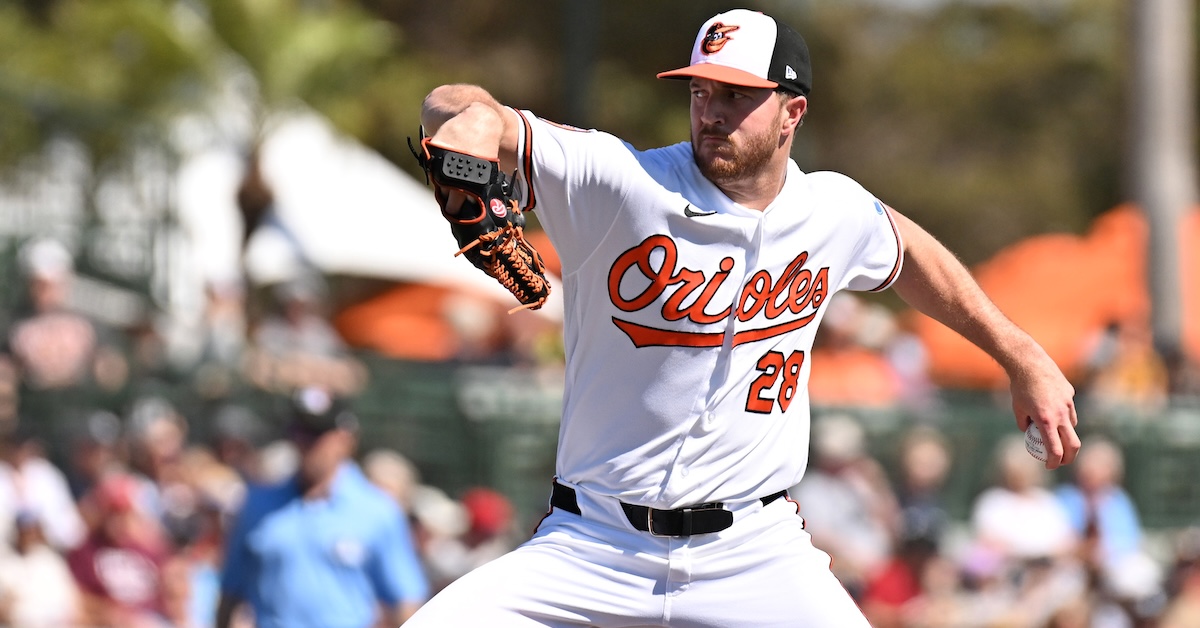
Last week, I did a radio hit in Baltimore to talk about the Orioles’ five-year extension for right-handed starter Shane Baz. As you might expect, I got asked for my general impressions of the Orioles’ rotation, and I gave an answer I did not expect to be controversial: I like Baltimore’s rotation, and I’m quite fond of Trevor Rogers and Kyle Bradish, the top two starting pitchers. That said, the Orioles don’t have a clear no. 1-quality starter, which could end up as a weakness in a playoff series.
“Ace” and its synonyms are fuzzy in meaning, so I’ll define my terms as clearly as I can: I meant that the Orioles don’t have a starting pitcher who can be expected to go up against one of the top pitchers in the league and fight him to a draw for six innings. I’ll give an example from last year’s World Series: I think Yoshinobu Yamamoto is a better pitcher than Kevin Gausman — and sure enough, Yamamoto beat Gausman twice in as many attempts — but the difference isn’t so great that you’d be able to tell over one start.
I got some pushback on social media — some of it quite intense — from Orioles fans who like their chances with Rogers against Tarik Skubal. Every sports fan thinks they’re the center of the universe these days, and accordingly that everything about their team is better than the biased national media will give them credit for. (Except White Sox and Twins fans, who think everything about their team is even worse than the biased national media realizes.) Even if that weren’t true, I would ordinarily never admit to treating randos on X, the Everything App, like an assignment editor. That way lies madness.
But Rogers is a special case, because he’s one of those guys I can’t stop writing about. Right or wrong, those angry Orioles fans reminded me that it’s been 14 months since I checked in on this guy in print, and a lot of interesting stuff has happened since then.
When last I wrote about Rogers, he was coming off a rough first half-season in Baltimore. Only partially in Baltimore, actually, since he was so bad immediately after being traded that he spent five starts with the Norfolk Tides figuring his stuff out.
It took a minute. Rogers — whose standout quality as a rookie was his exceptional velocity from the left side — was throwing five ticks slower with the Tides than he was during his first full season with the Marlins. Yikes. A lot of what ailed him was downstream of that.
When Rogers was at his best with the Marlins, he threw a hard four-seamer with sharp arm-side run and tunneled a changeup with similar horizontal movement but wicked sink — an extra five inches and change of induced vertical break compared to similar pitches.
His only other pitch worth mentioning was a low-80s slider that Baseball Savant calls a cutter for reasons that are not clear to me. I called it a slider in my article about Rogers last year, so whatever it actually is, we know what pitch I’m referring to. Between this and Zach Crizer’s article about Tatsuya Imai’s backwards slider, it’s a big week for me not knowing what a slider is or is not.
Whatever this is, slider or cutter, it’s an odd pitch. Baseball Savant tracks not only spin rate but active spin, which is the percentage of spin that contributes to movement. Who’s got a good cutter? Kenley Jansen, right? Last year, 297 pitchers threw 50 or more cutters, and Jansen was no. 1 in active spin rate at 81.8%.
Great fastballs and curveballs can have an active spin percentage in the upper 90s; the fact that Jansen has more active spin on his cutter than any other pitcher in baseball, and it’s only just over 80%, should tell you something. Curveballs have topspin, four-seamers have backspin, and cutters and sliders have more gyro spin. In perfect gyro spin, the axis of rotation would go straight from the pitcher’s hand to the catcher’s mitt, which would stabilize the flight of the ball. Indeed, the two best examples of gyro spin that I can think of are a football and a rifle bullet — both projectiles designed to fly in a straight line.
None of Rogers’ pitches have ever had standout active spin rates, but his cutter/slider is unusually gyro-y. Last year, his cutter had 27.3% active spin, which was 277th out of 297 cutters. (It’s always been like this; in 2021, Rogers’ cutter had 20% active spin.)
As you’d expect from such a gyro-y pitch, it doesn’t break much. Last year, it had five inches of glove-side movement, which was the first time in Rogers’ career it’s had above-average movement among comparable pitches, in either axis. But because Rogers’ fastballs veer off arm side so dramatically, no movement looks like glove-side movement by comparison. (Not unlike Imai’s backup slider, actually.)
But Rogers threw this pitch in 2021, when he was great, and he threw it in 2024, when he was awful. What changed in 2025?
Well, Rogers got some — but not all — of his velocity back, which helped. He dropped 28 points of opponent wOBA on his sinker and 126 points of opponent wOBA on his four-seamer, which was once again one of the best fastballs in the league. Maybe the best — last year, Rogers’ four-seamer was no. 1 in run value per 100 pitches, and his opponent wOBA (.222) was first among starters and third among all pitchers.
The other development was the addition of a sweeper. This pitch, like the cutter/slider, has highly limited movement and gyro spin (32.6% active spin, 278th out of 286 sweepers last year), giving it almost no induced movement in either direction. But it averages three to four ticks less velocity than the cutter, and roughly 15 less than the fastball, which led to the cutter and sweeper being nigh on unhittable last year.
These were Rogers’ two least-used pitches in 2025, totaling less than 20% of his offerings combined. But opponents hit .061 with a .121 SLG against the sweeper and .065 with a .161 SLG against the cutter. Both pitches averaged a whiff rate within a percentage point of 40%. It’s like hitters went up there expecting to see a slider and got thrown a lime instead.
That’s the state of play for Rogers, as he’s been resurrected from baseball purgatory. And in 18 starts in 2025, he posted a 1.81 ERA. So far in three starts in 2026, he has a 1.89 ERA. How can an ERA under 2.00 not look ace-like? Is two-thirds of a season not enough?
Well, not really, no. I think it’s fair to say that Rogers has pitched like an ace over the past year, but that’s not really the question the Orioles should be asking themselves. Practically, whether Rogers is an ace or not is going to inform Baltimore’s decision to extend Rogers, and if so, for how much. He’s a free agent this winter — is he worth $25 million a year, $30 million, or more? Should he expect a four-year contract? Five years? Seven?
At the same time, should the Orioles be trying to upgrade their rotation from the outside? Trading for Baz is a good start, and signing Chris Bassitt added depth, but are those additions, plus however they feel about Rogers and Bradish, enough to keep them from spending big on a starter at the trade deadline?
I genuinely don’t know. This version of Rogers has really only existed for 21 starts and 128 2/3 innings. It’s certainly possible to build a case for acehood in that short a time. Paul Skenes sure did. I know some people who were so bowled over by 48 innings of Nolan McLean last year that they’d have been happy to start him against Yamamoto or Cristopher Sánchez in Game 1 of a playoff series.
A week ago, Kiley McDaniel of ESPN made a list of pitchers he considered to be ace-quality. Only 11 starters made the cut, among them Jesús Luzardo. Luzardo, like Rogers, is another 28-year-old ex-Marlins lefty who remade himself after being traded to a team in the Crab Fry Belt. Like Rogers, Luzardo makes his case based mostly on a superb 2025 campaign.
I’m still a little hesitant to call Luzardo an ace based on one season, but I certainly understand the logic. So do the Phillies, who gave Luzardo a five-year, $135 million extension before the season. And if Luzardo, why not Rogers?
Three reasons. First: Luzardo is throwing as hard as he ever has, while Rogers is still at least a mile per hour down from his peak. This while average fastball velocity continues to rise. Second: Luzardo struck out 28.5% of batters last year, while Rogers’ strikeout rate was down at 24.3%. Rogers’ walk rate was lower, but only by 0.6%.
Now, velocity and strikeout rate aren’t the be-all and end-all, obviously. But all 11 of Kiley’s aces were in the top 10 last year (among starters with at least 100 innings pitched) in K-BB%. Rogers was 30th, between Edward Cabrera and Ranger Suarez. As I said, I can nitpick Kiley’s list here and there, but that difference illustrates quite nicely the sometimes-ineffable margin between a good pitcher and a great one.
But the biggest question I have about Rogers, and the most important reason why I said he’s not a no. 1 starter, is sheer volume. The more Rogers pitches, and the longer he performs the way he has for the past year, the more sure we can be that what he’s done isn’t a fluke. Because there are certainly fluke indicators.
I don’t think even Rogers’ most ferocious defenders would say that he’s a true-talent sub-2.00 ERA guy. But since the start of the 2025 season, Rogers has a 2.79 FIP, despite the merely-good K-BB%. He has only allowed six home runs in 21 starts since his resurrection, and looking at his game — good sinker, good changeup, good command, big fastball movement — I don’t see a reason why Rogers wouldn’t be good at preventing home runs.
And a 2.79 FIP is ace territory; Rogers was seventh in the league in that category last year (minimum 100 innings), behind five guys who made Kiley’s list and Nathan Eovaldi. Only 11 pitchers with that workload even got under 3.00.
But Rogers, who is not an elite strikeout guy, allowed a .179 batting average and a .226 BABIP last year, and that gives me pause. Because while he is good at suppressing home runs, I don’t see any indication that he’s an outlier quality-of-contact guy. His xERA was 3.40; only six pitchers outperformed their xERA by more last year. Only two outperformed their xwOBA by more than Rogers did.
Maybe he does have some ability to outperform his contact quality that isn’t captured by Statcast, but I’m going to need more than 21 starts to believe that’s not only a real skill but a durable one. A longer track record would give me more confidence that his fastball velocity, which is down a mile an hour from 2025, will bounce back once he shakes off his winter rust. A longer track record would show whether the sweeper will still be effective even as its induced movement separates from the cutter’s, as has been the case through three starts this year.
But most important, volume for volume’s sake is one of the key indicators of no. 1 starter-hood. When every pitcher is one bad sneeze from Tommy John or thoracic outlet syndrome, pitchers whose names you can put on the playoff roster in ink are worth their weight in gold. And whatever you think about Rogers, his career high in innings is 133. Even Luzardo and Chris Sale each have multiple 30-start seasons under their belt.
I think Rogers is a terrific pitcher, the Orioles’ best. He’s been phenomenal over the past year, even accounting for the likelihood that he’s played a little over his head. I’d feel good about having him in my presumptive playoff rotation.
But can I say, in April, that Rogers can handle Skubal one-on-one in October? I’m not convinced. Not yet, at least.
Michael is a writer at FanGraphs. Previously, he was a staff writer at The Ringer and D1Baseball, and his work has appeared at Grantland, Baseball Prospectus, The Atlantic, ESPN.com, and various ill-remembered Phillies blogs. Follow him on Twitter, if you must, @MichaelBaumann.
Loved this, Michael, but any discussion about acehood = the way to madness.