
Ryan Feierabend and the Disappearing Knuckleball
The signing of a 33-year-old lefty to a minor league deal with a non-roster invitation to major league camp isn’t normally the sort of news that grabs much attention at this time of year, particularly when the pitcher in question owns a 7.15 career ERA in the majors. Add the word “knuckleball” to the equation, however, and we’ve all got something to dream on in this chilly February. Such is the case with the Blue Jays’ addition of Ryan Feierabend, who simply by his current status is now the best hope to expand the ranks of the pitch’s practitioners in the majors.
You’re forgiven if Feierabend’s name doesn’t ring a bell. A 2003 third-round pick by the Mariners who made a total of 25 appearances with the team from 2006 to 2008, before logging six with the Rangers in 2014, he has spent the past four seasons pitching in the Korea Baseball Organization, first with the Nexen Heroes (2015 to mid-2016) and then with the KT Wiz. Beyond the occasional, spectacular bat flip, KBO happenings don’t get a ton of attention stateside, though last year for this site, Sung Min Kim spoke to Feierabend — who had just led the KBO in both ERA (3.04) and strikeout-to-walk ratio (4.26) — for an in-depth piece that’s worth your time. Feierabend wasn’t quite as successful in 2018, with his ERA rising to 4.30 (still a 123 ERA+ according to the Statiz site, the source of all of the KBO stats cited here) and his K/BB dropping to 3.71. His FIP didn’t jump quite as wildly from year to year, rising from 4.42 to 4.83 (108 to 113 in terms of FIP+), but his BABIP spiked from .289 to .332.
Though he’s been throwing the knuckleball since the age of 13, Feierabend didn’t integrate it into his arsenal until 2017, and doesn’t throw it all of the time. “I started throwing a knuckleball for the simple fact that I had nothing else to lose,” he told Kim. “If it worked, it would be something that the KBO hitters had never seen before.”
The pitch has essentially replaced his slider as his third offering. Expanding the repertoire breakdown from the aforementioned piece to include Feierabend’s last taste of MLB:
| Year | Fastball | Sinker | Slider | Curve | Change | Knuckle |
|---|---|---|---|---|---|---|
| 2014-MLB | 53.9% | 3.9% | 18.0% | 13.3% | 10.9% | 0.0% |
| 2015-KBO | 55.0% | 0.1% | 15.6% | 6.7% | 20.5% | 0.0% |
| 2016-KBO | 55.1% | 0.4% | 18.2% | 7.4% | 18.3% | 0.3% |
| 2017-KBO | 46.4% | 0.2% | 2.8% | 3.9% | 25.8% | 20.9% |
| 2018-KBO | 48.4% | 3.1% | 0.8% | 4.9% | 29.4% | 13.5% |
Since adding the knuckler, Feierabend has used it as an out pitch. Last year, he threw it 26.8% of the time when he was ahead in the count and 23.4% when he got to two strikes; by comparison his numbers for his changeup were 23.1% and 18.4%, respectively. If you needed further evidence of his confidence in the pitch, the splits say that there are negligible differences in the frequency with which he throws it when there are runners on base and when the bases are empty, or when the batter is a righty or a lefty.
Let’s watch a couple of GIFs. Here’s one where you can see the pitch getting about as little spin as physically possible:
This knuckle ball is ridiculous ?(Via Reddit /r/baseball) pic.twitter.com/OLoebh56pL
You Aren't a FanGraphs MemberIt looks like you aren't yet a FanGraphs Member (or aren't logged in). We aren't mad, just disappointed. We get it. You want to read this article. But before we let you get back to it, we'd like to point out a few of the good reasons why you should become a Member. 1. Ad Free viewing! We won't bug you with this ad, or any other. 2. Unlimited articles! Non-Members only get to read 10 free articles a month. Members never get cut off. 3. Dark mode and Classic mode! 4. Custom player page dashboards! Choose the player cards you want, in the order you want them. 5. One-click data exports! Export our projections and leaderboards for your personal projects. 6. Remove the photos on the home page! (Honestly, this doesn't sound so great to us, but some people wanted it, and we like to give our Members what they want.) 7. Even more Steamer projections! We have handedness, percentile, and context neutral projections available for Members only. 8. Get FanGraphs Walk-Off, a customized year end review! Find out exactly how you used FanGraphs this year, and how that compares to other Members. Don't be a victim of FOMO. 9. A weekly mailbag column, exclusively for Members. 10. Help support FanGraphs and our entire staff! Our Members provide us with critical resources to improve the site and deliver new features! We hope you'll consider a Membership today, for yourself or as a gift! And we realize this has been an awfully long sales pitch, so we've also removed all the other ads in this article. We didn't want to overdo it. In case you didn't read all that, here's the short version. Membership includes:✓Ad-free browsing✓Unlimited FanGraphs & RotoGraphs articles✓Historical & platoon projections✓Leaderboard & player-page stat heatmaps✓One-click data exports✓Customizable player-page dashboards✓Dark & Classic site modes✓Weekly Members-only mailbag✓FanGraphs Walk-Off, your year in review✓Optional homepage photo removal✓Gift articles to non-Members✓Full postseason coverage— Baseball is Fun (@flippingbats) June 7, 2018
Here’s a beauty that squirted away from the catcher, because knuckleballs gonna knuckle:
Fun, huh? Check the latter’s Twitter feed for more.
Last year, Feierabend’s knuckler averaged 71.0 mph, which is slower than that of R.A. Dickey (78.1 mph in his Cy Young-winning 2012 season, 76.6 mph for his career) or Steven Wright (75.8 mph last year, 74.3 for his career). Feierabend’s average fastball speed of 83.3 mph is slower than either pitcher as well, but for what it’s worth, he does have a greater separation between the two, velocity-wise.
I have no idea if Feierabend can succeed well enough stateside to return to the majors. The odds would seem to be against him, as they are for any NRI, though they may be higher with the rebuilding Blue Jays than they might be with another team. Right now, their rotation projects to include Marcus Stroman, Aaron Sanchez, Matt Shoemaker, Clayton Richard, and Ryan Borucki, with Sean Reid-Foley and Thomas Pannone contributing as well. The first three from that group totaled just 238.1 innings in the majors last year due to injuries, Richard was lit for a 5.33 ERA and 4.68 FIP while soaking up 158.2 frames with the Padres, and the other three are a trio 24-year-olds who just got their feet wet in the majors last year. All of which is to say that none of them are going to approach 200 innings; there will be opportunities there for other starters, including Feierabend if he’s not busy getting lit up at Triple-A Buffalo.
And lordy, the baseball world needs this to happen, because the knuckleball is an endangered species. Dating back to the mid-1970s, when the brothers Phil Niekro (who pitched in the majors from 1964 to 1987) and Joe Niekro (1967-1988), Wilbur Wood (1961-1978), and Charlie Hough (1970-1994) were established and often flourishing — even well past the age of 40 — the pitch has always had at least one standard-bearer with a secure spot in the majors, and sometimes as many as four. Tom Candiotti, who began his major league career in 1983, took up the pitch in 1986 under the tutelage of his Indians’ teammate Phil Niekro and pitched until 1999. Tim Wakefield arrived in 1992, contributed significantly in 1993, disappeared for a year, and then pitched for the Red Sox through 2011. Steve Sparks (1995-1996, 1998-2004) and Dennis Springer (1995-2002) were in the picture as well, though the latter made just seven appearances over the final three seasons.
But after Sparks disappeared, the knuckleball had some lean years. Dickey debuted in 2001, but didn’t start throwing the knuckler until 2005-2006, a span during which he made just 10 appearances; he spent all of 2007 in the minors before returning in 2008 and securing a regular rotation spot in 2010. Eddie Bonine made 62 appearances for the Tigers from 2008–2010. Meanwhile, fringe guys like Charlie Haeger (34 appearances from 2006-2010) and Charlie Zink (one prominent place in a 2004 New Yorker article, and exactly one major league appearance in 2008) came and went without any sustained success. In 2012, the year Dickey won the NL Cy Young award, he was the only pitcher who threw a single knuckleball in the majors according to either PITCHf/x or Pitch Info. Wright debuted in 2013, but made just 10 appearances in his first two seasons before spending substantial stretches in the majors in 2015 and ’16 (40 appearances, 33 starts, and a total of 229.1 innings). Between a left knee that required cartilage restoration surgery in May 2017 (the same one that teammate Dustin Pedroia had five months later) and sent him to the disabled list three times last year due to inflammation — not to mention a 15-game suspension for violating the league’s domestic violence policy that has really taken the bloom off the rose — Wright has totaled just 77.2 innings over the last two seasons, including 53.2 last year. He recently compared his repaired knee to pitching on a flat tire, which has since been upgraded to a spare. Not great.
Outside of Wright and Dickey, the knuckleball landscape has become almost completely barren. Position players pressed into mop-up duty (Erick Aybar, Alex Blandino, Mike Carp, David Murphy and Danny Worth) have floated the occasional one for kicks, and Pitch Info says that C.J. Wilson and Brian Wilson combined to throw five of them in 2014, but the only other pitcher to throw a knuckler in the majors in the last six seasons is Eddie Gamboa, who totaled 13.1 innings for the Rays in 2016. Since then, Gamboa has passed through the systems of the Rangers, Dodgers, and Orioles (who drafted him in 2008 and employed him through 2015). After a signing a minor league deal with Baltimore last spring, he threw just 25 minor league innings due to some kind of elbow trouble, was lit up for 10 runs in 3.1 innings in the Mexican Winter League, and appears to be jobless at the moment; at 34 years old, there are no guarantees he’ll get another shot in affiliated ball.
Here’s a look at the pitch’s declining frequency during the pitch-tracking era, using Pitch Info’s data:
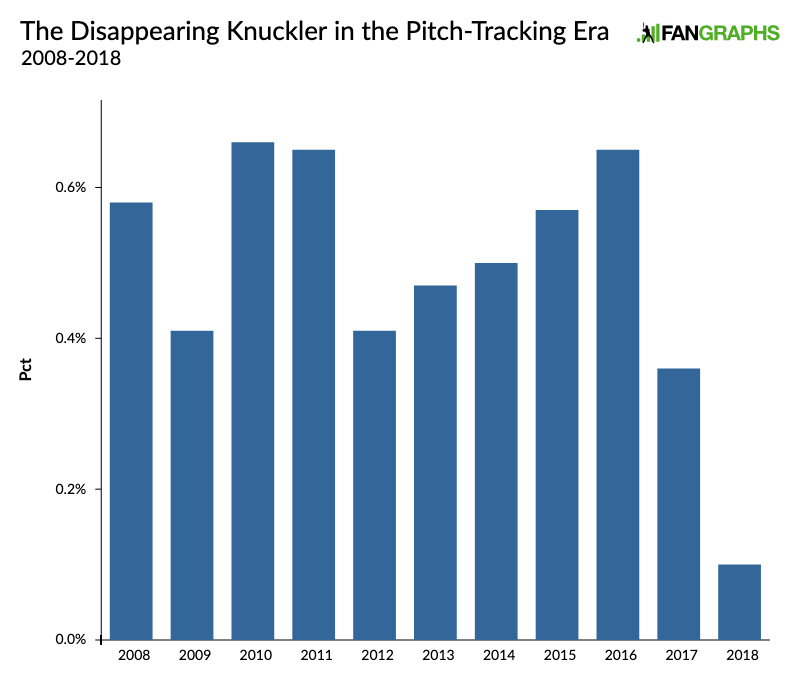
Note that we’re talking fractions of one percent, and last year was barely 0.1%.
As far as I can tell, the only other minor league knuckleball practitioners of any prominence are Mickey Jannis and J.D. Martin, both of whom are said to throw the pitch with Dickey-like velocity, in the high 70s to about 80 mph. Jannis, a 31-year-old, former 44th round pick by the Rays in 2010, who committed to the pitch he calls his “butterfly” during a 2012-15 detour to indie ball. Since July of 2015, he’s been a farmhand in the Mets’ system. Last year, he threw 142.1 innings at Double-A Binghamton with a 3.60 ERA and 3.69 FIP, but was torched for 13 runs in eight innings over two appearances at Triple-A Las Vegas. He’s been chronicling his minor league adventures for Metsmerized Online and last we heard, was headed to camp at Port St. Lucie, but it doesn’t appear that he’s gotten an invitation to major league camp.
Martin, a 36-year-old former supplemental first-round pick by the Indians in 2001, last pitched in the majors in 2010, and took a detour to the KBO himself in 2014. He committed to the knuckleball in indie ball in 2016, made a total of 10 appearances in the Nationals’ organization in 2016-2017, and spent last year with the Rays’ Double-A Montgomery affiliate, where he threw 124.1 innings with a 4.49 ERA and 5.03 FIP (he walked 12.8% of batters faced). Earlier this month, the Dodgers signed him to a minor league contract; he’s working with Hough this spring (h/t to careagan for calling my attention to this in the comments).
All of which is to say that under the circumstances, the signing and invitation of Feierabend rates as significant news in the world of knuckleballing, because the pitch itself appears to be hanging on by its fingertips. Here’s wishing him the best as he battles for a spot with the Blue Jays.
Brooklyn-based Jay Jaffe is a senior writer for FanGraphs, the author of The Cooperstown Casebook (Thomas Dunne Books, 2017) and the creator of the JAWS (Jaffe WAR Score) metric for Hall of Fame analysis. He founded the Futility Infielder website (2001), was a columnist for Baseball Prospectus (2005-2012) and a contributing writer for Sports Illustrated (2012-2018). He has been a recurring guest on MLB Network and a member of the BBWAA since 2011, and a Hall of Fame voter since 2021. Follow him on BlueSky @jayjaffe.bsky.social.
So this is an incredibly stupid story, but if I’m going to ever tell it anywhere it would be in the comments to this article. Back when I played video games one of the games I played was MLB 2K8 (couldn’t do The Show because I had an Xbox). I did a long dynasty with the A’s and at one point I needed to pick up a fifth starter so I traded for Feierabend. He immediately became my best pitcher and I rode him to 300 wins and 3000 Ks. The secret? His insanely good change up which looked like…a knuckleball. So for all the faults of that game, it somehow knew that Ryan f’n Feierabend had a magical knuckleball in him all this time. Hope he kills it for the Bluejays.
So stupid it’s great!
I’m sure this isn’t easy, but would there be value in a guy like Venditte picking up a knuckleball from both sides? Is there any advantage to that or not really?
And obviously since it’s very hard to do with even one hand, I’m sure it would be nearly impossible to do with both, but still, I can dream.
Well, here’s the thing: the whole reason you think about doing what Venditte tried to do is to eliminate your platoon splits. But Wright, Dickey, and Wakefield all show reverse splits for their career — they’re all right-handers, and they all had a (slightly) easier time against left-handed batters. (Which is strange, and I didn’t know that until your comment prompted me to look, so thank-you for that.) That suggests there’s no benefit to throwing a knuckle from both sides — even before factoring in the extra time and effort to try to learn to throw it with both hands.
So as fun as it would be (Maximum Weird? Always go for Maximum Weird!) I just don’t see the point.
When Venditte faces a switch hitter, IIRC, he’s got to declare which hand he’s throwing with first. So he loses the platoon advantage or, more likely, just doesn’t face them. Developing a pitch with a reverse split mike make him the world’s most perfect pitcher!
A knuckler thrown by a righthander tends to break away from a left-handed batter, which is why the splits are that way.
So does a 2-seamer and that doesn’t help it’s splits. The reason a good knuckleball is difficult to hit is that it’s movement is NOT predictable. I bet over a large sample size it is roughly platoon neutral.
You could be right. But Wright faced 618 LHB and 830 RHB; Wakefield faced 3282 LHB and 4044 RHB. And still the reverse split persists, small as it may be. On the other hand (heh) Hough and some of the others don’t show reverse splits. Anyway, the point is that if the platoon difference is small (whichever way it might be), there’s not much benefit in trying to throw it with the other arm.
Yeah when Dickey was with the Braves, he admitted that he almost always had no idea where the pitch would end.
It’s a crazy, really. First you have to perfect the grip, then the muscle memory of repeating that same delivery while putting enough velocity on the pitch. Years and years of practice to get it right, just to let go and have no idea where it’s going LOL.
Dickey was the man!
The Dodgers signed knuckler J.D. Martin to a minor league contract, doesn’t look like he’s in big league camp though.
https://twitter.com/Ken_Rosenthal/status/1093613503850655745
With luck he’ll get called up at some point this year and we can look forward to many fun FG autolinker burps!
If he does, at least we know Dave Roberts will keep an eye on his pitch count, even if he’s working on a no-hitter.
J.D. Martin is the bane of the FanGraphs autolinker because his ID gets picked up any time J.D. Martinez is mentioned, which is quite often (26 articles in my first year).
Damn you, J.D.!
And yet I don’t think he’ll come close to matching the patron saint of autolinking, Johan Santana.
The only principle that does not inhibit progress is: anything goes.
I think a large part of the problem with employing a knuckleball pitcher is that you also need to give a roster spot to Josh Thole, and no team wants to do that.
Josh Thole is currently with the Dodgers. Co-incidently, the Dodgers also have a knuckleballer, J.D. Martin, on a minor league contract.
He can be Martin’s backup, just like old times!
Interesting article.
So, beyond even a knuckleballer, would Feierabend be the first left-handed knuckleballer in MLB since Wilbur Wood? Pretty sure that every other knuckleballer mentioned in this article is right-handed. (I’m not counting David Murphy since he’s in the “position player pressed into mop-up duty” group.)
I meant to mention something about knuckleballers and handedness. As best I can tell, the only lefty knuckleballer since Wood was Danny Boone, who lasted all of 9.2 innings in a 1990 comeback, his first MLB action since 1982. He’s said to have thrown 80% knuckleballs at that point.
Thanks!
Right now I have Feierabend ninth on my depth chart for TOR SP behind the top 6 and then Gavigilo and Thornton.
So you’re saying he’s gotta chance??
Yes, I am saying that. However, if he was with the White Sox he would be fifth because Dylan Covey is not very good and we don’t know if Manny Banuelos can replicate his AAA numbers again.
Ervin Santana would bump him down to sixth
I love me some good knucklers! Thanks
I’m just excited that this guy’s name means “Party Evening” in German.
I think that graph’s decline in knucklers can be mostly explained by RA Dickey’s retirement. But I’d really like to see more guys throwing a knuckleball in the big leagues.
“…the pitch itself appears to be hanging on by its fingertips.”
He, he, good one!
One of my favorite player names for a reliever (I seriously considered getting a jersey when he was in the Mariners), “Feierabend” is the German expression for the end of your work day / quitting time / or when the waitstaff needs to close out because it’s the end of their shift. Tangentially, the German for “tip” is “Trinkgeld”, literally “drink money”.
Pitcher: fear uh’ bend
German: fire’ ah bend