
Ryon Healy Made That Popular Adjustment, So Should We
When Kiley McDaniel wrote about the Athletics prospects before the 2015 season, Ryon Healy was just a “name to note” with “55 raw power that plays down in games.” After Healy produced a nice year at Double-A — albeit one without much power — Dan Farnsworth didn’t add much love, saying that he didn’t think Healy had the “swing path to keep driving balls.”
They weren’t alone. Baseball America made him Oakland’s 22nd- and 23rd-best prospect those two years, respectively. He didn’t make it into either of the team write-ups on Baseball Prospectus. Keith Law didn’t include him in his Oakland write-up going into this season.
Healy is 24, yes. He’s only had 184 plate appearances, sure. But he’s already shown more power than projections and prognosticators had in mind for him, and it’s probably not a fluke. He’s made a change we’ve heard about from many other major leaguers. He’s not using the same swing path that kept him off the top-prospect lists.
“I had a steep swing before,” Healy told me last month. “I would start high and then load even higher, and then drive down steep to the ball.” If you look back on his college film, it’s remarkable. Very few hitters set up that high, and even fewer then load higher. (Fast forward about 50 seconds into Steve Fiorindo’s Prospect Pipeline video below).
After a couple of pro seasons that saw decent batting averages but lowly power for a guy that profiles best at an outfield corner or first base, Healy was looking for inspiration. “Change was something I knew that I needed to do,” he admitted.
An offseason vacation to Atlanta with teammates Matt Olson and Carson Blair was an eye-opener. “They brought it to my attention,” Olson said of his steep path to the ball. That gave him the motivation to change, and so when it was time to hit, he was primed for change. Some cage work with his brother-in-law’s good friend Kevin Pillar, and some second-hand advice from Bobby Tewksbary and Ed Sprague, and Healy knew what he had to do.
“I lowered my hand slot so I could load to a lower, more powerful position,” the Athletics’ outfielder said of that adjustment. “Then my bat was flatter earlier and through the zone longer.” The change is easy to see if you’re offered the same angle as before. Thanks to Baseball America, we got that chance when Healy was at the Futures Game in July:
When Healy talks about his bat path, he says things that sound a lot like what we’ve heard from Josh Donaldson when he described his major adjustments and Jake Lamb this year before his surge.
In fact, we’ve been hearing about this since it was called the Ted Williams stroke. From Williams’ book, The Science of Hitting:

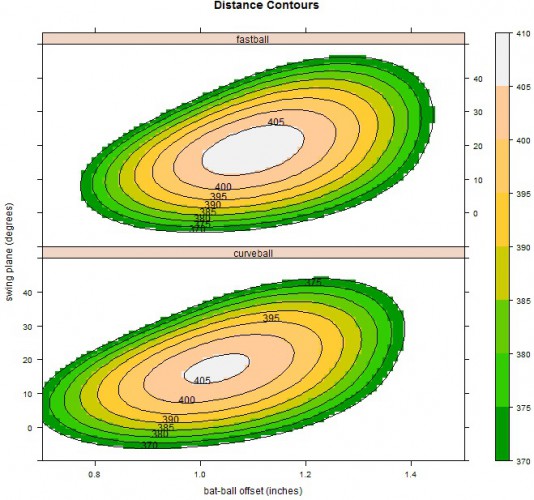
There are people that still challenge the validity of this finding, but baseball physicist Alan Nathan has used science to chime in on this, and a slight upswing does produce the best outcomes, it looks like. Especially if you’re looking to hit home runs. Against fastballs and curveballs, you get more distance with equal exit velocity and a slightly higher launch angle. Offset, here, is the distance between the bat’s center and the ball’s center, or a measure of how “flush” the ball is hit.
Along with the change came more power, but also more whiffs. That might seem to go against the purported benefits of the mechanical changes — more time in the hitting zone is supposed to mean more opportunity for strong contact — but once you start hitting for more power, your mindset changes sometimes. Like Joe Panik, who said that he’d learned to miss on purpose sometimes, in order to avoid soft contact, Healy has found that the whiff is not always bad news: “I changed my approach to hunting pitches I could drive. So if I swung and missed at sliders once in a while, or even a heater that I didn’t like, I’d rather swing through pitches rather than establish weak contact.”
Maybe this isn’t a plus-plus power package still. You can tell from his spray charts that, when he goes to the opposite field, it’s usually for a double, not a home run.
Source: FanGraphs
Healy explained his approach when it came to his spray chart. “I’m trying to hit a low line drive through the batter’s eye every time, so that helps control my effort level and where my body is going. When it misses, it just goes one side or the other, not pulled ground balls or pop flies.” So far that’s been the case: his pop-up rate is 30% better than league average, and he’s been able to do good things with fastballs both on the inner and outer thirds of the plate.
Put it all together, and Healy has only been about 12% better than league average with the bat while trying to find himself defensively. He could still benefit from reaching less on pitches outside the zone (36% this year, 30% is average), taking more walks, and even expanding his power further.
But that power that has taken his bat from below average to better than league average? It’s come from a fundamental change to his mechanics that is backed up by those using different kinds of evidence, a change that has led to other breakouts by other major leaguers recently.
Maybe that’s not something we can bake into our projections… yet. But it’s coming. Andrew Perpetua’s expected slugging percentage, based on Healy’s launch angle and exit velocities, is a meaty .492 compared to his actual .474. Maybe we should name that next projection system which uses this Statcast data to improve in-season projections KID or SPLINTER in honor of Ted Williams and his sweet science.
With a phone full of pictures of pitchers' fingers, strange beers, and his two toddler sons, Eno Sarris can be found at the ballpark or a brewery most days. Read him here, writing about the A's or Giants at The Athletic, or about beer at October. Follow him on Twitter @enosarris if you can handle the sandwiches and inanity.
I love these “Well, I guess Ted Williams is still right” articles. I guess it’s good to always keep analyzing but it’s hard to believe how good and ahead of his time Williams really was.
That book should be a required reading for every baseball player
Amen. When the best hitter of the mid 20th century speaks on hitting, we should listen.
And when he puts together a cool heat map of batting average vs. pitch location all the way back in 1971, we should be thoroughly geeked out.
Isn’t it possible that while optimizing a swing for power by elevating the attack angle that while you are increasing the time to hit the ball square you are limiting the area that can actually strike the ball?
By this I mean that if a batter’s problem was not a timing problem, but an eye problem, trouble knowing what pitch is thrown and to where in the strike zone, then a flat path would lead to fewer strikeouts.
You’re suggesting like a batter whose timing is perfect, but he has some error high and low?
If his plane matches the incoming ball, then as soon as his vertical error is one (radius of ball + radius of bat) it’s a whiff.
If his plane is level… no, I don’t see it makes a difference. The ball is a sphere. Whatever angle he attacks it from, it has a circle cross section, takes the same error to miss.
Or look at it this way, if his timing is perfect, he’s swinging in “bullet time” at a frozen ball, it’s basically tee ball. The incoming angle of the ball becomes irrelevant without timing error.
Am I talking about what you’re talking about?
I give a quantitative discussion of timing as relates to the swing plane in the 2nd of my THT articles: http://www.hardballtimes.com/optimizing-the-swing-part-deux-paying-homage-to-teddy-ballgame/. The swing plane that optimizes HR production is steeper than the downward plane of the ball. Timing errors for such a swing are not optimum. I quantify that in the article. Matching the swing plane to the downward plane of the ball minimizes timing errors but does not optimize for HR.
It seems expected to me that the more the swing plane is parallel to the pitch the chance of a whiff is increased. It’s like in the old sailing ship and cannon days, if you were broadside to broadside you have a better chance of making contact, but you strove to cross the enemy’s bow or stern to shoot the length of the ship where you might get an extra base hit but increase the chance that you hit nothing.
When you are in amateur ball and the fielders allow you a .600 BABIP, hitting more longballs but whiffing more probably produces fewer runs. So if I were coaching kids even up to HS, I would teach swing to contact.
Nice read, thanks for sharing Eno. Picked up Healy in my 20 Team Dynasty league early this season when I saw the splits transferring from AA to AAA. Happy I did.
Williams should’ve sued Nike. A glance at that swing graphic from his book clearly establishes he invented the Swoosh long before the company paid Carolyn Davidson $35 for it.
Especially since “swoosh” is the sound made by most of the lasers leaving Williams’ bat.
Regarding swinging up and strikeouts: matching the plane of the pitch is best for solid contact but the average pitch is only going down like 5-8 degrees.
sluggers however swing up 15-20 degrees (zepp data I found) which is steeper than the pitch and thus can cause a few more misses than a 5 degree up plane (especially on pitches up in the zone that tend to be flatter).
Plus 15 matches the plane better than chop down but you are trading a little bit of contact for elevation. you don’t need to swing up to elevate (hitting bottom of the ball lifts the ball too) but the more your exit angle and attack angle of the bat match the harder the exit velocity.
batters with flatter planes (0-+5 degrees) the thus often hit very hard low liners but have trouble carrying that velocity into higher launch angles (their fly balls tend to be sliced balls with too much backspin).