
Take Peralta: Brewers and Mets Trade Top Prospects for No. 1 Starter
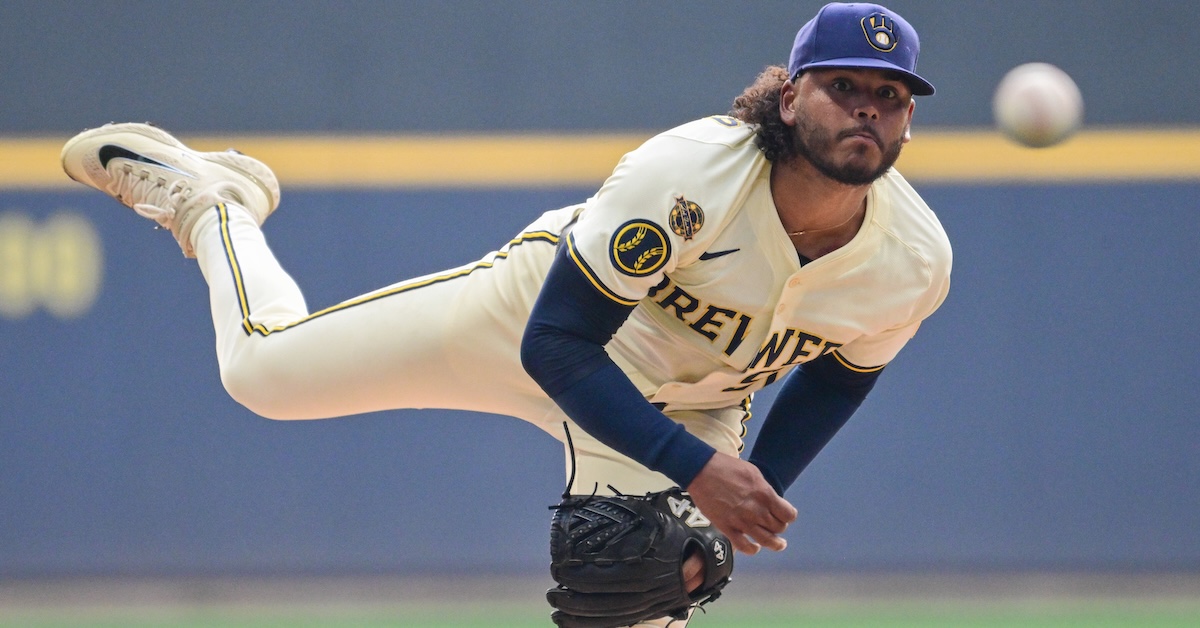
This one may be a little too one the nose. On Wednesday evening, the Brewers and Mets agreed to a trade that sent Freddy Peralta and Tobias Myers to the Mets in exchange for two top 100 prospects, Jett Williams and Brandon Sproat. That’s right, the Brewers got cheaper and younger by selling their best pitcher for prospects, the Mets flexed their financial muscle, and president of baseball operations David Stearns acquired Freddy Peralta. Welcome to every single day.
Peralta may not be your idea of a surefire ace, but he was the unquestioned leader of the Brewers rotation, their Game 1 starter in the playoffs for each of the past two years. As salary dumps go, this one is particularly depressing. Peralta is due just $8 million in his walk year, a hair more than the Angels will be paying Anthony Rendon to clear out of Anaheim as soon as possible, if you please. For Myers and the wildly underpaid Peralta, the Mets surrendered the prospects who ranked 31st and 63rd overall in our Top 100 update back in July. The Brewers did what they do, avoiding expenditures of any kind, finding young players, and trusting that they can keep creating aces out of whole cloth. Meanwhile, the Mets have increased their CBT tax hit from preposterously large to ludicrously large in order to reinforce a rotation that still ranks just 15th on our Depth Charts.
Brendan Gawlowski wrote about Sproat and Williams in a separate article, so our focus here is on the major league side of things, and we’ll start with the headliner. In February 2020, right before the world started exploding, Peralta signed a five-year, $15.5 million extension with two club options that could push the total to $30 million. He was, at that point, a 23-year-old with a career 4.79 ERA and 3.96 FIP and more relief appearances than starts. “We are happy to announce that we have reached a multi-year extension with Freddy that can keep him in a Brewers uniform for the better part of this decade,” said Stearns, then Milwaukee’s president of baseball operations. That prediction came true by the slimmest of margins.
Peralta pitched in relief in 2020, running a 3.99 ERA and an encouraging 2.41 FIP. He broke out in 2021. Over the past five seasons, Peralta has put up 14.8 WAR and gone 54-34 with a 3.30 ERA and 3.65 FIP. Despite dealing with shoulder injuries earlier in his career, he’s pitched at least 165 innings in each of the last three seasons. He anchored the rotation in 2024 when Corbin Burnes got traded and Brandon Woodruff got hurt. By my count, the Brewers extracted roughly two-thirds of a win for each million they paid Peralta. At that rate for their entire roster, the Dodgers would expect to win 208 games this season.
Peralta’s $8 million salary was the fourth-highest on the Brewers, but it will now slot in as the 14th-highest on the Mets. The galling part isn’t just that the Brewers couldn’t swallow the $8 million this year. Trading him means there wasn’t even a thought that they might be able to extend him, or at least that they might be able use a really good pitcher in 2026 and then just deal with losing him in 2027. After all, this is a team that just finished with the best record in baseball and made it to the NLCS. No matter. Milwaukee is taking the cash and the prospects and betting that Woodruff will finally get healthy (and that his alarming drop in velocity isn’t a portent of bad things to come).
After this year (and just in time for a possible work stoppage), Peralta will be entering his age-31 season and finally have the chance to make what he is worth on the open market, unless the Mets lock him up to another extension. This certainly seems like the kind of trade that ends up that way, especially when you consider that Stearns must like Peralta an awful lot, given that he has now traded for him twice and extended him once. Peralta won’t turn 30 until early June, and he just put up the highest fastball velocity of his career. Sproat was our top-ranked prospect on Eric Longenhagen’s updated Mets list from last June, and Williams came in at sixth. In his piece on the Brewers’ return, Brendan wrote that both players “are near-ready, 50-FV contributors and slot into Milwaukee’s farm system as the club’s third- and fourth-best prospects, respectively. Sproat projects as a mid-rotation starter, while Williams is a middle-of-the-diamond player with an as-yet undetermined defensive home.” That’s a serious haul. Keeping Peralta for a while would certainly take some of the sting out of losing them.
Peralta throws a four-pitch mix: four-seamer, changeup, curveball, and slider. He leads with the four-seamer, throwing it just over half the time to both righties and lefties. As Lance Brozdowski noted in his write-up of the trade, it’s a weird pitch (complimentary). It comes from a low release point not because of a low arm angle, but because he’s only six feet tall and he has a huge stride that brings him a long way down the mound. That huge stride also means huge extension. So even though Peralta’s 94.8 mph velocity put him in just the 57th percentile (among pitchers who threw at least 100 four-seamers in 2025), his 95.2 mph perceived velocity put him in the 74th percentile. A flat fastball with above-average velocity is a great combination, but it’s worth noting that Peralta really needs every bit of his stuff.
He hit the strike zone just 45% of the time in 2025, the lowest rate among all qualified pitchers. He ran the third-lowest mark in 2024 and the 13th lowest in 2023. Over the past five years, among pitchers who have thrown at least 2,000 pitches, his 46% zone rate puts him in the ninth percentile. That’s great if you can get away with it, as pitches over the plate are the ones that get hit. Peralta gives up too many walks, but he runs average chase rates and superlative whiff rates, allowing him to offset all those walks with tons of strikeouts and lots of weak contact. It’s a cocktail that some advanced ERA estimators, like DRA, absolutely abhor, but he’s got a long track record of success with it.
If and when Peralta’s stuff stops fooling batters, though, this trick could fall apart in a hurry. If he can’t induce chases, he’ll have to come into the zone. Once he’s in the zone, he’s probably going to allow more hard contact, and if he’s not inducing chases, he’s probably not going to induce as many whiffs either. That’s not to say that he couldn’t learn a new approach, and the good news is that this potentially swift decline doesn’t seem imminent. As you know, his four-seamer averaged 94.8 mph in 2025 (and played even faster), but his fastball velocity has actually been trending up over the past few seasons. It performed well even in 2022, when it averaged just 92.9 mph. That’s a reassuringly large margin for error. On the other hand, the inefficiency of his approach means that he throws tons of pitches; 8,991 over the past three years, to be exact. That’s the fifth most in the game, and it’s fair to wonder whether he might one day, you know, get tired.
Peralta halved his slider usage in 2025, throwing it just under 10% of the time. He didn’t really throw it to lefties at all, and against righties, he threw all three of his non-fastballs roughly 16% of the time.
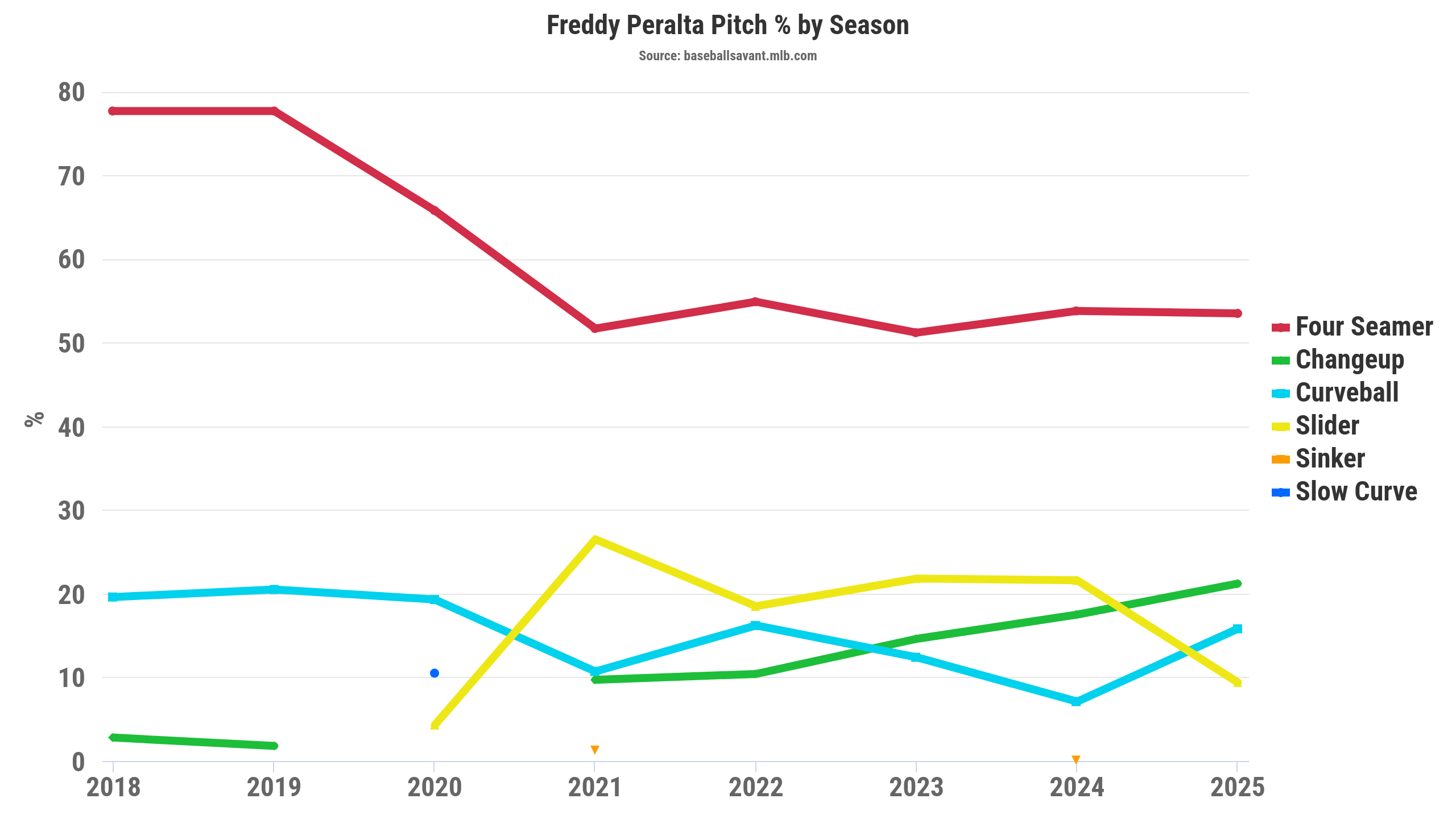
Brozdowski posited that Peralta lost feel for his slider, noting its inconsistent amount of horizontal break. It has shifted so much that in some years, some pitch classifications split it up into a slider and a sweeper. Regardless, Stuff+ and StuffPro both regard the pitch as Peralta’s best, and Brozdowski hypothesized that the Mets will try to help him figure it out and return it to its place of prominence. Even if he doesn’t find another gear, he still slides in as the top pitcher in a Mets rotation that completely fell apart in the second half in 2025, and projects as average in 2026. That’s not to say it’s without upside.
The Mets have several starters whose names any baseball fan will know. It starts with Nolan McLean and Jonah Tong, who made their debuts in 2025. McLean looks ready to contribute right away in 2026. Kodai Senga has a career 3.00 ERA and 3.82 FIP in MLB. After a shoulder capsule strain and a calf strain cost him nearly the entire 2024 season, his velocity dropped and his strikeout rate cratered last year, when he also dealt with a hamstring strain. As a result, the projections peg him for an ERA that’s dangerously close to 4.00. But if he finds his old form, he’s a star.
In his first season as a starter, Clay Holmes posted a solid 3.53 ERA, but his 4.11 FIP told a different tale, and the peripherals were scary. The velocity of his sinker, his most-used pitch, fell by 2.9 mph as he transitioned from high-leverage reliever to starter. His strikeout rate, which had averaged nearly 25% to that point in his career, dropped to 18%. Holmes is entering his age-33 season, and it’s hard to know how much improvement to expect from him with one year of starting experience under his belt.
Despite underperforming his peripherals in a major way in 2024, David Peterson seems solid as ever, and he’ll make $100,000 more than Peralta in his final year of arbitration. An oblique strain blew up Sean Manaea’s 2025 season, limiting him to 12 ugly starts, but he’s just one year removed from a 2024 season in which he earned a Cy Young vote. That’s six names and nearly as many question marks, but this rotation certainly isn’t devoid of talent. It’s not hard to envision this staff being good, and it’s not hard to envision it being quite bad. If nothing else, Peralta adds some much-needed stability.
Tobias Myers is 27, and across his two big league seasons, he has made 31 starts and 18 relief appearances, putting up a 3.55 ERA and 3.92 FIP. An early-season oblique strain cost Myers some time in 2025, and he got sent down after a rough start. However, he came back up in a relief role in July, and over the last three months of the season, he posted a 2.64 ERA and 3.49 FIP. With a 93.5 mph fastball, his stuff grades out as roughly average, and he doesn’t strike out many batters. He also had the odd distinction of tying for the splitter that had the most induced vertical rise in baseball at 10.5 inches.
Myers throws six pitches: a four-seamer, cutter, slider, splitter, changeup, and curveball. When you look at his extremely steep 61-degree arm angle and the huge rise on his four-seamer, you start to wonder why he doesn’t embrace this North-South profile and throw his curveball much more often. He was blocked in Milwaukee, and if all goes to plan, he’s likely to be blocked in New York too, and maybe he’s shown all that he has to offer. Still, though it might not be the smartest thing in the world to assume that some other team is going to do a better job of developing a pitcher than the Brewers, it’s fair to say that Myers doesn’t seem like a finished product.
The Mets spent the beginning of the offseason upgrading their bullpen and replacing Pete Alonso. Over the past several days, they’ve reminded everyone just how much of a juggernaut they really are. What’s $8 million (and the resultant $8.8 million luxury tax hit) to a team that just snatched Bo Bichette away from the Phillies for (in theory) three years and $126 million? It’s entirely possible that the Brewers will turn Sproat into their latest ace, and that in a year or two he’ll start a playoff game against the Mets, just like Peralta did in 2024. But the Mets are trying to win this season, and now that he’s not in Milwaukee, David Stearns has the luxury of leaving tomorrow’s problems for tomorrow.
Davy Andrews is a Brooklyn-based musician and a writer at FanGraphs. He can be found on Bluesky @davyandrewsdavy.bsky.social.
No 1 starter? lol. Zips thinks he’s a 3/4 at best