
The Adjustment That Stopped Andrew Vaughn’s Whiffs
In late June, Chicago White Sox rookie and 2019 third overall pick Andrew Vaughn had a 13-game stretch where he struck out 31% of the time with a 15.1% swinging strike rate. This slump brought his season-long wRC+ down to 91 and his K-rate up to 27.2%. It was a disappointing start to the career of a prospect who was seen as having a great hit tool and had always had below-average strikeout rates in the minors. That stretch culminated in a three-game series against the Mariners that saw Vaughn strike out four times in eight plate appearances and wave through 20% of the pitches he saw:
The White Sox had a day off the next day and by the time their next series against the Twins started on June 29, Vaughn had snapped out of his funk. In fact, he didn’t whiff a single time in the series against Minnesota. When watching his swing in that series, you could notice an adjustment beginning to take shape. Focus on his hands, compared to the swings you saw above:
Vaughn’s ability to make contact has continued and since June 29, his swinging strike rate is an elite of 6.3% — that’s Juan Soto territory. Now that we are into August, Vaughn’s new hand load has solidified further, making it easier to see the difference compared to his early season swings. Here’s a better look at the adjustment:
His pre-swing is less erratic in general but more importantly, I want to focus on the load-phase and how his hands are getting ready to drive to the ball. Here’s a zoomed in shot that only shows the time from when his hands start loading to when he makes contact:
You’ll notice his hands used to start higher up and then loop downward more, making a circle back to their loaded position. He’s all but eliminated that downward movement; his hands start in a lower spot making it a near straight-line back. This abbreviated movement gets his hands in position to drive forward sooner. The difference may be small but it could be giving him a more repeatable drive to the ball as there is less movement that could deviate the start of his swing path.
It doesn’t appear as if this more direct hand movement is entirely new to him either; if you take a look at some of the pre-draft scouting video of him, you’ll notice he didn’t have the loop in his hand-load that he had early this season. Vaughn has returned to having quieter movement with his hands and the result has been much more consistent contact:
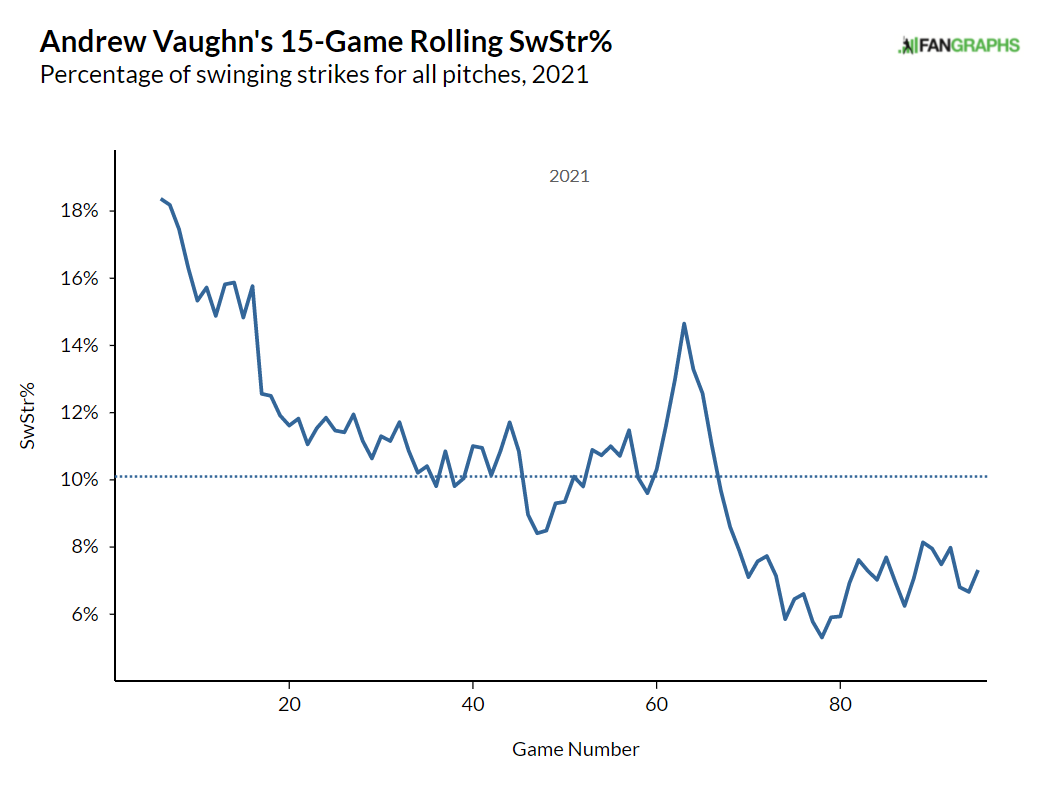
If you look at Vaughn’s season before and after the adjustment with his hands, you can see that the change in his performance goes well beyond whiffing less often. His results have gone through the roof:
| Stat | Through June 28 | Since June 29 |
|---|---|---|
| PA | 224 | 126 |
| HR | 6 | 7 |
| AVG | .222 | .336 |
| OBP | .299 | .389 |
| SLG | .389 | .584 |
| wOBA | .300 | .410 |
| wRC+ | 91 | 166 |
| K% | 27.2% | 14.3% |
| BB% | 8.5% | 7.9% |
| SwStr% | 12.2% | 6.3% |
| BABIP | .284 | .344 |
| FB% | 31.4% | 38.1% |
Vaughn has cut his strikeouts in half while hitting for more power. You can see the importance of his lower K-rate when looking at his StatCast results over that time:
| Stat | Through June 28 | Since June 29 |
|---|---|---|
| Exit Velocity | 91.7 | 90.7 |
| Launch Angle | 8.6 | 10.6 |
| Barrel% | 10.7% | 10.3% |
| Barrels/PA | 6.7% | 7.9% |
Typically during a hot stretch like this you might expect a player’s exit velocity to jump as well, but Vaughn’s has actually gone down. It’s possible this adjustment has cost his swing a slight bit of thump, which isn’t all that surprising given how much contact he has unlocked. And putting the ball in play nearly twice as often is more than making up for the slight dip in exit velocity. For example, his barrel%, which is based on balls in play, has dropped a small amount while his rate of barrels per plate appearance has actually gone up, suggesting that his contact-oriented swing isn’t actually costing him barrels. This is also partly due to him hitting more fly balls, which means he’s making better use of his hard contact:
This surge from Vaughn is made all the more impressive given some of the developmental roadblocks he’s had to push through this season. For one thing, he has very little professional hitting experience. Prior to making the White Sox Opening Day roster, Vaughn had never played above High-A. He skipped the two most advanced levels of the minor leagues in part because the pandemic cost him a 2020 minor league season and also because a late spring training injury to Eloy Jiménez created a need to expedite his development. Vaughn has seen a huge jump in pitcher quality this season and if that wasn’t enough, he has also been asked to play a new position. Vaughn has only made four starts all year at his natural position of first base as he was asked to plug the left field hole that Jiménez had left open. He’s also done some emergency work at third and second base and is now transitioning over to right field with Jiménez back in the lineup.
Given all that, Vaughn’s season, even with a 118 wRC+, has to be viewed as a huge success and a harbinger of his future role in the middle of Chicago’s lineup. That’s not to say there aren’t still things to be worked on. Vaughn’s swing decisions haven’t really shown much sign of improvement over this recent stretch. His propensity to swing out of the strike zone has been about the same all season long, with a slightly worse than league average O-Swing% of 32.6%. That isn’t a big issue but for someone who is expected to eventually draw a lot of walks, it is notable that his walk rate has dropped a touch and remains below average (league-average is 8.8%) even after this swing adjustment. It seems possible that his quicker, more abbreviated load might allow him extra time before making his swing decision. It’s notable then that after a 15-game drought of not drawing a single walk, he’s now drawn seven in his last seven games — with a 26.1% O-Swing during that stretch. The walks seem to be coming.
Another issue that Vaughn is working through is his difficulty against breaking balls. Again, it’s not all that surprising considering his lack of high-minors experience but check out how he’s fared by pitch category, as well as how often he sees them.
| Pitch Type | Pitch% | wOBA | xwOBA |
|---|---|---|---|
| Fastballs | 53.8% | .396 | .401 |
| Breaking Balls | 36.7% | .239 | .258 |
| Offspeed | 9.2% | .434 | .349 |
Vaughn torches fastballs. His .396 wOBA against them goes up to .415 on pitches 95 mph or faster. His rate of fastballs seen has actually increased to 58% since July 1. It may seem surprising that a rookie who has excelled against fastballs is still getting so many of them. Either pitchers haven’t noticed or they just think their fastball is good enough. Frankly, he’s probably lucky to still be seeing a league-average number of fastballs as his numbers against breaking balls suggest pitchers should be attacking him with benders instead.
Vaughn has struggled against sliders (.240 wOBA) but it’s curveballs that have been the bigger issue, as he has just a .136 wOBA — well below the .261 league average. Similar to how the fastball usage against him is going in a confounding direction, the number of breaking balls he’s seeing is actually dropping. He’s seen only 33.3% breaking balls since July 1, and even fewer so far in August.
The cat and mouse game between young players and the league is always fascinating. We’ve already seen an impressive adjustment out of Andrew Vaughn this season, as he’s drastically cut down on his whiffs seemingly thanks to a quieter and more direct hand-load. Now his struggles with breaking balls have become apparent; it seems time for the league to force him to fix that issue as well. Given his talent and the fact that we’ve already seen him push through a period of struggle, I have little doubt that Vaughn will begin showing improvement against breaking balls, especially once he inevitably starts seeing more of them.
Luke Hooper is a designer and writer at FanGraphs. He lives in Portland, Oregon, longing for a major league team to materialize.
Don’t Carter Kieboom and Keston Hiura both have that type of hand-load that Vaughn was using earlier in the season? If so they should both study up on what Vaughn is doing.
“ For example, his barrel%, which is based on balls in play, has dropped a small amount while his rate of barrels per plate appearance has actually gone up, suggesting that his contact-oriented swing isn’t actually costing him barrels.”
The first stat is more interesting, the second stat is harder to gauge because if he is striking out significantly less, and held a nearly consistent barrel%, that alone could cause his barrels per PA to go up.
.
I think it’s pointing out a limitation in barrel%. Plate appearances is a more relevant denominator than balls in play for just about any other stat, why should barrels be any different? Mike Zunino has the best barrel% this year and he’s the 99th best hitter by wOBA.
I think it was generally accepted that he played his way onto the big league team in spring training, even before Jimenez got hurt. he was going to be the primary DH and spell Abreu at first. Losing Jimenez gave him a longer leash if he struggled, especially with Engel on the DL to start the year, because they needed outfielders so it would have been harder to send him down if he struggled. They didn’t know in April that they would be getting adequate contributions from Goodwin and Hamilton.
Great article! Glad to see there is an identifiable change that could explain his increase in productivity. Now if he can actually play a non-disastrous outfield, then he could be a real gem. I’m not particularly confident in this, but he hasn’t been a complete train wreck at learning a new position, so maybe he becomes good enough to stick. This would be nice because Jimenez does not seem capable of sticking in the outfield.
He’s already playing a non-disastrous LF, which is kind of a miracle given he’s spent years at 1st base! We all were just hoping he’d survive and maybe just be as bad as Eloy is out there, but he’s actually been better despite not having played OF in forever. Eloy’s problems aren’t lack of trying (if anything he gets himself hurt by trying too hard on ill-advised plays), he’s probably going to end up DHing a lot, so Vaughn’s ability to actually play a cromulent left field is pretty valuable for the team to have for as long as they have Abreu around. And Abreu’s a Jerry Guy so they’ll keep him a while, they already signed him to one contract the industry hated at the money they gave him.
They put him in RF a couple games ago and his range wasn’t terrible and he made a good catch. Seems like he can handle it out there if necessary.
He doesn’t have a ton of margin for error with his speed. At some point in the next few years he’ll slow down and Abreu will retire.
The one interesting thing to monitor with this team–not so much now because they have Grandal, Goodwin, and Hernandez, but in the future–is that it is an exceptionally right-handed team. Normally teams balance their lineups by putting left handers at first base and the outfield, but with Vaughn, Jimenez, and Robert they’ve locked down 3 of those spots long-term with right handers. I would guess that guys like Goodwin, David Peralta, and Joc Pederson are going to be long-term fixtures since the only spot to stick left-handers is going to be in the corner outfield (probably).
Counterpoint, Eloy hits RHP better than LHP so he’s ostensibly filling the need of a left handed hitter in one of those spots. There is also the possibility they think Sheets can play RF everyday (doubt) which adds another lefty to the mix.
Reverse splits are the case of smaller samples or sitting a player against tough matchups something like 90% of the time. But even if he doesn’t have bigger platoon splits it’s good news.
I agree completely. But that’s a problem for future White Sox fan. I don’t envy that guy.
The early 2000s White Sox were similarly right-handed with Big Frank, Konerko, Magglio, Carlos Lee, and Rowand. Can’t say I’d recommend solving the problem by trading one of those big bats for Scott Podsednik in today’s game though.
Moncada
The overly RH’d lineup, especially with power hitters, isn’t a significant problem during the season when the White Sox can bludgeon weaker pitching. I do think it leaves a team more exposed when they’re in the playoffs facing higher competition, with power arms coming out of the pen. I believe this has been an issue for the Yankees the last few years in the postseason, and indeed we’ve seen their main competition constructing their pens to counter the Yankees RH’d power hitters. Also, a lineup of same-sided hitters allows RH’d starters to more easily lock in their pitches on the outside corners of the plate. I’ve heard more than one MLB starter saying it’s more difficult to adjust their pitch selection with a lineup comprised equally of righty and lefty hitters. Ultimately, though, put the best lineup out there, but lineup diversity is not something to completely ignore.
Excellent article, thank you. Is it possible that when his hand load was loopy, the advance scouting advice on Vaughn was to challenge him with velocity, and so right now, he’s getting a lot of FBs but eventually the numbers and advance scouting will lead to him seeing more breaking balls? A lag between a player making an adjustment and the league’s adjustment in response is pretty typical, I would think.
The thing that strikes me is his BABIP. While not terrible by any means early, his .344 mark lately has served to bring his overall BABIP up to around .300 – .305, which seems to be his typical level. So looking at his overall projection going forward, we have a guy who looks like he’ll hit .250 – .265, hit 20-30 HR, and slug between .450 -.500, all dependent on him getting his lack of control of the strike zone, especially curves and sliders, cleaned up. All in all, a very useful, if unspectacular, profile going forward. And if that ends up being his floor? So much the better.
I think we have to remember that all players, not just 23 year-olds, go through periods where they couldn’t hit a beachball if it were on a tee, as well as periods where they can drive a bb 450 feet with a broomstick. I don’t know if adjusting his hands helped him more physically or mentally. Confidence is a weird thing.
Anyone remember Yaz? It seemed every year he looked different at the plate. Hands high, bat pointing at the pitcher, traditional, and more that I’ve forgotten. Yet somehow when all was said and done and you added them all up, at the end of the year, they ended up as .290-25-80.
I bet that if you took Yaz’s production and put it in the steroid era, he probably has four thousand hits. Longevity plus a great peak, some of which was played during pitching-heavy seasons.
According to baseball-reference, his 1967 season would translate to .361/.455/.688 in Fenway Park in the year 2000. That’ll play.
That’s all good but [insert Tony La Russa rant here]
Fire Dayton Moore!
Our batting coach has worked miracles on a number of players. He helped TA make an adjustment Sunday and he hit HR’s in his first AB the next 2 days. He helped LAmb and Engel lose their leg kick because he thought it made timing that much more difficult when you don’t play every day. Engel went from a bottom 3% hitter to above average and Lamb went on a tear after a slow start prior to the injury. Good stuff man. Thanks, Luke.
Here we go again with the cover-of-SI-effect, three Ks in four A/Bs yesterday.
Eliminating that handsy stuff gives him a lot more time to recognize pitches. Significant improvement. The 3rd and 4th videos highlight this.